

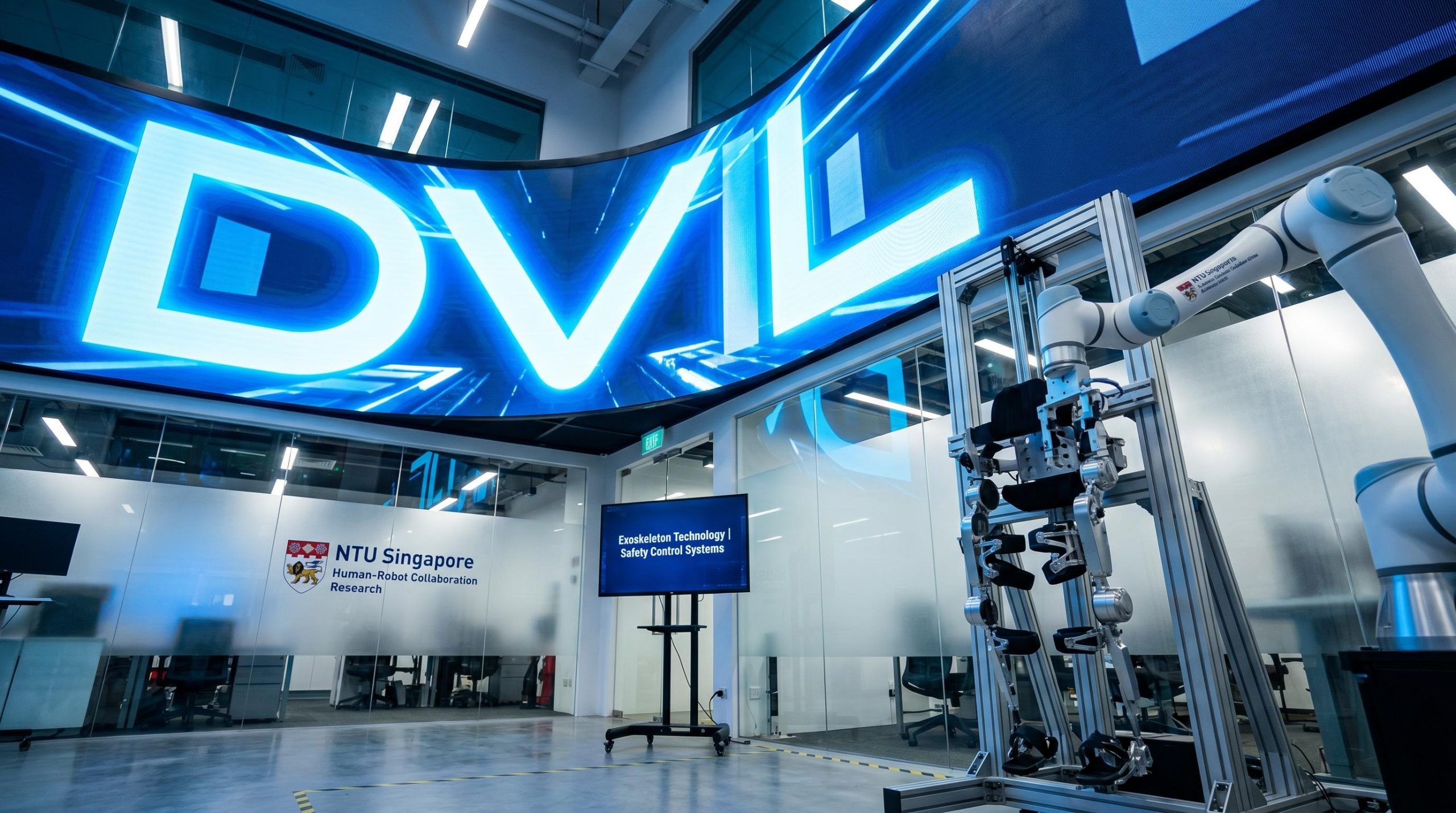
dorsaVi secures NTU Singapore robotics IP to complete exoskeleton platform
dorsaVi (ASX: DVL) has entered into an agreement to license two robotics intellectual property assets from Nanyang Technological University Singapore (NTU Singapore), marking the completion of a sequenced strategy to transform the company from a sensing component supplier into a full-stack robotics intelligence platform. The licenses add the safety control and data intelligence layers that sit above the hardware already under development, directly expanding dorsaVi’s addressable market into collaborative robotics (cobots), rehabilitation exoskeletons, autonomous industrial systems, and human-machine interface platforms.
The strategic significance lies in vertical integration. dorsaVi now owns every critical layer of the stack from sensing, memory, compute and control through to safety and learning — a rare end-to-end ownership that separates platform companies from component suppliers. The global collaborative robotics market is projected to exceed USD 17 billion by 2030, whilst the robotics AI software and data market is forecast to surpass USD 78 billion by 2031.
When big ASX news breaks, our subscribers know first
The two NTU inventions explained
The licensed IP portfolio comprises two complementary technologies that address critical gaps in the cobot ecosystem.
Invention 1 — Universal control framework for human-robot interaction
This patented control system gives robots the ability to work safely next to people in real time. The system solves a fundamental problem: existing collaborative robots rely on simplistic safety protocols — force limits or basic proximity sensors — that restrict productivity and limit how closely humans and robots can work together.
The technology employs control barrier functions, affine control models, and dynamic optimisation techniques to ensure that safety is never overridden by task demands. The framework guarantees human safety whilst preserving hierarchical task consistency, meaning the robot can continue productive work without compromising safety protocols. It is designed for ISO/TS 15066 compliance and emerging EU AI Act standards for autonomous systems. The invention is covered by US Patent Application 18/844,417.
Invention 2 — Data collection device for robotic manipulation tasks
This system helps robots learn from real-world human movement, turning dorsaVi’s existing clinical sensor data into training libraries for robotic systems. The strategic significance is direct: dorsaVi’s sensors already capture clinically validated human movement data across physical therapy, elite sport, and occupational health environments. This invention provides the systematic pipeline to transform that data into high-quality robot training sets.
The platform is platform-agnostic and scalable for cloud robotics, enabling data-as-a-service potential. Robots can learn directly from real human movement patterns captured in clinical and industrial environments, improving training speed and reducing the cost of acquiring quality datasets. The invention is held as know-how under NTU TD Ref: 2024-471.
The two capabilities address critical industry bottlenecks. The first solves the safety problem holding back human-robot collaboration. The second creates a monetisable data pipeline from dorsaVi’s existing clinical sensor networks.
How the pieces fit together — dorsaVi’s robotics intelligence stack
dorsaVi now owns or is developing three distinct but complementary layers of the robotics intelligence stack. When integrated with the V6.5 on-sensor processing architecture and the ITRI/NTU 22-nm neuromorphic compute programme, these layers form a cohesive technology platform for the next generation of human-aware autonomous systems.
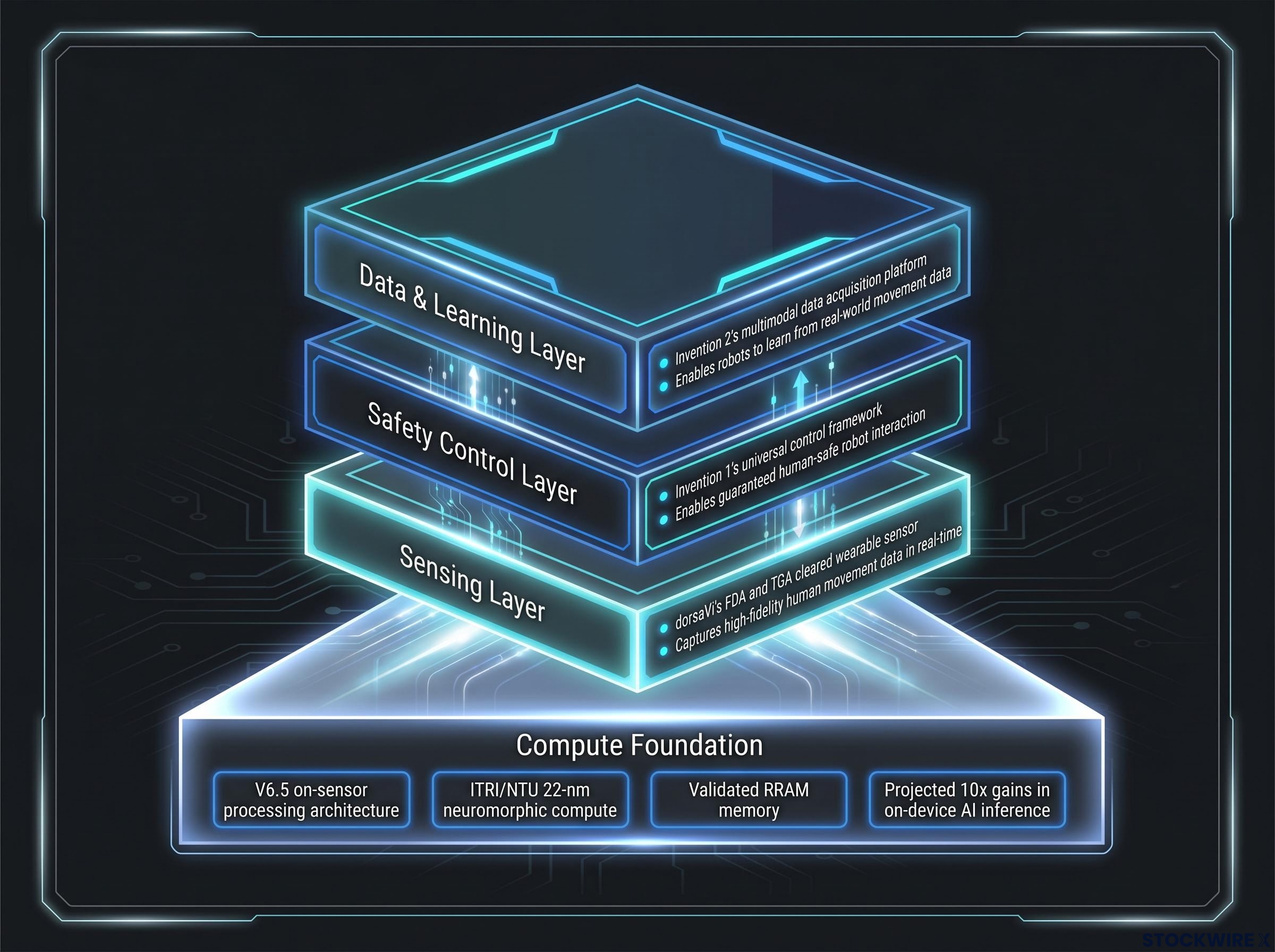
The RRAM platform validation confirmed that dorsaVi’s memory and neuromorphic processing IP operate as a coherent system, establishing the compute foundation upon which the NTU safety and learning layers now sit.
| Layer | Technology | Function |
|---|---|---|
| Sensing Layer | dorsaVi’s FDA and TGA cleared wearable sensor | Captures high-fidelity human movement data in real-time |
| Safety Control Layer | Invention 1’s universal control framework | Enables guaranteed human-safe robot interaction |
| Data & Learning Layer | Invention 2’s multimodal data acquisition platform | Enables robots to learn from real-world movement data |
The architecture delivers end-to-end control from data capture through to autonomous decision-making at the edge. dorsaVi’s validated RRAM memory and neuromorphic chip technologies form the compute foundation, delivering projected 10x gains in on-device AI inference with ultra-low power consumption. This enables real-time autonomous decision-making at the edge without cloud dependency — a critical requirement for latency-sensitive applications in healthcare, manufacturing, and defence.
Owning every layer of the stack creates defensible commercial value that component suppliers cannot replicate. This vertical integration positions dorsaVi as a platform company rather than a technology supplier.
Rehabilitation exoskeletons identified as priority commercialisation target
dorsaVi has identified rehabilitation exoskeletons and human-augmentation devices as a priority vertical for the combined IP portfolio. The convergence of capabilities directly suits this application: real-time, clinically validated movement data at the sensor level; mathematically rigorous safety controls that adapt to individual patient movement patterns; and automated data pipelines that enable machine learning algorithms to tailor therapy programmes at scale.
dorsaVi does not need to build clinical validation networks from scratch. The company already has access to real-world environments to test and commercialise exoskeleton applications through established clinical networks:
- SEROMA European study for Axial Spondyloarthritis across six European sites
- Select Medical’s network operating across more than 1,900 US physical therapy sites
- Dr. Patel elite sports programme
These networks provide immediate pathways to validate exoskeleton-oriented applications within credentialed clinical research environments. The SEROMA study, backed by the Assessment of SpondyloArthritis International Society (ASAS) research community and three global pharmaceutical groups, positions the company to demonstrate the IP’s clinical utility ahead of anticipated European regulatory deadlines.
Three commercialisation pathways
dorsaVi intends to pursue commercialisation of the NTU IP across three primary revenue pathways:
-
Licensing to cobot OEMs and industrial automation integrators — embedding Invention 1’s safety controller as middleware aligned with ISO/TS 15066 compliance. Target partners include ABB, Fanuc, KUKA, and Universal Robots.
-
Data-as-a-Service for robotics AI training — leveraging Invention 2 in combination with dorsaVi’s clinical sensor networks to generate proprietary movement datasets for third-party robotics AI developers.
-
Integrated exoskeleton and rehabilitation robotics partnerships — co-development agreements with medical robotics and exoskeleton manufacturers combining dorsaVi’s sensor platform, safety framework, and data pipelines.
Multiple revenue pathways reduce single-customer risk and position dorsaVi to capture value across different segments of the robotics market. Each pathway targets high-growth segments: collaborative robotics, robotics AI software and data, and rehabilitation exoskeletons.
For investors wanting to understand how each revenue pathway maps to specific customer segments and deal structures, our deep-dive into dorsaVi’s exoskeleton commercialisation strategy covers the OEM licensing, human-in-the-loop control, and data flywheel models identified prior to the NTU licence being secured.
Transaction terms and consideration
The commercial licence grants dorsaVi an exclusive worldwide right to develop and commercialise the licensed IP within the Field of Application, being Human-Robot Collaboration Safety Systems. The licence period is ten years.
Total cash consideration over the ten-year period is SGD $290,000, exclusive of patent cost recovery obligations. Critically, there are no royalty payments on product sales, preserving margin on future commercialisation. Share consideration comprises 5,000,000 fully paid ordinary shares issued to Clayton Capital Pty Ltd as Consideration Shares, issued concurrently with execution of the Licence Agreement.
The deal structure — modest upfront cash with no ongoing royalties — preserves margin on future product sales whilst securing exclusive global rights.
CEO outlines strategic rationale
Mat Regan, Group CEO
“The license completes an important part of a strategy we have been building step by step. We identified exoskeletons and human-robot collaboration as priority application markets. We validated that our RRAM and neuromorphic technologies can operate together as a coherent architecture, with modelling and technical evaluation indicating the potential for approximately 10x performance improvements in targeted robotics and exoskeleton applications… Together, these capabilities expand the potential application of dorsaVi’s technology into collaborative robotics, rehabilitation systems and human-machine interfaces.”
Regan highlighted the sequential nature of the strategy: identifying target markets, validating the semiconductor architecture, launching the developer platform, commencing the hardware build programme, and now securing robotics-focused intellectual property. The NTU IP license adds the safety control and robot learning capabilities that complement the sensing, compute and memory technologies already under development.
European regulatory positioning strengthened
The licence strengthens dorsaVi’s regulatory positioning in Europe at a critical moment. The EU AI Act and emerging European Machinery Regulation standards for autonomous systems and medical robots place increasing emphasis on validated, on-device AI inference and mathematically documented safety frameworks for human-robot interaction.
Invention 1’s control barrier function architecture directly addresses the validated safety documentation requirements embedded in ISO/TS 15066 and the EU AI Act’s high-risk AI system requirements. The framework delivers the mathematically rigorous safety guarantees that European regulators are expected to mandate for autonomous systems operating in close proximity to humans.
Invention 2’s automated data collection methodology supports the data provenance and traceability requirements that European regulators are expected to impose on AI-trained robotic systems. The ability to demonstrate where training data originated, how it was labelled, and how it was used to train autonomous decision-making systems will be a compliance prerequisite under the AI Act’s transparency requirements.
dorsaVi’s existing European foothold through SEROMA positions the company to validate the licensed IP within a credentialed clinical research environment ahead of anticipated regulatory deadlines. Regulatory alignment ahead of European compliance timelines reduces market access risk for dorsaVi’s robotics products.
Strategic completion
dorsaVi has now assembled sensing, compute, memory, safety, and learning capabilities into a vertically integrated robotics intelligence platform. The NTU license represents the completion of a sequenced strategy: exoskeleton announcement, chip validation, developer platform, hardware build programme, and now the safety control and data intelligence layers.
The company has transitioned from a clinically validated sensing company to a full-stack robotics intelligence provider. Owning every layer of the stack — from sensing through to autonomous decision-making at the edge — creates defensible commercial value that component suppliers cannot replicate. With established clinical networks for validation, exclusive worldwide licensing rights, and multiple commercialisation pathways identified, dorsaVi is positioned to pursue commercialisation across collaborative robotics, rehabilitation exoskeletons, and human-machine interfaces.
Want the Next Robotics Breakthrough in Your Inbox?
Join 20,000+ investors getting FREE breaking ASX news delivered within minutes of release, complete with in-depth analysis. Click the “Free Alerts” button at StockWire X to start receiving real-time alerts the moment market-moving announcements hit the ASX across Technology, Healthcare, Finance, and more.