European ADHD study delivers 82% sensitivity, expanding BlinkLab beyond autism
BlinkLab Limited (ASX:BB1) has reported that its European case-control study of smartphone-based digital neurobehavioural biomarkers achieved sensitivity of 82% and specificity of 83% in children aged 6 through 17 years, both with and without attention-deficit/hyperactivity disorder (ADHD). The addressable market for ADHD is four to five times larger than the market for autism, underscoring the commercial significance of these results.
The results support development of BlinkLab Dx2, the Company’s novel AI model designed to detect ADHD in addition to autism using smartphone tracking of digital neurobehavioural biomarkers. The multicentre study was completed in collaboration with Mental Care Group (MCG) in Europe at no cost to BlinkLab, demonstrating the value of the Company’s collaborative research model.
The announcement is intended to lift the Company’s trading halt, applied for and granted on Monday 3 August 2026.
When big ASX news breaks, our subscribers know first
Inside the study results and cohort
Participants completed brief smartphone-based assessments designed to capture digital neurobehavioural biomarkers, including the detection of often subtle and involuntary behaviours such as blinking and facial reflexes. Children were recruited across multiple MCG centres in the Netherlands, as well as from the general community, which formed the neurotypical control group.
Of the 375 children recruited, those with co-occurring neurodevelopmental or psychiatric conditions, and those taking medication, were excluded to establish a clearly defined ADHD group and a clean comparison group. This produced a final analysis set of 208 children, of whom 117 (56%) had a confirmed clinical diagnosis of ADHD and 91 (44%) had no diagnosis of ADHD or any other neurodevelopmental condition.
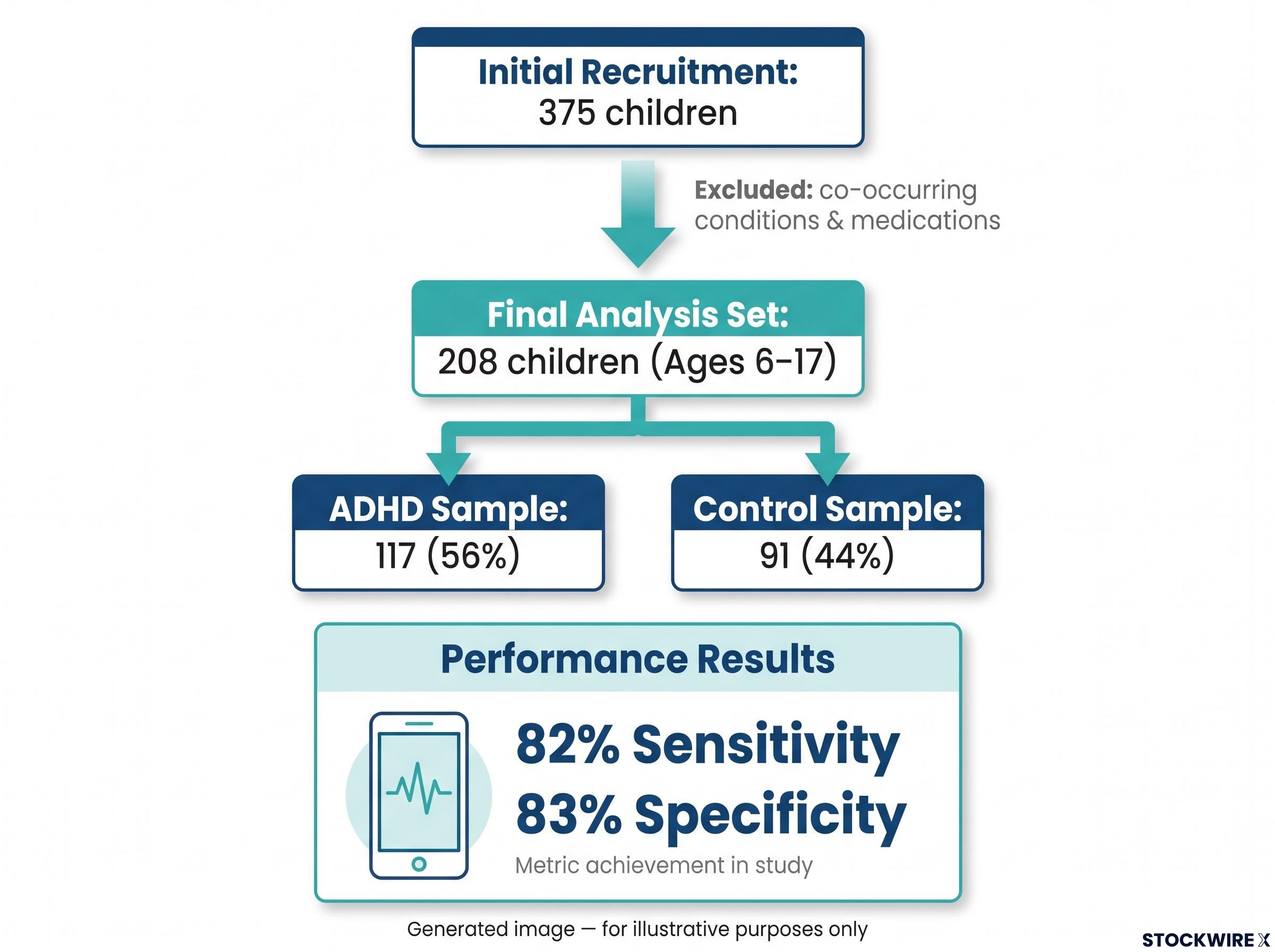
Both arms exceeded the minimum 50-per-arm threshold used in published meta-analyses to define studies of robust sample size. According to the Company, the cohort represents “one of the largest case-control datasets reported for ADHD assessment tools.”
Importantly, the smartphone-derived objective neurometric markers were positively associated with subjective clinical observations documented in participants’ diagnostic reports, providing further support that the measures reflect clinically relevant features for the diagnostic process.
| Metric | Control Sample (n=91) | ADHD Sample (n=117) | Total (n=208) |
|---|---|---|---|
| Proportion of cohort | 44% | 56% | 100% |
| Mean age (years) | 12.2 | 10.8 | 11.4 |
| Age range (years) | 6–17 | 6–17 | 6–17 |
| Male (%) | 45% | 63% | 55% |
| Female (%) | 55% | 37% | 45% |
Why ADHD diagnosis is a significant unmet need
There is no blood test or brain scan for ADHD. Diagnosis in children and adolescents generally relies on clinical interviews, behavioural observations, questionnaires and input from families and schools. This process is highly subjective and resource-intensive, and limited specialist capacity may result in long waiting times for patients seeking a diagnosis.
Two statistical measures are used to evaluate the accuracy of diagnostic tests such as BlinkLab’s. Sensitivity refers to the ability to correctly identify those who have the condition, while specificity refers to the ability to correctly identify those who do not.
Because objective tests are graded against a benchmark that itself carries error, the Company argues that the 82% and 83% results sit close to the practical ceiling for any test scored against subjective clinical opinion.
For investors, the scale of the opportunity is notable. ADHD has substantially higher prevalence than paediatric autism, representing a larger addressable clinical opportunity, while current diagnostic pathways remain resource-intensive with long waiting times.
Dr Henk-Jan Boele, Managing Director and CEO of BlinkLab
“These numbers deserve context. There is no blood test or brain scan for ADHD. Diagnosis is a subjective clinical judgement, and two experienced clinicians assessing the same child often disagree. Every objective test is therefore graded against a benchmark that carries its own error. Seen that way, BlinkLab’s 82% sensitivity and 83% specificity sit close to the practical ceiling for any test scored against subjective clinical opinion. And that ceiling is precisely the opportunity we intend to break through, by measuring biology directly instead of chasing an imperfect label.”
A capital-efficient collaboration model
The European ADHD study with MCG was completed at no cost to BlinkLab, reinforcing the Company’s capital-light research model. Study procedures, including administration of the smartphone-based assessments and collection and analysis of neurometric data, were executed by BlinkLab.
The clinical procedures establishing the diagnostic reference standard were performed by a multidisciplinary clinical team at MCG, which contributed clinical expertise, access to participants, and diagnostic review at no cost to the Company.
Critically, BlinkLab retains ownership of the study data and of all intellectual property generated through the collaboration as part of its agreement with MCG.
Jan Willem van der Windt, CEO of Mental Care Group
“As one of the largest providers of youth mental health care in Europe, we see every day what long waiting times and resource-intensive assessment pathways mean for children and their families. These BlinkLab results show that a brief smartphone measurement could help our clinicians direct extensive diagnostics to the children who need them most. We eagerly look forward to implementing BlinkLab into our diagnostic workflow. Technology will not replace professional judgement, but it can support it. We thank BlinkLab for making their platform and scientific expertise available to us, and the children, parents and colleagues who made this study possible.”
The investment case: extending the platform beyond autism
BlinkLab Dx1, an autism diagnostic aid for clinicians, is the Company’s most advanced product. The Dx2 model extends the same smartphone and AI platform into ADHD, applying reflex-based measures already developed for autism detection.
The platform’s scientific credibility rests on peer-reviewed validation in a Q1-ranked journal from a 536-child multi-centre study, which established that the smartphone-based sensorimotor measures can objectively detect neurodevelopmental differences before the ADHD program began building on that foundation.
Management has stated the ADHD program will follow the same FDA regulatory pathway and development strategy established for the autism product.
The broader vision extends beyond diagnosis. The Company believes it is at the forefront of developing quantitative digital biomarkers potentially capable of measuring ADHD symptom domains, including hyperactivity, inattentiveness and impulsivity, as well as severity, and potentially tracking treatment response. Such biomarkers could also provide pharmaceutical companies with objective endpoints for clinical trials.
The results provide what the Company describes as the first evidence that digital neurobehavioural biomarkers can detect differences associated with ADHD. Dr Boele stated he anticipates the technology will be “the first smartphone-based digital biomarker test for ADHD in the world.”
Next steps toward ADHD regulatory approval
BlinkLab has emphasised that this first exploratory case-control study was not designed to support a regulatory submission. Further prospective clinical validation, model improvement and regulatory clearance (FDA/MDR) are required before the technology could be used as an ADHD diagnostic aid.
Consistent with the pathway established for BlinkLab Dx1, the Company has outlined the following steps:
The FDA 510(k) Validation Program for autism, which enrolled its first participant in March 2026 across ten leading US clinical sites, provides the regulatory template and institutional relationships that the ADHD program intends to replicate.
- Commence preparatory activities for a US regulatory study program for Dx2.
- Initiate a U.S. pilot study in collaboration with leading ADHD clinical centres.
- Progress to a prospective FDA registrational study, subject to regulatory engagement and successful completion of the pilot.
- Continue evaluating commercialisation and regulatory opportunities in other jurisdictions, including Europe under the EU Medical Device Regulation (MDR).
Beyond the immediate roadmap, BlinkLab intends to investigate further opportunities:
- ADHD diagnosis in adults
- Monitoring ADHD symptom progression over time
- Monitoring response to pharmaceutical treatment
- Supporting clinical development of ADHD therapeutics
The Company expects to leverage its existing clinical development and regulatory framework, including engagement with experienced contract research organisations (IQVIA-MCRA) and regulatory advisers. While the initial regulatory focus is expected to be the United States, BlinkLab will continue to evaluate opportunities in other jurisdictions as the Dx2 program advances.
Don’t Miss the Next Healthcare Breakout
Big News Blast delivers FREE breaking ASX healthcare news directly to your inbox within minutes of release, complete with in-depth analysis. Join 20,000+ investors already staying ahead of the market. Click the “Free Alerts” button at StockWire X to get the next market-moving announcement the moment it drops.