WTI crude oil is trading in the low $90s in late September 2026, but the number itself is almost beside the point. What is remarkable is that the price is being pulled toward $100 and toward $80 at the same time, by forces that have nothing to do with each other.
Six months into an active US-Iran conflict, the market has not settled into a simple war-premium story. A strengthening US dollar, rising Federal Reserve rate expectations, and a pivotal China PMI release are all competing with geopolitical headlines for control of crude oil’s direction. The result is a market that swings 4-5% in a single session on one diplomatic statement, then reverses the next day on a different one.
This breaks down each of the three forces acting on crude right now, why they interact the way they do, and the specific developments that will decide which force wins the next leg of the move. Finish it, and you will have a framework for reading the next oil headline rather than just reacting to the price number.
Why WTI is oscillating in the $90s instead of trending cleanly in either direction
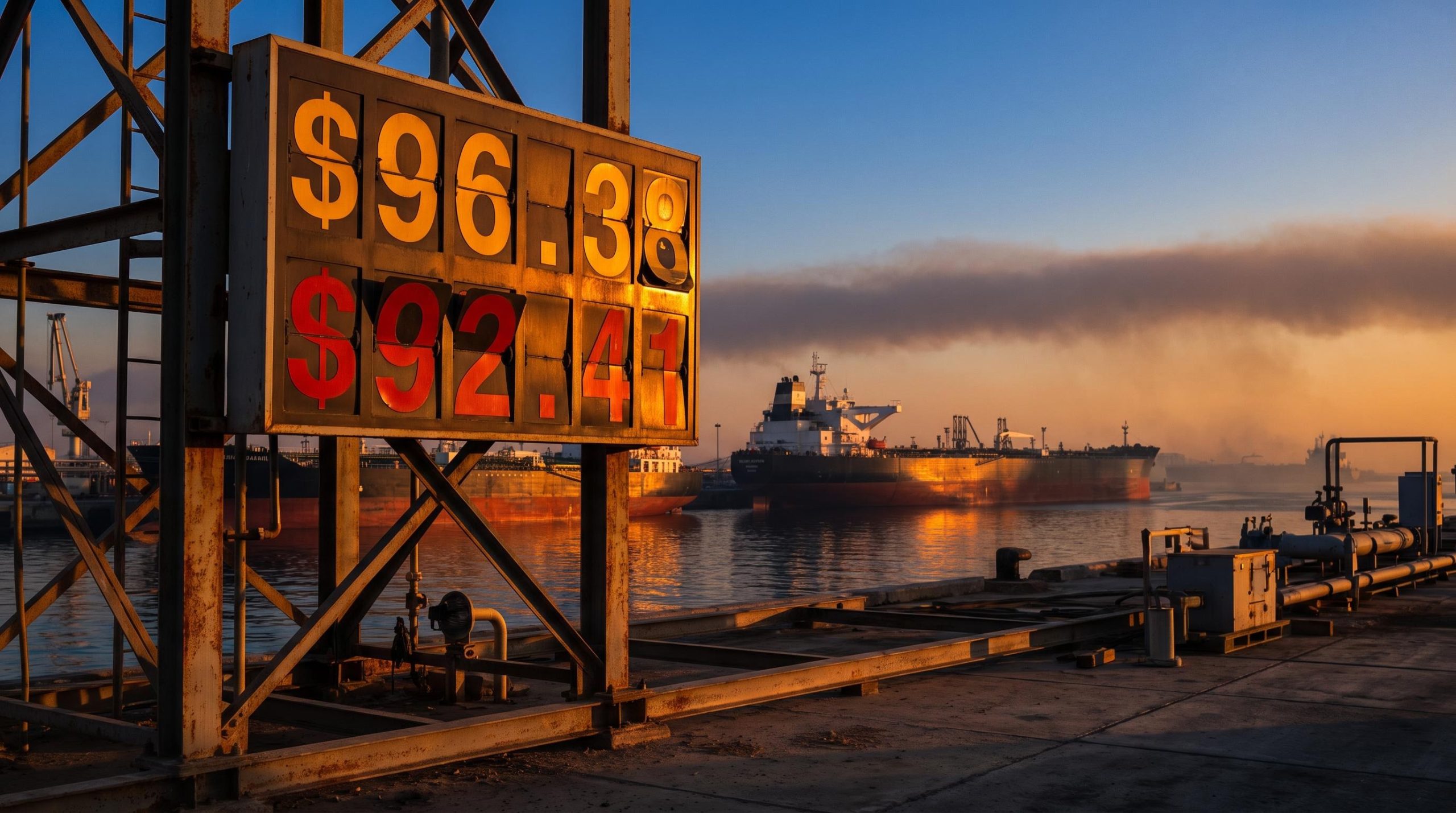
Look at the last few sessions and the pattern almost draws itself. WTI closed at $96.38 on 24 September 2026, up 4.58% on the day, according to The National, on renewed fighting and fading hopes of a breakthrough. Then it gave most of that back.
By the following session it had reversed hard. WTI settled at $92.41 on 25 September 2026, down $2.20 or 2.3% on the day, Reuters reported, this time on mounting hopes of a US-Iran truce.
The sequence over late September looks like this:
- Early September: WTI jumped more than 5% to around $90.22 as renewed fighting raised supply concerns.
- 24 September: Close of $96.38, up 4.58%, on escalation rhetoric.
- 25 September: Settlement of $92.41, down roughly 2%, on truce hopes.
- 26 September: After a Thursday close near $94.61, WTI dipped below $92 intraday before edging back up.
- Monday’s Asian session: WTI just above $92, up more than 0.80% on the day.
There is a detail buried in the supply data that most readers will skip past, and it matters more than any single headline. Preliminary Kpler data showed Middle Eastern crude exports recovered to 12.8 million barrels per day in September, the highest level since the conflict began in February. That figure quietly challenges the whole “war means less oil” story, because the oil is still moving.
The three forces competing for control of crude right now
What you are watching is not random noise. It is the signature of three distinct forces acting on the same price at the same time.
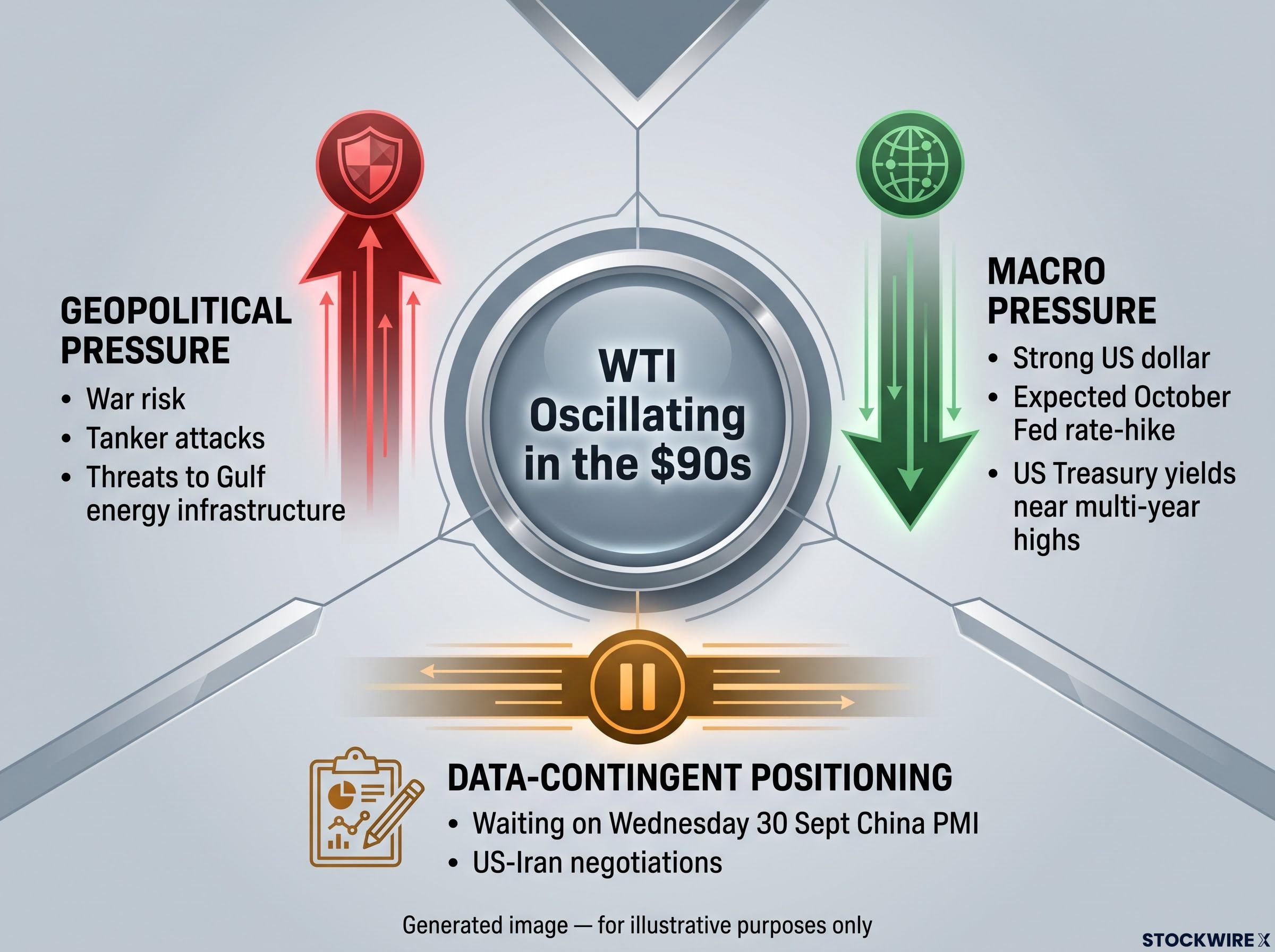
The first is geopolitical upward pressure: war risk, tanker attacks, and threats to Gulf energy infrastructure, all pushing crude higher. The second is macro downward pressure: a strong US dollar and rising Fed rate-hike expectations pressing a ceiling onto every rally.
The third is data-contingent positioning. Traders are holding fire ahead of China’s PMI release and clarity on the negotiations, which leaves the market unusually sensitive to whichever headline lands next. When all three are live simultaneously, you get oscillation, not trend.
When big ASX news breaks, our subscribers know first
What the US-Iran conflict is actually doing to oil supply (and what it is not)
The conflict began in late February 2026, and six months on there has been no significant breakthrough despite pressure from global and regional actors. The rhetoric of the past week reached the top of the scale.
On 23 September, Iranian President Masoud Pezeshkian vowed never to surrender, a day after President Donald Trump warned he could “annihilate” Iran. Oil settled higher on the exchange.
“Never to surrender.” Pezeshkian’s vow on 23 September, one day after Trump’s warning that he could “annihilate” Iran, was the kind of rhetoric that pushed WTI to $96.38.
Then the tone shifted. Over the weekend, Iran offered to reopen the Strait of Hormuz within seven days in exchange for removal of the US naval blockade on its ports, an offer Trump initially declined, according to Fox News on 26 September. Trump indicated US negotiators were expected to hold further talks during the current week.
Here is where the data complicates the war-premium story. Kpler’s 12.8 million barrels per day export figure is the highest since February, which tells you the supply disruption has been less severe than the headlines suggest. Six months of conflict has partially rerouted trade flows rather than shutting them.
The Hormuz bottleneck has reshaped the physical market in ways the headline price does not fully capture: vessel traffic fell to roughly five ships per day from pre-conflict baselines, yet around 6.5 million barrels per day are still moving via costly ship-to-ship shuttles in the Gulf of Oman, which explains why export volumes recovered even as the chokepoint risk stayed elevated.
| Diplomatic event | Date | WTI price impact | Direction |
|---|---|---|---|
| Trump “annihilate” warning; Pezeshkian “never surrender” | 23 Sep 2026 | Settled higher, rally toward $96.38 | Up |
| Escalation, fading breakthrough hopes | 24 Sep 2026 | Close $96.38, up 4.58% | Up |
| Mounting US-Iran truce hopes | 25 Sep 2026 | Settle $92.41, down about 2% | Down |
| Iran offers to reopen Strait of Hormuz | 26 Sep 2026 | Slid more than 1%, dip below $92 | Down |
The upside risks remain genuine, which is why the premium has not collapsed. Traders are wary of increasing Houthi attacks on Saudi facilities, Iran has threatened to strike energy infrastructure across the region, and the tanker war has already lifted global prices.
That said, the fact that a single day’s diplomatic signalling erased about 2% of the premium tells you something uncomfortable about current pricing. A meaningful slice of WTI right now reflects fear of supply loss, not actual supply loss. Only the latter is durable, which leaves the premium highly exposed to any sustained de-escalation signal.
How a strong dollar and rising Fed rate expectations put a ceiling on oil prices
Crude is priced globally in US dollars, and that single fact is the starting point for understanding why oil is not simply racing to $100. A broadly bullish dollar, driven by rising expectations of a Federal Reserve rate increase in October, is applying a ceiling to WTI’s upside, reinforced by US Treasury yields near multi-year highs.
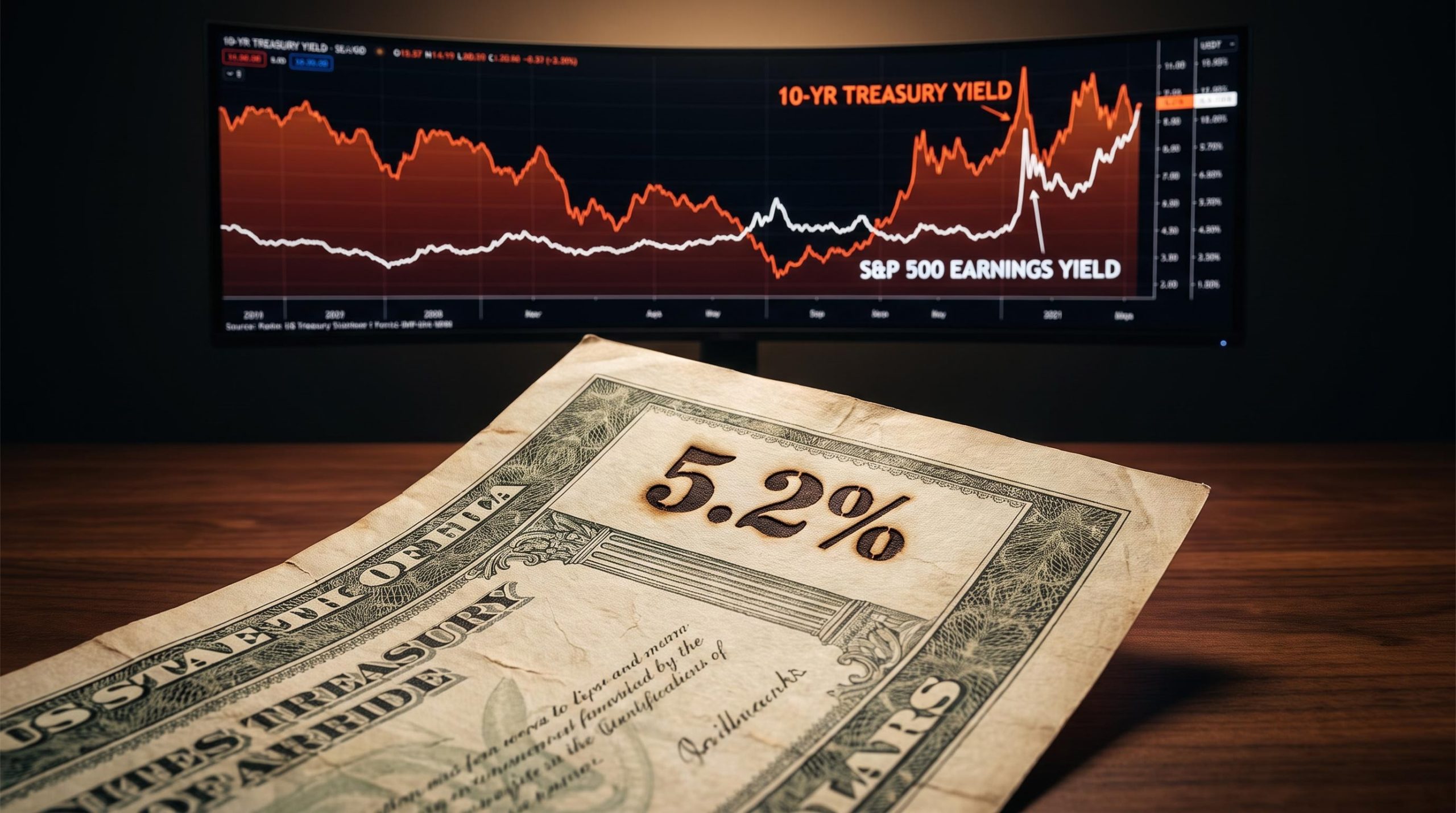
Rate-differential pricing has become the dominant dollar driver in September 2026: the 10-year Treasury yield closed at 4.975% following an upside core CPI surprise, and the DXY rose 1.4% week-on-week to near 100.5 even as Brent fell below $100, confirming that the commodity channel has been largely overridden by Fed expectations.
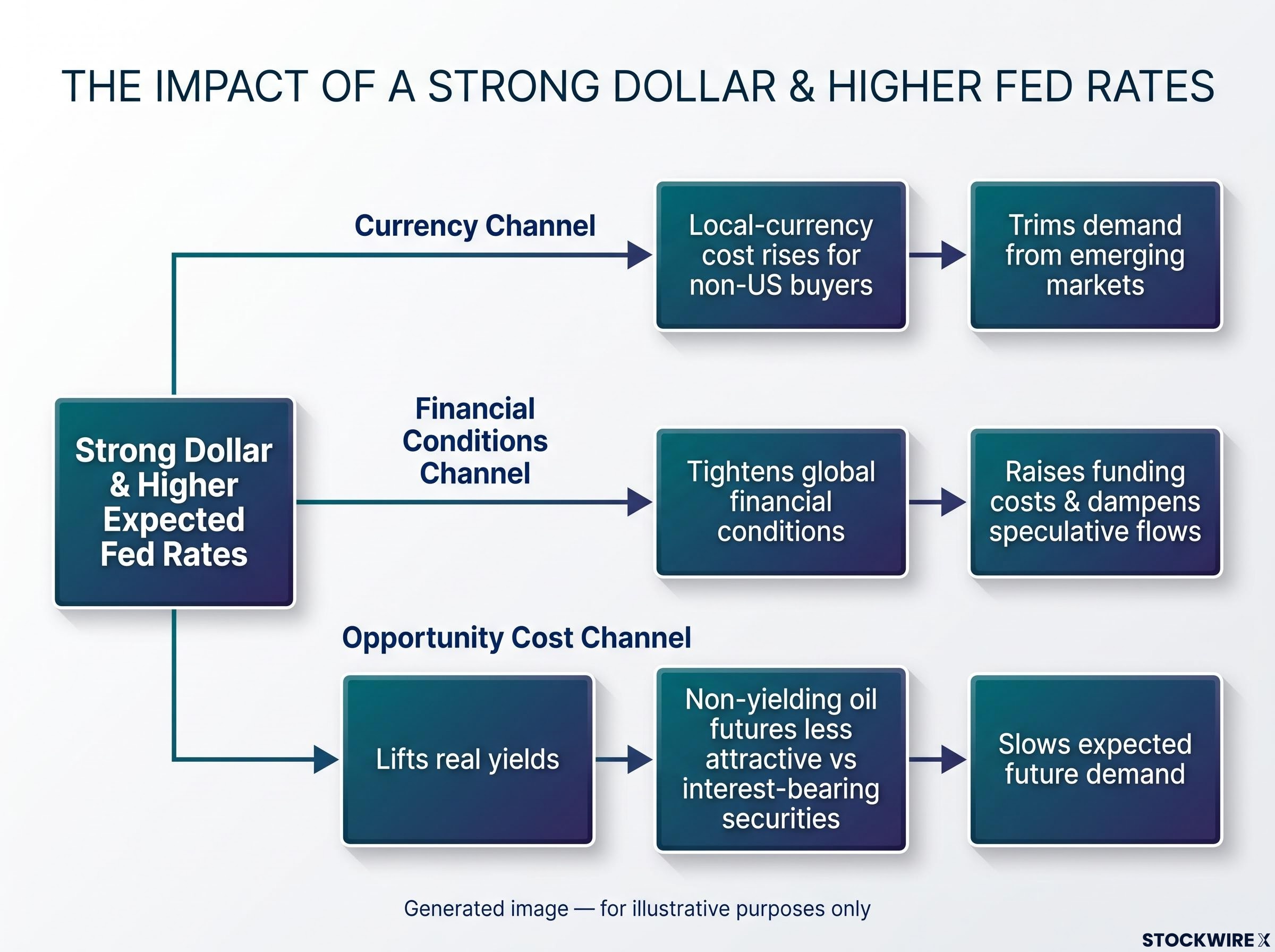
There are three distinct channels through which this works, and they build on each other:
- The currency channel. When the dollar strengthens, the local-currency cost of oil rises for non-US buyers even if the dollar price holds steady. That trims demand from price-sensitive importers, especially in emerging markets.
- The financial conditions channel. A stronger dollar tied to higher expected Fed rates tightens global financial conditions, raising funding costs for producers and traders and dampening speculative flows into oil futures.
- The opportunity cost channel. Higher expected rates lift real yields, making a non-yielding asset like oil futures less attractive relative to interest-bearing securities, while also slowing growth prospects and expected future demand.
There is a feedback loop hiding inside all this, and it is the key to the whole picture. Oil-driven inflation is itself amplifying bets on an October Fed hike. So the higher geopolitical risk pushes crude, the stronger the macro force pushing back, which is precisely why WTI is finding a ceiling rather than trending toward $100. The premium is partly self-limiting.
What history tells us about this pattern
This dynamic is familiar. During the 2014-2015 oil price collapse, a sharp dollar rally and expectations of Fed normalisation coincided with intense downward pressure on crude, alongside OPEC supply factors.
In 2018, a strong dollar and Fed rate hikes were again associated with periods of commodity weakness, even as oil responded to geopolitics and OPEC+ policy.
Use those episodes as calibration, not a template. The suppression mechanism is the same, but the geopolitical pressure sitting opposite it now is more acute than in either case. That is what keeps the current standoff from resolving cleanly in the dollar’s favour.
The next catalysts: what will break the stalemate between geopolitical risk and macro headwinds
If geopolitical risk is priced and dollar headwinds are priced, the demand picture is the variable still open. That is why traders are holding off on fresh directional bets until China’s official PMI data lands, expected on Wednesday 30 September.
Three catalysts will decide the next leg:
The PMI divergence between private and official surveys that emerged in August 2026 is the context for reading Wednesday’s release: the private composite PMI rose to 52.1 while the NBS composite sat at 49.5, a split that means a single headline number will likely obscure which parts of China’s economy are actually expanding.
- China PMI (Wednesday): A strong print supports demand expectations and gives bulls a second leg to stand on. A weak print leaves the geopolitical premium more vulnerable to any simultaneous de-escalation signal.
- US-Iran negotiations (the current week): Concrete ceasefire progress could accelerate the premium erosion already visible on 25 September. A collapse in talks would test the $96-$97 resistance seen on 24 September.
- Houthi attack trajectory: Escalation involving Saudi infrastructure would be a fundamentally different supply shock from the tanker war, with potentially more durable upward impact.
12.8 million barrels per day Middle Eastern crude exports in September, the highest since the conflict began in February. This is the supply-side figure to re-evaluate if Houthi attacks on Saudi facilities intensify.
The levels to watch are concrete. WTI’s $96.38 intraday area on 24 September is the marker on re-escalation; the sub-$92 dip on 26 September is the marker on de-escalation acceleration.
What the market’s wait-and-see posture really tells you is that professionals regard demand-side confirmation as the missing piece. The war premium and the macro ceiling are both in the price. China’s data is the swing factor with the power to resolve the stalemate in either direction.
What the balance of forces means before the next headline lands
Pull the three forces together and the picture becomes coherent. Geopolitical pressure is real but fragile, and partly self-limiting through its own feedback into Fed rate expectations. Macro headwinds are structural but not strong enough to break the war premium while escalation risk stays elevated. And the market is openly waiting for demand-side confirmation before committing.
That is why WTI sits in the low-to-mid $90s: not because either side has won, but because neither has. The six-month conflict has run without a supply catastrophe, and the Kpler export recovery shows the market has already done much of the work adjusting to a war-contingent baseline.
The honest read is that the next major move is more likely to come from a genuine resolution signal or a real infrastructure shock than from the conflict simply grinding on at its current pace. No price target is warranted here, because the value is in the framework, not a forecast.
For readers wanting to understand why even a confirmed ceasefire may not quickly unwind the war premium, our full explainer on the Hormuz risk premium examines the IEA’s two-year supply chain recovery timeline and the insurance market dynamics that keep commercial tanker traffic suppressed well after diplomatic conditions improve.
Keep three variables on your screen:
- China PMI on Wednesday, for the demand signal.
- US-Iran negotiation outcomes, for the direction of the premium.
- The Houthi attack trajectory against Saudi facilities, for the tail risk.
This article is for informational purposes only and should not be considered financial advice. Investors should conduct their own research and consult with financial professionals before making investment decisions. Past performance does not guarantee future results, and these statements are speculative and subject to change based on market developments.