
The US Treasury quietly doubled its buying power in the long-end bond market on 19 August 2026, and almost nobody called it what it was.
The announcement came wrapped in the language of liquidity support and market stabilisation. The mechanics, however, point toward something more deliberate: a policy apparatus using every available tool to hold long-dated yields below where an unfettered market would place them. When a heavily indebted sovereign benefits directly from keeping nominal yields below inflation, the distinction between liquidity support and financial repression starts to collapse.
This piece maps the policy architecture behind that August announcement, explains why negative real yields are more likely a feature than a bug of current US debt management, and connects that macro backdrop to a structured case for gold, silver, and Bitcoin. Here is the framework for reading the policy signals, not just the price moves.
What the Treasury actually announced on August 19
The announcement was specific, and the specifics matter more than the framing.
On 19 August 2026, the US Treasury announced it would at least double its buybacks of longer-term nominal coupon securities, covering 10-30 year maturities, raising the cap per operation from $2 billion to at least $4 billion. The key operational facts:
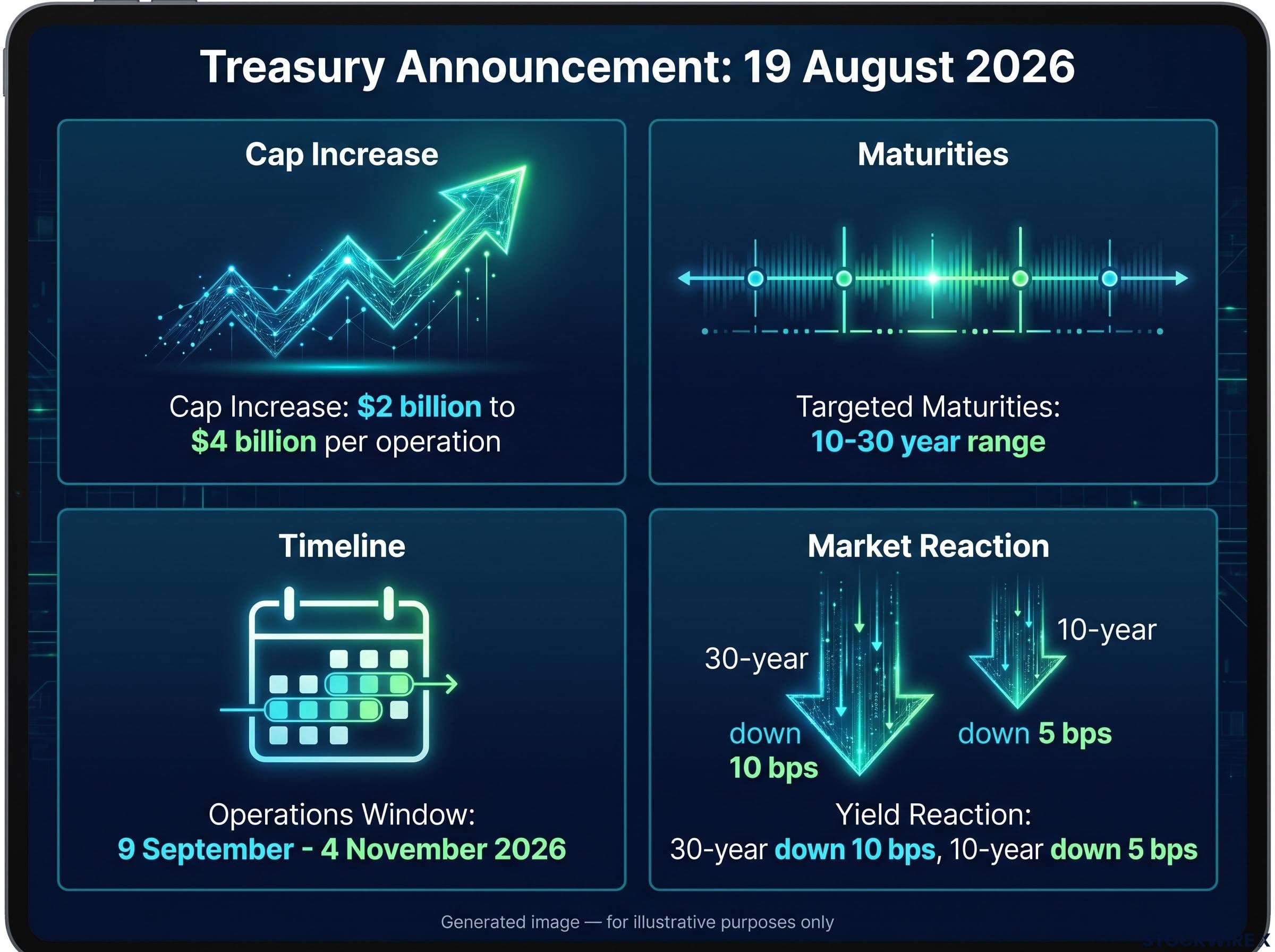
- Cap increase: From $2 billion to at least $4 billion per operation on longer-term nominal coupons
- Maturities targeted: 10-30 year range
- Operations window: 9 September through 4 November 2026
- Immediate yield reaction: 30-year yields fell approximately 10 basis points; 10-year yields fell approximately 5 basis points
This did not come out of nowhere. Roughly three months before the announcement, former Treasury Secretary Henry Paulson had spoken publicly about the need to establish a dedicated facility capable of supporting the Treasury market in the event of a funding crisis. And current Treasury Secretary Scott Bessent went further.
Bessent publicly stated that Treasury valuations had become disconnected from economic fundamentals and that the department was prepared to expand its purchase activity if necessary.
One distinction matters here and is easy to miss. These buybacks are funded by swapping one type of Treasury security for another, not by central bank balance sheet expansion. This is not conventional quantitative easing (QE), where the central bank creates new money to buy bonds. The Treasury is reshuffling its own liabilities, placing a named, official buyer into the long end of the market at doubled capacity.
The yield response was immediate. For investors, that sequence, a named buyer entering the market at expanded scale followed by an instant drop in long-dated yields, is the relevant signal, regardless of how the operation is labelled.
The announcement drove a roughly 9-basis-point drop in the 30-year yield within a single session, and the cross-asset transmission chain that followed, from lower yields to a softer dollar to a stronger gold bid, illustrates precisely why the signal value of the operation exceeded its mechanical footprint.
When big ASX news breaks, our subscribers know first
Financial repression as a policy toolkit, not a conspiracy theory
Financial repression is a specific, well-documented policy regime: one in which nominal interest rates on government debt are held below the inflation rate, generating negative real returns for creditors and allowing the sovereign to reduce its real debt burden over time. It is not speculative language. It has named dates.
From 1942 to 1951, the US operated under precisely this regime. The Federal Reserve pegged short-term bill yields at approximately 3/8 percent and capped long-term bond yields at approximately 2.5 percent, requiring sustained purchases to maintain those ceilings. The motivation was straightforward: financing World War II without an unmanageable interest bill.
That regime was explicitly acknowledged as yield curve control only after it ended. The 1951 Treasury-Fed Accord formally abandoned the caps because maintaining them against rising inflation had become untenable. Contemporary macro research describes a potential future “phase three” in which a politicised coordination between Treasury and Fed would again cap long-end yields and absorb Treasuries, producing collapsing real yields as inflation expectations rise.
| Dimension | 1942-1951 regime | 2026 policy environment |
|---|---|---|
| Yield ceiling mechanism | Explicit Fed purchases at fixed cap rates | Treasury buybacks at doubled capacity; no explicit cap announced |
| Scale and duration | Open-ended, sustained for nine years | Time-limited (September 9 to November 4, 2026) |
| Official framing | War financing and economic stabilisation | Liquidity support and market functioning |
| Sovereign debt context | Wartime debt exceeding 100% of GDP | Peacetime debt exceeding 120% of GDP |
The parallel is not perfect. But the incentive structure is identical: a heavily indebted sovereign using institutional tools to keep the cost of its own borrowing below what an unfettered market would demand. Investors should not wait for the explicit label before adjusting their positioning. The 1942 regime did not carry one either, until historians named it afterward.
Why negative real yields serve the government’s balance sheet
The arithmetic of financial repression runs in one direction, and it runs in the government’s favour.
The mechanics work in three steps:
- Inflation rises above the nominal yield on government debt. If Treasury bonds pay 4% but inflation runs at 5%, the real return to bondholders turns negative.
- Real returns to creditors turn negative. Bondholders are repaid in dollars that buy less than the dollars they lent. In effect, inflation transfers purchasing power from creditors to the borrower.
- The real value of outstanding debt erodes over time. The government repays its obligations in nominal terms while the real burden quietly shrinks, year after year, without requiring explicit default, restructuring, or even a public conversation about it.
Macro research shows that this type of repression can increase bond values and lower the inflation response to fiscal expansions, effectively providing cheaper and more stable funding for the sovereign. Negative real yields, in this framing, are not an unintended consequence. They are the mechanism through which debt becomes manageable.
Neither the Treasury nor the Fed describes price stability as subordinate to debt management in official communications. Framing the current buyback programme as functionally equivalent to open-ended QE overstates current evidence. But the incentive structure is observable: when the government is the largest borrower in the market and also controls the institutions that set borrowing costs, investors should not expect that institution to voluntarily keep real borrowing costs positive. That asymmetry in incentives is itself the investment thesis.
Real yield trends remain observable via market proxies such as the TIPS bond ETF (TIP), which tracks the spread between nominal yields and inflation.
The real yield trajectory heading into the August announcement matters for calibrating the thesis: the 10-year TIPS benchmark reached 2.22% under new Fed Chair Kevin Warsh, its highest level in over 12 months, meaning the buyback programme entered a market where real yields were already elevated rather than already suppressed.
Why the US can sustain this without a currency crisis (most countries cannot)
Under ordinary circumstances, deliberately negative real yields would be expected to produce a currency crisis. Creditors flee, the currency collapses, and the game ends. The US dollar’s reserve currency status is the key factor providing structural insulation from that outcome. Global demand for dollars as a reserve and trade settlement currency creates a floor under the currency that non-reserve economies simply do not have. Historical episodes of deliberate yield suppression in smaller economies have frequently ended in exactly the currency crisis the US has so far avoided.
The reserve currency insulation argument rests on the dollar’s structural position: it appears on one side of 89% of global FX trades and holds roughly 57% of allocated global reserves, a dominance that provides a demand floor no non-reserve economy can replicate, which is precisely why deliberate yield suppression carries a different risk profile in Washington than it would in Ankara or Buenos Aires.
What history says about hard assets under financial repression
The opportunity cost logic is the foundation of the hard asset case, and it is worth stating plainly.
When real yields on sovereign debt turn negative, the zero-yield nature of gold stops being a cost and becomes a competitive feature. Holding an asset that pays nothing is no disadvantage when the alternative pays less than nothing in real terms.
Gold has the longest and most documented relationship to real yield regimes. Periods of negative real rates have historically coincided with strong gold performance precisely because the opportunity cost of holding a zero-yield asset falls, or becomes positive, relative to deeply repressed bonds. Central banks, especially in emerging markets, have accelerated gold purchases over the past decade, aligning with the monetary insurance argument rather than a speculative one.
The relationship between sovereign debt and gold allocation has shifted from tactical to structural in institutional portfolios, with central banks buying 244 tonnes in Q1 2026 alone and major institutions explicitly linking rising debt burdens in the US, UK, and eurozone to a durable reduction in the safe-haven value of government bonds.
Silver carries dual exposure. Through the monetary channel, it benefits from the same real yield logic as gold. Through the industrial channel, it serves as a key input for solar, electrification, and grid infrastructure, tying it to energy transition spending that operates independently of the repression thesis.
Bitcoin’s fixed supply and non-sovereign characteristics make it a natural candidate for regimes where fiat currencies and sovereign debt offer negative real returns. Over longer horizons, Bitcoin tends to trade more like a macro asset sensitive to liquidity and real rate conditions than like a traditional growth equity, which is consistent with the repression thesis. The caveat is that short-term price action can be dominated by mechanical forces rather than macro fundamentals. In a recent session, Bitcoin posted a gain of roughly 6.2% while Ethereum climbed approximately 10.6%, yet both moves occurred against the backdrop of a record-setting wave of Bitcoin short liquidations recorded by Coin Glass as of around 11:00 AM that morning. That is liquidation-driven price action, not macro-driven accumulation, and distinguishing the two matters.
| Asset | Primary repression channel | Secondary driver | Key risk to thesis |
|---|---|---|---|
| Gold | Opportunity cost collapse when real yields turn negative | Central bank reserve accumulation | Reversal to positive real yields |
| Silver | Monetary hedge via same real yield channel as gold | Industrial demand from energy transition | Deflationary technology shock compressing industrial demand |
| Bitcoin | Non-sovereign store of value with fixed supply | Liquidity-sensitive macro asset over longer horizons | Short-term price dominated by leverage and liquidation mechanics |
The structural case for hard assets under financial repression is not that these assets always go up. It is that the cost of holding them relative to suppressed sovereign debt falls in a way that makes them rational portfolio hedges rather than speculative bets.
Where the thesis is strong and where it still requires a judgement call
The directional argument is well grounded. But treating the current programme as a finalised architecture rather than a developing signal is the most common way to get the sizing wrong.
The current Treasury buyback programme is time-limited, running from 9 September through 4 November 2026. It is explicitly framed as a market-stabilisation circuit breaker. And it is funded by securities swaps, not balance sheet expansion. Equating this with open-ended QE is not accurate at present.
The risks to the thesis are real and should not be softened:
- Reversal to higher real yields if inflation undershoots or policy shifts toward tightening
- Loss of dollar confidence that forces yields higher despite intervention, breaking the reserve currency insulation
- Deflationary pressure from technology or global slack that eliminates the inflation-yield spread defining repression
- Non-renewal of current operations after the 4 November end date, removing the named buyer from the long end
The Bank of Japan analogy, while illustrative, is imperfect. Japan’s yield curve control was a standing regime maintained for years. Current US operations are explicitly time-boxed and conditional.
What would confirm the thesis is deepening vs. stalling
Signals the regime is becoming more entrenched:
- Operations renewed or scaled up once the current window closes past 4 November
- Issuance mix continuing to shift toward shorter maturities, keeping demand pressure on the long end
- Real yields (as measured by TIPS) pressing toward or through zero
Signals the regime is stalling or reversing:
- The programme concludes after 4 November with no successor mechanism or comparable support put in place
- Inflation undershooting enough to restore positive real yields
- Fed communications becoming more hawkish in explicit terms, pushing back on yield suppression
The direction of this thesis is supported by evidence. The degree of permanence is not yet confirmed. Investors who treat the current programme as a done deal rather than a signal worth monitoring will be caught off guard if the buyback window closes without extension.
Reading the policy calendar before the next refunding cycle
The period between now (late August 2026) and 4 November 2026 is the most informative window available for evaluating whether this policy regime is being institutionalised or treated as a one-off response to market stress.
Three signals to monitor, ordered by informational priority:
- Whether the buyback programme is extended beyond 4 November or expanded in scope. This is the single highest-information event. Renewal converts a temporary circuit breaker into something more permanent.
- Whether the issuance composition continues shifting toward shorter maturities. A sustained shift confirms the Treasury is managing the maturity profile to concentrate demand at the long end, consistent with repression mechanics.
- Whether the next Treasury refunding announcement adjusts the buyback cap further or signals expanded purchase activity. The refunding cycle is the institutional moment when issuance decisions and buyback posture become public, making it a high-information checkpoint.
The signal value of policy announcements in a financially repressed environment exceeds the mechanical market impact of the operations themselves. The specific dollar amounts involved in buybacks have been characterised as primarily signalling mechanisms, meaning what the Treasury chooses to announce may matter more than the volume it actually purchases.
If the programme extends or expands, the structural case for gold, silver, and Bitcoin as real yield hedges strengthens. If it lapses without replacement, the regime thesis requires reassessment, and positions sized on the assumption of permanence become vulnerable.
What matters most is not the size of the buyback cap in isolation. It is whether Treasury opts to continue, scale up, or simply allow the programme to wind down quietly once 4 November arrives. That decision will reveal more about the policy commitment behind this thesis than any single yield move.
This article is for informational purposes only and should not be considered financial advice. Investors should conduct their own research and consult with financial professionals before making investment decisions. Past performance does not guarantee future results. Financial projections are subject to market conditions and various risk factors.
—