USD/CAD has spent the past week pinned near 1.40, and on the surface nothing much is happening. Yet Scotiabank’s fair-value estimate and the 50-day moving average now sit within two pips of each other at that same level, while sentiment toward the Canadian dollar has been improving underneath a flat price. A currency can look still while the forces around it shift, and that gap is where this USD/CAD forecast debate sits.
Timing makes it urgent. The Bank of Canada decides on rates on 28 October 2026, the Federal Reserve meets on 27-28 October, and US-Canada tariff talks are live and unresolved.
If you trade CAD pairs or hold Canadian assets, the next few sessions will test which signals matter and which are noise.
Here is a working method for reading the pair by layering fundamentals over technicals, along with a clear view of what would confirm, or break, Scotiabank’s bearish call on the US dollar.
Why does USD/CAD keep stalling at 1.40?
Start with the path. USD/CAD reportedly traded above 1.42 earlier in October, then slid to 1.4007 on 22 October, the Canadian dollar’s strongest level since 21 September. By 27 October it was hovering around 1.4022, with a market report citing support in the 1.4015-1.4040 zone.
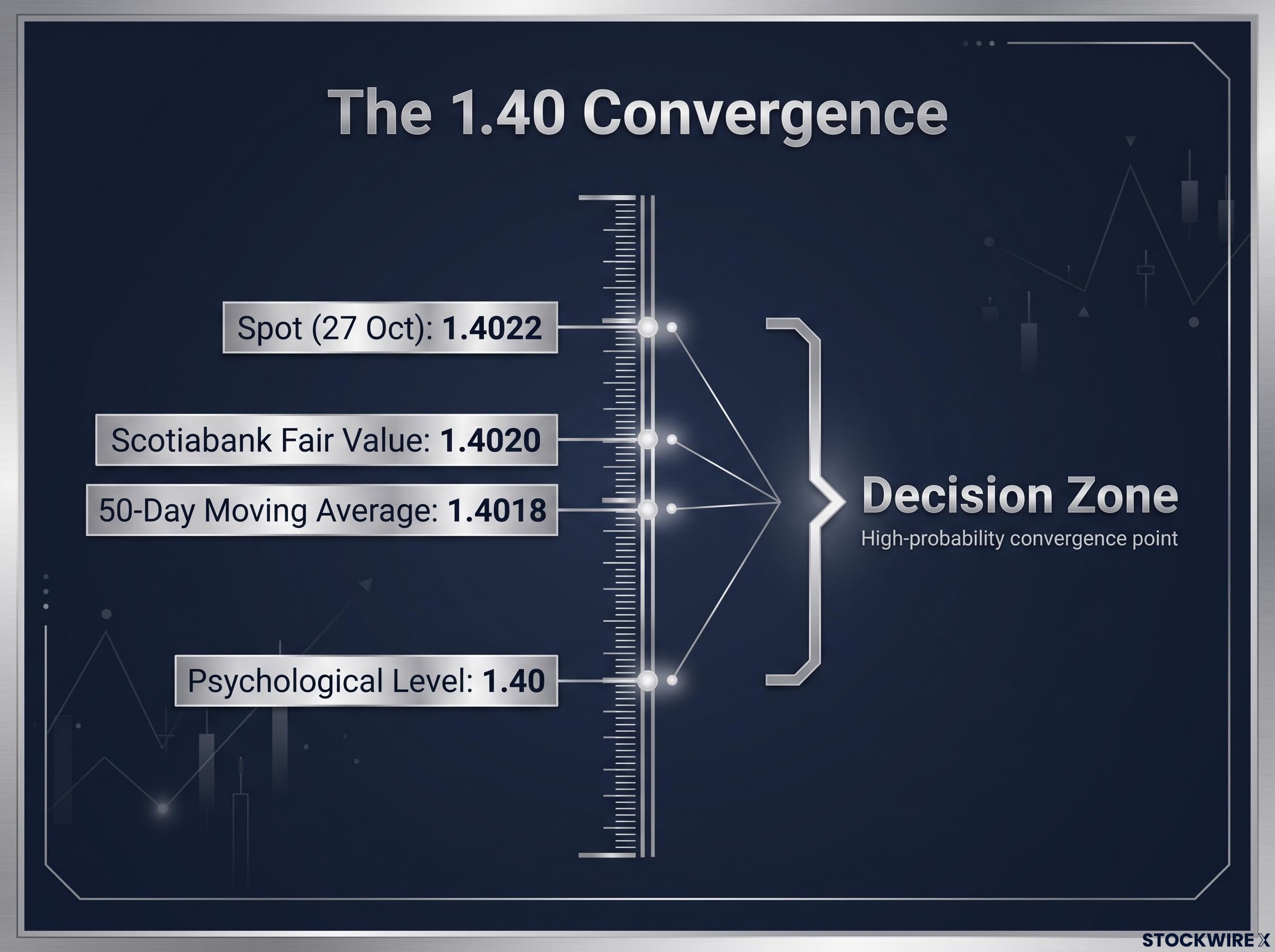
Now line up the measures. Scotiabank strategists Shaun Osborne and Eric Theoret put fair value at 1.4020, meaning the level their model suggests the pair should trade at given rate gaps, commodities and risk appetite. The 50-day moving average, the average closing price over the past 50 sessions, sits at 1.4018.
| Level | Value | What it represents |
|---|---|---|
| Spot (27 October) | 1.4022 | Where the market is trading now |
| Scotiabank fair value | 1.4020 | Where fundamentals suggest the pair should sit |
| 50-day moving average | 1.4018 | Where recent trend and positioning have centred |
| Psychological level | 1.40 | Round number where orders tend to cluster |
Three independent measures, one price. That agreement is the story.
Scotiabank describes its technical bias as bearish to neutral, with the recent decline settling into consolidation. Opposing doji candles on Friday and Monday, sessions where the pair opened and closed at almost the same price, point to buyers and sellers in a standoff. CAD has barely moved against the US dollar and has lagged other commodity currencies, even as it gained ground on the euro, pound and yen.
Scotiabank’s read Sentiment toward the Canadian dollar has improved alongside a narrowing of US-Canada 2-year yield spreads, a combination the bank describes as strongly supportive.
When fair value, trend and a round number cluster within a few pips, you are looking at a decision zone. The next catalyst, not the chart, will decide which way the pair breaks. Consolidation is not yet a breakout.
Readers interested in how the pair got here will find our full explainer on the 1.42 overshoot, which traces the yield spread compression from its 18-month high.
When big ASX news breaks, our subscribers know first
What is actually driving Canadian dollar sentiment?
The chart shows a standoff. The drivers explain why one side has been gaining quiet ground.
Rate policy, crude, trade balances, inflation and US economic health are the structural Canadian dollar drivers that interact continuously, which is why a single signal rarely explains a move on its own.
Yield spreads and central bank divergence
Currencies follow interest rates because investors earn more by holding the higher-yielding one, a trade known as carry. The 2-year government bond yield is the best gauge, because it tracks where markets expect central bank rates to go over the next couple of years.
The US 2-year premium over Canada narrowed from roughly 160 basis points earlier in October to about 141 bp on 22 October, falling 11 bp that day alone as odds of a Bank of Canada (BoC) hike climbed. A basis point is one-hundredth of a percentage point. Spot yield levels date from early October and the spread figure from 22 October, so the two should not be combined arithmetically.
| Central bank | Policy rate | Next decision | Market expectation |
|---|---|---|---|
| Bank of Canada | 2.25% | 28 October 2026 | About 80% odds of a 25 bp hike to 2.50% |
| Federal Reserve | 3.75%-4.00% | 27-28 October 2026 | About 90% odds of a hold; December hike expected |
A BoC hike against a Fed pause narrows the policy gap at the front of the curve. The Reuters poll still expects a Fed hike in December, which limits how far that narrowing runs. One market guide had a BoC hold as its base case, but the more recent Reuters pricing is the stronger signal.
Options premia as a fear gauge
A risk reversal compares the price of options betting on a currency rising with options betting on it falling. When protection against CAD weakness costs more, traders are paying up for insurance against a shock.
Scotiabank reports that this premium has nearly vanished, with risk reversals back to neutral. No numeric reading is available, so treat it as a qualitative signal. Still, it suggests markets fear a trade shock far less than they did.
A narrower spread and cheaper downside hedges both reduce the reward for holding US dollars against CAD. You should read them as a shift in positioning pressure, not just a change in price.
Trade headlines and oil
The US applies tariffs of up to 50% on Canadian steel and 25% on autos, and talks broke down in August before resuming. US National Economic Council Director Kevin Hassett said negotiators were very close to a deal, and President Trump echoed him. Prime Minister Mark Carney was more guarded, pointing only to modest progress, while Reuters reported negotiators working on Section 232 steel and auto concessions.
Oil helps less than you might expect. Higher crude lifts export receipts, but when it rises on geopolitical disruption it can also push up inflation and US rate expectations. That helps explain why CAD trails its commodity peers:
- The US is Canada’s dominant trade partner, so tariff threats hit harder.
- The US yield advantage remains large even after narrowing.
- Oil strength was partly read as an inflation shock rather than a clean export gain.
Where do the banks disagree on the USD/CAD forecast?
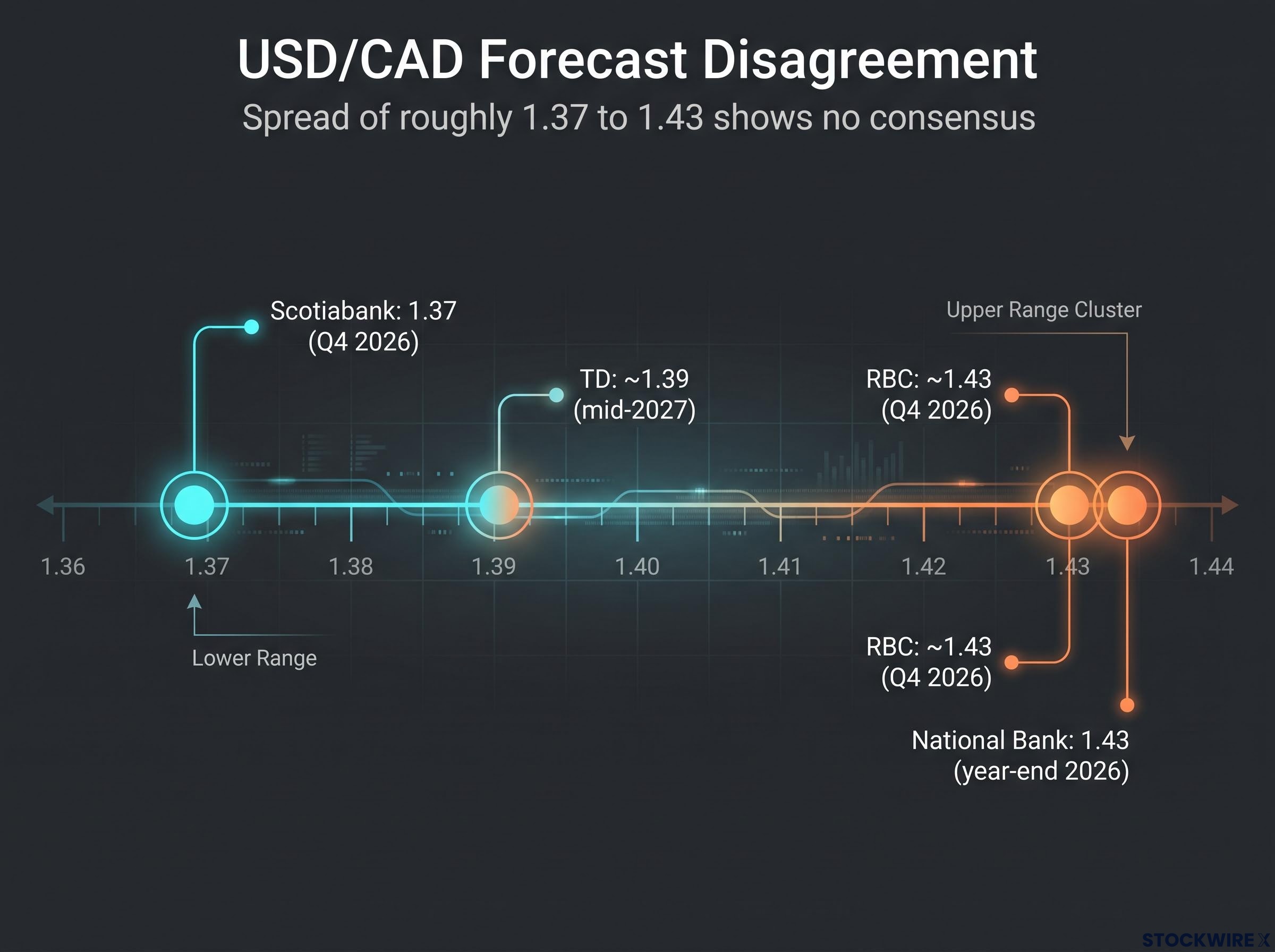
Scotiabank sits at the bold end. It targets 1.37 by Q4 2026 and 1.33 by Q4 2027, citing improving CAD fundamentals, narrower spreads and shifting positioning.
The rest of the street is more cautious. RBC sees about 1.43 in Q4 2026, easing to 1.42 in Q1 2027 and 1.39 in Q2 2027. National Bank of Canada expects 1.43 by year-end, pointing to weaker labour momentum, the wide US rate advantage and limited benefit from high oil. TD sits in between at about 1.39 through mid-2027.
| Institution | Near-term view | Key reasoning | Stance vs Scotiabank |
|---|---|---|---|
| Scotiabank | 1.37 Q4 2026 | Narrower spreads, cheaper CAD hedges, BoC tightening | Benchmark |
| RBC | About 1.43 Q4 2026 | Wide US rate advantage, trade uncertainty | More USD-positive |
| National Bank | 1.43 year-end 2026 | Weak labour data, limited oil benefit | More USD-positive |
| TD | About 1.39 | CAD-positive but less aggressive | Same direction, smaller move |
| Convera | Test of 1.40 likely | Narrowing 2-year spread | Cautiously aligned |
CIBC’s Avery Shenfeld expects a 25 bp hike to 2.50%, though he attributes it mainly to Governor Tiff Macklem’s communication rather than convincing evidence that energy inflation has spread to core prices.
Convera’s caveat Kevin Ford expects USD/CAD to test 1.40, but argues a sustained move below that level needs further Canadian data and BoC support.
The disagreement is mostly about timing and the weight placed on tariffs, the US yield advantage and Canadian labour weakness, not about whether CAD has support. A spread of roughly 1.37 to 1.43 tells you there is no consensus, so treat any single forecast as a scenario to test. These figures come from published summaries and secondary coverage, as primary sell-side notes are not fully accessible.
What could break the CAD-positive case, and how do you weigh the signals?
The bank range already hints at the fault lines. Each could unwind the rally:
- Trade-deal failure: collapsed talks would restore the hedging premium; the August breakdown shows how quickly optimism can reverse.
- Weaker oil: a crude decline would remove export support.
- Hawkish Fed surprise: a hike or tougher signal would widen the rate gap, though October hold odds sit near 90%.
- BoC disappointment: a hold or soft statement would hit CAD, with only 19 of 34 Reuters-polled economists expecting a hike.
- Canadian data misses: weak jobs or inflation would undercut tightening bets.
- Failed technical break: a close back above the 50-day average would weaken the bearish signal.
Talks remain active, with a possible deal before the 3 November US elections, but US sources say Washington wants further Canadian concessions.
The way to weigh these risks starts with understanding your tools. A fair-value model tells you where price should be. A moving average tells you where positioning has been. When the two agree, as they do now, the level carries more weight.
A four-step check for combining signals
- Check the level. Is USD/CAD holding below 1.40 and the 50-day average on a closing basis? A single intraday dip proves little.
- Check the spread. Is the US 2-year premium still narrowing? If it widens while price falls, the move lacks fuel.
- Check options sentiment. Are risk reversals staying neutral? Renewed demand for CAD downside protection is an early warning.
- Check the headline calendar. Do central bank decisions and trade news support the direction, or contradict it?
Scotiabank’s strongest-signal combination is exactly this: spot near 1.40, a narrowing spread, neutral risk reversals, rising BoC hike expectations and tentative trade progress. Your confidence in a move below 1.40 should rise only when technical, spread and sentiment signals confirm each other, and fall when only one does.
This article is for informational purposes only and should not be considered financial advice. Investors should conduct their own research and consult with financial professionals before making investment decisions. Past performance does not guarantee future results, and forecasts are subject to market conditions and various risk factors.
What the 1.40 stall does and does not tell you
The evidence points to a modestly improving backdrop for the Canadian dollar: narrower spreads, calmer options pricing and rising odds of BoC tightening. The price itself says something different. The market is waiting, not committed.
Three catalysts will decide which reading wins. Watch the 28 October BoC and Fed decisions, any trade-deal announcement before 3 November, and whether USD/CAD closes decisively below the 50-day average.
Scotiabank’s 1.37 target needs confirmation from data, policy and trade together. Track those signals rather than the round number alone, and let agreement between them, not any single headline, set your conviction.