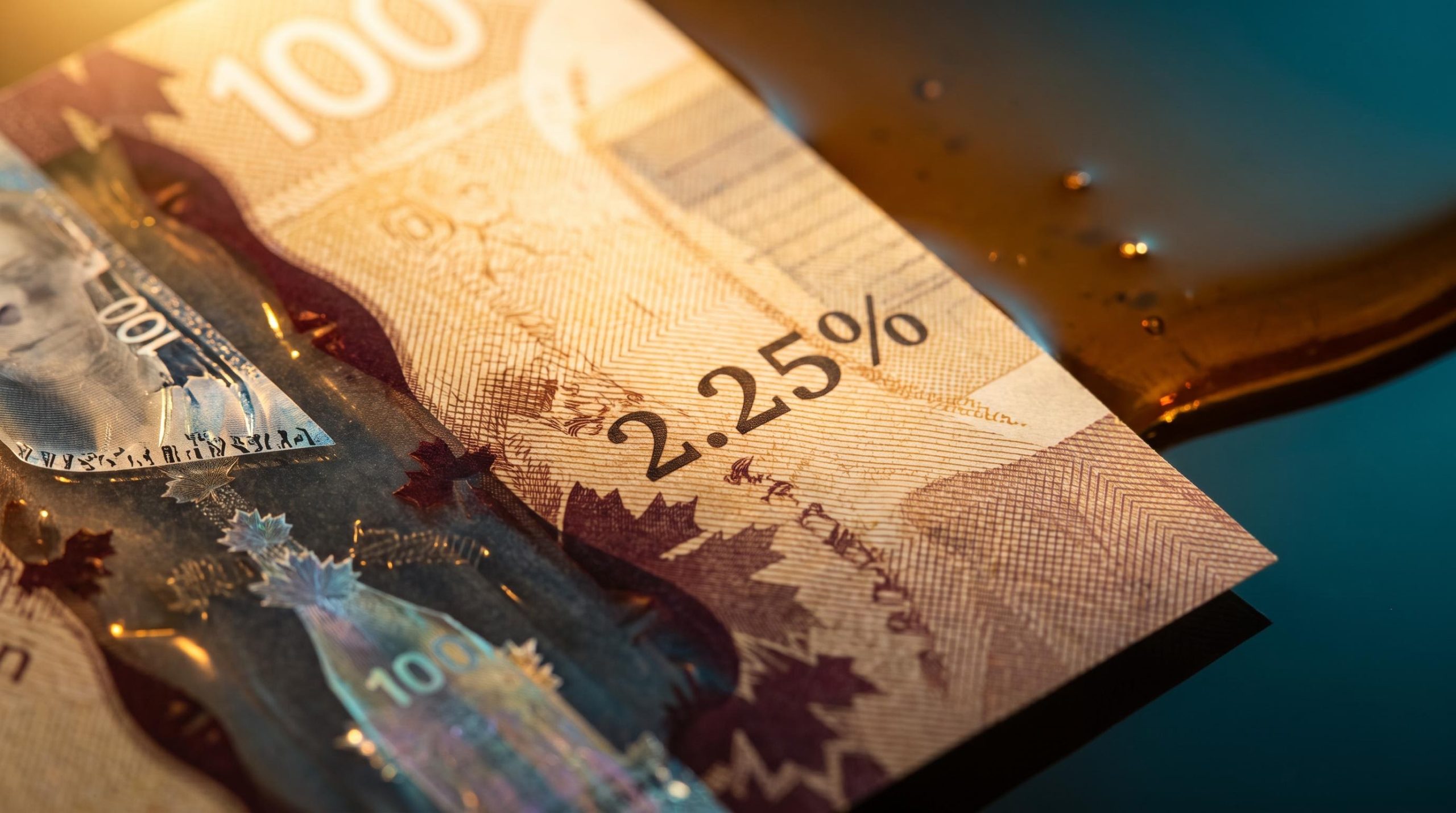
When the Bank of Canada held its policy rate at 2.25% on 2 September 2026, a casual glance at the headlines might have suggested a central bank sitting on its hands. The economy had just posted flat growth. Surely a cut was overdue.
That reading misses almost everything that actually matters.
Currency markets look chaotic on a chart, all noise and jagged lines. But the Canadian dollar does not move randomly. It responds to a distinct set of structural rules, and once you know them, the noise starts to resolve into signal.
Understanding these rules is not an academic exercise. It is what protects a portfolio from being blindsided by volatility that looked, in hindsight, entirely predictable.
Here is the framework for reading the Canadian dollar drivers that matter most: a durable, repeatable way to evaluate why the currency moves, so you can spot opportunities regardless of what the broader market is doing on any given day.
The five structural forces that determine Canadian dollar value
Before looking at any specific data point, you need the machinery. Every move in the Canadian dollar traces back to a small number of forces, and they interact constantly.
There are five primary drivers:

- Bank of Canada interest rate policy, which sets the return foreign capital earns on Canadian assets.
- Crude oil prices, since petroleum is Canada’s largest single export.
- Domestic economic data and the trade balance, which reveal the underlying health of the economy.
- Inflation trends, which shape what the central bank does next.
- The economic health of the United States, Canada’s dominant trading partner.
These are not five separate boxes to tick. They are interconnected levers, and pulling one moves the others. The read you should take is that together they decide a single question: is global capital flowing toward Canadian assets, or away from them?
Bank of Canada research on CAD demand determinants confirms that capital flows, trade balances, and relative interest rates are the foundational structural forces shaping the currency’s level, providing the academic grounding for why these drivers carry more explanatory weight than short-term price noise.
How monetary policy reshapes the currency
The central bank has two broad ways of influencing the money supply, and they push the currency in opposite directions.
Quantitative tightening, where the central bank shrinks its balance sheet and drains liquidity from the system, is historically considered supportive for the Canadian dollar. Quantitative easing, where it expands the balance sheet and adds liquidity, has tended to weigh the currency down.
The quantitative tightening mechanics that matter for the Canadian dollar run through two reinforcing channels: the portfolio-balance effect, where higher domestic yields pull investors back into Canadian assets, and the signalling channel, where a QT stance communicates that rates will stay elevated for longer.
Sitting above both is the inflation mandate. The Bank of Canada targets inflation within a 1% to 3% band, and interest rates are its primary tool for keeping it there.
Here is a point that trips up a lot of casual observers. Elevated inflation was once seen as unambiguously bad for a currency. In modern conditions, the opposite often plays out: rising inflation prompts the central bank to raise rates, higher rates attract foreign capital chasing better returns, and that capital inflow supports the currency.
The lesson is to stop reacting to single prints. One inflation number tells you little on its own. What matters is how it feeds the rate decision, and how that decision pulls capital across borders.
Unpacking the mechanics of capital flows
Higher relative interest rates are the clearest magnet for foreign money. When Canadian assets pay more than comparable assets elsewhere, global investors buy Canadian bonds and equities, and to do that they must first buy Canadian dollars.
The trade balance works more quietly but just as structurally. When Canada exports more than it imports, foreign buyers need Canadian dollars to pay for those goods, generating steady, built-in demand for the currency beneath the day-to-day noise.
When big ASX news breaks, our subscribers know first
Reading the Bank of Canada and looking past headline economic data
Theory only takes you so far. The real skill is applying it to live data, and the current Canadian picture is a near-perfect test case.
On 2 September 2026, the Bank of Canada held the overnight rate at 2.25%, with the Bank Rate at 2.50% and the deposit rate at 2.20%. The governing council did not frame this as a pause before easing. According to the Bank’s summary of deliberations, it flagged stronger upside risks to inflation, driven by higher energy costs and new US tariffs.
Now look at the growth data, and the trap becomes obvious. Canadian gross domestic product was flat at 0.0% in July, following 0.4% growth in June. On its own, a flat print looks bearish for the currency.
But the composition tells a different story. Construction expanded 1.3% in July, its strongest non-residential building month since early 2022, helped by work on a new Toronto hospital. Utilities rose 1.7% on a summer heat wave. Manufacturing, down 0.9%, was the main drag.
| Indicator | Current value | Period | Context |
|---|---|---|---|
| Overnight rate | 2.25% | 2 September 2026 | Held; upside inflation risks flagged |
| Monthly GDP | 0.0% | July | Flat, following 0.4% in June |
| Construction output | +1.3% | July | Strongest non-residential month since early 2022 |
| Manufacturing output | -0.9% | July | Primary drag on the month |
A flat headline masking strong underlying sectors is exactly why policymakers are holding rather than cutting. That is the read a strategist takes, and it is available to you too.
Reading GDP releases without overreacting to headline misses requires the same compositional approach applied here: US advance GDP estimates carry average absolute revisions of approximately 0.6 percentage points, meaning a modest consensus miss can disappear entirely before the next policy meeting.
The headline gross domestic product number tells you the speed of the economy. The composition tells you the direction. When the drag is a single sector and the strength is broad, holding rates is the logical call, not a puzzle.
The forward view sharpens the point. National Bank of Canada estimates third-quarter growth is tracking near 2.0% annualised, well above the Bank of Canada’s own 1.5% projection. If that holds, the case for near-term cuts weakens further.
The debate over delayed rate cuts
Analysts split into two camps here, and both are worth holding in your head.
The first argues that stronger growth and a smaller output gap keep rates higher for longer. If the economy is running hotter than forecast, inflation pressure lingers, and cuts get pushed out or shelved entirely.
The second counters that growth is not the real constraint. What drives the Bank’s hand is inflation dynamics, wage growth, and a fragile credit and housing backdrop. On this view, one strong quarter, especially if it is export-led while households stay soft, need not delay easing at all.
Both camps agree on one caution: early tracking estimates get revised, and reading too much into a single quarter is a reliable way to misprice the currency.
Navigating the crude oil connection and risk sentiment cycles
Here is an assumption worth discarding: that the Canadian dollar simply tracks the price of oil. It is intuitive, widely repeated, and only half true.
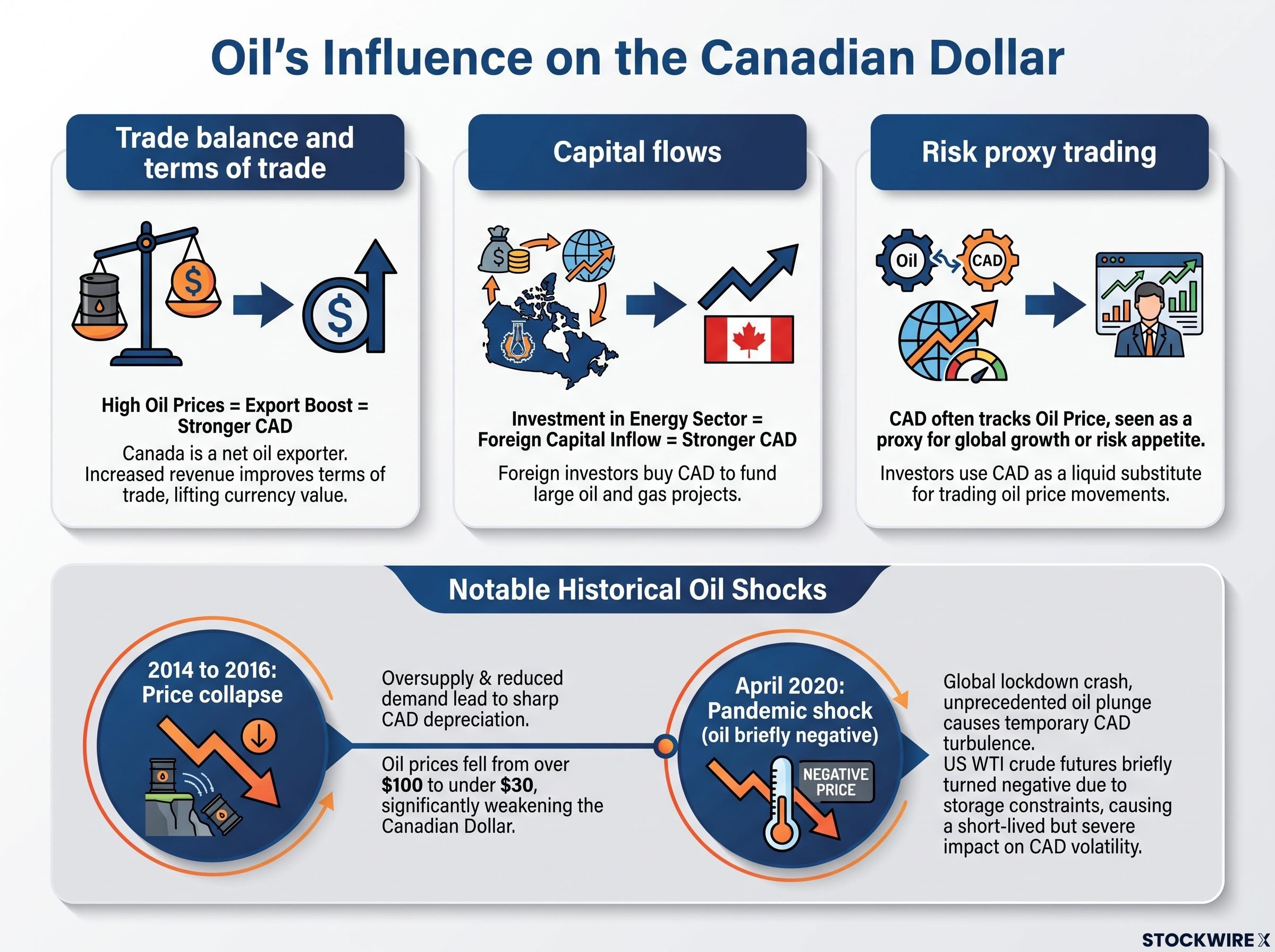
Oil does influence the currency, through three distinct channels:
- Trade balance and terms of trade. Higher oil prices lift export revenues relative to import costs, improving the trade balance and generating demand for Canadian dollars over months.
- Capital flows. Rising oil boosts energy sector profits and investment, drawing foreign money into Canadian equities and corporate debt, all of which requires buying the currency.
- Risk proxy trading. Global investors often treat the Canadian dollar as a bet on oil and global growth, moving it intraday on oil headlines long before any trade data adjusts.
The sentiment channel usually dominates the immediate reaction, while the trade channel shapes the medium-term level. Timing matters, because the two can point in different directions on the same day.
Why the commodity label is only half the story
The commodity currency label ignores how diversified Canada actually is. Energy is the largest export, but services and manufacturing are large sectors in their own right, and domestic drivers like housing, labour and productivity matter enormously.
The correlation between oil and the currency is also unstable. It tightens during major shocks and loosens when rate differentials or US policy take over. The oil price collapse of 2014 to 2016 dragged the currency down as energy revenues and investment fell. In April 2020, the pandemic shock sent oil briefly to negative territory and the currency sold off with every other cyclical asset.
Global dollar strength complicates it further. Because oil is priced in US dollars, a strong US dollar can mute the currency’s response to rising oil, or deepen its fall when oil drops.
The practical takeaway: do not buy the Canadian dollar reflexively just because oil is surging, particularly during a global risk-off event when investors are fleeing to safe havens regardless of what crude is doing.
The oil-to-CAD transmission chain weakens materially when safe-haven flows into the US dollar absorb the commodity tailwind, a dynamic Scotiabank research confirms has reduced the oil-CAD beta significantly over the past decade, even as all three transmission channels remain structurally active.
Measuring the impact of the US economy and Federal Reserve divergence
Zoom out, and one factor sits above almost everything else. Canada’s currency is bound to its far larger southern neighbour, and no assessment of Canadian fundamentals is complete without it.
The linkages run through three main channels:
- Real-economy trade. The United States is Canada’s dominant trading partner. When US demand softens, orders for Canadian exports fall, the output gap widens, and the odds of Bank of Canada easing rise, all of which pressures the currency lower.
- Interest-rate and yield spreads. The currency pair is acutely sensitive to the gap between Federal Reserve and Bank of Canada policy paths. A more hawkish Fed holding rates higher while the Bank of Canada holds or cuts widens the differential in favour of the US dollar and pulls capital south.
- Safe-haven flows. In periods of global recession fear, investors pile into US dollars and Treasuries. Even with sound Canadian fundamentals, the currency can weaken simply because the US dollar is strengthening everywhere.
Policy-error risk sits underneath all of this. If the Bank of Canada eases too slowly, it risks unnecessary economic weakness. Too quickly, and it risks reigniting inflation. Either misstep can translate directly into currency volatility.
The read to carry away is blunt: your view on Canadian strength is incomplete until you weigh it against US data. A widening gap between American and Canadian rates can override domestic strength entirely, which is why evaluating Canadian assets in a purely domestic vacuum is a mistake.
US-Canada tariff escalation affects the currency through two distinct channels: genuine trade flow disruption, which would require a fundamental reassessment of export revenues and the trade balance, and rhetorical risk-off sentiment, which has historically reversed once political cycles move on.
Applying this macro framework to your portfolio decisions
The five drivers do not act alone. Policy, oil, domestic data, inflation and US health interact continuously, and the current exchange rate is simply the market’s running verdict on all of them at once.
Right now that verdict reflects a central bank holding at 2.25% on live inflation risk, growth tracking above forecast at roughly 2.0% annualised, and a US relationship complicated by fresh tariffs. Read together, they explain why the Bank is holding rather than cutting.
The next test of your framework is close. The Bank of Canada’s next scheduled announcement is 28 October 2026. Watch not just the rate decision but the composition of the data feeding it, and the Federal Reserve’s stance alongside it.
Successful currency evaluation is continuous. It means reading domestic nuance and global risk sentiment together, not reaching for a single variable and calling it a day.
This article is for informational purposes only and should not be considered financial advice. Investors should conduct their own research and consult with financial professionals before making investment decisions. Past performance does not guarantee future results, and financial projections are subject to market conditions and various risk factors.