
UiPath’s biggest enterprise customers are spending more every quarter. Its total customer base is quietly shrinking. Both of those things are true at the same time, and how you weight that contradiction decides whether PATH at roughly $14 looks like a reasonable entry point or a value trap dressed in AI marketing language.
The tension matters right now because the story on the surface reads well. UiPath crossed into GAAP profitability, its $1 million-plus ARR customer cohort grew 21% year-over-year, and management is selling an AI orchestration narrative that lands neatly in the current enterprise spending mood. Underneath that, net new annualised recurring revenue slowed to $37 million in the most recent quarter, Q3 guidance points to flat year-over-year additions, and forward P/E estimates sit near 170x. This is neither a clean growth story nor a clean value story.
This UiPath stock analysis gives you the framework, the specific numbers, and the scenario math to decide whether the company fits your portfolio thesis. By the time you finish, you will know which two or three variables actually drive the investment case, and what each one moving in either direction would mean for your position.
What UiPath’s recent numbers actually say beneath the headline growth
Start with the number management wants you to see. As of Q2 FY2027 (ended 31 July 2026), UiPath reported ARR of $1.938 billion, up 12% year-over-year. On a near-$2 billion base, low-teens recurring revenue growth reads as steady and resilient. Revenue told a similar story at $410 million, up 13%, following $418.4 million (up 17%) in Q1 FY2027.
Then peel back a layer. The metric professional investors watch most closely is net new ARR, the dollar amount of fresh recurring revenue added in a quarter, and that figure has been sliding. UiPath added $70 million in Q4 FY2026 (though $14 million of that came from a foreign exchange tailwind, not underlying demand), then $49 million in Q1 FY2027, then just $37 million in Q2 FY2027.
That sequence is the pattern that matters, and here is why the market fixates on it rather than the cumulative ARR base.
| Period | Net New ARR | ARR Total |
|---|---|---|
| Q4 FY2026 | $70M (incl. $14M FX) | $1.853B |
| Q1 FY2027 | ~$49M | $1.901B |
| Q2 FY2027 | $37M | $1.938B |
| FY2027 guidance (31 Jan 2027) | Implied flat YoY in Q3 | $2.065B-$2.070B |
The forward guidance is where the caution sharpens.
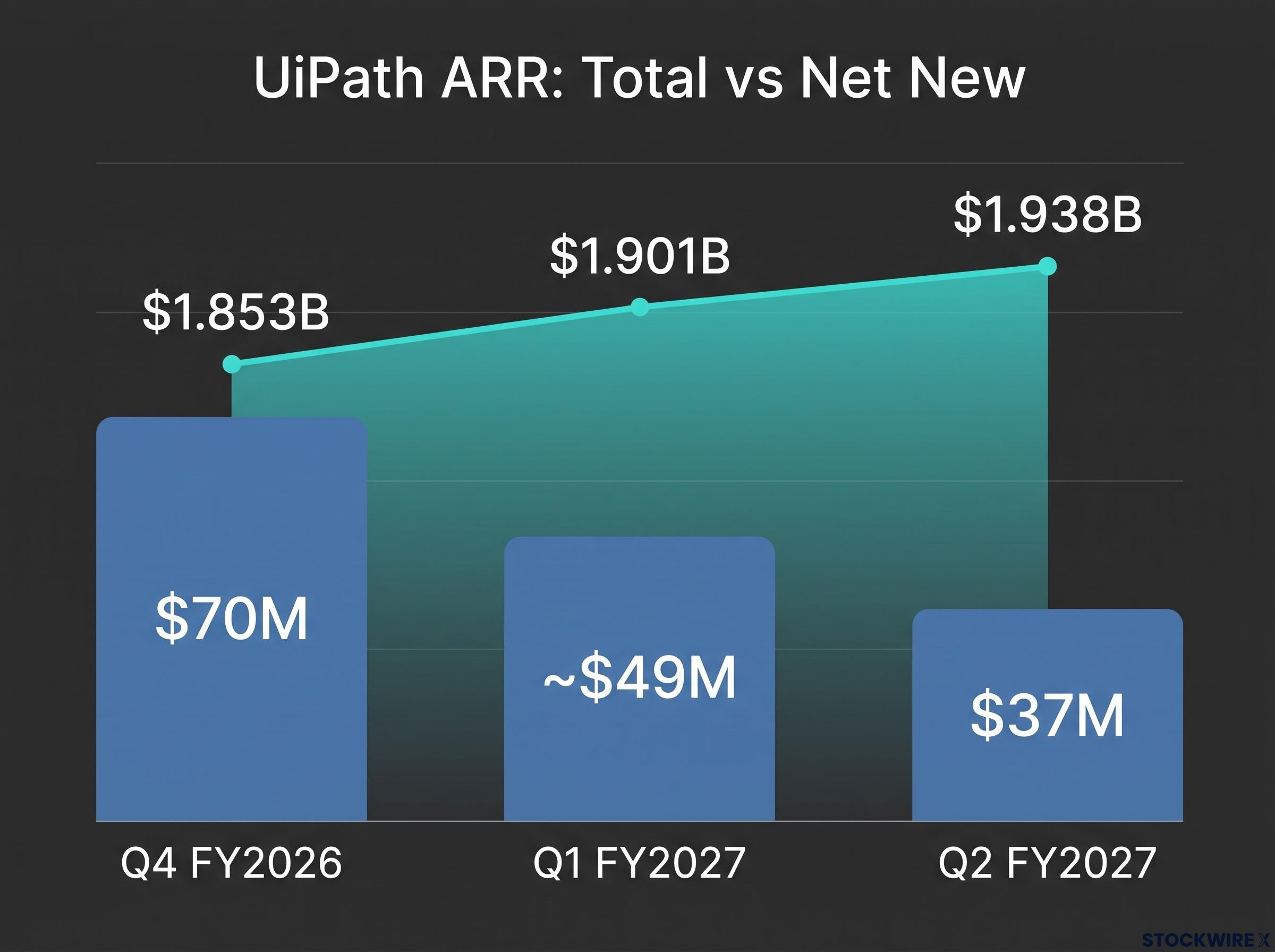
The signal the market reacted to: Management guidance implies Q3 FY2027 net new ARR could land roughly flat year-over-year, meaning the company may add no more fresh recurring revenue than it did in the same quarter a year earlier.
That is the reason the stock reacted poorly after recent earnings even though the headline metrics looked stable. UiPath also posted GAAP operating income of $32 million in Q2 FY2027, and FY2026 marked its first full fiscal year of positive GAAP operating income at roughly $57 million, both genuine milestones.
The profitability milestone UiPath crossed matters in a broader context: enterprise software gross margins of 70-80% mean that any price increase or ARR expansion flows almost entirely into free cash flow, which is why the path from GAAP operating profitability to meaningful cash generation can accelerate faster than revenue growth alone would imply.
Here is what the deceleration tells you. Net new ARR is the leading indicator of where ARR will sit in 12 to 18 months, and it is not meaningfully accelerating. If you are evaluating PATH as a growth investment, you are being asked to pay a premium multiple for a growth rate that may already be plateauing.
When big ASX news breaks, our subscribers know first
The metrics that matter most when evaluating enterprise software stocks
Before the harder questions land, you need the vocabulary to interpret them precisely. Enterprise software throws a lot of similar-sounding numbers at investors, and three metric families do almost all the diagnostic work.
Growth rate metrics: what ARR and net retention tell you
Think of ARR as the water level in a bathtub. It is the total pool of recurring revenue the business has accumulated, and at $1.938 billion it looks impressively full. Net new ARR is the rate the tap is flowing, the fresh recurring revenue added in a given quarter. The water level can keep rising even as the flow slows, which is exactly what is happening at UiPath.
The third growth metric is dollar-based net revenue retention (NRR), which measures whether existing customers are expanding or shrinking their spend over a year. A figure above 100% means expansion is outrunning churn. UiPath reported 109% in Q2 FY2027, meaning existing customers increased their annual spend by roughly 9% on average.
That is solid, but it is not top-tier. The strongest enterprise software vendors often post NRR above 120%, so 109% signals genuine stickiness rather than exceptional expansion momentum.
Customer composition metrics: volume versus quality
The second family tells you where the growth is coming from, and this is where UiPath gets interesting. Roughly 70% of ARR growth in recent quarters came from expansion within existing customers, with only 30% from new logos in Q1 FY2027.
The customer tier data splits into three signals, each moving in a different direction:
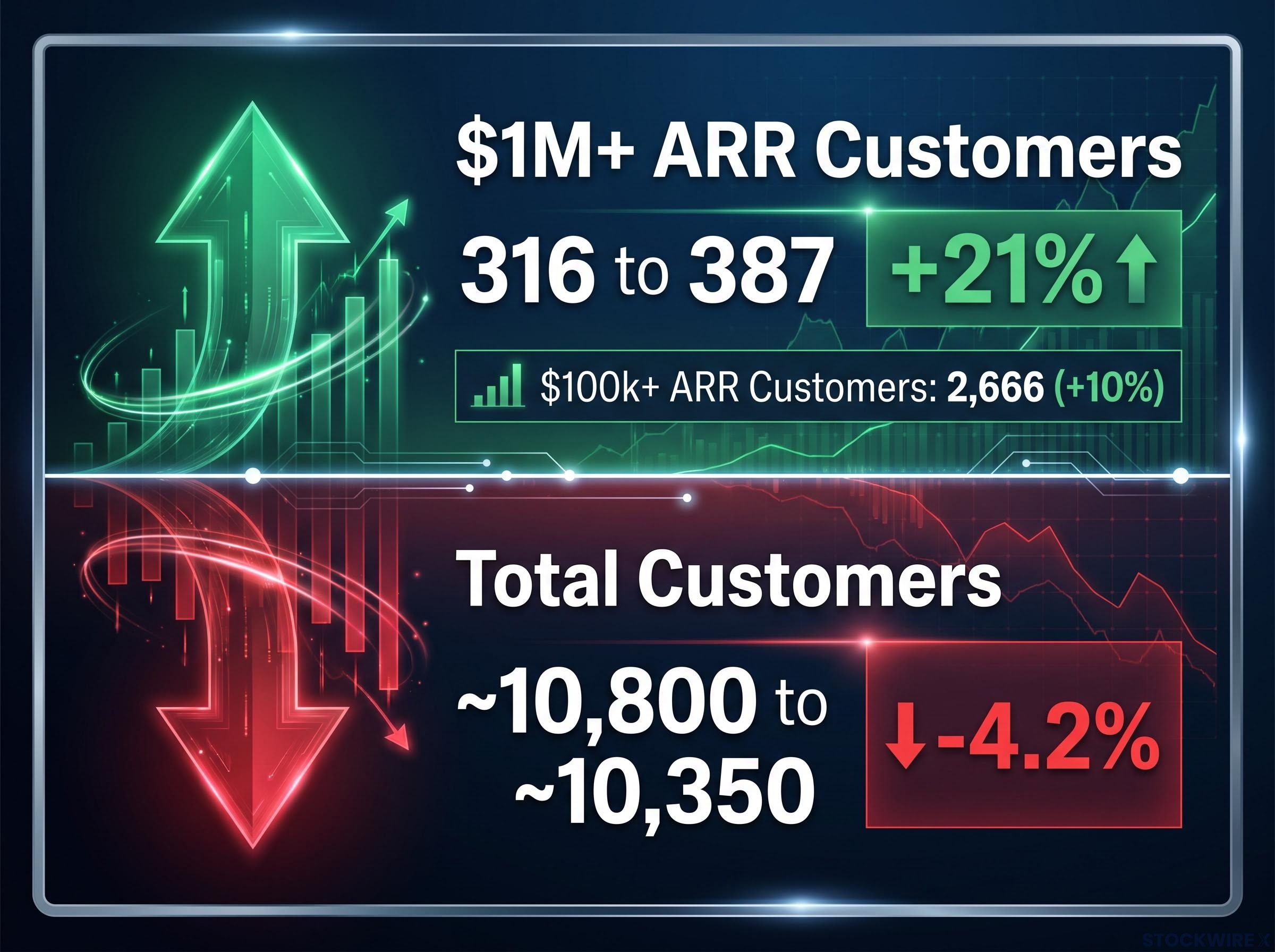
- Total customer count: approximately 10,350, down from roughly 10,800 a year earlier
- $100,000-plus ARR customers: 2,666, up 10% year-over-year
- $1 million-plus ARR customers: 387, up 21% year-over-year
The divergence between those trajectories is the data signal that powers the disruption concern in the next section.
Here is the read for you. A 109% NRR with 70% of growth coming from existing accounts tells you UiPath has real enterprise stickiness. It also tells you the company is leaning ever harder on a shrinking pool of large accounts to hold its growth rate together. Learn to ask these same three questions of any subscription software name, from Salesforce to ServiceNow, and you can size up the quality of its growth in minutes.
The customer bifurcation problem and what it signals about competitive pressure
Put the tier data side by side and the picture is stark. The $1 million-plus cohort grew from 316 to 387 customers, a 21% jump, while total customers fell from roughly 10,800 to 10,350. UiPath is getting bigger at the top and thinner at the bottom at the same time.
Management attributes the small-account losses to competitive pressure from automation tools embedded inside larger platforms. That is where a specific analytical lens becomes useful.
The build-versus-buy shift accelerating this pressure is not hypothetical: named enterprises like Publicis Sapient cut SaaS licences by roughly 50% in a single year by substituting AI tools, and the structural analysis of which SaaS business models survive that repricing separates vendors with genuine data moats from those competing on feature interfaces alone.
The Innovator’s Dilemma lens: A framework attributed to Clayton Christensen, describing how disruption typically begins at the low end of a market with a simpler, cheaper alternative, then migrates upmarket over time until it reaches the incumbent’s most valuable customers.
Apply that lens and the shrinking customer count stops looking like a rounding error. The tools drawing small accounts away sit inside software these companies already pay for, and they fall into four broad threat categories:
- Embedded Microsoft tools, principally Power Automate bundled into existing enterprise agreements
- Embedded Salesforce, SAP, and ServiceNow workflow tools that automate processes without a separate vendor
- AI-native agent platforms, with OpenAI’s computer-use model (Operator/CUA), released in January 2025, cited as an example of the pace of advancement
- General AI capability improvement that could reduce the need for a dedicated orchestration layer at all
The bull case pushes back credibly. Management reported that 18 of the top 20 deals in Q2 FY2027 included AI components, evidence that UiPath’s largest customers see the platform evolving alongside AI rather than being displaced by it. The platform is model-agnostic, meaning it works with multiple AI providers including OpenAI and Anthropic’s Claude, and its governance and audit-trail capabilities create meaningful switching friction in regulated industries such as financial services and healthcare.
The direction of the customer count trend matters more than the absolute number. If the embedded tools displacing UiPath among small accounts keep improving, the question you need to answer is how long the enterprise-tier insulation holds. The data alone cannot tell you whether this bifurcation is deliberate up-market strategy or the opening act of disruption, and that ambiguity is the crux of the long-term debate.
Running the valuation math: what return scenarios look like from here
Start with what you would pay today. PATH traded near $14 as of 8 September 2026, against a consensus analyst price target of roughly $16.50-$16.75. That implies mid-teens upside to the average target, which sounds appealing until you see what supports it.
The valuation multiples reframe the entire question. UiPath carries a forward P/E near 170x and an enterprise value multiple around 51x on an FY2026 basis, according to model-based analysis flagged by SimplyWall.st and Macroaxis. Those are the multiples of a hypergrowth company, applied to a business growing ARR at 12%.
The 170x forward P/E applied to 12% ARR growth is precisely the kind of mid-transition valuation problem where standard metrics mislead: scenario analysis that probability-weights bull, base, and bear outcomes at different entry prices converts the narrative ambiguity into a single blended expected return that can be tested against a required internal rate of return.
Coverage reflects that discomfort. Of roughly 20 analysts, the split runs approximately 3 Buy, 16 Hold, and 1 Sell, a consensus Hold with no strong directional conviction. The full bull-versus-bear picture looks like this.
| Dimension | Current Data Point | Bull Interpretation | Bear Interpretation |
|---|---|---|---|
| ARR growth | ~12% YoY | Stable, resilient demand | Too slow for a 170x multiple |
| Net new ARR | $37M in Q2 FY2027 | Sequential base still building | Decelerating; Q3 guided flat YoY |
| Total customer count | ~10,350, down from ~10,800 | Deliberate up-market focus | Innovator’s Dilemma at the low end |
| $1M+ ARR customers | 387, up 21% YoY | Deep enterprise entrenchment | Concentrated risk in fewer clients |
| AI positioning | 18 of top 20 deals AI-linked | Orchestration layer for AI agents | Could be disintermediated by platforms |
| GAAP profitability | $32M operating income (Q2) | Milestone achieved and sustained | Non-GAAP adjustments mask SBC burden |
| Valuation | ~170x forward P/E | Base-case returns still possible | Priced for growth not materialising |
Now walk the two paths. In a base case of 7-10% annual revenue growth with margins expanding gradually toward 20%, scenario analysis from Unrivaled Investing points to roughly 10-15% annual returns, a reasonable but not exceptional outcome. In the risk case, where net new ARR stays flat or declines and platform displacement accelerates, multiple compression alone creates meaningful downside from current levels, because there is almost no room to fall further on growth without the P/E collapsing.
That asymmetry is the whole point. A 170x forward P/E paired with 12% ARR growth leaves no margin for error, so any further deceleration or credible sign of enterprise-tier displacement would compress the multiple sharply. Size any position with that skew in mind, and monitor these three variables specifically:
- Net new ARR trajectory over the next two to three quarters, the clearest read on whether growth is stabilising or eroding
- The $1 million-plus ARR customer count, and whether it holds its 20-plus percent growth rate
- Evidence of enterprise-tier displacement, particularly any change in the AI-component inclusion rate in large deals
Past performance does not guarantee future results. Financial projections are subject to market conditions and various risk factors, and scenario estimates are speculative and subject to change based on market developments and company performance.
What the data tells you, and what it cannot
Hold both sides at once, because the honest read requires it. UiPath has genuine enterprise stickiness, a credible AI orchestration position, and a plausible path to continued low-teens ARR growth. It also carries a 170x forward P/E, decelerating net new ARR, a shrinking total customer base, and a competitive threat from AI platforms that is real but genuinely unquantifiable on a five-year horizon.
That combination makes PATH a Hold with a skewed risk profile: limited near-term upside to the roughly $16.50-$16.75 consensus target, meaningful downside if the growth thesis deteriorates, and a legitimate long-term disruption risk that no current data point can resolve. It suits an investor comfortable owning ambiguity, not one who needs a clean growth story. The case strengthens if net new ARR reaccelerates and the $1 million-plus cohort keeps compounding; it weakens fast on any evidence that embedded platform tools are climbing into the enterprise tier.
Watch those three variables and let them drive any buy, hold, or trim decision. Being honest about what the numbers cannot tell you is part of the analysis, not a failure of it.
Separating genuine competitive displacement from background noise is a recurring challenge across the automation sector, and the tiered evidence hierarchy applied to automation risk signals, distinguishing disclosed corporate headcount actions from susceptibility rankings and BLS projections, offers a calibration framework for investors deciding how much weight to place on UiPath’s customer count decline.
This article is for informational purposes only and should not be considered financial advice. Investors should conduct their own research and consult with financial professionals before making investment decisions.