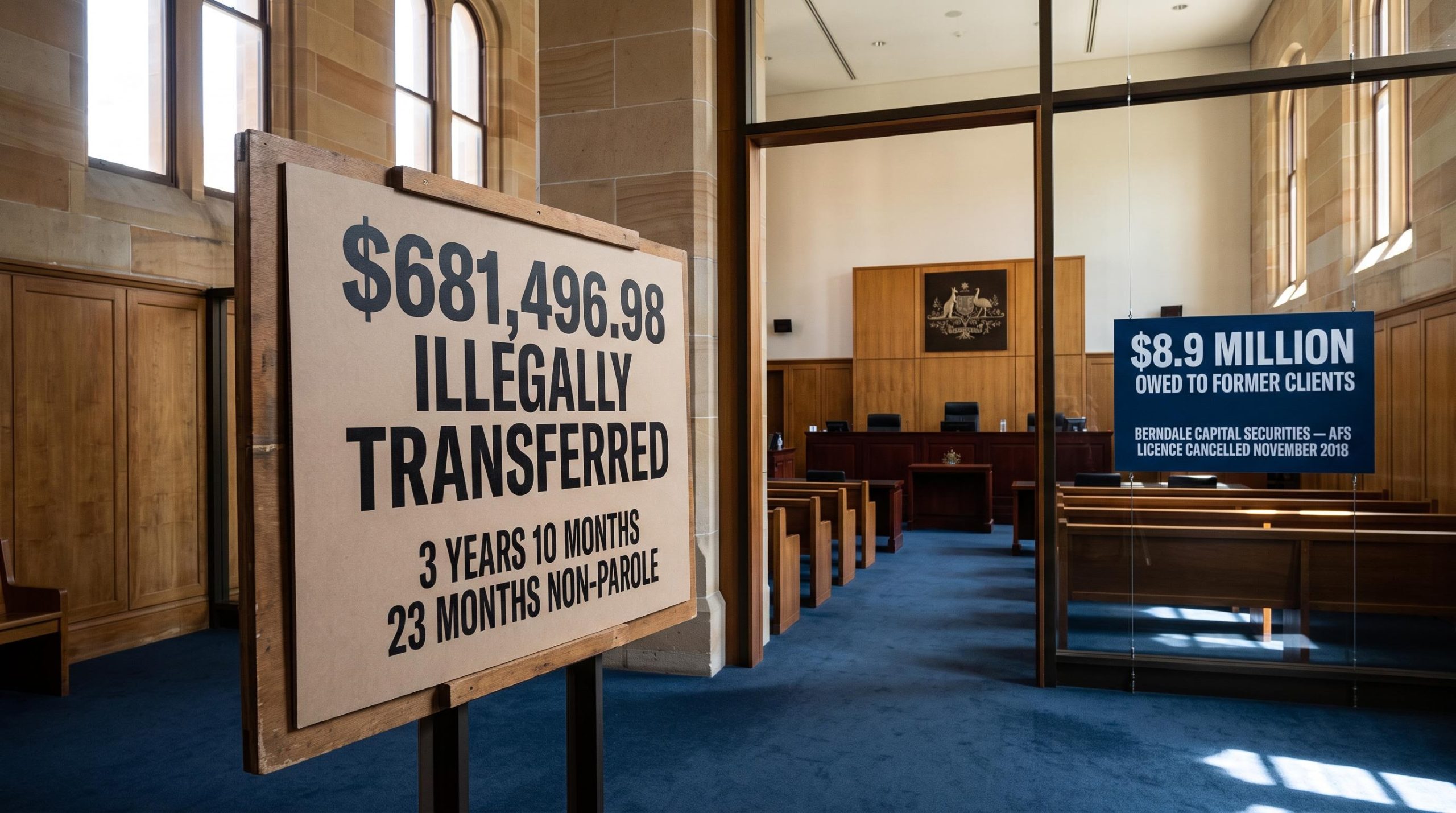
Stavro D’Amore, the former director of Berndale Capital Securities, was sentenced to 3 years and 10 months’ imprisonment on 23 July 2026 for illegally transferring $681,496.98 in retail client funds and filing false statements with the corporate regulator. He was taken into immediate custody.
The sentence followed a criminal prosecution that began with ASIC’s referral to the Commonwealth Director of Public Prosecutions (CDPP) and moved through years of proceedings. D’Amore had initially faced 16 charges before pleading guilty on 1 May 2026 to three rolled-up counts, each combining multiple underlying offences into a single charge. Berndale collapsed in December 2018, and more than $8.9 million remains owed to former clients.
The case is one of the clearest illustrations in recent years of how ASIC’s criminal referral pathway works in practice, and what it produces. Here is what the sentencing outcome tells you about director-level accountability, the consequences of misleading the regulator, and what the custodial term signals to the broader financial services industry.
Federal Court hands former Berndale director a custodial term over client fund transfers
The Federal Court of Australia sentenced D’Amore on 23 July 2026 to a total effective term of 3 years and 10 months’ imprisonment. Justice Abraham presided. D’Amore was taken into immediate custody at sentencing and will serve a non-parole period of 23 months before any release consideration.
The prosecution was conducted by the CDPP following a referral from ASIC. ASIC published its formal announcement of the outcome on 6 August 2026 (media release 26-182MR).
ASIC media release 26-182MR, published on 6 August 2026, sets out the regulator’s full account of the sentencing outcome, the charges to which D’Amore pleaded guilty, and ASIC’s role in the investigation and referral to the CDPP.
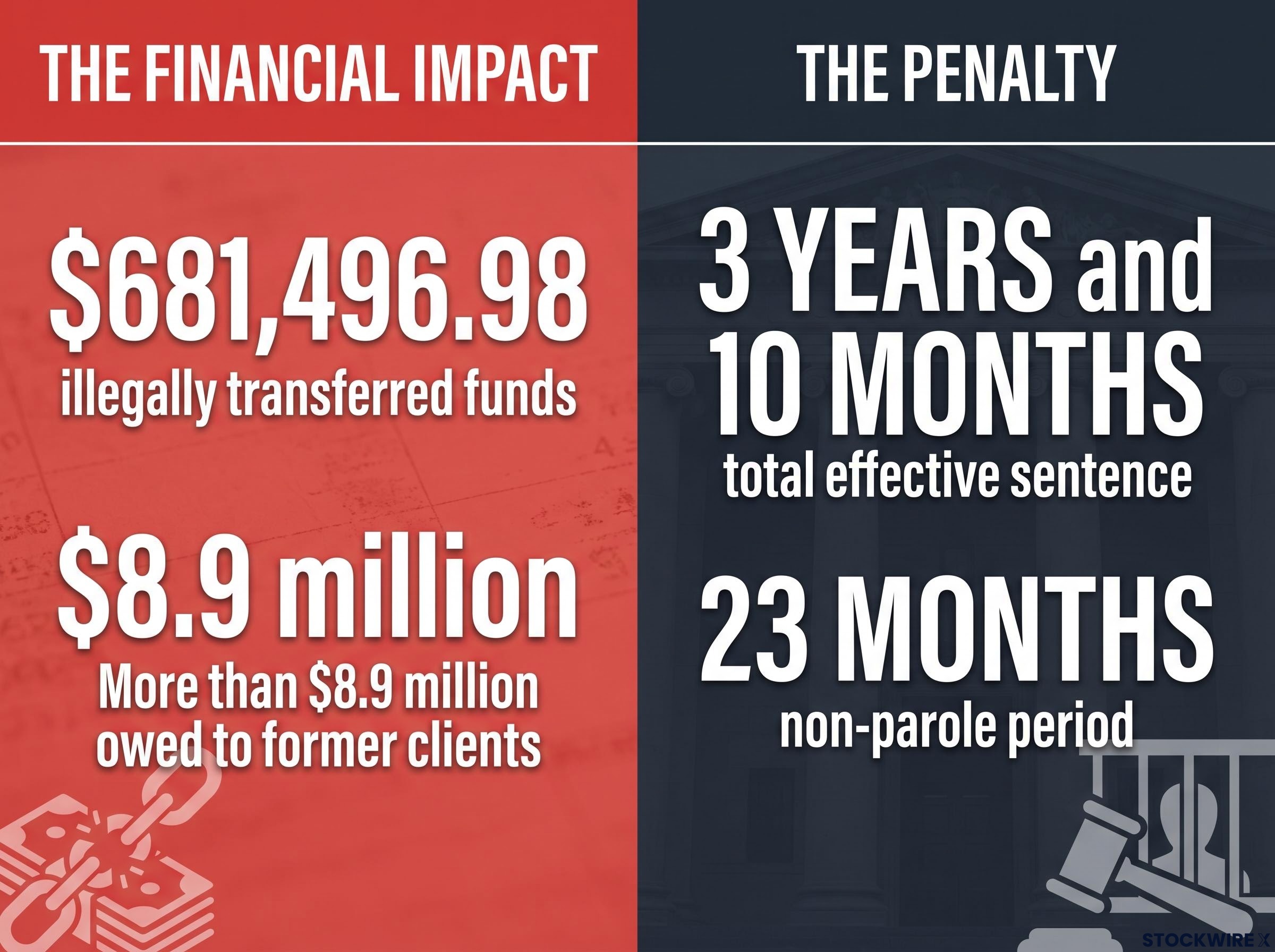
The core sentence terms:
- Total effective sentence: 3 years and 10 months
- Non-parole period: 23 months
- Custody status: Taken into immediate custody on 23 July 2026
- Presiding judge: Justice Abraham, Federal Court of Australia
- Prosecuting authority: CDPP, following ASIC referral
The immediate custodial outcome is the detail that carries weight. Courts have a range of options for white-collar offending, including suspended sentences, community corrections orders, and fines. Justice Abraham chose prison, and chose it without deferral. That tells you the court treated director-level financial misconduct against retail clients as conduct warranting real imprisonment, not a regulatory slap.
When big ASX news breaks, our subscribers know first
Three charges, three types of criminal misconduct
D’Amore pleaded guilty on 1 May 2026 to three rolled-up charges under the Corporations Act 2001. A rolled-up charge is a prosecutorial structure in which multiple individual acts of similar misconduct are combined into a single count, allowing the full pattern of conduct to be reflected without requiring a separate conviction for each act.
Each of the three charges captured a distinct category of wrongdoing:
- Dishonestly using his position as a director (s 184(2) of the Corporations Act 2001): D’Amore used his directorial role to transfer company funds for personal benefit.
- Dishonest conduct in carrying on a financial services business (ss 1041G and 1311(1)): the misconduct took place while running a licensed financial services business, with the transferred funds sourced substantially from money deposited by retail clients.
- Authorising false and misleading statements in documents lodged with ASIC (ss 1308(2) and 1311(1)): D’Amore authorised filings that fabricated or materially misstated references to overseas bank accounts, misrepresenting Berndale’s financial position to the regulator.
The total amount illegally transferred was $681,496.98, moved between 2017 and 2018.
ASIC Chair Sarah Court stated: “D’Amore seriously abused his position as director to enrich himself and he authorised false statements to ASIC to hide the true financial position of the company he had taken money from at the expense of Berndale investors. The sentence demonstrates the egregiousness of his misconduct.”
The overseas bank account fabrication is what separates this from careless mismanagement. D’Amore did not merely fail to manage client funds properly. He actively concealed where the money was, and was not, by lodging false documents with the regulator. That deliberate concealment is why ASIC’s 2018 regulatory banning was followed years later by criminal prosecution: the conduct warranted more than administrative consequences.
For anyone in a director or responsible manager role, the standalone criminalisation of false ASIC filings under ss 1308(2) and 1311(1) is the charge that matters most. The CDPP treated misleading the regulator as seriously as the fund theft itself.
What Berndale Capital Securities was, and what its collapse cost clients
Berndale Capital Securities Pty Ltd was a licensed Australian financial services firm. D’Amore served as its sole responsible manager and key person on the Australian Financial Services (AFS) licence, the individual designated as responsible for ensuring the firm met its regulatory obligations.
ASIC cancelled Berndale’s AFS licence in November 2018 and simultaneously banned D’Amore from providing financial services for six years. Within weeks, Berndale collapsed into insolvency in December 2018.
ASIC’s AFS licence banning powers operate independently of criminal prosecution, allowing the regulator to remove an individual from the financial services industry through an administrative process that requires no court order, criminal conviction, or formal legal proceeding.
The firm’s former clients are collectively short by over $8.9 million as a result of the collapse. That figure puts D’Amore’s $681,496.98 in personal transfers into a larger frame: his conduct was part of a broader failure that left retail investors with losses they have not recovered.
| Key fact | Detail |
|---|---|
| Firm | Berndale Capital Securities Pty Ltd |
| D’Amore’s role | Sole responsible manager and key person on AFS licence |
| AFS licence cancelled | November 2018 |
| Financial services ban | Six years (from November 2018) |
| Firm collapse | December 2018 |
| Total client debt outstanding | More than $8.9 million |
For retail investors and those who monitor AFS-licensed firm risks, Berndale’s trajectory from licence cancellation to insolvency within weeks illustrates how quickly a firm can collapse once regulatory action is taken, and how little recourse clients typically have after the fact.
From 16 charges to three: how this case moved through the courts
The gap between D’Amore’s offending in 2017-2018 and his custodial sentence in July 2026 spans eight years. That timeline reflects how ASIC’s criminal referral pathway works in practice: administrative action first, criminal prosecution sustained in parallel, with the court process playing out over a multi-year horizon.
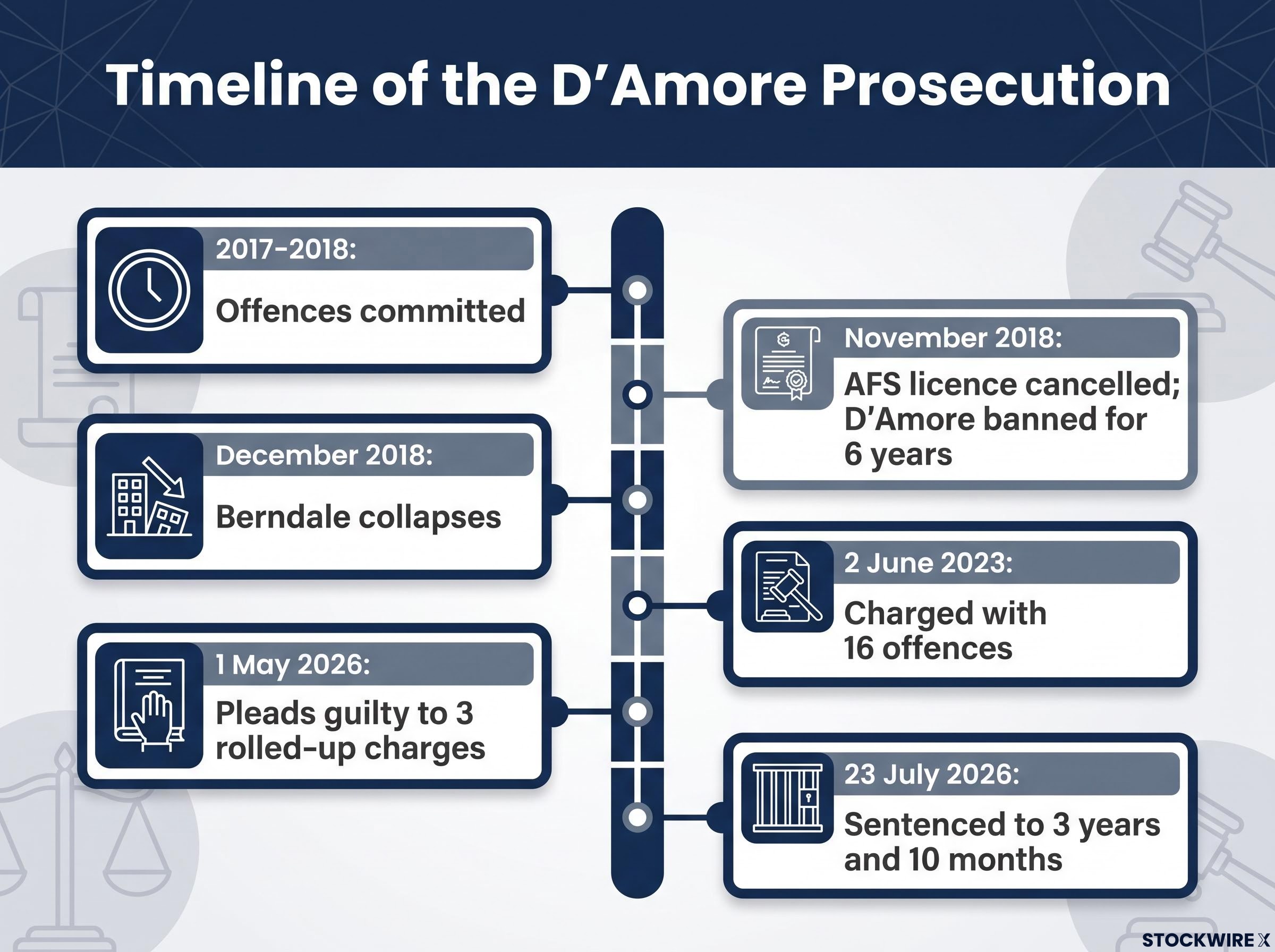
| Date | Event |
|---|---|
| 2017-2018 | Offences committed: illegal fund transfers and false ASIC filings |
| November 2018 | ASIC cancels Berndale’s AFS licence; D’Amore banned for six years |
| December 2018 | Berndale collapses into insolvency |
| 2 June 2023 | D’Amore charged with 16 offences (Sydney Morning Herald) |
| September 2024 | Committal proceedings; D’Amore pleads not guilty |
| 1 May 2026 | D’Amore pleads guilty to three rolled-up charges |
| 2 July 2026 | Matter listed for sentence hearing |
| 23 July 2026 | Federal Court sentences D’Amore; taken into immediate custody |
| 6 August 2026 | ASIC publishes media release 26-182MR announcing the sentence |
The original 16 charges filed in June 2023 were consolidated through the rolled-up charge structure into the three counts D’Amore ultimately pleaded guilty to. This approach allowed the prosecution to capture the full scope and duration of his misconduct within a streamlined set of charges, rather than requiring separate convictions for each individual act.
D’Amore initially pleaded not guilty at committal in September 2024. The guilty plea did not come until 1 May 2026, nearly three years after the charges were first laid. For compliance officers and finance professionals, this procedural timeline is a practical illustration of ASIC’s dual-track enforcement model: an initial regulatory banning in 2018 did not close the criminal file. The CDPP prosecution ran on its own timeline and produced its own, separate consequence.
What ASIC’s enforcement posture in this case signals to the industry
This case establishes three enforcement principles that extend well beyond D’Amore personally.
- Director-level accountability carries custodial consequences. D’Amore was the sole responsible manager and key person on Berndale’s AFS licence. The court sentenced him to prison, not a fine or a suspended term.
- False regulatory filings are prosecuted as standalone criminal offences. The charge under ss 1308(2) and 1311(1) confirms that misleading ASIC in formal documents is not treated as an administrative failing. It is a crime with a custodial penalty.
- Administrative penalties do not replace criminal prosecution. ASIC banned D’Amore and cancelled Berndale’s licence in 2018. It then referred the matter to the CDPP for criminal prosecution that produced a prison sentence eight years later.
The dual enforcement model ASIC operates runs corporate and individual proceedings in parallel, meaning a company penalty or licence cancellation does not extinguish personal criminal exposure for the directors whose decisions caused the underlying misconduct.
ASIC Chair Sarah Court’s public statement framed the outcome explicitly as a deterrence signal, describing D’Amore’s conduct as a serious abuse of his directorial position at the expense of Berndale’s investors.
The D’Amore outcome sits within a broader shift in ASIC enforcement posture: Australian courts ordered a record $830 million in civil penalties connected to ASIC’s work in FY2025-26, with average penalties per case rising sharply rather than case volumes increasing, signalling that courts are now pricing financial misconduct at a fundamentally higher level.
For anyone holding a director, trustee, or responsible manager role in an AFS-licensed business, the message from this case is specific: false statements to ASIC in formal filings are prosecuted criminally and carry custodial consequences, independent of any civil or administrative action the regulator has already taken.
The sentence is delivered, but the client losses remain
D’Amore is now serving a custodial sentence. The criminal process has reached its conclusion at the trial court level, and the CDPP prosecution has delivered the custodial outcome ASIC pursued.
The criminal case is resolved. The financial harm is not. Former Berndale clients are collectively owed in excess of $8.9 million, and the insolvency proceedings have not produced full recovery for the retail investors who lost money when the firm collapsed.
What this case adds to the evidence base is clear: ASIC will pursue director misconduct through criminal referral to a custodial outcome, even when administrative penalties were imposed years earlier. For investors watching the enforcement space, that sustained commitment is the signal that matters.
For investors wanting to apply practical due diligence before placing funds with any Australian financial services firm, our dedicated guide to verifying AFS licence holders covers the exact ASIC register checks, AFCA membership confirmation, and banned persons search steps that can be completed for free in under 15 minutes.
This article is for informational purposes only and should not be considered financial advice. Investors should conduct their own research and consult with financial professionals before making investment decisions.