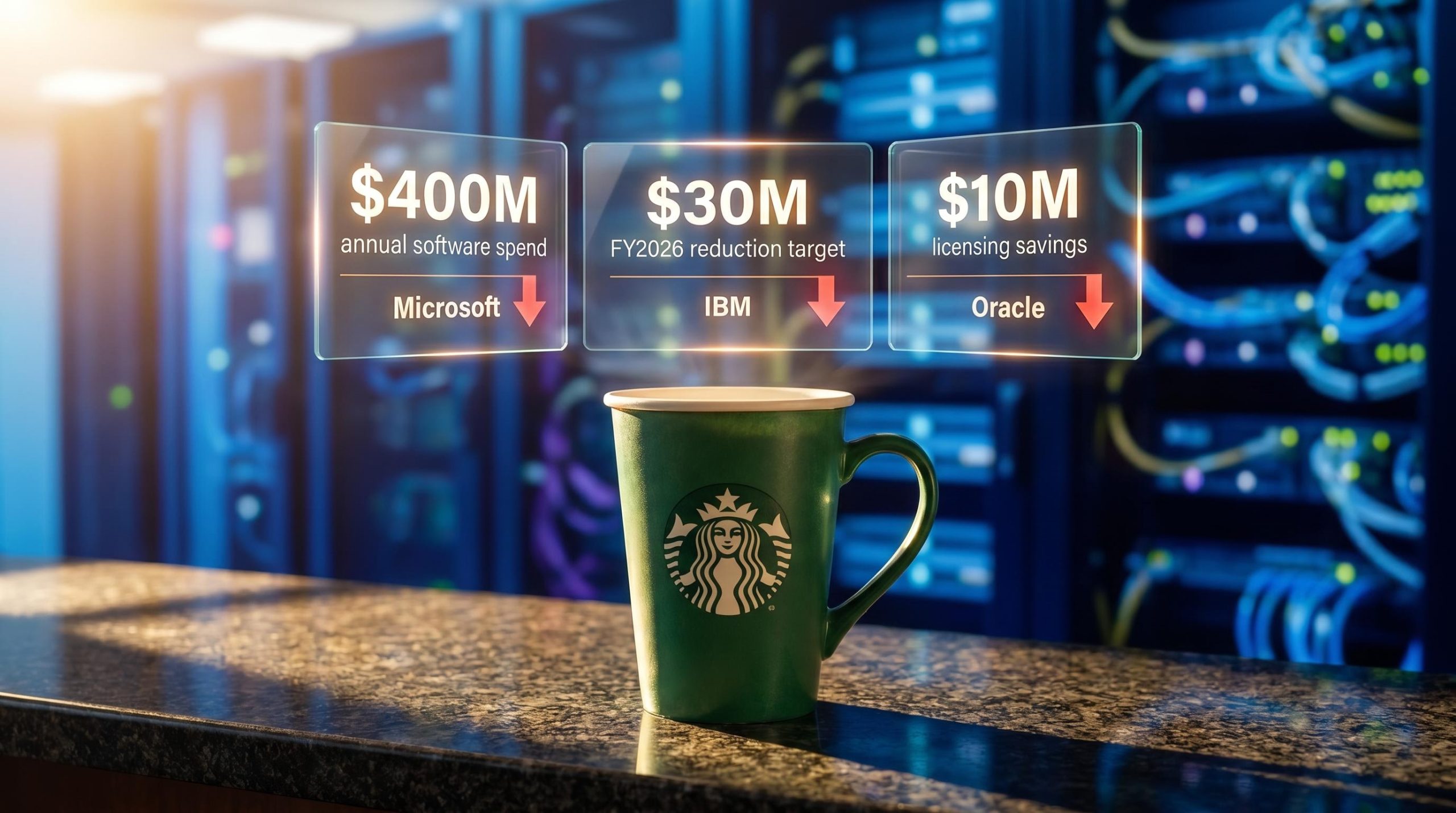
Starbucks directs roughly $400 million annually toward software procurement. Internal company materials obtained by Bloomberg show it now plans to build AI-powered tools to replace licensed systems from Microsoft, IBM, and Oracle, targeting direct savings on licensing fees as part of a broader cost-reduction push.
The initiative sits inside a $2 billion corporate cost-cutting programme, with the enterprise technology division carrying a $30 million annual reduction target for the fiscal year ending September 2026. The Bloomberg report draws on an internal presentation and a recording of an internal meeting attended by Starbucks Chief Technology Officer Anand Varadarajan, both reviewed by Bloomberg’s journalists, so this is not a press release or a pilot announcement. It is a strategic shift with named vendors and dollar figures attached.
Here is what Starbucks is building, what it costs to replace, and what those moves signal for anyone tracking enterprise software stocks or the broader shift in how large corporations decide whether to build or buy their technology.
The financial pressure driving Starbucks to build its own software
The numbers tell you why Starbucks is willing to attempt this. A $400 million annual software bill is large enough that even modest percentage reductions translate into meaningful savings, and the company’s enterprise technology division has been handed a specific target: cut $30 million from the budget by the fiscal year ending late September 2026.
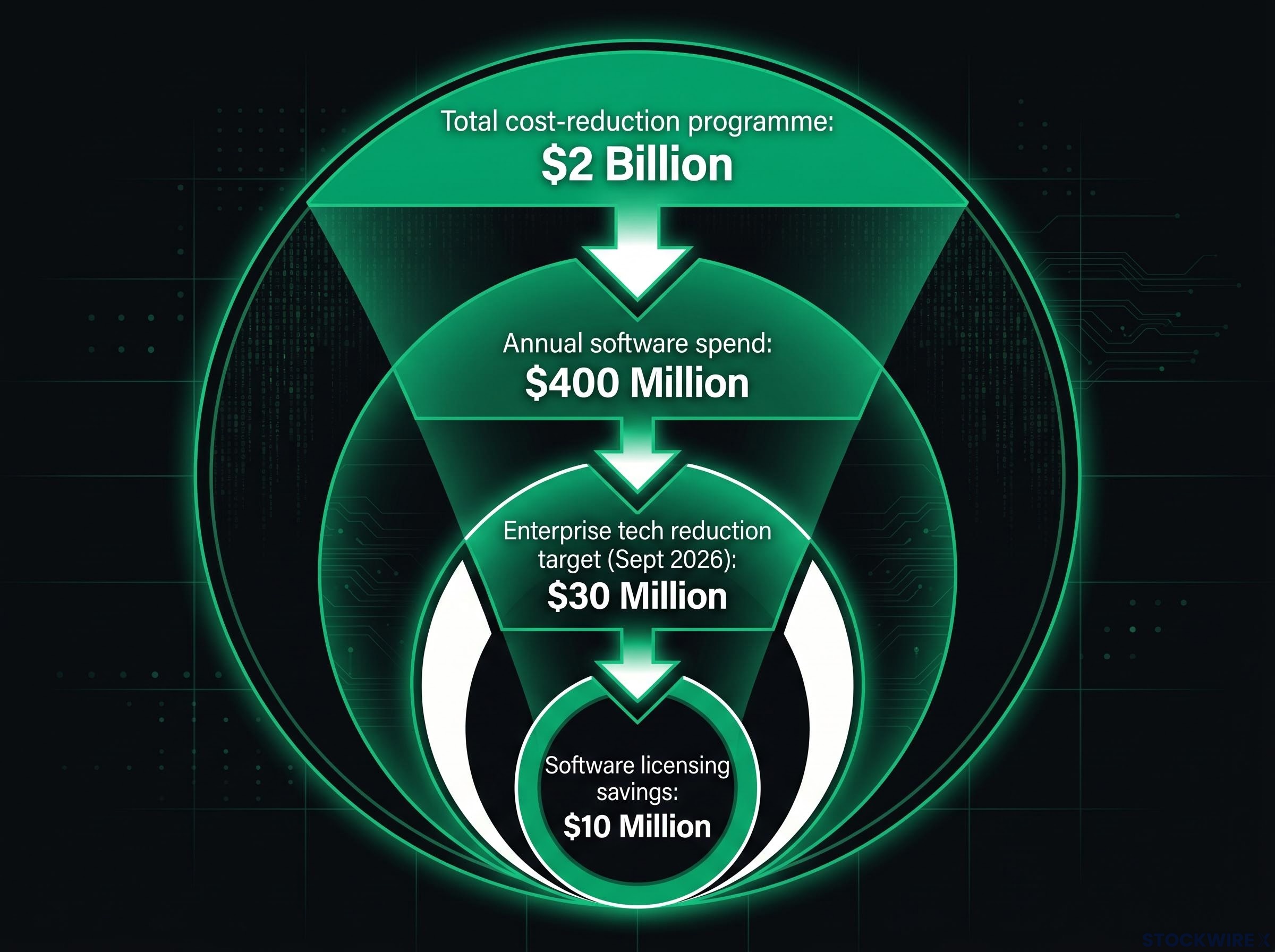
According to the internal presentation cited by Bloomberg, around $10 million of that $30 million target is directed at reductions in software licensing and vendor payments. The rest comes from broader operational efficiencies across the technology organisation.
| Financial metric | Dollar figure | Context |
|---|---|---|
| Annual software spend | $400M | Full company |
| Enterprise tech reduction target | $30M | FY 2026 |
| Software licensing savings | $10M | Direct vendor fee reduction |
| Total cost-reduction programme | $2B | Company-wide initiative |
The $10 million in direct software savings is modest against a $400 million base, which tells you this is the opening move in a longer-term vendor renegotiation strategy, not a one-year fix. The proportionality matters: the absolute number is small, but the strategic signal is not.
The technology cost reduction sits within a broader turnaround programme that spans store operations, digital engagement, and supply-chain efficiency, a multi-front restructuring that CEO Brian Niccol outlined to investors after taking the helm in late 2024.
When big ASX news breaks, our subscribers know first
What Starbucks is actually building, and who it replaces
Three in-house development projects are underway, each targeting a different vendor:
- Inventory tracking: A home-built solution designed to take over inventory-tracking functions currently handled by a Microsoft application within Starbucks operations.
- Maintenance management: An internally developed platform to supersede the IBM system currently responsible for maintenance management.
- Point-of-sale platform: A fully owned POS system intended to displace Oracle Simphony, which processes store transactions today. This development effort stretches back several years; the introduction of AI is quickening its pace rather than launching it anew.
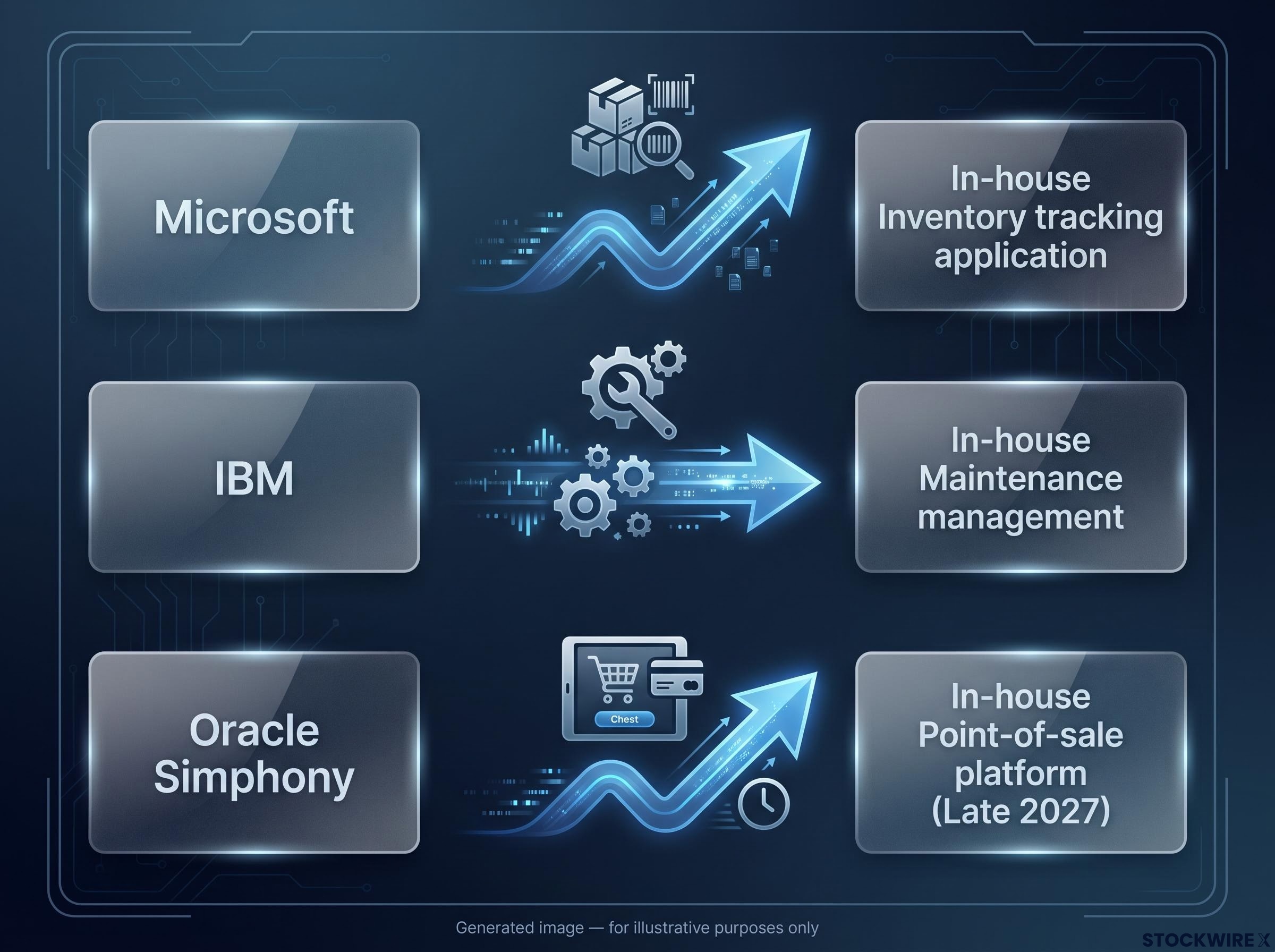
None of these tools have been deployed. Deployment depends on the outcome of testing, with company documents pointing to a possible rollout window extending to late 2027.
Bloomberg’s reporting is based on an internal Starbucks company presentation and a recording of an internal meeting with CTO Anand Varadarajan. These are not public-facing announcements.
The 2027 timeline and testing condition tell you this is a multi-year bet, not an imminent contract cancellation. That distinction matters for anyone assessing near-term vendor revenue risk.
Where Starbucks and AI have clashed before
Starbucks has recent history with AI deployment that did not go to plan. In 2025, the company rolled out an AI-powered inventory counting tool supplied by NomadGo across North America. The tool used computer vision to automate counts of milk and beverage components, replacing manual methods.
Employees reported miscounts, mislabelling, and product shortages. Nine months later, in May 2026, Starbucks scrapped the programme entirely, reverting to manual counting. The company cited a decision to “standardise inventory counting” and focus on supply-chain improvements.
- 2025: NomadGo AI counting tool rolled out across North America
- May 2026: Programme scrapped after approximately nine months of operational issues
The NomadGo tool is a separate function from the Microsoft inventory-tracking system now being replaced internally. One automated counting; the other manages broader inventory data. But the episode is directly relevant context. A nine-month failure cycle on a live operational AI tool should put you on notice that the in-house builds now planned for POS and inventory management carry real execution risk at scale.
What Starbucks keeps buying from Microsoft, and why that distinction matters
The headline framing of “Starbucks replacing Microsoft software” is accurate but incomplete. The company’s relationship with Microsoft is far deeper than the application-layer tools being displaced.
Starbucks remains heavily dependent on Microsoft Azure for core cloud infrastructure. It uses Azure OpenAI to power personalisation in the mobile app, where reinforcement learning (a type of machine learning where the system improves its recommendations based on how customers respond to them) serves tailored suggestions to millions of Rewards members. IoT equipment monitoring across stores also runs on Azure.
Then there is Green Dot Assist, a generative AI barista support tool built on Azure OpenAI. According to reports, it is targeting a broader U.S. and Canada rollout during fiscal 2026.
| Microsoft service | Status |
|---|---|
| Azure cloud infrastructure | Retained |
| Azure OpenAI services | Retained |
| Green Dot Assist (via Azure OpenAI) | Expanding |
| Inventory-tracking application | Being replaced internally |
The distinction is infrastructure versus application layer. Starbucks is using Microsoft’s own AI infrastructure to build tools that reduce spend on Microsoft’s application-layer products. The vendor relationship is competitive and cooperative at the same time. For anyone tracking Microsoft’s enterprise exposure, the financial impact of this initiative is far more limited than the headlines suggest.
For investors tracking Microsoft’s enterprise exposure, our deep-dive into Microsoft’s Azure concentration risk examines how OpenAI’s compute diversification to AWS and Google Cloud is eroding the exclusivity assumption that underpinned Azure’s competitive advantage.
What this means for enterprise software vendors and the build-versus-buy calculus
The category of enterprise software most exposed to AI-assisted in-house replacement is mid-tier operational tooling: inventory tracking, maintenance management, point-of-sale systems. These are applications with well-defined requirements and relatively contained scope. They sit in a different risk band from the software categories that remain difficult to replicate internally.
Software that is harder to replace:
- Core ERP systems with deep organisational integration
- Security infrastructure and identity management
- Large-scale database and cloud platform layers
- Compliance and regulatory reporting systems
Software more vulnerable to in-house replacement:
- Operational tracking and monitoring applications
- Maintenance and asset management tools
- POS and transaction-processing platforms with defined feature sets
Microsoft, IBM, and Oracle are all investing heavily in AI-enhanced versions of their own platforms, which means they have both the incentive and the capability to sharpen pricing or bundle additional AI features in response to credible in-house competition.
The investor implications extend beyond individual vendor relationships: the 2026 software stocks selloff created a record 133-percentage-point spread between the top and bottom deciles of US technology stocks, as markets began making sharp distinctions between companies embedding AI into their platforms and those facing structural pricing pressure.
The most immediate financial benefit for Starbucks may not come from deploying these tools at all. The credible threat of internal replacement can improve contract terms before a single tool goes live, which changes how you should interpret the $10 million savings target.
What a successful POS replacement would actually prove
Of the three in-house builds, the Oracle Simphony replacement is the one that matters most. A POS system runs in every store, handles real-time transactions at scale, and has a visible failure mode: if it breaks during a morning rush, the financial and reputational cost is immediate.
The POS development programme predates the current AI push by a number of years. AI is now being used to accelerate what was already an internal development effort. According to Bloomberg’s source materials, completion could come by the close of 2027, though that depends on how testing proceeds.
Oracle’s AI backlog has reached a record $638 billion, anchored by a $300 billion OpenAI contract, which means the company enters any enterprise renegotiation carrying significant capital commitments that may shape how aggressively it responds to customers threatening in-house displacement of products like Oracle Simphony.
Rollout of the in-house POS platform remains conditional on successful testing. This is not a confirmed deployment timeline.
If Starbucks successfully deploys a fully in-house POS system across thousands of stores worldwide, it becomes one of the most visible proof points in enterprise technology that AI has genuinely shifted the economics of build versus buy. That is the story worth watching.
Three variables that will determine whether Starbucks’ bet pays off
- Testing survival. Every in-house tool must pass testing before deployment. The NomadGo failure showed what happens when an AI system reaches live operations before it is ready. Whether these tools survive contact with real store conditions, without a repeat of miscounts and operational disruption, is the first gate.
- POS deployment at scale. If the Oracle Simphony replacement actually reaches thousands of stores by around 2027 and functions reliably, it becomes a replicable proof point for the entire build-versus-buy thesis. If it stalls in testing, the thesis weakens considerably.
- The Microsoft renegotiation. How Starbucks handles its Microsoft relationship will tell you more about the real financial logic of this initiative than the headline savings figures. Using Azure OpenAI to build tools that displace Azure applications creates a negotiation dynamic that will reveal whether vendor leverage is the primary goal or whether genuine platform replacement is.
This article is for informational purposes only and should not be considered financial advice. Investors should conduct their own research and consult with financial professionals before making investment decisions.