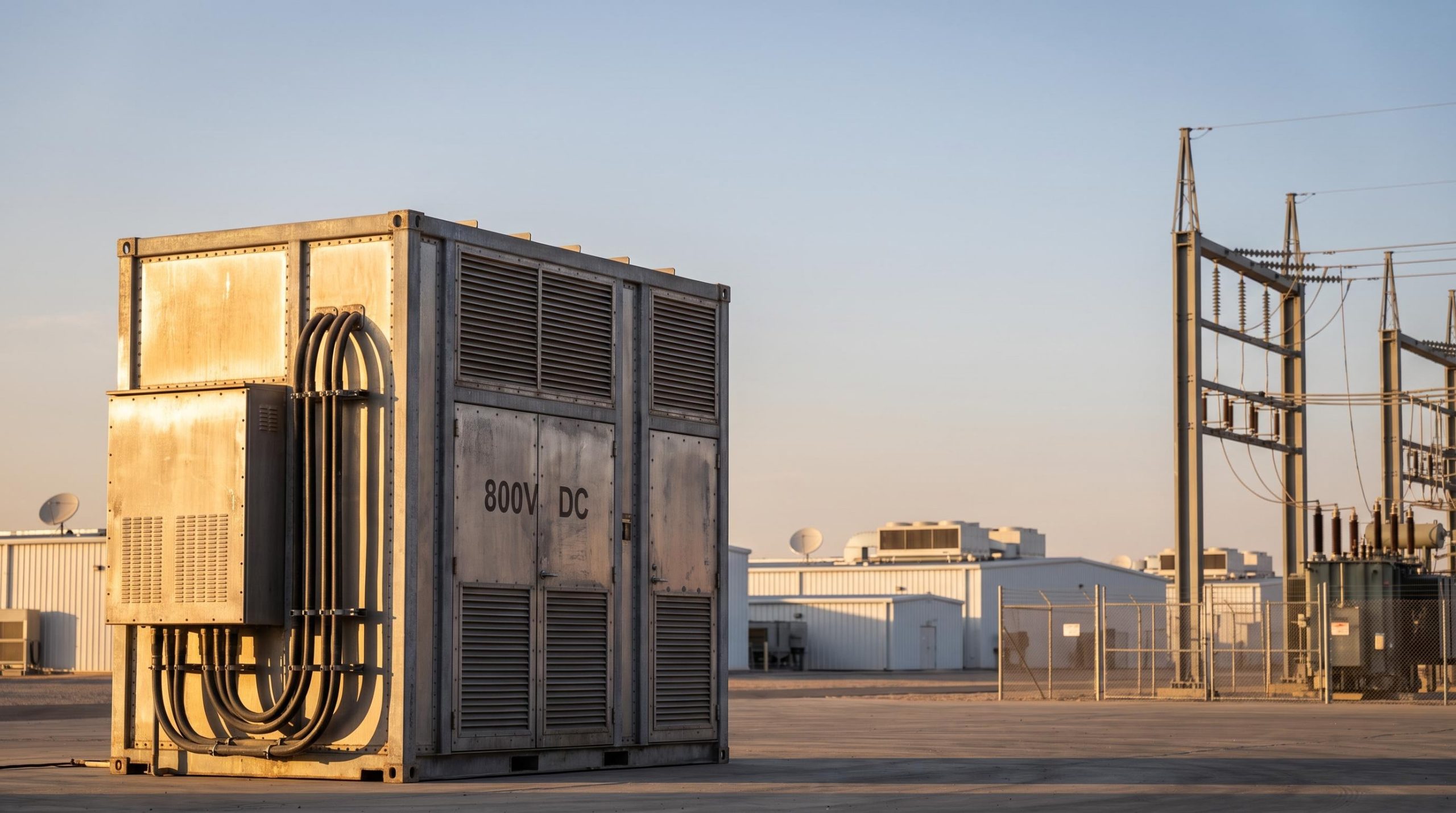
The power constraint holding back AI data centres is not a server problem. It is not a cooling problem. It is not even a real estate problem. It is a grid engineering problem, and the companies best positioned to solve it may not be the ones most investors are tracking.
On 26 August 2026, SMA Solar Technology AG unveiled a dedicated power infrastructure portfolio built specifically for AI and hyperscale data centre applications. That alone would be worth noting. What makes it worth examining closely is the foundation underneath: SMA has spent 45 years developing utility-scale energy systems, and its technology has been deployed across gigawatts of capacity worldwide. This is not a startup pivoting into data centres. It is a grid-engineering firm applying proven infrastructure to a new customer segment.
Here is what that means for you. This analysis breaks down where SMA’s three architectures sit in the infrastructure value chain, why the grid-integration bottleneck is structural rather than temporary, and what the 800V DC transition signals about the next capex cycle. If your AI infrastructure exposure stops at semiconductors and cloud platforms, the gap in your coverage may be sitting in the power-electronics layer.
Why AI data centres have a grid problem, not just a power problem
AI workloads are driving power densities higher inside hyperscale facilities and accelerating total energy consumption per site. That much is widely understood. What is less widely appreciated is where the actual bottleneck sits.
It is not inside the facility. It is at the point where the facility connects to the grid.
The binding constraint for new data centre capacity is increasingly the grid interface itself. Several specific factors are compounding the problem:
The IEA projects data centre and AI electricity consumption will exceed 1,000 TWh by 2026, a scale that reframes the structural grid crisis from a near-term capacity concern into a decade-long infrastructure investment thesis spanning utilities, grid equipment manufacturers, and power electronics specialists.
Data on grid interconnection queue backlogs indicates the U.S. queue has swelled to approximately 2,600 GW, with median wait times for commercial operation approaching five years and data centres in some markets facing delays of up to 12 years, making queue position the dominant variable in new capacity planning.
- Interconnection queues: In multiple regions, the queue to connect a large new load to the grid stretches years, not months. Queue position now determines project timelines more directly than construction schedules.
- Grid code compliance: Regulators are tightening the stability and power-quality requirements that large loads must meet before connection is approved.
- Dynamic load variability: AI workloads create fast-changing, spiky demand profiles that stress grid infrastructure in ways traditional data centre loads did not.
- Stability requirements: Grid operators are requiring new large loads to demonstrate they will not destabilise the wider network, adding engineering complexity at the point of connection.
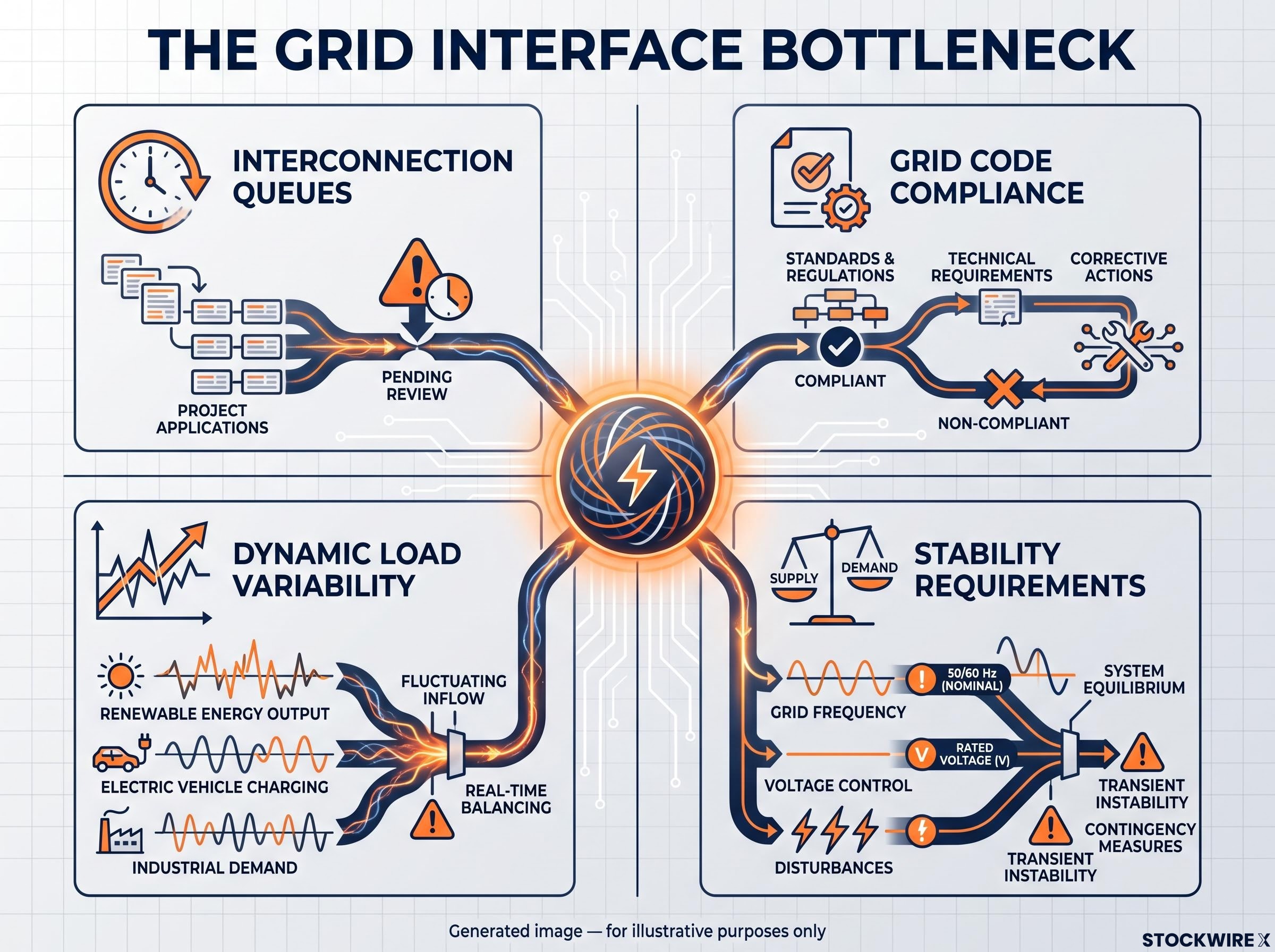
This reframes the data centre power challenge. It is not an IT problem or a facilities engineering problem. It is a power-electronics and grid-engineering problem. The companies that can compress interconnection timelines and manage grid compliance at medium voltage are solving the constraint that actually determines whether a facility comes online in two years or seven.
For a capital allocator or data centre developer, the implication is direct: the most strategically valuable infrastructure partners in the AI build-out may not be colocation vendors or server OEMs. They may be grid-technology firms with medium-voltage power-electronics expertise that sit outside your current coverage universe entirely.
When big ASX news breaks, our subscribers know first
What SMA’s three-architecture portfolio actually offers
SMA’s data centre portfolio is structured as three distinct architectures, each designed for a different grid scenario. Read them in sequence and the logic becomes clear: this is a progression from today’s grid-connected mainstream to tomorrow’s native DC buildout.
GridAssist is the entry point. It is a battery-centred architecture for facilities that can secure a grid connection but need help managing what happens after they connect. As rack densities and AI utilisation rise, demand profiles become increasingly variable. GridAssist handles the job of evening out demand spikes, stabilising power quality, and keeping the facility within grid code requirements as workloads fluctuate.
GridLink AC solves a harder problem. In jurisdictions where interconnection requirements for large loads have tightened and queue times have stretched to years, GridLink AC deploys a medium-voltage uninterruptible power supply (UPS) architecture that places a controlled, managed interface between the data centre and the grid. Instead of presenting raw, spiky AI demand to the network, it presents a controlled, stable interface. That turns what would otherwise be a multi-year regulatory and network upgrade process into a power-electronics problem that can be resolved at the point of connection.
GridLink DC is the forward-looking play. Targeting a 2027 project deployment, this is a native 800V DC system built end-to-end for next-generation AI infrastructure, running from the grid connection through to the compute layer. By eliminating conversion stages between the grid and the server, it targets efficiency gains that compound in significance as rack power densities increase. The architecture aligns with emerging 800V DC server, accelerator, and cooling designs.
| Architecture | Grid scenario it addresses | Key technical mechanism | Deployment readiness |
|---|---|---|---|
| GridAssist | Grid-connected, rising AI load variability | Battery-based load smoothing, power quality stabilisation, grid code compliance | Available now |
| GridLink AC | Constrained interconnection, lengthy queue times | Medium-voltage UPS with grid decoupling | Available now |
| GridLink DC | Next-generation DC-optimised AI facilities | Native 800V DC, reduced conversion stages, grid-to-compute efficiency | 2027 project deployment |
SMA describes its approach as working alongside customers to determine which architecture fits each project best, whether that means an AC solution today, a DC solution in future, or a combination that shifts as the facility evolves.
The three-tier structure tells you something about strategy. SMA is not betting on a single architecture winning the data centre power market. It is positioning to capture revenue at each stage of the industry’s transition from today’s AC-dominant builds to a DC-optimised future.
Why SMA’s 45-year utility-scale foundation matters for hyperscale customers
Product descriptions are one thing. The credibility question is another: why would a hyperscale operator trust a solar inverter company with mission-critical data centre power?
The answer sits in platform reuse. Rather than building from scratch for a new market, SMA’s data centre portfolio draws on the same underlying technology platform that the company has already deployed at gigawatt scale across its utility business. The core technical capabilities that underpin the portfolio are well established:
- Grid-forming inverters: active stabilisation of grid conditions at the point of connection, not just passive compliance with existing grid behaviour
- Battery storage integration: coordinated management of large-scale charge and discharge cycles across highly variable load profiles
- Medium-voltage power stations: infrastructure engineered to operate at the voltage level where data centres actually interface with the grid
- Cybersecurity: hardened protection frameworks designed for critical power infrastructure environments
- Power plant controls: orchestrated management of complex, multi-component electrical systems operating at scale
These are not generic UPS or backup generator capabilities. Grid-forming inverters and medium-voltage power stations are the specific differentiators that separate SMA’s offering from conventional data centre power solutions.
From solar parks to server halls: translating utility credentials
What matters to hyperscale procurement teams right now is time. Delivering projects to schedule, hitting peak performance from initial commissioning, and maintaining consistent uptime over the long term are the outcomes they prioritise above all else, particularly when grid connection delays are already a primary project risk.
Jay Arghestani, who leads Sales, Technology and Marketing for Large Scale Solutions at SMA America as Managing Director, serves as the named commercial spokesperson for the portfolio, reinforcing SMA’s commitment to bringing its full utility-scale engineering capability to the data centre segment.
For an investor evaluating this opportunity, the platform reuse argument is the key risk-reduction signal. SMA is not launching a new technology venture. It is redirecting established grid-engineering capability toward a new class of customer. That compresses both technology risk and time-to-revenue compared to a ground-up development effort.
The 800V DC transition and what it means for AI infrastructure capex
Today’s AI data centres are overwhelmingly AC-centric. Power arrives from the grid as alternating current, gets converted multiple times through transformers and UPS systems, and eventually reaches the server as direct current. Each conversion stage adds losses, generates heat, and requires hardware.
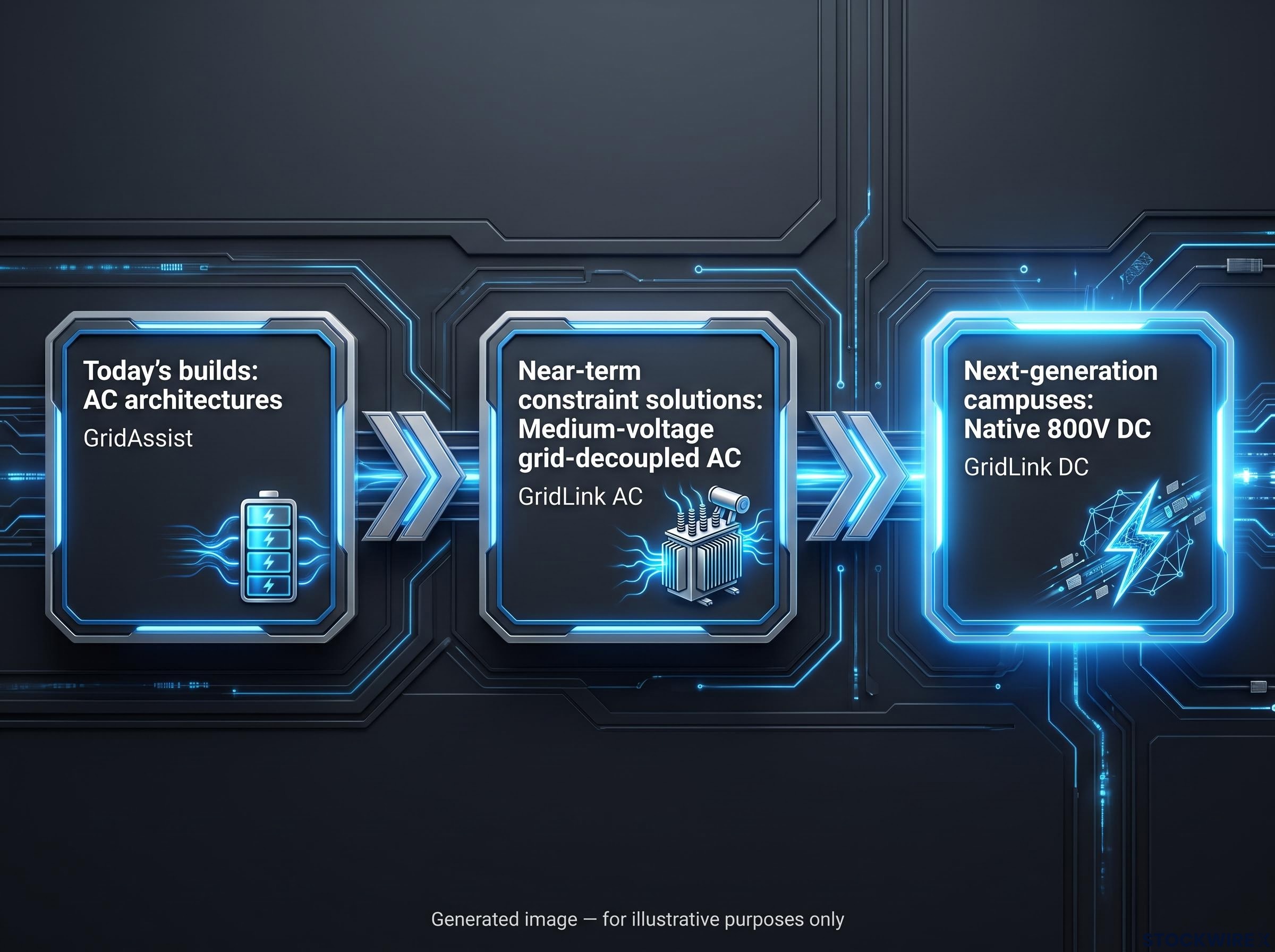
The industry trajectory points toward eliminating those stages. SMA’s GridLink DC, with its 2027 project deployment target, aligns with a broader shift toward DC-optimised AI facilities and liquid-cooled, high-density racks. That creates a distinct infrastructure cycle:
- Today’s builds: predominantly AC architectures with battery augmentation to manage load variability and grid compliance (GridAssist)
- Near-term constraint solutions: medium-voltage grid-decoupled AC architectures that compress interconnection timelines (GridLink AC)
- Next-generation campuses: native 800V DC greenfield and deep-retrofit facilities that run end-to-end DC from grid to compute (GridLink DC)
Each stage maps directly to an SMA architecture. The efficiency logic behind the DC transition is straightforward: fewer conversion stages mean reduced electrical losses, lower heat loads, and less hardware complexity. At scale, those savings compound. As rack power densities continue to climb, the efficiency differential between multi-stage AC distribution and native DC delivery widens.
Power semiconductor value per rack is estimated to double from $50,000 to $100,000 as facilities approach 1 MW rack configurations, a content expansion dynamic that makes the 800V architecture transition one of the most consequential capex inflection points across the broader AI supply chain.
SMA expects its data centre business to contribute revenue in the mid- to high-double-digit million euro range in fiscal year 2027, with further growth thereafter. This is guidance-level and should be treated accordingly.
For a capital allocator, the 2027 DC deployment timeline and that revenue guidance together mark the point where SMA’s data centre business line transitions from a strategic option to a measurable revenue contributor. SMA trades in Frankfurt under ticker S92 and has historically been valued as a solar inverter and energy-management company. The data centre expansion adds a distinct strategic vector to that equity story. If you are sizing positions or adjusting coverage depth, the 2027 fiscal year is when the data starts arriving.
What SMA’s market entry signals for investors beyond the company itself
Step back from SMA specifically and a broader pattern comes into focus. The companies entering the AI infrastructure value chain with the most differentiated capabilities are not always the ones technology-focused investors would expect.
Many of the most leveraged infrastructure plays in AI are emerging from firms historically classified as renewable or grid-technology companies, not from traditional IT, networking, or colocation vendors. SMA’s move confirms that “AI infrastructure” now extends deeply into a layer of the stack that many technology investors have limited coverage on:
- Grid-technology companies with medium-voltage interconnection expertise
- Medium-voltage equipment manufacturers producing the transformers and switchgear at the grid interface
- Battery and storage integrators managing dynamic loads at scale
- Power electronics specialists delivering conversion and grid-forming capability
Around Intersolar 2026, SMA explicitly highlighted “solutions for AI data centres and highly dynamic loads with strong demand for reliability and grid stability.” That framing is not incidental. It reflects a market structure in which grid integration has become a competitive differentiator, not a commodity input.
SMA’s portfolio will not on its own resolve the global AI power bottleneck. But its launch confirms that industrial-grade grid engineering is becoming one of the most consequential levers in the AI infrastructure buildout.
If your AI infrastructure exposure is concentrated in semiconductors, cloud platforms, or colocation REITs, this announcement should prompt a concrete question: how much of the value being created in the AI build-out is accumulating in the grid-engineering and power-electronics layer you are not currently tracking?
Hyperscaler AI capital expenditure is projected to consume approximately 94% of operating cash flow in 2026, a compression that concentrates risk in semiconductor and cloud-platform positions and makes infrastructure adjacencies, including the grid-engineering layer, increasingly attractive to investors reading the AI capital cycle for durable cash-flow exposure.
Where grid engineering fits in the AI infrastructure investment thesis
Grid-side engineering is no longer peripheral to the AI infrastructure thesis. It is structurally central. The interconnection bottleneck is durable, the technical complexity at the point of grid connection is increasing, and the companies that can compress timelines and manage compliance at medium voltage are solving the constraint that determines whether new capacity actually comes online.
Three variables merit tracking from here. First, SMA’s FY2027 data centre revenue contribution, which will be the first hard data on whether the commercial traction matches the product ambition. Second, the pace of 800V DC adoption in announced greenfield projects, which will signal how quickly the next capex cycle takes shape. Third, how interconnection timelines evolve in key markets, as any compression or further lengthening directly affects the addressable market for grid-decoupling solutions.
The companies defining the next layer of AI infrastructure are being announced now, in grid-technology and power-electronics categories that sit outside most technology investors’ coverage. The window to build that coverage, or that position, is the present.
For investors wanting to map the full physical constraint landscape before sizing positions in grid-technology names, our full explainer on AI infrastructure physical bottlenecks covers battery storage investment trajectories, energy availability as a structural limit, and the ASX-listed companies positioned across the AI build-out.
This article is for informational purposes only and should not be considered financial advice. Investors should conduct their own research and consult with financial professionals before making investment decisions. Forward-looking statements regarding SMA’s revenue guidance and product deployment timelines are subject to change based on market developments and company performance.