The Reserve Bank of India has disclosed that it mobilised USD 136 billion through a single dollar-deposit programme, and that inflow helped lift India’s foreign exchange reserves to a record USD 740.803 billion. That figure now lands on the eve of the most closely watched US inflation print of the year.
The rupee is trading near 95 per dollar, and the RBI has been holding that level through simultaneous operations in the domestic spot market and the offshore non-deliverable forward market. The special deposit mobilisation is not a passive reserve build. It is the scaffolding of an active intervention strategy.
Here is precisely what the RBI has built, how it works in practice, and what the next 48 hours could do to test it. The 11 September 2026 US Consumer Price Index (CPI) release is the immediate trigger, and this piece maps the mechanism and the risk before Friday’s open.
How the RBI assembled a USD 740 billion shield
The record reserve figure did not arrive by accident. India’s foreign exchange reserves reached USD 740.803 billion in the week ended 28 August 2026, reported by the RBI on 4 September 2026, up USD 11.475 billion in a single week and nearly USD 75 billion across the prior nine weeks.
That pace of accumulation is far too fast to be explained by trade surpluses or portfolio inflows. It was engineered.
The engine was the Foreign Currency Non-Resident Bank, or FCNR(B), programme. The structure works in three steps:
- Non-resident Indians (NRIs) deposit US dollars with Indian banks under FCNR(B), often at sweetened rates.
- Banks swap those dollars with the RBI, receiving rupees in return.
- The RBI books the dollar inflows as reserves and can then deploy them across spot and offshore intervention.
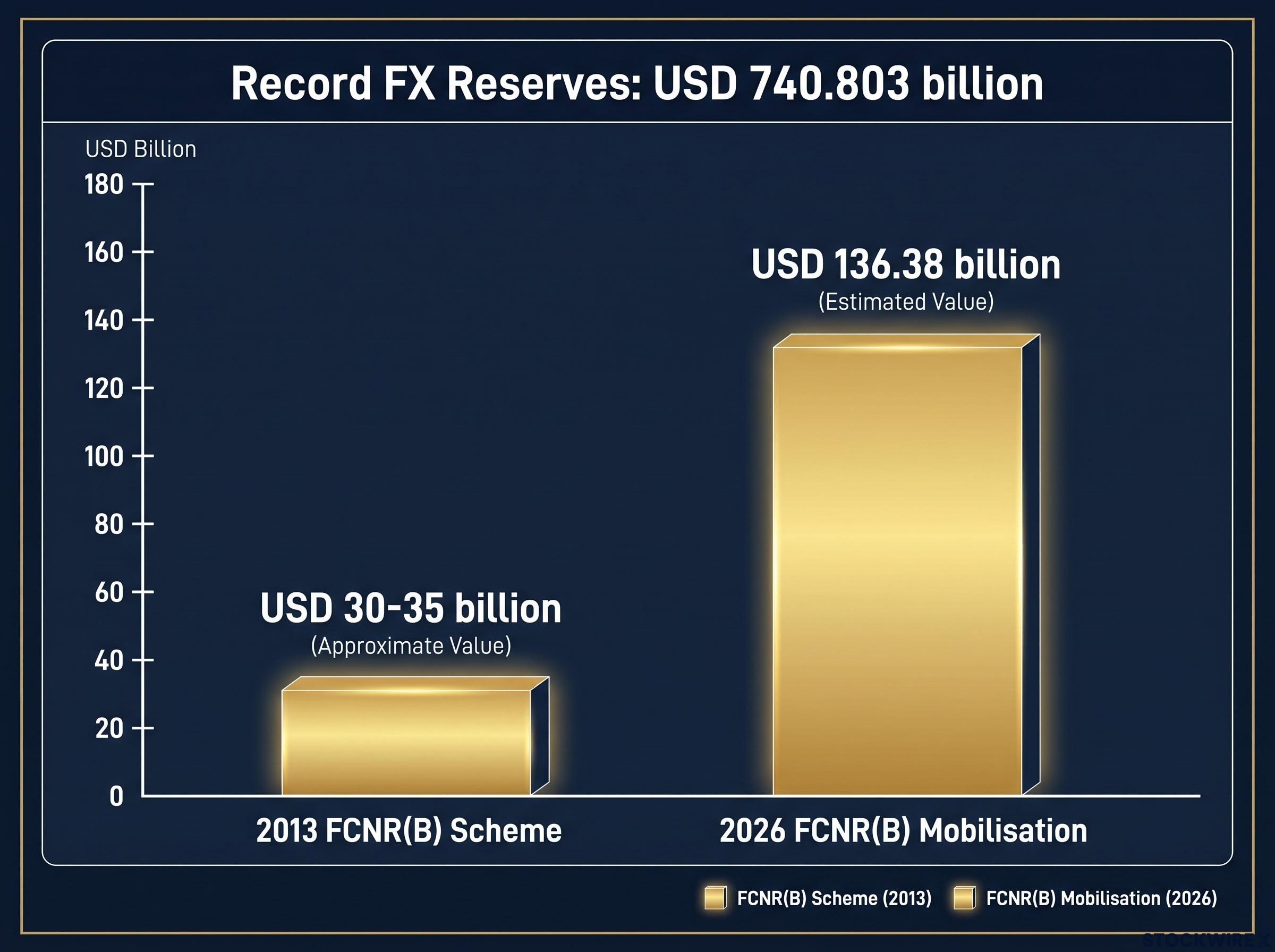
The window opened on 8 June 2026 and closed at the end of August. By close, the RBI disclosed it had mobilised USD 136.38 billion in total, with the primary FCNR(B) component reaching roughly USD 127.2 billion.
Scale versus precedent 2026 FCNR(B) mobilisation: approximately USD 136.38 billion. The 2013 Rajan-era FCNR(B) scheme: approximately USD 30-35 billion. The current programme is close to four times larger.
Here is the part the headline number hides. These are swap-backed inflows, not current-account surpluses. The RBI has effectively borrowed forward purchasing power from NRIs, which hands it immediate firepower but also creates future repayment obligations that the reserve figure does not show. For rupee risk, that distinction matters more than the record itself.
The FCNR(B) programme outlook beyond the window closure centres on whether USD 127.23 billion in locked long-tenor deposits can absorb structural depreciation pressure once no fresh mobilisation tops up the reserve buffer, a dynamic that shapes the rupee’s trajectory well into 2027.
What the 2013 playbook tells us about 2026
When the 2013 taper tantrum hit, then-Governor Raghuram Rajan used FCNR(B) swaps to draw roughly USD 30-35 billion of long-tenor NRI deposits, a move widely credited with steadying the rupee at the time.
The 2026 version is built on the same idea but at a different scale. It is around four times larger and paired with a more diversified toolkit, including FX swap auctions and direct offshore interventions. Import coverage now sits at approximately 9.2 months, a genuine buffer, though not an unlimited one.
When big ASX news breaks, our subscribers know first
The mechanics of RBI intervention in two markets at once
A trader watching the screen in late July saw the rupee recover sharply from a record low. What looked like a single move was actually a coordinated operation across two separate markets.
The RBI runs a dual-front defence. On the onshore spot market, it sells dollars to smooth domestic rate volatility. Simultaneously, it sells in the offshore non-deliverable forward (NDF) market, an offshore contract that settles rupee positions in dollars without physical delivery, traded heavily in Singapore, Dubai and London.
That second front is where speculative positioning concentrates, and it is where the RBI has been hitting hardest.
| Market | Instrument | Estimated scale | Strategic purpose |
|---|---|---|---|
| Onshore spot | Dollar sales | USD 55.073 billion (FY26) | Smooth domestic volatility |
| Offshore NDF | NDF sales | USD 3-4 billion single-day peak | Suppress speculative positioning |
The strategic logic behind the NDF push follows three steps:
- Offshore NDF volumes dominate global rupee pricing, so intervening there moves the currency where it actually trades.
- Direct NDF sales target leveraged speculative positions rather than genuine hedgers.
- Constraining offshore arbitrage reduces the feedback loops that amplify rupee weakness onshore.
The regulatory layer reinforced this. From 1 April 2026, the RBI banned banks from offering rupee NDF contracts to resident and non-resident clients. From 10 April 2026, it capped banks’ net open USD/INR positions at USD 100 million, forcing them to unwind arbitrage trades. Both measures were designed to close the channel through which offshore speculation bled into onshore prices.
The RBI’s tightening of INR NDF regulations, which prohibited authorised dealers from offering non-deliverable derivative contracts to resident and non-resident users from 1 April 2026, was accompanied by a USD 100 million cap on banks’ net onshore USD/INR positions, compressing the arbitrage channel that had amplified rupee weakness.
Timing amplified the effect. In late July, the RBI sold an estimated USD 8-9 billion across spot and NDF over three days, deliberately concentrated during off-peak hours when liquidity is thinner and speculative positions are more exposed. At earlier record-low levels, traders estimated USD 3-4 billion in a single day, predominantly in the NDF market.
The scale of the offshore ban tells you something specific. The RBI judged that speculative offshore positioning had become a primary amplifier of rupee weakness, not a sideshow. The governor has said the curbs “will not be permanent,” framing them as crisis tools rather than lasting capital controls.
For anyone hedging INR exposure through forwards, this matters directly. With the RBI active in both markets at once, the pressure points, hedging costs and basis risk all shift depending on where it chooses to lean.
What a hot US CPI print could do to the rupee in the next 48 hours
The August US CPI release, scheduled for 11 September 2026, is the week’s primary market catalyst. The forecasts already circulating do not point to a Fed comfortable with cutting.
Consensus estimates cluster around headline inflation of 3.34-3.45% year-over-year and core near 2.38-2.43%, levels several analysts argue leave little room for a pause.
CPI surprise mechanics determine the magnitude of the dollar move more than the absolute inflation level: markets reprice relative to consensus, not the number itself, which is why the gap between the 11 September print and current forecasts clustered at 3.34-3.45% is the figure rupee traders will be watching most closely.
| Forecaster | Headline MoM | Headline YoY | Core MoM | Core YoY |
|---|---|---|---|---|
| TD Securities | ~0.37-0.39% | ~3.4% | ~0.19-0.24% | ~2.3-2.4% |
| Goldman Sachs | 0.39% | – | 0.23% | ~2.40% |
| Cleveland Fed | 0.38% | 3.45% | 0.20% | 2.43% |
The read from TalkMarkets Published on 13 August 2026, the analysis frames projected readings as “not supporting a Fed pause,” arguing such prints justify keeping policy restrictive, supporting higher US yields and a firmer dollar.
If the print lands at or above consensus, the pressure travels to the rupee through four sequential channels:
- Fed repricing: Markets price fewer or later rate cuts, lifting US Treasury yields and front-end rates.
- Dollar strength: Wider rate differentials and risk-off sentiment strengthen the dollar against high-beta emerging market currencies.
- EM capital outflows: Tighter global financial conditions pull portfolio capital out of Indian assets.
- Oil import cost amplification: With India importing roughly 85-87% of its crude demand, a stronger dollar raises oil costs in rupee terms, widening the current account deficit.
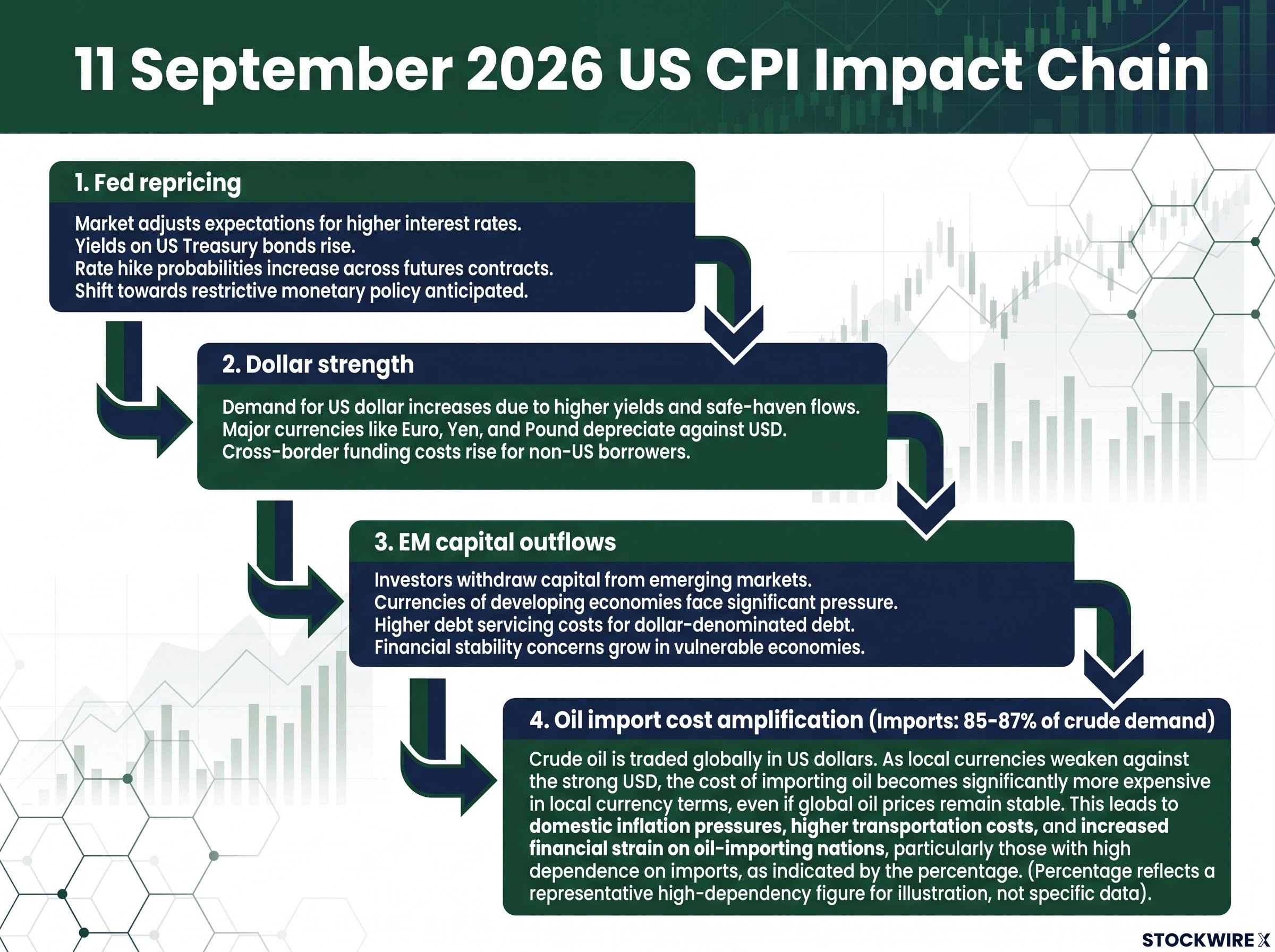
Each channel feeds the next, which is why an upside surprise would not stay a US data event. In that scenario, the RBI would likely escalate spot and NDF dollar sales, drawing on the FCNR(B)-funded buffer, consistent with its late July playbook.
For rupee holders, that is the signal to watch. A hot print would mean the external pressure the RBI has been managing intensifies at the exact moment the FCNR(B) window has closed and the next wave of forward maturities approaches. The strength of the reserve position only means something relative to the size of the shock it may have to absorb, and Friday sets that size.
Can USD 740 billion actually hold the line?
Start with the bullish case, because it is genuinely strong.
- Reserves sit at a record USD 740.803 billion, the largest in India’s history.
- Import coverage runs at roughly 9.2 months.
- FCNR(B) inflows are structured as long-tenor deposits, not short-term hot money.
- The RBI has already demonstrated willingness to escalate across both spot and NDF markets.
Taken together, that combination makes a balance-of-payments crisis look unlikely. Then the structural skeptics enter, and the picture gets more complicated.
- Domestic brokerage Systematix estimates the rupee sits on a structural depreciation path of roughly 6.5% per year.
- Approximately USD 7 billion in NDF forward maturities clustered in early 2026 as a source of residual pressure.
- Reuters has warned the rupee could fall toward 110 per dollar if adverse conditions persist.
- Forward and swap obligations mean the usable buffer is smaller than the headline reserve figure implies.
The Systematix estimate Without aggressive RBI intervention, the brokerage argues, the rupee could already have crossed 100 per dollar, implying that reserves and FCNR(B) schemes are delaying rather than eliminating downside pressure.
The RBI’s own stated position sits between these camps. It does not target a specific rupee level, intervenes to manage excessive volatility rather than defend a peg, and has characterised its regulatory tools as temporary.
The RBI’s inflation-rate calculus adds a second layer to the rupee picture: if domestic CPI tracks the official path toward 5.9% in Q3 FY27, the case for rate hikes strengthens, and a credible tightening pivot would simultaneously reprice Indian fixed income and put a structural floor under the currency independent of reserve levels.
The number that actually limits how long the RBI can sustain its current pace is not the headline figure. It is the net usable buffer after forward liabilities are stripped out. If US rates stay elevated and outflows intensify, that gap between the visible reserve stock and the contingent-liability side is what tightens first.
The rupee’s next test arrives Friday, and the RBI has done what it can to prepare
Two facts define this moment. The RBI enters US CPI week with its largest-ever reserve position and a proven dual-market intervention toolkit. And the FCNR(B) window has now closed, meaning the next wave of firepower must come from existing reserves and ongoing intervention rather than fresh mobilisation of USD 136.38 billion in deposits.
Whether the mid-90s range holds, with spot near 95.17-95.18, depends on variables the RBI does not control. Monitor these after Friday:
- The 11 September 2026 CPI outcome and any surprise relative to consensus.
- Fed rhetoric on the forward rate path.
- Crude price direction, given India’s import dependence.
- Whether foreign portfolio flows stabilise or accelerate outward.
The RBI has built the strongest reserve position in India’s history, but it has also pre-committed part of that position through forward and swap obligations. What Friday’s print changes is not the size of the war chest. It is the intensity of the test it must absorb.
The central bank manages volatility, not a level. Some further rupee movement is expected and accepted. The question after Friday is whether the move stays orderly or turns disorderly.
This article is for informational purposes only and should not be considered financial advice. Investors should conduct their own research and consult with financial professionals before making investment decisions. Past performance does not guarantee future results. Financial projections are subject to market conditions and various risk factors, and forward-looking statements are speculative and subject to change based on market developments.