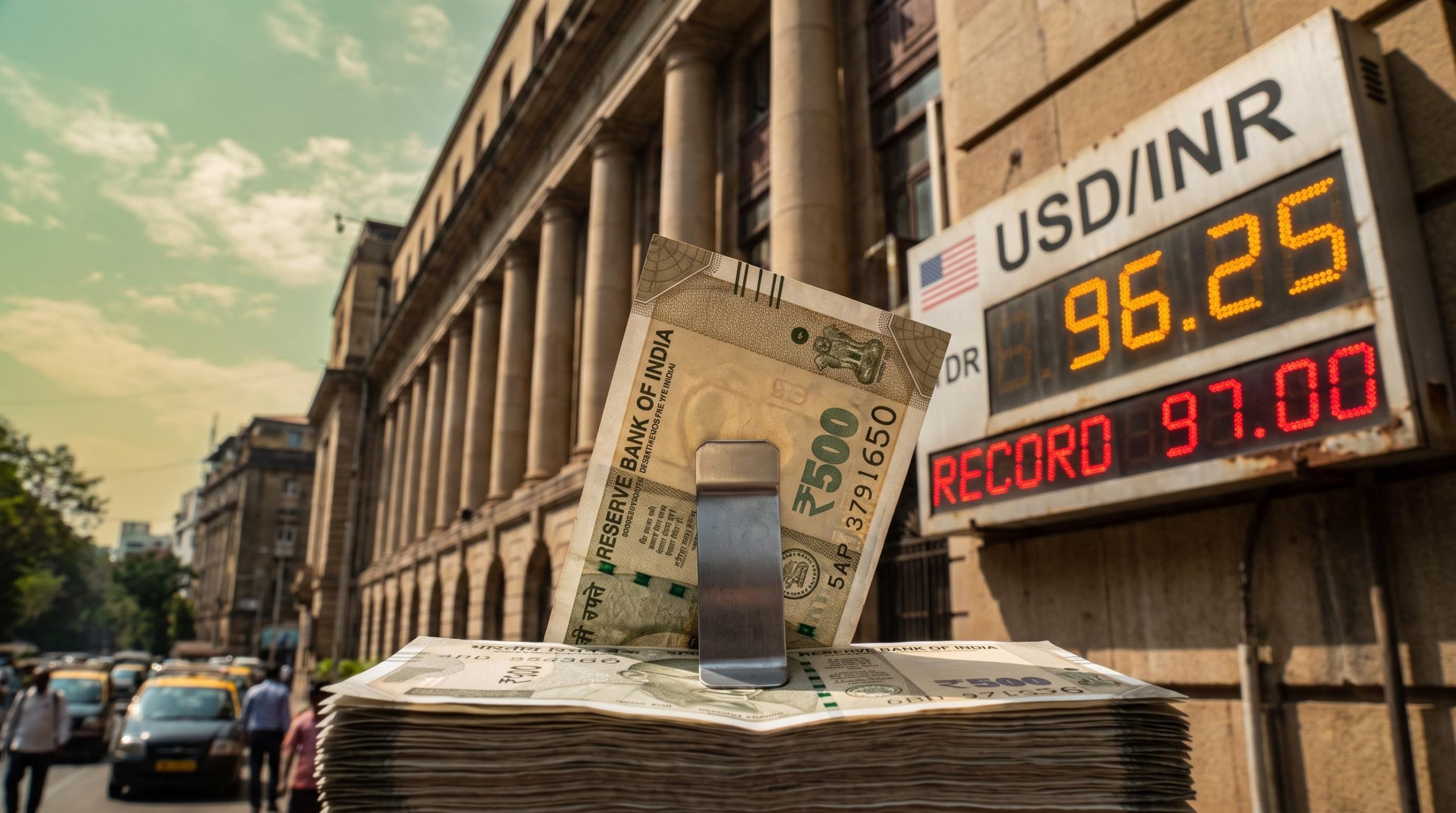
India’s foreign exchange reserves crossed $707 billion in the week ending 7 August 2026, a figure that sounds like a comfort blanket for the rupee. It is not the whole story. The harder question sitting beneath that buffer is whether the Reserve Bank of India (RBI) is done cutting rates or quietly building the case to reverse course.
The RBI’s latest policy cycle has produced something unusual: an official inflation forecast that rises through the second half of the fiscal year, an unchanged repo rate, and public signals from Governor Sanjay Malhotra that tightening remains on the table. For anyone holding INR exposure or watching USD/INR from a trading or portfolio perspective, the combination of a rebuilt reserve buffer and a potentially hawkish pivot creates a genuinely different risk environment than the one that prevailed six months ago.
Here is the framework for evaluating the three structural forces shaping the Indian Rupee forecast right now, what the institutional forecasters are tracking, and where the live risks sit. If you hold INR exposure, you will finish with a clear read on whether the current reserve-inflation dynamic supports your position or challenges it.
Why India’s reserve rebuild matters more than the headline number
$707.002 billion. That was the RBI’s reported reserve level for the week ending 7 August 2026, near-record territory after weekly fluctuations that ranged between roughly $692 billion and $707 billion across July and August. One reporting period alone recorded a $14.1 billion weekly increase.
The headline number is large. The operationally relevant measure is what it covers. India’s reserves currently provide approximately 11 months of import coverage. The conventional adequacy threshold used by international institutions sits at roughly three months. The RBI’s public characterisation of reserves as “adequate” is not rhetorical. It is technically grounded by a margin of nearly four to one.
What does that buffer actually do? It functions as three things simultaneously:
Coordinated currency intervention by major central banks has become a live policy tool in 2026, with the US and Japan deploying an estimated $59 billion in a single session to arrest yen weakness, a precedent that reframes how investors should assess the credibility signals embedded in large reserve buffers across emerging and developed market central banks alike.
- Intervention capacity: the ability to deploy dollars directly into currency markets to dampen disorderly rupee moves
- External credibility signal: a visible commitment to currency stability that shapes how foreign investors price INR risk
- Policy-timing flexibility: the freedom to absorb external shocks through FX intervention rather than forced rate reactions, buying time for data to clarify whether inflation is transitory or persistent
Commerzbank characterises the RBI’s current posture as “wait-and-see, anchored by current reserve levels and steady domestic growth conditions.”
That 11 months of import coverage tells you the RBI has unusually wide discretion over the timing of any policy response. Rate decisions in the near term are genuinely optional, not forced by external pressure. For investors assessing INR downside risk, this reserve floor is the structural starting point.
When big ASX news breaks, our subscribers know first
The inflation path the RBI is actually navigating
The reserve buffer buys the RBI time. The inflation trajectory determines how much time it actually has.
The RBI’s current official baseline for FY27 CPI inflation is 5.0% for the full year, set at the August 2026 policy review. That full-year number masks a back-loaded quarterly profile that puts sustained above-target inflation squarely into the second half of the fiscal year.
| Quarter (FY27) | Official RBI CPI Forecast | Key Risk Factor |
|---|---|---|
| Q1 | Actual data available | Base effects from prior year |
| Q2 | 4.7% | Early monsoon outcomes |
| Q3 | 5.9% | Food price seasonality, energy costs |
| Q4 | 5.5% | Fertiliser costs, crude oil import exposure |
Note: The RBI’s full-year FY27 CPI forecast has been revised upward across successive policy meetings: approximately 4.6% at the April 2026 review, 5.1% at the June 2026 review, and 5.0% at August 2026.
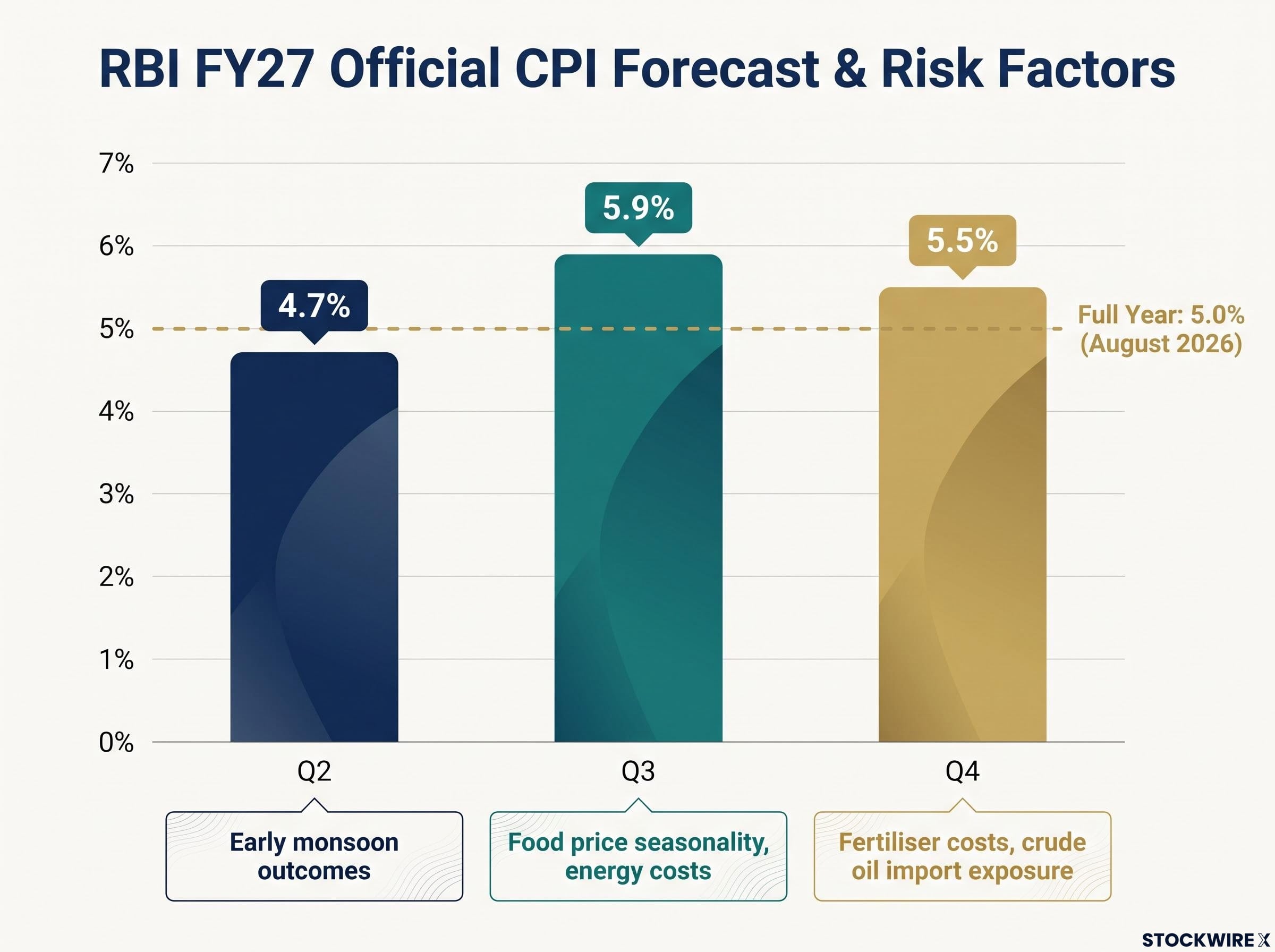
The direction of those revisions matters more than any single number. The RBI has been consistently underestimating its own inflation problem across three successive policy cycles. That revision sequence, from 4.6% to 5.1% to 5.0%, tells you the current 5.0% baseline carries upside risk rather than downside comfort.
DBS Group Research holds a more hawkish position than the RBI’s official forecast, projecting that consumer price inflation will run well above 5% on average through the second half of FY27.
What could push inflation above the official path
Three primary channels could drive outturns above even the revised baseline:
- Food prices: India’s food inflation is directly tied to monsoon outcomes. Weather variability remains an active, live variable for the second half of FY27, and seasonal patterns create concentrated price pressure in Q3.
- Energy costs: India imports the vast majority of its crude oil. Global oil market uncertainty feeds directly into domestic inflation through fuel and transportation costs.
- Fertiliser costs: Agricultural input prices compound the food inflation channel, creating a multiplier effect when both move adversely.
CRISIL and consensus economists identify these same categories as the primary risk drivers for FY27 inflation. The RBI’s own policy communications recurrently reference “supply-side shocks and their second-round effects” as the operative framework for interpreting the data.
The repo rate is paused, but the RBI’s posture is not neutral
The repo rate stands at 5.25% as of the August 2026 review, unchanged. The RBI’s stated stance is “withdrawal of accommodation,” a phrase that carries more weight than it might appear.
“Withdrawal of accommodation” is not a neutral position. It signals that the central bank considers its prior easing cycle to be over and is actively withdrawing the support it previously extended. In operational terms, this means the RBI has already committed linguistically to a tightening bias. Any shift from this stance toward explicit tightening language in subsequent communications would be a market-moving signal rather than a surprise.
Governor Sanjay Malhotra has signalled openness to tightening monetary conditions should inflation accelerate beyond current projections, framing the RBI’s posture as “patient but alert to upside inflation risks.”
That language is directly tied to the forecast path covered above. The Governor is not offering generic caution. He is connecting his conditional willingness to tighten to the specific quarterly inflation projections that already embed 5.9% in Q3 and 5.5% in Q4.
The broader MPC dynamic reinforces this reading. Meeting minutes indicate a cautious majority with no near-term appetite for easing. Some members have signalled openness to tightening if price pressures surprise to the upside.
The August 2026 minutes document a hawkish MPC bias that the headline rate decision deliberately obscured: four of six committee members ranged from cautious to explicitly opposed to rate cuts, and H2 FY27 inflation is projected to average approximately 5.7%, a figure the full-year 5.0% forecast actively flatters.
For currency-focused investors, three language signals deserve active monitoring between policy meetings:
- The stance descriptor itself: any shift from “withdrawal of accommodation” toward explicit tightening bias
- The Governor’s conditional framing: whether “patient but alert” evolves into something more direct
- MPC minutes language around the balance of inflation risks: shifts in how individual members characterise upside versus downside probabilities
Tracking these language signals is a more reliable leading indicator than waiting for the rate announcement itself. The rate decision confirms what the language has already been telling you.
What a hawkish pivot would mean for USD/INR
The structural setup is established: reserves provide the floor, inflation is rising through the official forecast, and the RBI’s language is already oriented toward tightening. The question is what happens to the rupee if that orientation becomes explicit action.
The transmission mechanism runs through a clear causal chain:
- Inflation overshoot: Q3 or Q4 CPI prints above the RBI’s already-elevated projections
- Tightening signal: the RBI shifts language or raises the repo rate in response
- Rate differential widening: higher Indian policy rates increase the yield advantage of INR-denominated fixed-income assets relative to alternatives
- Capital inflow support: international investors allocate toward the higher-yielding currency, increasing demand for INR
- Rupee stabilisation: the combination of rate-driven inflows and reserve-backed intervention capacity limits depreciation pressure
Commerzbank considers the rupee to be well protected by its substantial FX reserve buffer and solid domestic growth trajectory, factors that together limit the currency’s vulnerability to near-term energy price swings. DBS Group Research argues that investors repricing the probability of RBI tightening would deliver an additional layer of structural backing for the rupee.
Counterintuitively, worsening inflation data could be a short-term positive for the rupee if it accelerates the hawkish repricing that both institutions expect. The logic runs against the instinct that inflation is always currency-negative. In this specific configuration, inflation that triggers a credible tightening response strengthens the rate differential that supports the currency.
The intervention framework and what the reserve floor means in practice
The 96.00 USD/INR level has appeared in some analyst commentary, but it should be read as a stress-scenario or tail-risk reference rather than a near-term consensus target. That level would represent a substantially weaker rupee than recent trading ranges.
The better-supported framing is that the RBI’s $707 billion reserve buffer gives it demonstrated capacity to lean against disorderly rupee weakness through direct FX intervention. This intervention capacity complements rather than replaces rate policy as a currency-support tool. The two instruments work in tandem: reserves absorb short-term volatility while rate signals shape medium-term capital flow direction.
Maintaining reserves above the $680-700 billion floor flagged by Commerzbank is a prerequisite for this credibility to hold. A sustained drop below that zone would meaningfully erode the structural support narrative.
The mechanics behind the rupee’s reserve-backed stability
If you are watching the rupee and wondering why the reserve number and the rate outlook keep appearing together, the connection is worth understanding clearly.
Central bank foreign exchange reserves serve two functions simultaneously. First, they are a direct intervention tool: the RBI can sell US dollars from its reserves into the market to support the rupee during periods of pressure. Second, they are a credibility signal: even when reserves are not being actively deployed, their size shapes how currency traders and foreign investors price INR risk. A central bank with 11 months of import coverage is a fundamentally different counterparty than one operating with three months.
The repo rate (the interest rate at which the RBI lends to commercial banks, which anchors domestic borrowing costs) and the FX reserve buffer address different problems:
Central bank FX intervention operates under institutional constraints that vary significantly by currency regime: Japan’s Ministry of Finance faced IMF free-floating scrutiny after its ¥11 trillion Golden Week operations, a precedent that illustrates why intervention capacity and credibility are distinct concepts even when the reserve buffer is large.
- Repo rate: anchors domestic inflation by raising or lowering the cost of borrowing within India
- FX reserves: absorb external shocks by providing the capacity to intervene in currency markets without depleting the buffer
India’s 11 months of import coverage sits nearly four times above the conventional three-month adequacy threshold used by international institutions. That gap materially changes the risk calculus for INR holders relative to currencies with thinner reserve cover.
This is why the RBI can hold the rate steady while still managing exchange rate volatility. The two tools operate on different channels. The reserve buffer handles the external pressure; the repo rate handles the domestic inflation question. Understanding this distinction helps you evaluate INR vulnerability during external shock periods more accurately, rather than reacting to headline volatility that the reserve buffer is designed to absorb.
Three variables that will define the rupee’s next move
The analytical framework is built. Converting it into actionable monitoring means knowing exactly which data points matter most between now and the end of FY27.
- Monthly CPI prints relative to the official path. This is the primary trigger variable. Q3 and Q4 FY27 outturns matter most, because the RBI’s own projections already embed elevated levels. If Q3 CPI prints above 5.9%, treat this as a meaningful probability-raising event for an explicit tightening pivot, which would in turn pull forward the positive rupee repricing that the current analyst consensus already assigns to the hawkish scenario.
- RBI language shifts. Track any movement from “withdrawal of accommodation” toward explicit tightening bias in MPC communications or Governor Malhotra’s public remarks. Language moves before rates do.
- FX reserve persistence above $680-700 billion. A sustained drop below this Commerzbank-flagged threshold would meaningfully erode the structural support narrative anchoring the current INR stability thesis. Food and energy price developments, including monsoon outcomes and global crude oil trends, feed directly into all three variables.
The Q3 FY27 projection of 5.9% is the single most important near-term benchmark number for the rupee outlook. Whether actual CPI comes in above or below that figure will shape the RBI’s next communication and the market’s rate expectations simultaneously.
What the reserve-inflation framework tells you before the next RBI decision
The rupee’s near-term trajectory is better understood through the reserve-and-inflation framework than through rate decisions alone. The three pillars point in the same direction: a reserve buffer that provides structural support, an inflation trajectory that signals a hawkish policy direction, and supply-shock risks that could accelerate an explicit tightening pivot.
The asymmetry of this setup matters. The downside case for the rupee, where reserves hold above the floor and inflation tracks the official path, is relatively contained. The upside case, where inflation overshoots and triggers a hawkish repricing, represents an active scenario rather than a tail risk.
The rupee’s reserve-backed stability thesis sits within a 2026 global growth divergence that has produced sharply differentiated policy trajectories: the UK posting above-consensus GDP growth while the eurozone faces near-stagnation with re-accelerating inflation, a configuration that shapes capital flow direction toward economies where the rate and growth outlook is more clearly defined.
The next MPC decision is not the moment of resolution. It is a data update. The real inflection points are Q3 CPI outturns and any shift in Governor Malhotra’s conditional language, both of which will arrive before the formal rate decision. If you track those three monitoring variables, you will be positioned to interpret the signals before the market prices them.
This article is for informational purposes only and should not be considered financial advice. Investors should conduct their own research and consult with financial professionals before making investment decisions. Financial projections and inflation forecasts are subject to market conditions and various risk factors. Past performance does not guarantee future results.