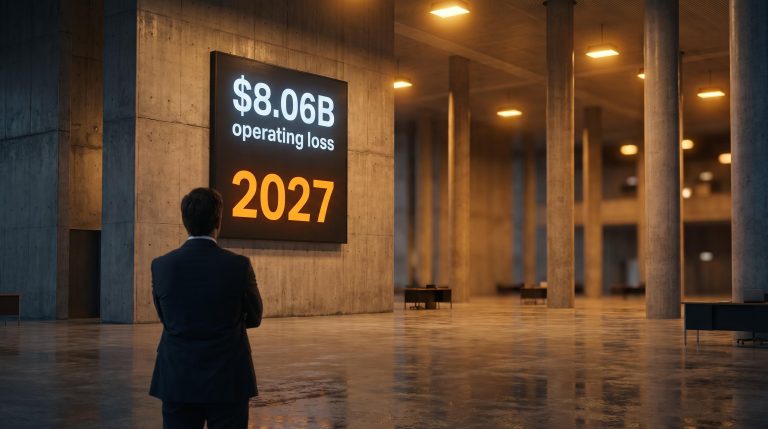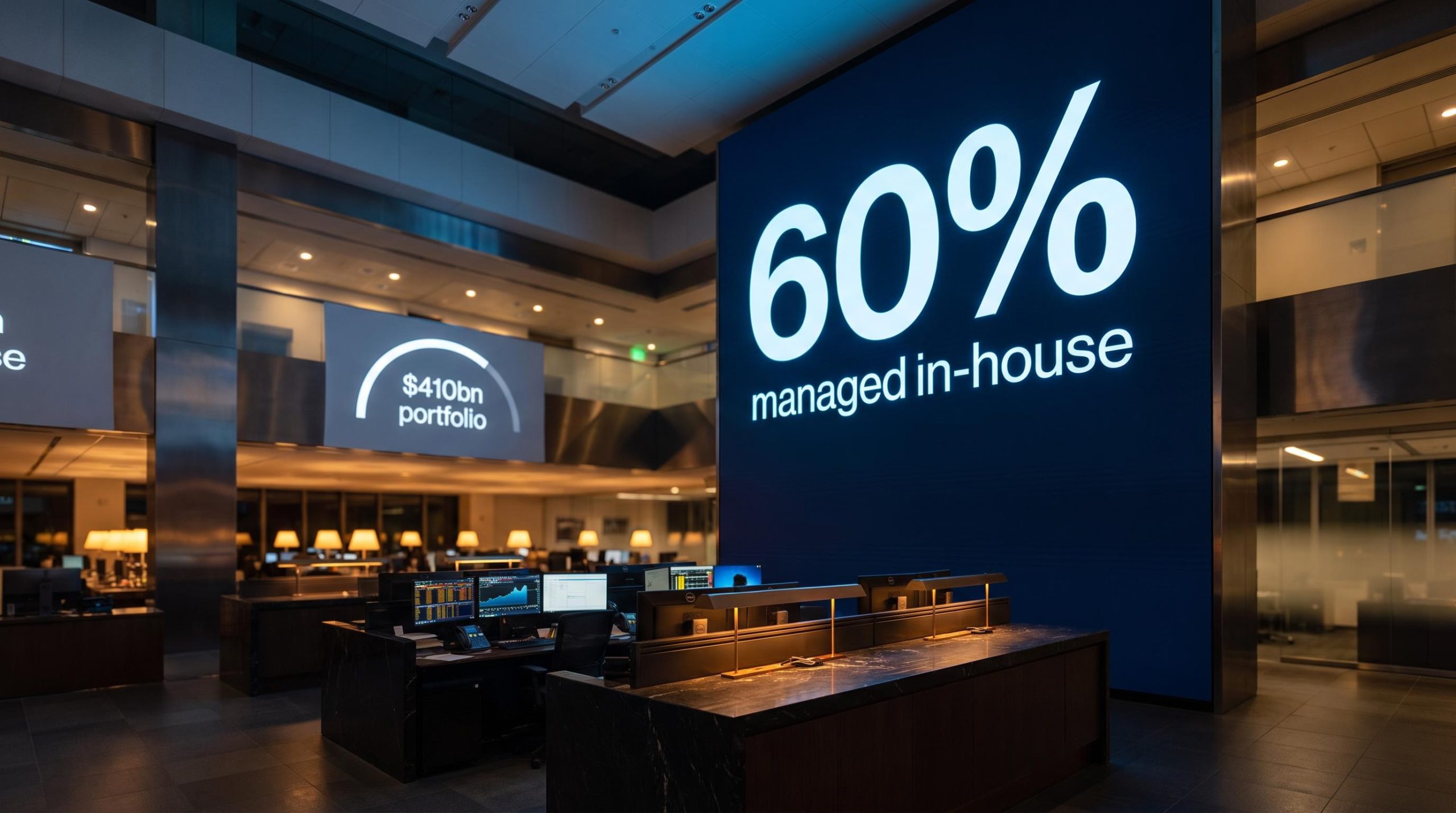
AustralianSuper now runs roughly 60% of its $410 billion portfolio in-house, a proportion that would have been structurally impossible a decade ago, and it is aiming to push that figure above 75% by 2030.
That single decision tells you how much the operating logic of Australian superannuation has already changed. Insourcing, the practice of a fund managing its own money rather than paying external firms to do it, is no longer a cost-cutting experiment at the margins.
It is a rational institutional response to scale. Once a fund’s assets exceed what most external managers run across their entire business, paying external fees for core liquid exposures becomes increasingly difficult to defend.
The numbers underline the point. Australia’s superannuation sector reached $4.8 trillion in total assets as at June 2026, according to APRA, and Rainmaker Information reports that internally managed assets more than doubled from roughly $227 billion in 2020 to approximately $550 billion in 2025.
This piece sets out why that shift is structural rather than cyclical, and what it means for external active managers who now compete for a shrinking pool of mandates in which differentiation is the only defensible position.
How much capital has already moved in-house
The scale of what has happened is worth sitting with before any explanation. According to Rainmaker’s April 2026 release, internally managed superannuation assets rose from about $227 billion in 2020 to roughly $550 billion in 2025, more than doubling in five years.
What makes that figure striking is the context. Total superannuation assets grew by around $1.4 trillion over the same period, which means insourcing accelerated against a backdrop of rapid sector-wide growth rather than simply riding asset appreciation higher. This was a deliberate reallocation, not a passive drift.
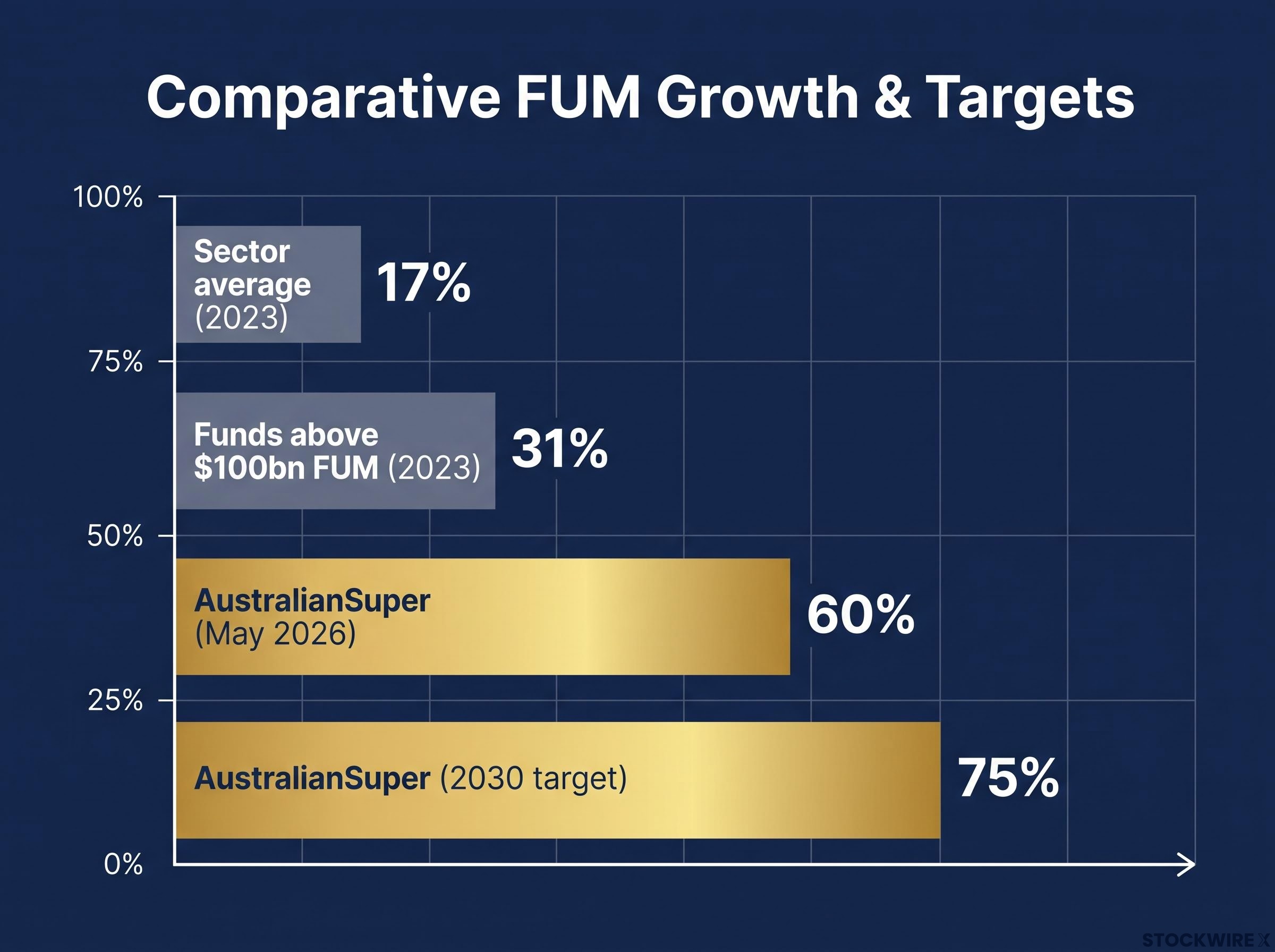
The shift is also uneven, and that unevenness is the real signal. Rainmaker’s January 2024 analysis found that 17% of APRA-regulated FUM was internally managed on average in 2023, but funds with more than $100 billion in FUM were already running 31% internally.
In other words, the largest funds are operating at proportions that would once have defined a global pension leader, and the aggregate average hides how far ahead the mega-funds already are.
| Fund or cohort | Internal management share | AUM or FUM context | Source date |
|---|---|---|---|
| Sector average | 17% | APRA-regulated FUM | 2023 |
| Funds above $100bn FUM | 31% | Largest-fund cohort | 2023 |
| AustralianSuper | 60% | $410bn portfolio | May 2026 |
| Cbus and Aware Super | Outsource above 60% each | Large not-for-profit funds | Current |
| Rainmaker projection | 43% | APRA-regulated assets | 2043 (projection) |
AustralianSuper as the leading indicator
AustralianSuper is the clearest window into where this trend is heading. As of May 2026 it managed around 60% of its $410 billion portfolio internally, with a stated target to exceed 75% by 2030.
More than half of the fund’s equity holdings are already run in-house, which makes Australian equities the asset class most directly affected by its strategy. If you manage a broad domestic equity mandate, this is the fund whose decisions set the tone for the rest of the sector.
AustralianSuper’s outgoing CIO publicly acknowledged in March 2026 that the fund’s active investment strategy cost members measurable gains through an underweight to AI and digital stocks held since approximately 2022, a disclosure that illustrates the real accountability stakes when insourced teams make directional sector calls at scale.
Yet the pace varies even among large not-for-profit funds. Both Cbus and Aware Super still outsource more than 60% of their respective portfolios, a reminder that insourcing is a spectrum rather than a switch, and that the sector is at very different points along it.
When big ASX news breaks, our subscribers know first
What insourcing actually means and why it is economically logical
Viewed from inside a fund’s boardroom, the decision to insource looks less like a trend and more like arithmetic. Three structural forces drive it:
The Monash Centre for Financial Studies analysis of the Australian superannuation system identifies scale as its most structurally distinctive characteristic, a foundation that explains why the economic calculus of internal versus external management shifts decisively once a fund’s asset base crosses certain thresholds.
- Scale economics: the fixed cost of an internal team spreads across an ever-larger asset base, lowering the cost per dollar managed.
- Governance and control: direct ownership of investment decisions, voting, and risk systems carries more value under heightened regulatory scrutiny.
- Technology-driven cost reduction: analytics and AI tools lower the per-unit cost of research, making internal capability viable at scale.
Start with scale. With APRA-regulated assets at $3.4 trillion as of June 2026, the biggest funds have crossed a threshold where their portfolios exceed what many external managers run in total.
At that size, the fixed cost of building an internal investment team spreads across a vast base of capital, which makes internal management cheaper per dollar than external fees, particularly in liquid, listed markets such as Australian equities. Rainmaker identifies equities and fixed income as the primary asset classes being brought in-house for exactly this reason.
The governance dimension compounds the logic. The post-Royal Commission environment and APRA’s focus on member outcomes and fee transparency reward funds that can demonstrate tighter control over how members’ money is invested.
Then there is technology. Hiring a senior portfolio manager lifts a team’s cost base, whereas bringing on an investment analytics and AI engineer is increasingly framed as a way to reduce the per-unit cost of research. In an environment of compressed fees, that distinction carries real strategic weight.
The pressure that makes standing still untenable As APRA-regulated assets push past $3-4 trillion, funds gain negotiating leverage that pushes external fees down. Compressed fee revenue means survival in active management now depends on lowering the operational cost of market coverage, a squeeze that bears on funds and external managers alike.
For an external manager or allocator reading this, the key implication is uncomfortable but clarifying. Insourcing is not primarily a signal of dissatisfaction with performance; it is a structural economic decision that will continue whether or not external managers improve their outperformance rate.
That matters, because it means the relationship is rationalising rather than evaporating. Funds still engage around 37 external managers on average. The mandate pool is narrowing and re-sorting, not closing.
The performance evidence that closed the argument
If scale explains why insourcing makes economic sense, the performance record explains why so few funds feel they are giving anything up.
85% of active Australian equity managers failed to outperform their benchmarks over a 15-year period. S&P SPIVA Australia scorecard, year-end 2025.
That figure, from S&P’s SPIVA Australia scorecard for year-end 2025, is the kind of number many in the industry suspected but rarely saw stated so plainly. Over a full 15-year window, the overwhelming majority of active managers did not beat the index they were measured against.
For a fund weighing whether to build an internal, benchmark-aware team or keep paying external fees, that record does a lot of the persuading. The performance evidence reframes the whole debate, moving it away from an ideological argument about active versus passive and toward a structural commercial reality.
ASX equity performance over the decade to December 2025 trailed the MSCI World Index by 3-4 percentage points per annum, a structural gap that compounds the SPIVA finding and helps explain why large funds building broad domestic capability face a doubly uncomfortable question: they are insourcing into a market that has chronically underperformed global peers.
When outperformance is not enough
The harder truth is that even genuine outperformance does not solve the problem for external managers. Consider Lazard’s flagship Australian Equity fund, which returned 10.3% over one year against the 6.1% posted by the ASX 200 benchmark to July 2025.
That is real outperformance. Yet the fund’s I Class held only $140.84 million in assets as of July 2025, a modest base for a strategy beating its benchmark by more than four percentage points.
The read you should take from this is sharp. The existential challenge for external active managers is not only generating alpha; it is generating alpha at a scale, and with a client base, that supports a commercially viable business. Insourcing makes that second condition harder to meet even when the first is satisfied.
The commercial pressure is already producing firm-level exits, not just lost mandates. Ox Capital entered wind-up proceedings in March 2026, and Goldman Sachs Asset Management has reportedly conducted a strategic review of its Australian business.
What surviving external managers must now offer
The reallocation is not from external management to zero. It is from broad domestic market coverage to demonstrably differentiated capability, and that distinction defines who survives.
Remember that funds still run around 37 external managers each. The mandate pool is narrowing and re-sorting toward managers who can do something an internal team cannot easily replicate. The question is which positions hold up under that pressure.
Four differentiation pathways look most defensible:
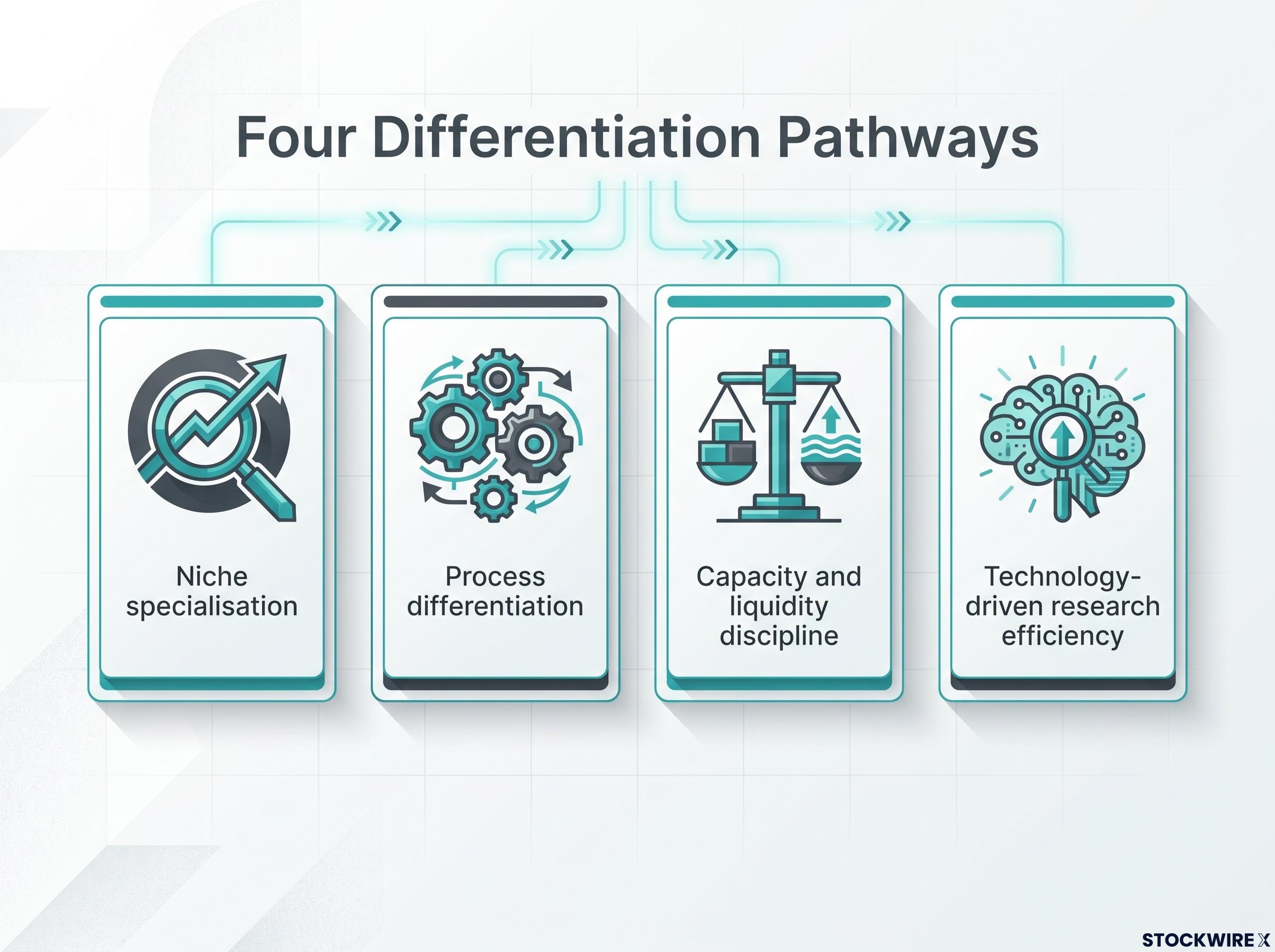
- Niche specialisation: small caps, microcaps, and sector specialists, where internal teams are least likely to build deep capability.
- Process differentiation: long-short, market-neutral, systematic factor, or concentrated high-conviction strategies that are difficult to replicate in-house.
- Capacity and liquidity discipline: demonstrable control of capacity, which appeals to mega-funds wary of moving markets themselves.
- Technology-driven research efficiency: using analytics and AI to sustain attractive fee structures as internal alternatives expand.
The logic linking these is straightforward. Broad-cap Australian equity mandates are the most directly threatened, because that is precisely the coverage a well-resourced internal team can build cheaply across a large asset base.
ASX concentration risk, with resources at approximately 25% of market capitalisation and the big four banks dominating financials, shapes the structural conditions in which mega-funds are building broad internal equity capability, reinforcing why genuine specialisation in less-represented segments carries defensible differentiation value.
Specialisation runs the other way. A $100 billion-plus internal team can replicate broad market exposure far more easily than it can stand up genuine microcap expertise or a market-neutral book, and that difficulty is the external manager’s defence.
Process differentiation works on the same principle. Systematic factor approaches, concentrated portfolios, and long-short structures represent a distinct way of investing, not just a different list of holdings, which makes them harder and more expensive to build internally.
The international record supports this reading. Canadian pension funds such as CPPIB and Ontario Teachers converged on hybrid structures, running core liquid exposures internally while keeping external managers for specialised, capacity-constrained strategies.
For any external active manager, the strategic question is not whether insourcing continues. It is whether your specific process and market segment occupy a position that a large internal team would find genuinely difficult or expensive to replicate.
What the next decade looks like for Australian active equities
Rainmaker projects that around 43% of APRA-regulated assets could be internally managed by 2043 if current trends hold. That is the directional signal, and it points clearly one way.
It also deserves caution. A projection running 17 years forward carries substantial uncertainty and depends on fund merger dynamics, regulatory evolution, and how internal teams perform across full market cycles rather than favourable ones.
Several risks could slow the trajectory:
- Talent competition: building and retaining top-tier internal equity teams is hard when global asset managers and investment banks compete for the same people.
- Governance concentration: moving more assets internally concentrates decision-making within a single institution’s board and investment committee.
- Performance durability: early internal outperformance does not guarantee results through multiple cycles, and internal teams face organisational constraints independent managers do not.
The most likely end state is not wholesale insourcing but a hybrid equilibrium. International precedent points there: large institutional investors globally tend to run core, liquid exposures internally while retaining external managers for specialised, capacity-constrained, or genuinely idiosyncratic strategies.
The scale backdrop reinforces the direction without resolving the detail. Total sector assets stood at $4.8 trillion in June 2026, and external estimates cited in a Reserve Bank disclosure paper have projected growth to around $8.1 trillion by 2035, though that figure is an external estimate rather than a confirmed forecast.
What the projection and the hybrid model tell you together is this. External active management in Australia is not facing extinction, but it is facing a structural narrowing that will reward genuine specialisation and penalise broad domestic market exposure for at least the next two decades.
The insourcing wave is running in parallel with a broader questioning of home bias in Australian portfolios, with retail data from Selfwealth by Syfe confirming that international ETFs overtook domestic products as the most purchased category in Q1 2026, a structural shift that suggests institutional and retail capital are converging on the same reallocation logic from different starting points.
This article is for informational purposes only and should not be considered financial advice. Investors should conduct their own research and consult with financial professionals before making investment decisions. Past performance does not guarantee future results, and financial projections are subject to market conditions and various risk factors.
The mandate pool is shrinking, but it is not disappearing
The analytical conclusion refuses both the catastrophist and the complacent reading. Insourcing is structural and will continue, but the external management industry survives in a re-sorted form where differentiation of process and market segment becomes the primary determinant of commercial durability.
The transition is asymmetric, and that asymmetry is where the decisions sit. Broad-cap domestic equity managers face the most acute pressure, while specialists in small caps, microcaps, systematic strategies, and genuinely idiosyncratic approaches occupy a position that internal teams at mega-funds will find structurally difficult to replicate.
The SPIVA record makes this non-optional rather than a matter of taste. With 85% of active managers failing to beat their benchmarks over 15 years, broad coverage is the one thing funds feel most comfortable building themselves, which is exactly why differentiation has stopped being a strategic choice and become a survival condition.
Yet the industry is not closing. Funds still run around 37 external managers each, which means the pool is re-sorting toward genuine specialists rather than draining away.
The firms that endure will be those able to answer one question clearly: what does our process do that a well-resourced internal team at a $300 billion-plus fund cannot replicate? If the answer is specific, the position is defensible. If it is broad, the pressure has only begun.