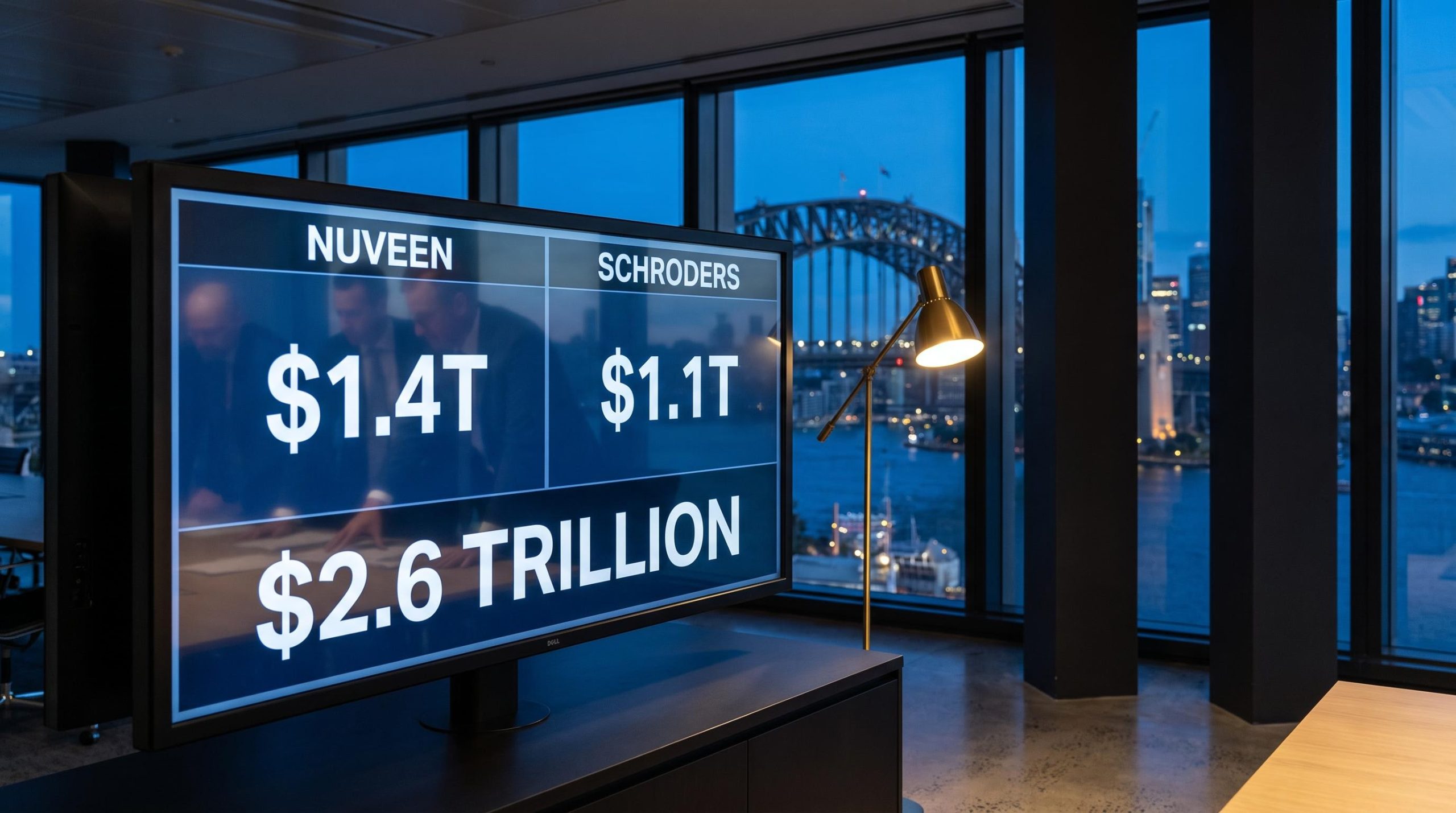
On 1 October 2026, Schroders stopped being an independent company. After more than two centuries, it was absorbed into a US$2.6 trillion manager that its Australian institutional clients never hired, never evaluated, and never selected through any consultant process.
That is the uncomfortable starting point for every superannuation trustee and investment committee holding a Schroders mandate. The firm that produced their returns still exists as a brand, but the parent making decisions about its leadership, resourcing, and autonomy is now Nuveen, backed by US retirement giant TIAA.
A scale event of this magnitude is qualitatively different from a routine review trigger. The combined entity now sits among a small group of managers holding top-ten positions globally across active equities, fixed income, and private markets at the same time. For Australian asset owners, this is not a market-performance event. It is an organisational-change event with specific fiduciary consequences.
What follows gives you the analytical framework to decide whether to maintain or review your Schroders mandate: the questions to ask, the risks to weight, and the evidence of stability to look for before the integration period closes and those decisions are made for you.
From $1.4 trillion to $2.6 trillion: what the Nuveen deal actually created
The deal mechanics are settled and verifiable. Nuveen acquired Schroders through a recommended cash transaction valued at approximately £9.9 billion, structured as £5.90 per share plus permitted dividends of up to 22 pence per share. Shareholders approved it overwhelmingly, with more than 99.9% of votes cast in favour in April 2026. Completion followed court sanction on 29 September 2026, with the deal closing on 1 October 2026 and Schroders’ London Stock Exchange listing cancelled the same day.
The scale is the headline. Nuveen contributed roughly $1.4 trillion in assets under management and Schroders around $1.1 trillion at announcement, creating a firm positioned at approximately $2.6 trillion at completion.
| Measure | Nuveen (pre-deal) | Schroders (pre-deal) | Combined (post-deal) |
|---|---|---|---|
| Assets under management | ~$1.4 trillion | ~$1.1 trillion | ~$2.6 trillion |
| Geographic reach | US-centred | UK and global | 40+ markets |
| Key capability positioning | Fixed income, private markets | Active equities, multi-asset | Top-ten across all three |
The two AUM figures you will see quoted are both correct. At announcement in February 2026, Nuveen described a combined pool of nearly $2.5 trillion. At completion, multiple sources confirmed approximately $2.6 trillion. The difference reflects updated measurement dates, not a reporting error.
The combined firm is described as the only manager holding a top-ten position globally in active equities, active fixed income, and private markets simultaneously.
That framing matters for context. Reuters characterised the combined group as sitting just below Europe’s Amundi and well below passive giants BlackRock, Vanguard, and State Street. This is a deliberate scale play in active management, not a challenge to the index-tracking houses.
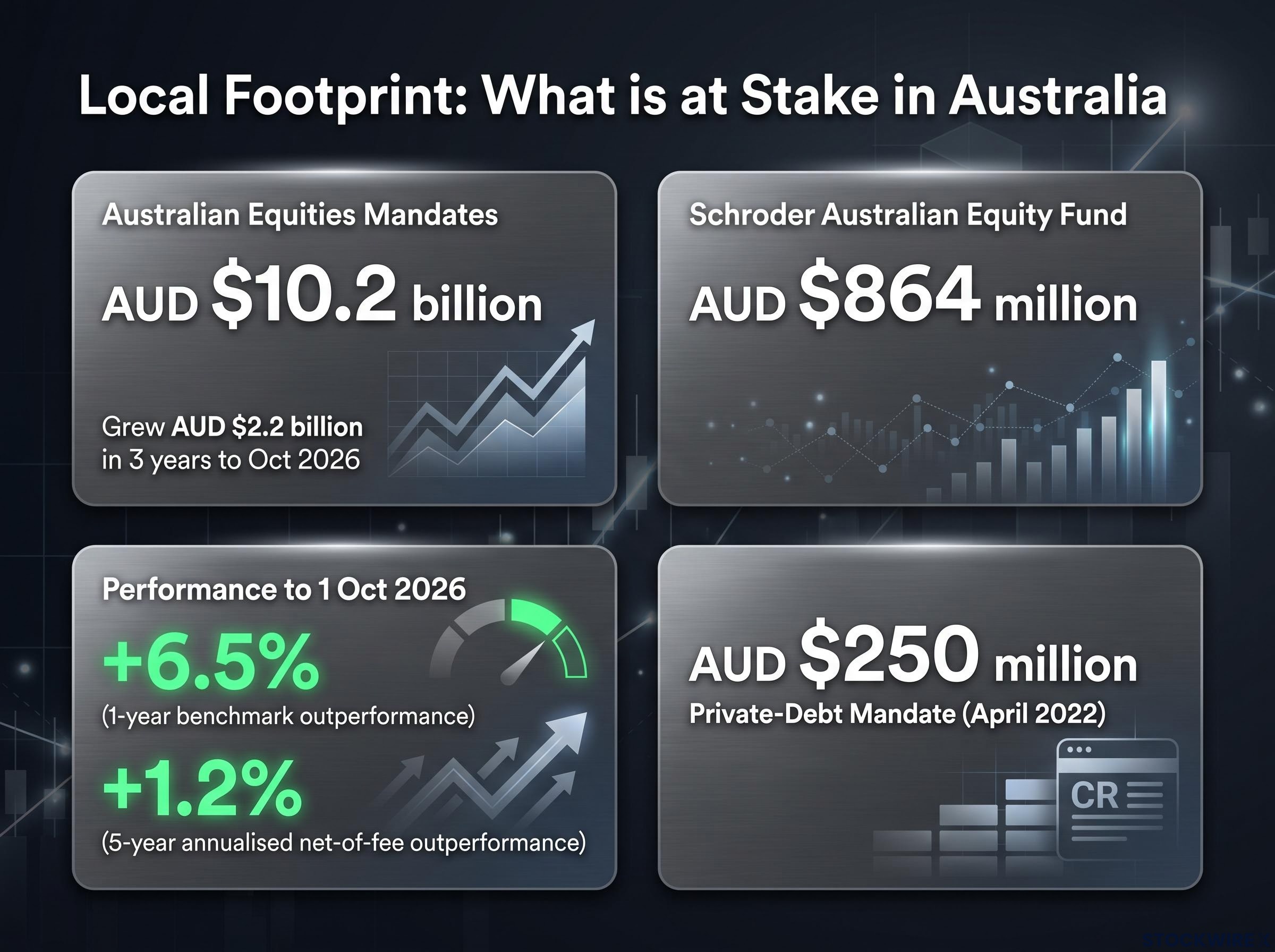
For Australian clients, the relevant detail is closer to home. Schroders Australia manages approximately AUD $10.2 billion in Australian equities mandates, the majority institutional, all built under one parent’s governance and now sitting inside a materially different corporate structure.
Here is the practical complication. Schroders will operate separately within Nuveen for an integration period of roughly 12-18 months, and no detailed leadership, branding, or local-autonomy decisions had been publicly announced as of completion. The due-diligence clock is running against an incomplete information set, which is precisely why the starting point is knowing what is settled and what is not.
When big ASX news breaks, our subscribers know first
What ownership transitions of this scale typically do to mandates
Large asset-manager acquisitions do not destroy or preserve mandates at random. They produce attrition or retention along five documented dimensions, and understanding the causal chain is what lets you apply it to your own position rather than simply worry about it.
- Key-person and team stability: Mandates are most at risk when lead portfolio managers or core team members depart or are reassigned.
- Strategy continuity: Attrition rises when strategies are merged or rebranded to fit an acquirer’s architecture, because clients perceive drift from what they hired.
- Product rationalisation: Mergers often close overlapping funds, which can force clients to migrate vehicles or re-tender, hitting niche and capacity-constrained mandates hardest.
- Fees and economics: Higher post-acquisition pricing or cross-selling of multi-asset products at the expense of single-asset mandates prompts some institutions to rebid.
- Communication quality: Clear, early, detailed communication supports retention; poor or delayed communication systematically increases attrition.
Strategy drift deserves particular attention. When an acquirer re-tools a strategy to fit its global product shelf, clients can lose confidence even when performance has not deteriorated. The perception of change is enough.
Governance complexity is the second underappreciated driver. A larger, more intricate corporate structure increases the oversight burden on asset-owner boards, who must now weigh potential conflicts between Nuveen’s asset-management, wealth-management, and private-markets lines, and between US TIAA-parent objectives and local Australian-client interests.
The governance oversight burden on Australian institutional investors has grown materially since ASIC’s April 2026 ASX inquiry confirmed that regulators will now intervene assertively against licensed entities whose governance practices are inadequate, a precedent that reinforces why investment committees cannot rely on passive monitoring of a manager undergoing a major ownership transition.
Commercial and communication signals to watch in the integration period
Fee and revenue-sharing changes are a concrete trigger. If post-acquisition pricing rises, or if cross-selling into multi-asset solutions is encouraged at the expense of your single-asset mandate, that is a material commercial signal worth acting on.
ESG and stewardship is a specifically Australian concern. Superannuation trustees should verify that Schroders’ voting and engagement policies remain aligned with their own ESG commitments and regulatory obligations, and that these are not standardised or diluted through the merger.
Stewardship and ESG reporting requirements have become more specific for Australian institutional investors since ASRS 1 and ASRS 2 took effect for major entities in 2025, meaning a trustee verifying that Schroders’ voting and engagement policies survive the merger intact must now do so against a backdrop of enforceable climate disclosure obligations, not merely voluntary commitments.
The communication variable is already live. No public client communications from Schroders Australia addressing the ownership change had been identified as of 1 October 2026. For you, that silence on day one is itself a data point: managers navigating transitions well tend to communicate proactively and early. Its absence suggests the due-diligence conversation should begin now, not when a formal notice eventually arrives.
The Australian due-diligence checklist: six dimensions to assess now
In standard Australian institutional practice, an ownership transition of this scale is a material organisational event, and material organisational events trigger an out-of-cycle manager review. You have professional standing to initiate that process immediately, and the integration period is the window to do it in.
APRA’s trustee investment governance proposals, released in September 2026, require trustees to set enforceable member-level investment limits, strengthen conflict management, and maintain robust oversight capabilities, precisely the obligations activated when a significant ownership change occurs in an incumbent manager.
Work through six dimensions in priority order:
Australian fund disclosure standards sit at the bottom of Morningstar’s 2026 global scorecard, with Australia the only market studied that does not mandate past performance data in short-form Product Disclosure Statements, a gap that amplifies the difficulty of evaluating a manager whose ownership structure has just changed.
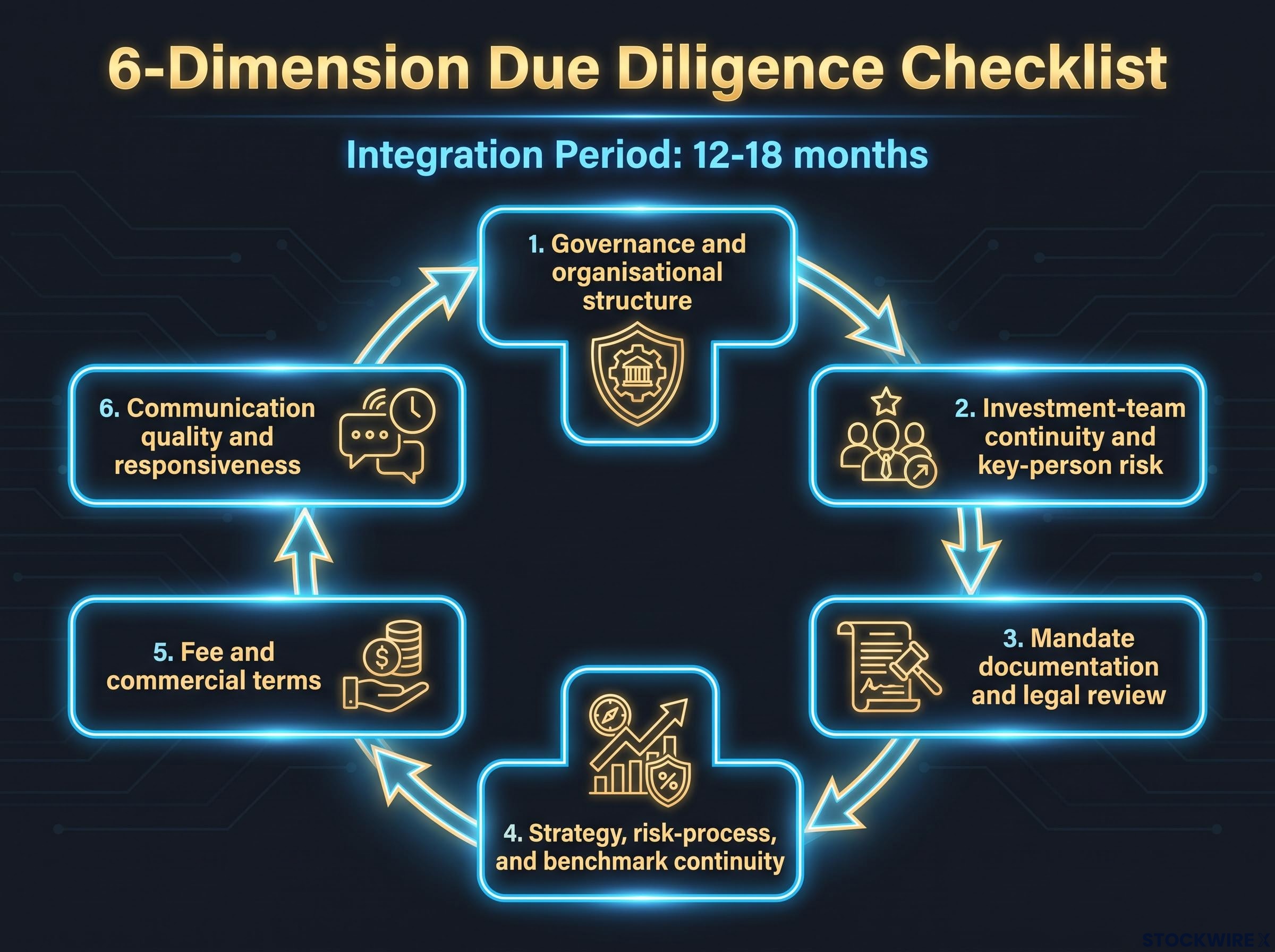
- Governance and organisational structure: Review board composition, reporting lines, risk management, and compliance structures after the transaction.
- Investment-team continuity and key-person risk: Interview the CIO, lead portfolio managers, and research heads to confirm commitment, retention arrangements, and any changes to delegated authority.
- Mandate documentation and legal review: Confirm which legal entity manages the assets post-transaction and whether a change-of-control clause requires action.
- Strategy, risk-process, and benchmark continuity: Verify that investment processes, risk limits, and benchmarks for each mandate remain unchanged or remain appropriate if changed.
- Fee and commercial terms: Check whether pricing, fee schedules, or revenue-sharing arrangements have been altered, and consider whether greater scale should justify a reduction.
- Communication quality and responsiveness: Assess how proactively and specifically the merged entity responds to your inquiries.
The legal dimension carries particular weight. Some arrangements may require novation or formal notice within a defined period, and a missed window is a governance failure that is entirely avoidable.
Action item: key-person and legal review Verify whether your investment management agreement contains a change-of-control or key-person clause, and whether any named portfolio manager departure would trigger an automatic mandate review or termination right. This is a distinct task, not a paragraph in a broader report.
Schroders Australia’s track record is the baseline you are protecting, not a reason to defer. The Schroder Australian Equity Fund held AUD $864 million and outperformed its benchmark by 6.5% over the one year to 1 October 2026, with 1.2% annualised net-of-fee outperformance over five years and since inception. The broader franchise manages AUD $10.2 billion in Australian equities and grew mandates by AUD $2.2 billion in the three years to October 2026. Schroders Capital’s AUD $250 million private-debt mandate, secured in April 2022, evidences an established alternatives capability.
That five-year record is not a reason to wait. It is a reason to act. The specific team, process, and autonomy that generated it are now subject to integration decisions that have not been made, and early due diligence is the mechanism for ensuring they survive the transition intact. Running the review now, while mandates are performing, lets you negotiate from evidence rather than concern.
The bull and bear case for Australian institutions holding their Schroders mandates
Both interpretations of this deal are legitimate, and the honest position is that neither is yet proven.
The constructive and cautious cases
The constructive case rests on resources. Nuveen and TIAA balance-sheet strength could deepen research infrastructure, fund technology investment, and widen the alternatives platform available to Australian clients, with a combined private-markets capability referenced at around $400 billion (a figure not independently verified by primary sources). The 40-plus market footprint is the scale advantage underpinning this view, and in principle it improves rather than diminishes what Schroders Australia can offer.
The cautious case rests on integration risk. Combining a US TIAA-owned manager with a long-standing independent UK active house carries genuine cultural-integration risk. Product rationalisation could affect niche or highly active strategies, and governance complexity increases the oversight burden on your board without any immediate offsetting benefit.
| Dimension | Bull case | Bear case |
|---|---|---|
| Scale and resources | Deeper research, technology, risk systems | Scale favours benchmark-relative, lower-conviction portfolios |
| Alternatives access | Broader private-markets platform for clients | Pressure to favour proprietary internal vehicles |
| Governance | Stronger parent capital backing | Higher oversight burden, cross-business conflicts |
| Cultural integration | Complementary capabilities combine well | US-UK culture clash disrupts teams |
| Local autonomy | Local track record backed by global scale | Centralisation erodes local decision-making |
Three variables that will determine the outcome
Which case proves correct will be decided by three observable indicators during the integration period, not by the deal itself:
- Team-continuity announcements: Whether the portfolio managers and research heads behind the track record are retained with genuine authority intact.
- Local-autonomy and branding decisions: Whether Schroders Australia keeps meaningful independence over portfolio construction and client servicing, or is centralised.
- Quality of client communications: Whether the merged entity engages proactively and specifically, or defaults to generic reassurance.
Treat these as monitoring tripwires rather than pass or fail tests. The 12-18 month timeline means a structured review cadence serves you better than a single decision point. Your rational posture is neither immediate termination of a performing mandate nor unconditional retention, but a monitoring framework that lets the evidence make the call. That protects you from both common failure modes: dumping a good manager prematurely, or passively holding one whose parent context has quietly changed.
What the next 18 months will reveal, and how to position for either outcome
The Nuveen-Schroders combination is neither clearly positive nor clearly negative for Australian institutional clients. The problem is the absence of public guidance on leadership, branding, and local autonomy, which means the next 18 months carry genuine governance uncertainty that warrants structured monitoring rather than a verdict today.
For Australian superannuation trustees, this is a fiduciary matter. The statutory duty to act in members’ best interests is precisely the obligation a parent-change event of this scale is designed to activate, and the appropriate response is a documented governance process, not passive observation.
Superannuation governance obligations have intensified since the introduction of Payday Super on 1 July 2026, which created near real-time payment verification expectations that sit alongside the broader trustee duty to act in members’ best financial interests, the same statutory standard that a parent-change event at a major manager is designed to activate.
Your immediate action set is clear:
- Initiate the out-of-cycle manager review using the six-dimension framework.
- Complete the legal review of your investment management agreement, including any change-of-control or key-person clauses.
- Schedule a formal meeting with Schroders Australia leadership to request specific responses on team continuity and integration planning.
- Set a structured monitoring cadence across the full integration window, not a single review date.
The leading indicator to watch is communication itself. Managers that navigate large acquisitions well tend to demonstrate intent through early, specific, proactive engagement. The quality of Schroders Australia’s response to your inquiries over the coming quarter will itself tell you a great deal about the health of the integration.
This article is for informational purposes only and should not be considered financial advice. Investors should conduct their own research and consult with financial professionals before making investment decisions.
Past performance does not guarantee future results, and forward-looking assessments of the integration are speculative and subject to change based on decisions not yet made by the merged entity.
—