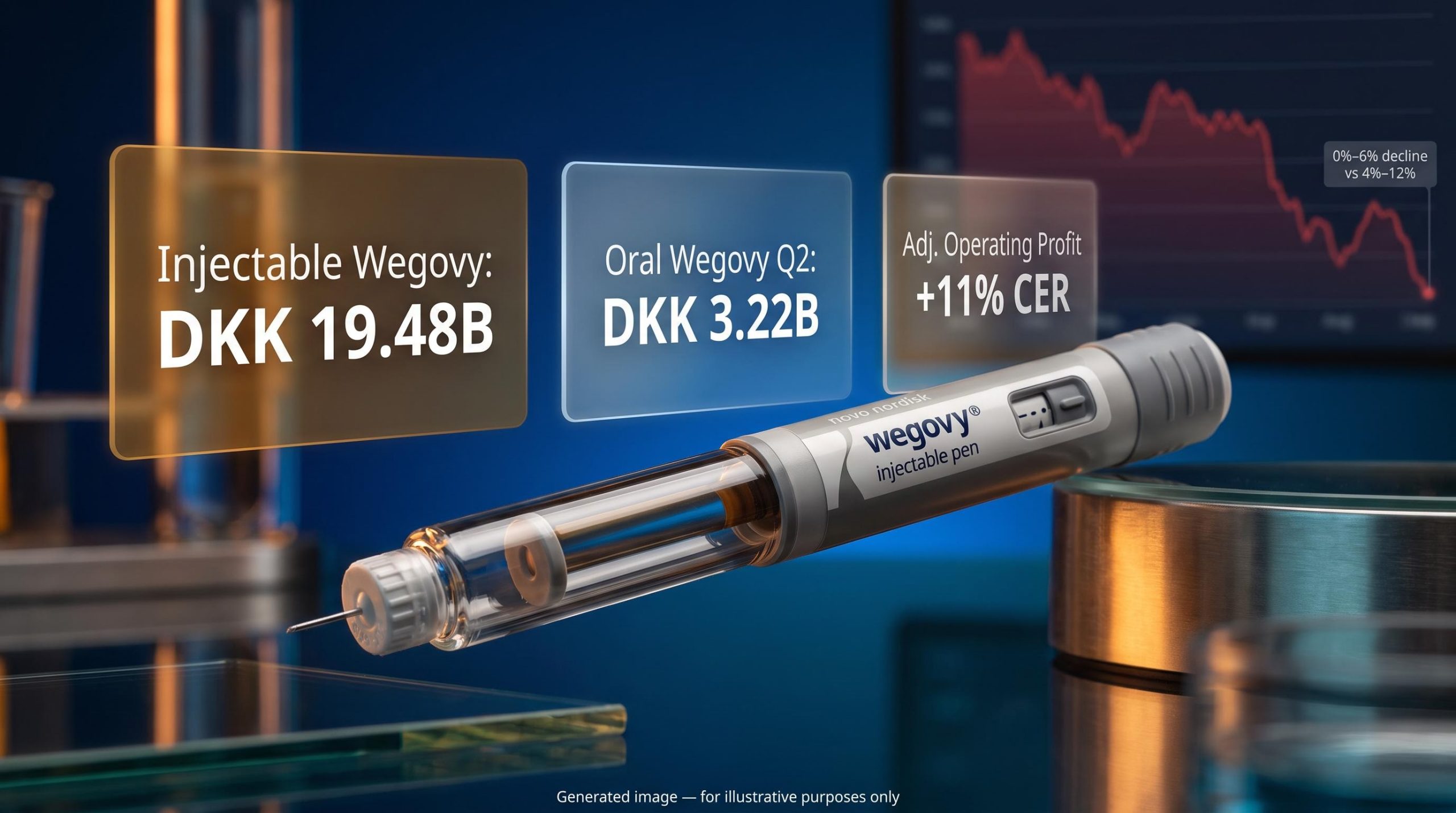
Novo Nordisk raised its full-year profit guidance on 4 August 2026, and its shares fell. That is not a contradiction; it is the signal investors in richly valued pharmaceutical stocks most need to learn to read.
The Q2 2026 results show adjusted operating profit rising 11% at constant exchange rates, injectable Wegovy generating DKK 19.48 billion in revenue, and the guidance range shifting from a decline of 12%-4% to a decline of 0%-6% versus 2025. Yet both revenue and earnings per share (EPS) came in fractionally below consensus, the oral Wegovy figure of DKK 3.22 billion fell short of the DKK 3.3 billion that FactSet-surveyed analysts had pencilled in, and an experimental next-generation compound delivered disappointing clinical results. The market sold the news.
Readers who understand the five analytical layers behind that reaction, from the arithmetic of guidance upgrades to the pipeline and competitive signals that actually drive pharmaceutical valuations, will be better equipped to interpret any major pharma earnings release, not just this one.
When a guidance upgrade is not good enough
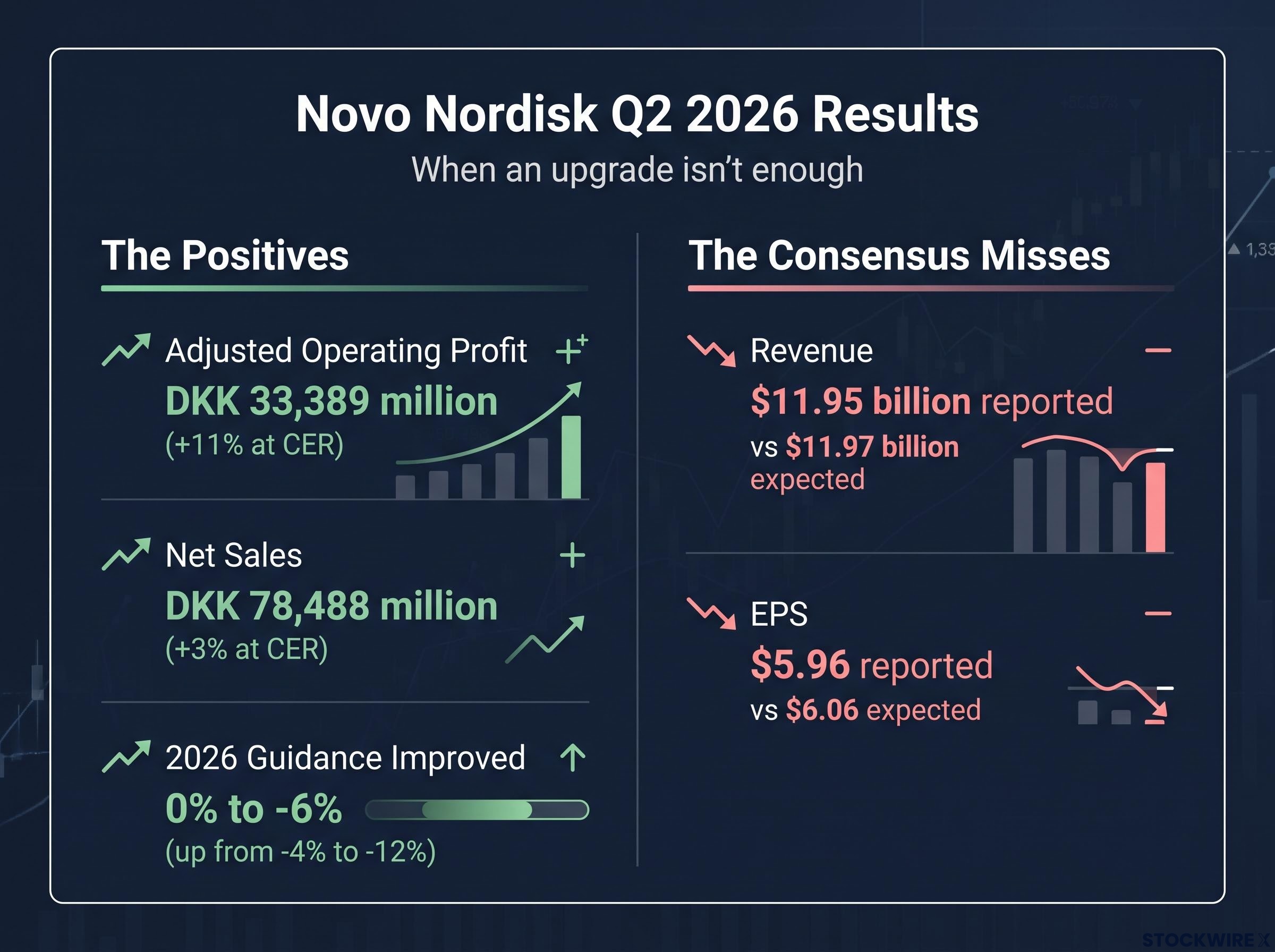
Start with the numbers. For its full year 2026, Novo Nordisk now projects that adjusted sales and adjusted operating profit will contract by between 0% and 6% at constant exchange rates (CER), having previously forecast a fall of between 4% and 12%. That is a meaningful improvement. It is also still a declining year.
The revised 2026 outlook points to adjusted sales and operating profit contracting by 0%-6% at CER, a material improvement on the former guidance of a 4%-12% decline.
Guidance only moves a stock when it surprises relative to what investors already have in their models, not relative to the prior official range. By the time the upgrade landed, the market had already moved its expectations beyond the old guidance floor. The revision confirmed direction. It did not deliver a genuine positive surprise.
The quarterly details reinforced that dynamic. The four metrics that mattered most:
- Net sales: DKK 78,488 million, up approximately 3% at CER
- Adjusted operating profit: DKK 33,389 million, up 11% at CER
- Revenue versus consensus: approximately $11.95 billion reported versus $11.97 billion expected
- EPS versus consensus: approximately $5.96 reported versus $6.06 expected
The misses are small in isolation. Together, they tell you that near-term demand is stabilising, but they do not answer the question investors actually care about: whether Novo Nordisk can return to the growth trajectory that justified its premium valuation.
When big ASX news breaks, our subscribers know first
What the injectable-to-oral gap reveals about Wegovy’s next chapter
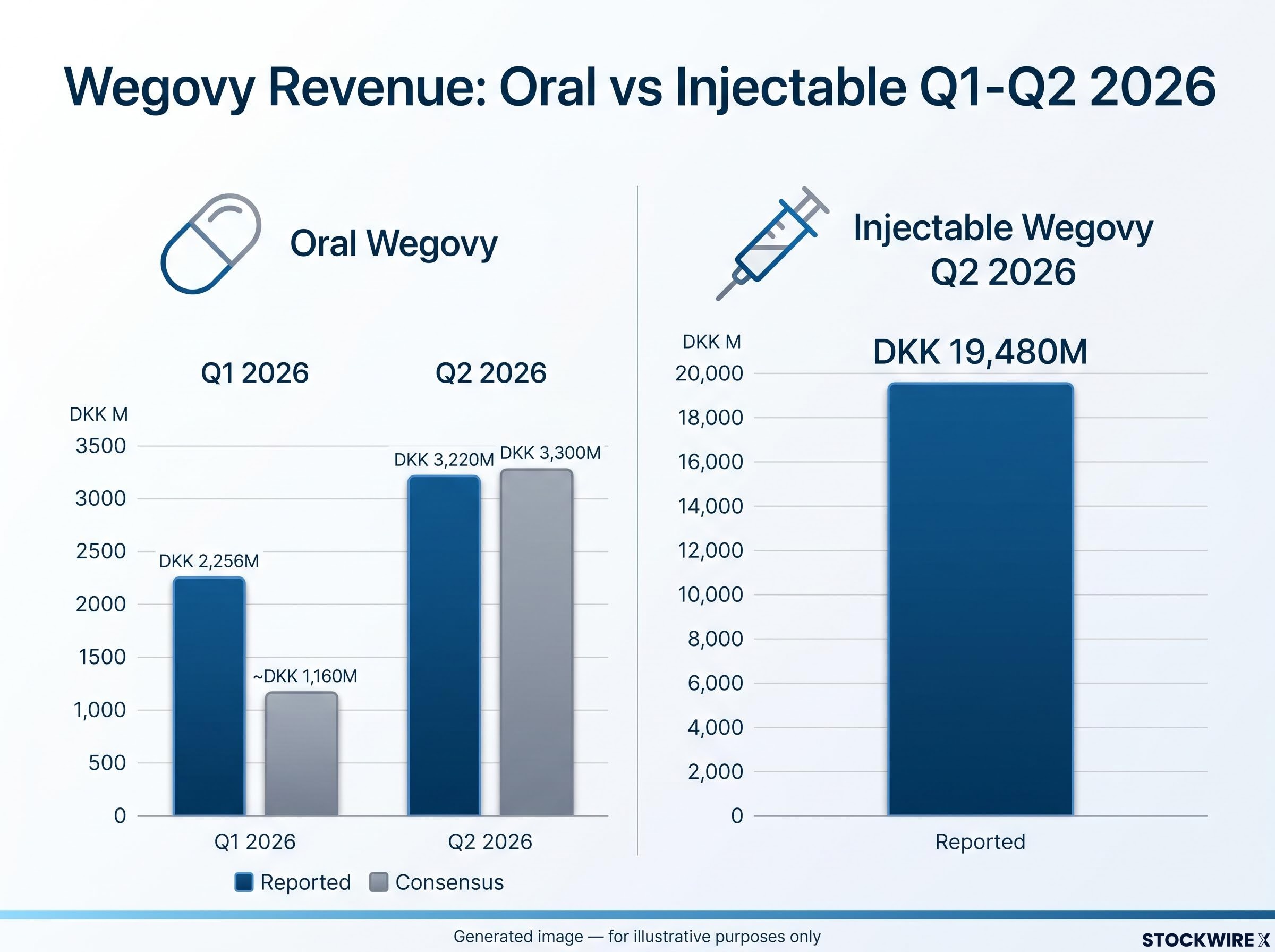
Oral Wegovy launched in the United States on 5 January 2026. Its first full quarter was a statement. Q1 2026 sales reached DKK 2,256 million, nearly double the analyst consensus of approximately DKK 1.16 billion. The pill format had proved it could generate real commercial traction.
Then came Q2. The quarter produced DKK 3.22 billion in oral Wegovy revenue (approximately $500 million at prevailing exchange rates), a sequential increase that nonetheless came in just under the DKK 3.3 billion consensus figure compiled by FactSet. It was not a large miss. It was enough to interrupt the beat-and-raise narrative that had built around the oral launch.
| Metric | Reported | Consensus |
|---|---|---|
| Oral Wegovy Q1 2026 | DKK 2,256M | ~DKK 1,160M |
| Oral Wegovy Q2 2026 | DKK 3,220M | DKK 3,300M |
| Injectable Wegovy Q2 2026 | DKK 19,480M | — |
The injectable franchise still dwarfs the oral business. That is expected at this stage. The question is what the oral sales trajectory tells you about the next chapter.
Cannibalisation or market expansion?
Two interpretations compete for the same data. The bullish read is that oral Wegovy is bringing genuinely new patients into the franchise, people who would not have started an injectable but are willing to take a pill. If true, every oral prescription adds to total revenue without subtracting from the injectable base. The bearish read is that many oral patients are switching from injectables, redistributing existing revenue across formats rather than growing the total.
Analysts have not yet received definitive data on this split, and it will be a primary focus of future quarterly disclosures. The distinction matters enormously: a market-expansion story supports a higher long-run revenue ceiling, while a cannibalisation story caps it. The Q2 miss is not large in absolute terms, but it introduces doubt about whether the oral launch can sustain the trajectory needed to offset pricing and growth headwinds in the injectable franchise.
How GLP-1 drugs work and why the delivery format is a strategic battleground
GLP-1 receptor agonists work by mimicking a hormone your gut naturally produces after eating. That hormone, glucagon-like peptide-1, suppresses appetite and helps regulate blood sugar. The drugs were originally developed for type 2 diabetes and have since been approved for obesity treatment. Semaglutide, the active compound in both Ozempic (for diabetes) and Wegovy (for obesity), is Novo Nordisk’s franchise molecule in both injectable and oral forms.
The difference between a needle and a pill might sound like a convenience issue. For investors, it is a market-size question. The key differences between formats break down across three dimensions:
- Patient experience: An oral daily pill removes the barrier of self-injection, which remains a significant deterrent for a large share of the eligible patient population
- Market expansion potential: A pill format could bring millions of additional patients into treatment who would never have started an injectable, substantially increasing the total addressable market
- Margin implications: Oral formulations have different manufacturing cost profiles and capacity constraints compared to injectable biologics, affecting long-run profitability
Injectable Wegovy generated DKK 19.48 billion in Q2, against total net sales of DKK 78,488 million. The GLP-1 franchise is already the centre of Novo Nordisk’s revenue. For investors, the delivery format debate is a proxy for how large the obesity treatment market can ultimately become. A world where pills replace needles is a world with a substantially larger addressable patient population, which is why every oral sales figure carries outsized signal value.
CagriSema’s setback and what pipeline disappointments do to a premium-priced stock
CagriSema is an experimental combination weight-loss compound designed to succeed the current generation of GLP-1 obesity treatments. Its clinical trial results in the current earnings cycle were described as underwhelming. No catastrophic failure, no programme-ending signal, just results that fell short of the high bar the market had set for Novo Nordisk’s next act.
In a stock priced for sustained innovation leadership, that kind of outcome carries a specific cost. Pharmaceutical valuations partly reflect risk-adjusted net present value (rNPV), a method of estimating a drug’s future revenue potential while discounting for the probability that it might fail in trials or never reach the market. When a pipeline candidate disappoints, rNPV models mark down the probability of success and the projected peak sales, compressing the stock’s forward multiple even if current commercial products are performing adequately.
Pharmaceutical pipeline disappointments compress forward multiples through intrinsic value estimation frameworks that discount pipeline probability of success into net present value models, meaning CagriSema’s underwhelming results reduce the stock’s calculated worth even when the current commercial franchise is performing adequately.
In a richly valued pharma stock, the absence of major positive pipeline news can function as a mild negative surprise.
The CagriSema result matters less as a single data point than as a signal about the degree of difficulty in maintaining innovation leadership in an increasingly competitive obesity drug market. Analysts are now focused on three pipeline areas that will shape the next phase of that competition:
- Combination therapies: GLP-1/GIP, GLP-1/glucagon, and other multi-mechanism approaches targeting greater efficacy
- Oral small-molecule candidates: next-generation pills that could disrupt the injectable category entirely
- Late-stage competitive readouts: meaningful data from both Novo Nordisk and Eli Lilly that will determine relative positioning
Each of these represents a future signal. None delivered a decisive result this quarter, and for a stock carrying Novo Nordisk’s valuation premium, that silence is itself informative.
The competitive reality Novo Nordisk’s earnings cannot change
No single quarterly result alters the structural forces reshaping the GLP-1 market. Eli Lilly’s tirzepatide franchise, marketed as Mounjaro for diabetes and Zepbound for obesity, provides a sustained competitive advantage through its GLP-1/GIP dual-mechanism profile. Lilly is also developing its own oral obesity programme, directly challenging the market-expansion thesis that Novo Nordisk’s oral Wegovy is built on.
The competitive framing has shifted. Two years ago, the question was which company would dominate a hyper-growing market. Now the question is who wins in an increasingly crowded and price-sensitive space. That is a structurally different investment case, and it applies to both companies.
The compounded semaglutide wildcard
Compounded semaglutide products are lower-cost alternatives produced by compounding pharmacies, available primarily in cash-pay channels where patients pay out of pocket rather than through insurance. They emerged because demand for GLP-1 treatments outstripped supply of branded products, and compounding pharmacies stepped in to fill the gap.
The FDA’s compounded GLP-1 enforcement policy clarified the phased wind-down of discretion periods for both 503A compounding pharmacies and 503B outsourcing facilities following the resolution of the semaglutide shortage, the regulatory inflection point that made this competitive threat difficult to model with precision.
Three dimensions of structural risk persist:
- Pricing pressure: Compounded products undercut branded pricing in cash-pay markets, capping Novo Nordisk’s ability to raise or maintain list prices
- Brand erosion: Patient awareness of cheaper alternatives reduces the perceived premium of branded semaglutide
- Regulatory uncertainty: The enforcement and regulatory status of compounded semaglutide remains unresolved, making the competitive threat difficult to model with precision
These headwinds are already embedded in Novo Nordisk’s revised guidance. They are a structural feature of the investment case rather than a temporary distraction. Investors comparing Novo Nordisk to Eli Lilly need to assess not just which company has better current sales, but which has the stronger pipeline and pricing position for the next competitive phase, where the market is no longer simply expanding fast enough to accommodate all players.
Investors comparing the two companies across pipeline depth and pricing position will find our deep-dive into Eli Lilly’s tirzepatide franchise covers orforglipron’s Phase 3 timeline and the market-share mechanics that determine relative positioning in the next competitive phase.
What actually moves Novo Nordisk’s valuation from here
Q2 2026 confirmed the current commercial health of the GLP-1 franchise: adjusted operating profit up 11% at CER, injectable Wegovy generating DKK 19.48 billion. That is the floor, not the catalyst. The variables that will actually move the stock sit elsewhere.
Incremental beats on current injectable sales now carry less informational weight than pipeline readouts and the oral Wegovy trajectory. Q2’s oral baseline of DKK 3.22 billion is the number from which future quarters will be measured. The CagriSema disappointment raises the stakes of the next meaningful pipeline readout. Five forward-looking variables, ordered by signal weight, deserve monitoring:
The implied growth rate embedded in Novo Nordisk’s current share price encodes a specific forward revenue demand, and with the oral Wegovy trajectory now the primary commercial variable, the gap between that mathematical requirement and realistic growth scenarios is the most direct measure of valuation risk.
- Pipeline readouts: Late-stage data on combination therapies and next-generation oral candidates
- Oral Wegovy trajectory: Quarterly sales growth rate and evidence of market expansion versus cannibalisation
- Pricing and reimbursement trends: Movements across public and private payers that affect unit economics
- Competitive data from Eli Lilly: Tirzepatide commercial results and oral programme progress
- Compounded semaglutide regulatory status: Enforcement developments that could expand or shrink the competitive threat
| Variable | Positive signal | Negative signal |
|---|---|---|
| Pipeline readouts | Combination therapy meets or exceeds efficacy targets | Further underwhelming data or trial delays |
| Oral Wegovy trajectory | Sequential growth accelerates; new-patient data confirms expansion | Growth decelerates; evidence of injectable cannibalisation |
| Pricing and reimbursement | Payer coverage expands; net price stabilises | Net price erosion deepens; payer restrictions tighten |
| Eli Lilly competitive data | Lilly oral programme delayed or underperforms | Lilly oral data beats expectations; market share shifts |
| Compounded semaglutide regulation | Regulatory enforcement limits compounded supply | Compounded products gain legal clarity and expand |
Readers who can identify which specific data releases will move a pharmaceutical stock are better positioned than those waiting for a quarterly EPS line to tell them what to think.
Reading the next Novo Nordisk earnings release differently
Guidance upgrades and share price declines can coexist when investor expectations have already moved beyond the official guidance range. That is the paradox Q2 2026 resolved, and it applies far beyond Novo Nordisk.
The five-layer framework, current revenue performance, guidance versus expectations, launch-product trajectory, pipeline signals, and competitive positioning, provides a hierarchy. Pipeline readouts and competitive dynamics now carry more weight than quarterly injectable sales beats. The GLP-1 market is transitioning from a category-growth story to a competitive-advantage story, and investors who understand that transition will interpret future disclosures more accurately than those tracking headline numbers alone.
This article is for informational purposes only and should not be considered financial advice. Investors should conduct their own research and consult with financial professionals before making investment decisions. Past performance does not guarantee future results. Financial projections are subject to market conditions and various risk factors.