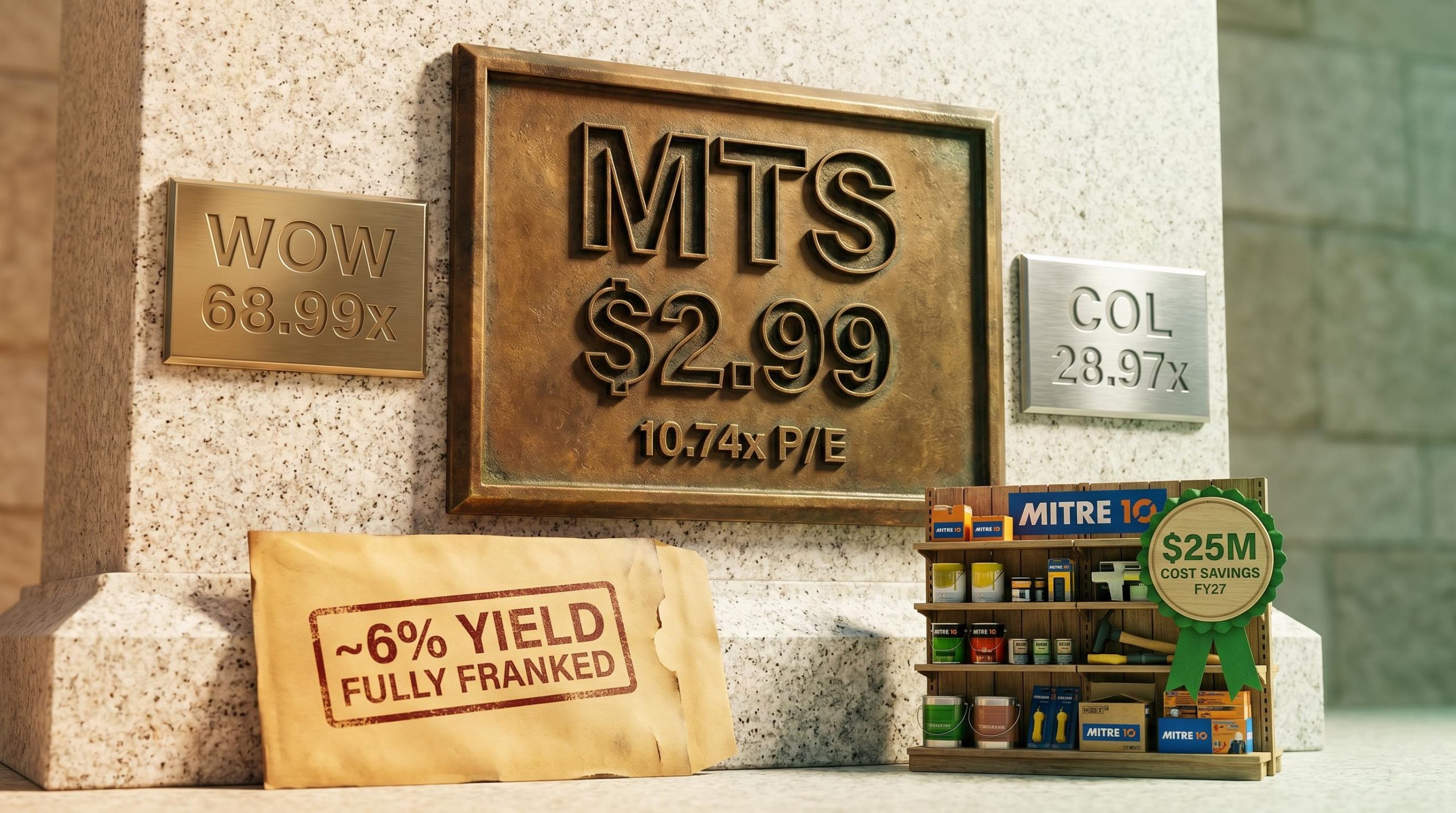
Metcash shares fell roughly 26% in the six months before 11 May 2026, then jumped 9.12% in a single session on the back of a trading update that confirmed full-year earnings and flagged a $25 million cost savings programme. That kind of repricing on a day of no dramatic news revision raises an obvious question: was the selloff overdone?
MTS is currently trading at $2.99, a trailing price-to-earnings (P/E) ratio of 10.74x and a forward P/E of 10.96x, against a market backdrop where Woolworths trades at nearly 69x and Coles at nearly 29x. The gap is extraordinary enough to demand scrutiny: either the market has embedded a structural discount that is entirely justified, or the stock is genuinely mispriced heading into an earnings-catalyst cycle.
What follows works through the MTS investment case from first principles: what the valuation actually reflects, what the cost programme is worth in earnings terms, where the structural risks are real versus overstated, and what conditions would need to hold for the consensus Buy thesis to pay off.
The valuation gap between MTS and its grocery peers is almost impossible to ignore
At $2.99, Metcash trades at 10.74x trailing earnings. Woolworths trades at 68.99x. Coles trades at 28.97x. The numbers, laid side by side, make the case before any interpretation is required.
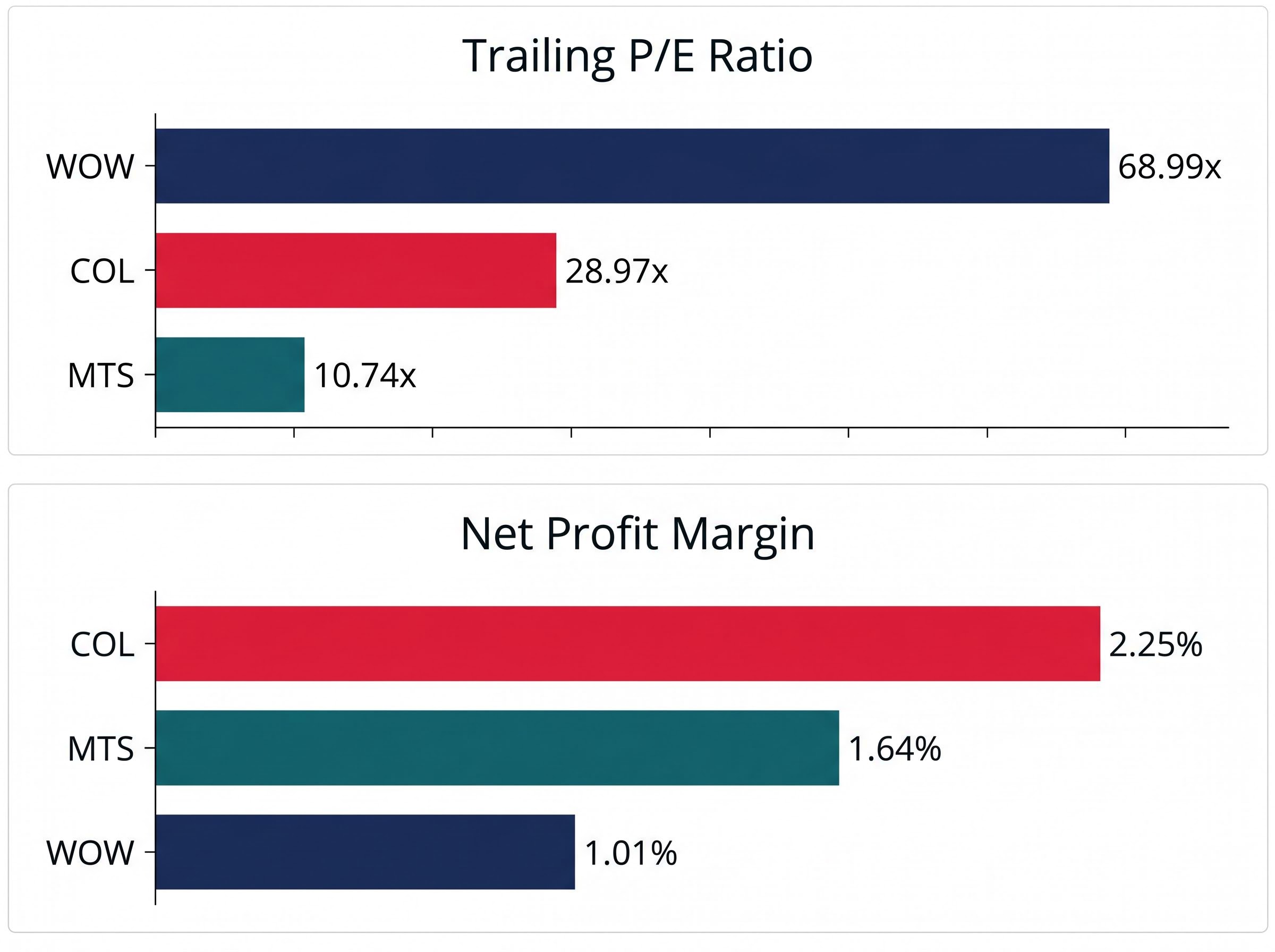
| Metric | MTS | WOW | COL |
|---|---|---|---|
| Trailing P/E | 10.74x | 68.99x | 28.97x |
| Net Profit Margin | 1.64% | 1.01% | 2.25% |
| P/B Ratio | 1.836x | 9.23x | 7.54x |
| ROE (TTM) | 17.5% | Higher (est.) | Higher (est.) |
The simple “MTS is cheap” reading, however, requires a qualifier. Woolworths’ trailing P/E of 68.99x reflects compressed earnings rather than a growth premium; the ratio is inflated by a period of margin contraction, not by expectations of future expansion.
Woolworths’ net profit margin of 1.01% is actually lower than Metcash’s 1.64%, partially undermining the narrative that MTS is the structurally inferior margin business.
That leaves the central analytical question. Is MTS trading at a discount because of genuine structural inferiority in its business model, or because the market is applying a wholesale intermediary penalty that overstates the risk? The answer lies in how Metcash actually makes money.
The ASX consumer staples sector carries a structural beta of approximately 0.55-0.6 against the broader market and recorded a maximum drawdown of around -9% in 2025, roughly half the ASX 200’s equivalent fall, which partly explains why Woolworths and Coles command defensive premiums that a wholesale intermediary like Metcash cannot fully replicate.
When big ASX news breaks, our subscribers know first
What Metcash actually is, and why the wholesale model creates a persistent valuation discount
Metcash operates three segments, each serving independent retailers rather than consumers directly:
- Food: Wholesale supplier to the IGA supermarket network across Australia, competing for shelf space against the vertically integrated models of Woolworths and Coles.
- Liquor: Wholesale distribution to independent liquor retailers, operating in a fragmented but competitive market.
- Hardware and Tools: Operates the Mitre 10, Home Timber & Hardware (HTH), and Total Tools banners through the Independent Hardware Group (IHG), serving trade and professional customers alongside the consumer segment.
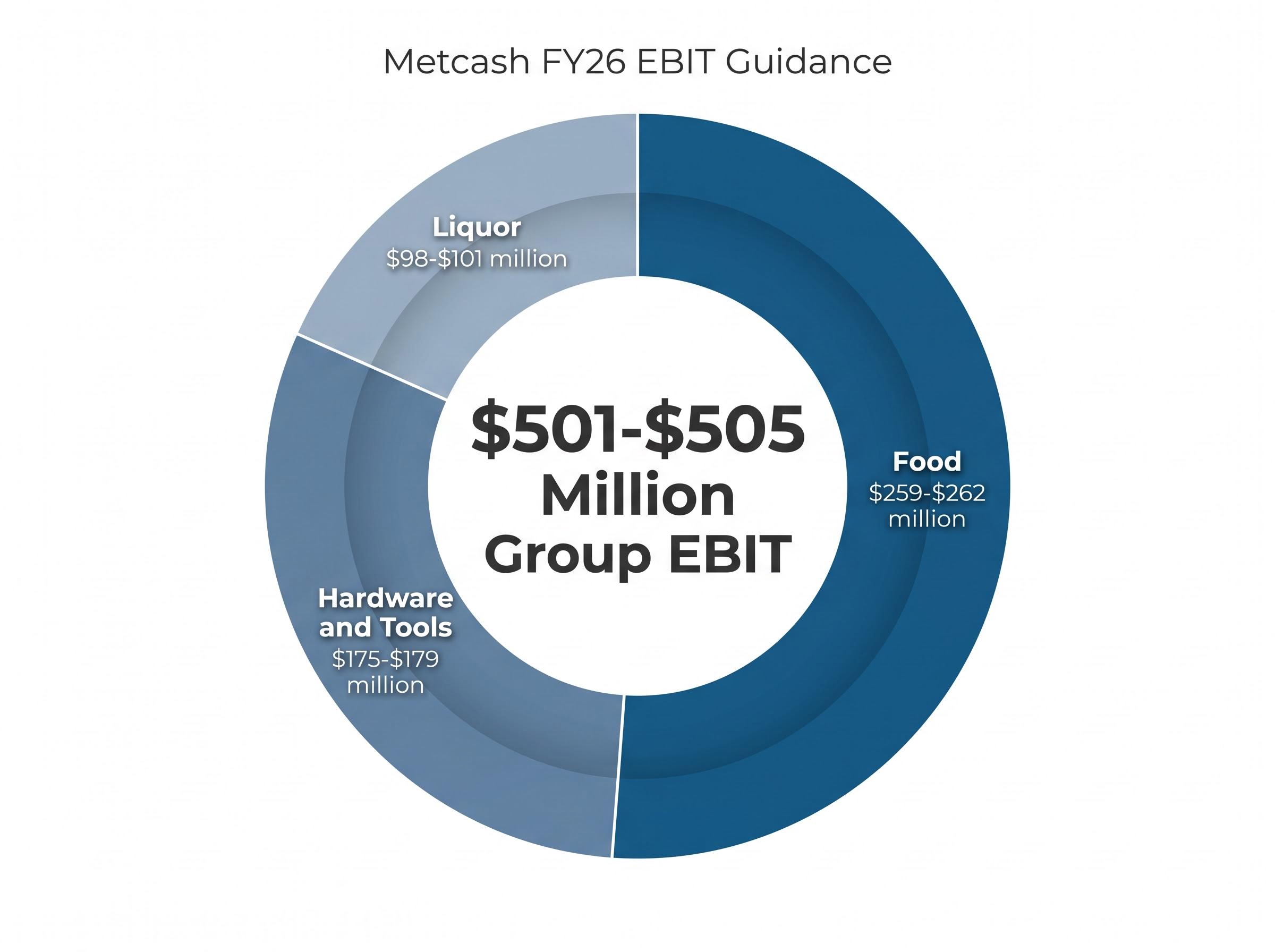
The FY26 trading update confirmed EBIT (earnings before interest and tax, the profit a company generates from its operations) guidance of $501-$505 million across the group, with Food contributing $259-$262 million, Liquor $98-$101 million, and Hardware and Tools $175-$179 million. Group revenue grew 0.7% overall, or 3.8% excluding tobacco.
Wholesale distribution businesses typically trade at lower multiples than integrated retailers. The reasons are structural: thinner margins, limited own-brand pricing power, and customer concentration risk. MTS does not control its shopfront. It supplies it. That distinction permanently compresses the multiple the market is willing to pay.
Coles margin expansion in 1H FY26, driven by automation benefits and strategic sourcing gains that lifted supermarkets EBIT by 14.6%, illustrates the operational advantage integrated retailers hold over wholesale intermediaries: Metcash cannot replicate store-level automation savings across a network it does not own, which is one structural reason the multiple gap is unlikely to fully close.
The Drakes departure and what it tells us about customer concentration risk
The sharpest illustration of that concentration risk arrived in May 2018, when Drakes Supermarkets announced its departure from the Metcash supply network, effective June 2019. The result was a $352 million writedown, comprising a $318 million non-cash impairment and a $34 million asset writedown, recorded in FY18 results.
The Drakes episode is historical and distinct from the current share price weakness, which has been driven by FY26 operating results and broader market conditions. But it remains the baseline case study for what happens when a wholesale intermediary loses a material customer. It is the risk that the valuation discount permanently prices in, and it is the reason MTS will never trade at Coles’ multiple regardless of operational execution.
The $25 million cost programme: real earnings catalyst or incremental noise?
The 11 May 2026 trading update introduced a cost savings programme targeting at least $25 million in annualised savings from FY27. The anatomy is straightforward:
$15 million from labour savings. $10 million from non-trade procurement. These two levers constitute the full programme as currently disclosed.
The question for investors is whether $25 million moves the needle against an FY26 underlying net profit after tax (NPAT) base of $268-$270 million. Working through the arithmetic:
- Pre-tax savings: $25 million in annualised cost reductions, assuming full delivery.
- After-tax impact: At a corporate tax rate of approximately 30%, the after-tax benefit is roughly $17-$18 million.
- EPS implication: Against the current share count, this contributes to the consensus FY27 earnings per share (EPS) growth forecast of approximately 5%, which is already embedded in the forward P/E of 10.96x.
At roughly 9% of FY26 NPAT on a pre-tax basis, a fully delivered programme is not transformational. It is, however, meaningful when layered onto a hardware recovery cycle, and it demonstrates management intent to self-fund earnings growth rather than rely on top-line expansion alone. The risk is execution: labour cost savings in a tight Australian employment market carry implementation risk, and the forward P/E already partially prices in delivery.
Hardware is the swing factor, and the cycle timing is everything
Hardware and Tools contributed EBIT of $175-$179 million at the FY26 guidance midpoint, representing approximately 35% of group earnings. This is the division where the investment thesis is most leveraged and most uncertain.
IHG/Mitre 10 is structurally differentiated from Bunnings (owned by Wesfarmers). Where Bunnings dominates the consumer hardware market with scale, purchasing power, and brand recognition, IHG targets the trade and professional construction segment through its network of independent retailer members. That distinction matters in a housing recovery cycle: trade spending tends to follow construction activity and renovation pipelines, and IHG’s independent network is positioned to capture share in categories where Bunnings’ consumer orientation is less competitive.
The broader hardware distribution market context matters here: Stealth Group’s record half-year results following its HBT acquisition position it as a third independent competitor in a segment estimated at $93 billion, adding competitive texture to the trade and professional construction channels where IHG and Mitre 10 are most active.
MFAM Research holds a Buy rating on MTS with a price target of $3.80, implying approximately 27% upside from $2.99. The thesis centres on a hardware division re-rating as the Australian housing cycle accelerates.
MFAM Research’s price target of $3.80 represents the most optimistic end of the analyst range, against a consensus average of $3.43 (TipRanks, May 2026).
Why the recovery timing has already slipped, and what that means for the bull case
The FY26 trading update explicitly described trade market conditions as soft and acknowledged the recovery timeline had extended beyond earlier expectations. This is the single most important caveat in the bull case: analyst consensus positions the cycle bottom at H2 FY26, with acceleration into FY27, but that call has already been pushed back once.
A delayed recovery extends the earnings catalyst window rather than eliminates it, provided the underlying housing cycle thesis remains intact. Wesfarmers’ net profit margin of 6.60% (TTM) serves as a reminder of the competitive scale gap MTS faces in hardware, even with favourable cycle timing.
Dividends, buybacks, and what the capital allocation signals about management confidence
At $2.99, Metcash offers a dividend yield of approximately 6%, supported by a payout ratio estimated at 60-70% of NPAT. The H1 FY26 interim dividend was declared on 1 December 2025. Against NPAT guidance of $268-$270 million, the yield appears sustainable at current levels.
The capital allocation picture extends beyond dividends. Management is running an ongoing share buyback programme, a signal that carries specific implications at current valuations:
- Dividend yield: Approximately 6%, fully franked, at $2.99.
- Buyback programme: Ongoing, as noted by MFAM Research, intended to support EPS performance in the post-guidance period.
- EPS accretion logic: At sub-11x earnings, buybacks are mathematically accretive. Every share retired at $2.99 removes equity valued at roughly $0.28 in annual earnings, reinforcing the 5% consensus FY27 EPS growth forecast.
| Capital Return Mechanism | Current Metric | Investor Significance |
|---|---|---|
| Dividend Yield | ~6% (fully franked) | Income floor at current price levels |
| Payout Ratio | 60-70% of NPAT | Sustainable against $268-$270m guidance |
| Buyback Programme | Ongoing | EPS accretive at sub-11x earnings |
Management returning capital via buybacks at these price levels implies a view that the stock is undervalued relative to intrinsic value. Capital allocation decisions of this nature only make economic sense if the board believes the shares are priced below the present value of future cash flows.
At $2.99, the risk/reward balance tilts toward the bull case, but not without conditions
The bear case against MTS is not fabricated. Wholesale intermediaries carry permanent structural ceilings on multiple expansion, customer concentration risk is embedded in the food division, and the hardware recovery has already slipped once. These are legitimate constraints.
The bull case, however, rests on three specific conditions:
- Cost programme delivery: The $25 million savings target is executed on schedule, with labour and procurement reductions translating to the bottom line by H2 FY27.
- Hardware cycle materialisation: Trade market conditions improve in line with the consensus view that H2 FY26 marks the cycle bottom, with acceleration into FY27.
- Food network stability: No material customer departures from the IGA wholesale network, avoiding a repeat of the Drakes-style writedown scenario.
MTS will not re-rate to 29x like Coles or anywhere near Woolworths’ levels. The structural ceiling is real. Investors entering at current levels should calibrate expectations to the analyst consensus range of $3.43 to $3.80, not to a multiple re-rating scenario.
At sub-11x earnings with a 6% yield and buyback support, the downside is cushioned even if the hardware recovery is delayed. The 26% prior decline has done the market’s work in pricing risk; the cost programme and hardware cycle are the variables that determine whether upside is captured.
The weight of evidence, including the analyst consensus Buy rating, the MFAM target of $3.80, and the valuation floor established by the dividend yield, suggests the current discount overshoots structural risk rather than appropriately prices it. That conclusion, however, is conditional on execution.
Where MTS sits heading into full-year results, and what to watch
The full FY26 results are expected in June 2026 and will provide the first complete view of segment-level performance since the trading update. Key metrics to monitor:
- Hardware and Tools EBIT against the $175-$179 million guidance range, with particular attention to commentary on trade market conditions and recovery sequencing.
- Cost savings run-rate disclosures, confirming whether the $25 million annualised target is tracking to plan or encountering implementation headwinds.
- Food network customer retention, including any commentary on IGA retailer churn or competitive dynamics with Woolworths and Coles.
- Net debt and leverage ratios, which were not available in the trading update and will be reported for the first time in the full results.
The 11 May trading update resolved some uncertainty and prompted the 9.12% single-session rally. The June results will be the first real test of whether management’s cost savings framing holds up under analyst scrutiny, with divisional EBIT granularity providing the data needed to validate or challenge the consensus Buy thesis at an average target of $3.43.
The MTS bull case rests on execution, not re-rating hope
Metcash at $2.99 is not a valuation story that requires multiple expansion. It is a yield and cost-discipline story that pays even in a flat-market scenario: a 6% fully franked dividend, a mathematically accretive buyback, and a cost programme that contributes to 5% consensus EPS growth in FY27.
The structural ceiling is real. MTS will not trade at 25x earnings. Investors entering at current levels should calibrate expectations to the $3.43-$3.80 analyst consensus range rather than sector multiples.
The 26% prior decline has done the market’s work in pricing downside. The cost programme and hardware recovery are the variables that determine whether the upside is captured. The June 2026 full-year results will deliver the segment-level detail needed to test this thesis against divisional reality. Until then, the balance of evidence favours the patient buyer over the sceptic, provided execution follows intent.
For investors weighing whether the structural discount on ASX domestic-facing stocks like Metcash is likely to persist or narrow, our full explainer on Australian investor trends and home bias documents the shift that saw international ETFs overtake domestic ETFs as the most purchased category on Selfwealth by Syfe in Q1 2026, examining what that capital rotation means for the relative demand outlook for ASX mid-cap value names.
This article is for informational purposes only and should not be considered financial advice. Investors should conduct their own research and consult with financial professionals before making investment decisions. Past performance does not guarantee future results. Financial projections are subject to market conditions and various risk factors.