Meta’s shares climbed as much as 5% after hours on 21 October 2026. By the close of the next regular session, they had fallen more than 7%.
Between those two moves sat a quarter in which revenue jumped 26% to $64.60 billion. If you read that reversal as the market shrugging off good news, you may be misreading the signal. Strong growth was never what investors were pricing in Meta’s Q3 2026 earnings.
What they were pricing was cost. Adjusted operating margin fell about 500 basis points to roughly 35%. Full-year expense guidance climbed to $175-$179 billion.
The question hanging over the stock is no longer whether Meta can grow. It is whether its AI spending is turning into returns.
This analysis covers three things. First, what the quarter’s data says about whether AI is paying off. Second, how Morningstar’s $850 fair value and 4-star rating fit the picture. Third, which AI revenue paths sit outside that model entirely. All figures are as of 25 October 2026.
What did Meta’s third quarter show beneath the 26% revenue headline?
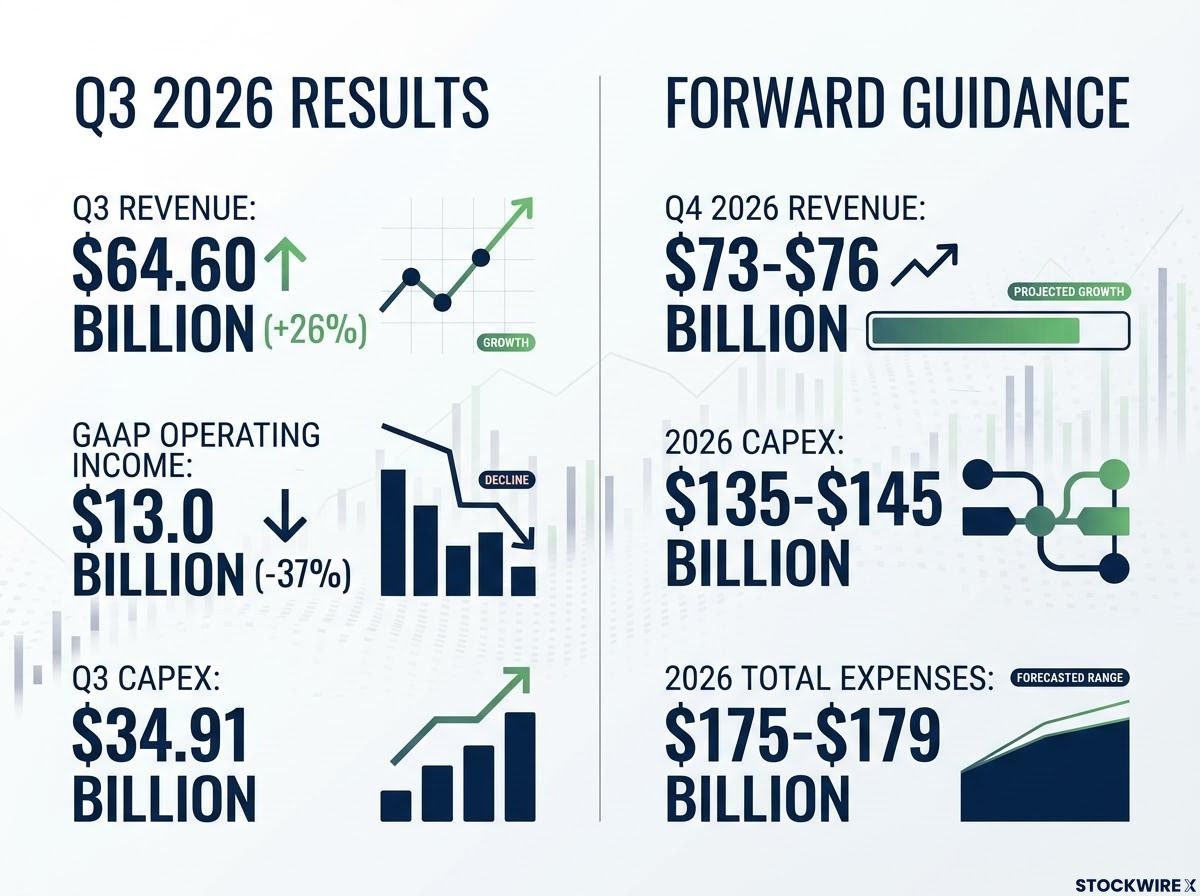
The top line was strong by any measure. Meta Platforms grew revenue 26% year over year to $64.60 billion for the quarter ended 30 September 2026. Adjusted earnings per share came in at $7.40.
Then the GAAP figures arrive, and the picture darkens. GAAP (generally accepted accounting principles, the standard rules companies must follow in official filings) operating income fell 37% to $13.0 billion, a 20% margin.
That decline is mostly one item. A roughly $9.9 billion legal charge tied to an August 2026 agreement with multiple state attorneys general dragged the GAAP result down. Excluding it, GAAP operating income would have risen.
The same tension appeared going into the previous report, as the Q2 earnings preview showed EPS growth tracking near 1% against double-digit revenue growth, with capex rather than the headline beat setting the tone.
Results versus guidance
| Metric | Figure | Note |
|---|---|---|
| Revenue | $64.60B | Up 26% year over year |
| GAAP operating income | $13.0B | Down 37%; 20% margin, hit by legal charge |
| Adjusted operating margin | About 35% | Down about 500 basis points |
| GAAP diluted EPS | $3.83 | Includes legal charge |
| Adjusted EPS | $7.40 | Excludes legal charge |
| Q3 capex | $34.91B | Includes principal payments on finance leases |
Guidance tells you where the spending goes next:
- Q4 2026 revenue: $73-$76 billion, implying about 21%-27% growth
- 2026 capex: $135-$145 billion, with the lower end lifted from $130 billion
- 2026 total expenses: $175-$179 billion, up from $165-$169 billion
- 2027: no formal capex or expense guidance yet
That last gap is an open question, and markets dislike open questions about the size of a bill. The read you should take from this section is simple: the GAAP decline overstates the damage, while the adjusted margin drop is the honest measure of what the AI build-out costs.
When big ASX news breaks, our subscribers know first
Why are margins compressing, and is it temporary?
If the legal charge is a one-off, the 500-basis-point adjusted squeeze is not. Morningstar analyst Malik Ahmed Khan points to growing AI expenses as the main cause.
The mechanics matter here. Capital expenditure (capex) is money spent on long-lived assets such as buildings and equipment. It does not hit profit all at once. Instead, it is spread across the asset’s useful life as depreciation, a recurring annual expense that shows up in operating costs.
Five drivers are pushing on the margin:
- Depreciation: data centres, servers and networking gear entering service turn past capex into ongoing expense.
- Compute costs: Muse is expensive to run, which partly explains why Meta has not launched it globally. Management expects to improve its cost efficiency by more than 10x over the next year.
- AI talent: competition for researchers and engineers lifts pay, even with headcount down 15% to 66,775.
- Reality Labs: Morningstar treats it as a consumer of capital without comparable profit.
- Legal costs: the $9.9 billion charge, separate from the AI cost story.
The capex wave keeps building. Melissa Otto of S&P Global Visible Alpha told Fortune that consensus 2026 capex has risen by more than $14 billion since April to about $140 billion, nearly twice the 2025 level. Wedbush’s Ygal Arounian expects about $249 billion in 2027, though that is an analyst estimate, not Meta guidance; other published estimates sit near $193 billion or $205 billion.
The capex wave builds on commitments made earlier in the year, when Meta’s locked-in infrastructure obligations and a guidance raise already cut analyst free cash flow estimates, so this quarter’s spending guidance extends a pattern rather than starting one.
What 2022 does and does not tell us
Morningstar frames this as an investment cycle. The risk is that it becomes structural if utilisation or monetisation lags.
The 2022 lesson (American Century) Capex rose roughly two-thirds, EPS fell nearly 40% and shares fell about 75% peak to trough. Investors tolerate heavy investment when the core business accelerates, not when it weakens.
Today’s revenue growth is far stronger than it was then. But the market is running the same test again: can infrastructure spending become durable returns? For you, the practical check each quarter is whether revenue growth keeps outrunning cost growth. Once it stops, tolerance can reverse quickly.
Is AI starting to pay off? Reading the early signals
The evidence splits cleanly in two, and the advertising half looks good.
Evidence in advertising
Ad impressions rose 10% and average price per ad climbed 14%. Morningstar credits AI-driven content and ad technology for the gains and believes they are lifting Meta’s share of digital ad spending. Family daily active people reached 3.64 billion, up 3%.
The balance is the point. Growth in both volume and price tells you AI is improving the existing ad machine, rather than squeezing higher prices out of a shrinking audience.
Evidence in Muse and new products
More than 10 million people in the US and Canada set up Muse personal agents in about six weeks. Muse is expected to stay free for most users, with businesses paying through several routes:
- Commerce fees
- Paid subscriptions
- Additional token usage
- Business subscriptions
- APIs and Muse Code
- Enterprise agents
Morningstar called the adoption “early”, and that word carries weight.
| Signal | Evidence | Stage |
|---|---|---|
| AI-improved ad targeting | Impressions up 10%, price per ad up 14% | Proven |
| Muse consumer adoption | More than 10 million users in about six weeks | Early |
| Muse and enterprise revenue | Monetisation paths outlined, not yet reported | Unproven |
The bear case, reported by Reuters, is that investors are less willing to treat AI spending as costless optionality. Meta also disclosed plans for a new non-voting share class that could raise hundreds of billions of dollars over several years. You are left holding two truths: AI is paying off inside the ad business, while Muse revenue remains a future option rather than a present earner.
What does Morningstar’s $850 fair value assume, and what sits outside it?
Strip out the after-hours jump and the next-day slide, and an anchor remains. Morningstar maintained its fair value estimate and considers the shares undervalued.
Morningstar’s view (as of 22 October 2026) Fair value: $850 per share. Rating: 4 stars against a $697.52 close on 21 October. Wide moat, high uncertainty, reflecting the scale of unprofitable AI and Reality Labs investment.
What the model assumes and omits
Morningstar maps several AI revenue paths: advertising, enterprise intelligence via Meta Enterprise, selling surplus compute to other AI labs, and revenue share from agentic commerce. Agentic-commerce take rates, AI subscriptions and enterprise revenue are excluded from its model. If they scale, they could add upside.
The likely sequence is advertising and engagement first, then enterprise and developer products, then agent monetisation. What this tells you is that the undervalued call rests on the core business. The unmodelled AI revenue is optionality, not a base case to count on.
For readers wanting to test fair value claims themselves, our dedicated guide to valuing stocks with a margin of safety shows how to build an intrinsic value estimate from projected free cash flow.
Risks that could change the picture
| View | Reasoning | Source |
|---|---|---|
| Bull: AI reinforces ads | Better targeting lifts engagement and pricing | Meta Q3 release and call |
| Bull: multiple AI revenue streams | Enterprise, surplus compute, commerce revenue share | Morningstar; MarketBeat |
| Bear: uncertain capex returns | Tolerance can reverse if ad growth slows | Reuters; American Century |
| Bear: financing risk | New non-voting share class to fund AI | Reuters |
| Regulatory and adoption risk | Youth-safety litigation; uneven business uptake of agent-to-agent commerce | Meta call; Investing.com |
The biggest structural exposure is advertising itself. A downturn in the ad cycle could arrive before AI revenue matures, and that is the scenario that would test the fair value hardest.
Past performance does not guarantee future results. Fair value estimates and financial projections are subject to market conditions and various risk factors, and forward-looking statements may change based on market developments and company performance.
Weighing heavy AI spend against long-term upside: what to watch next
The quarter drew a clear line. AI’s operational payoff is visible in advertising, while the economic return on infrastructure remains unproven. The stock now trades on the gap between the two.
Three indicators will show which way that gap moves:
- Whether ad impressions and price per ad keep growing together
- Whether Meta issues formal 2027 capex and expense guidance
- Whether Muse monetisation or enterprise revenue starts appearing in reported results
If all three trend well, the spending case strengthens. If the core business slows while costs climb, the 2022 pattern becomes the relevant guide. Your decision rests on which of those you think is more likely.
This article is for informational purposes only and should not be considered financial advice. Investors should conduct their own research and consult with financial professionals before making investment decisions.