The largest battery in Poland has no publicly reported price tag, yet its revenue is already secured. Greenvolt Power began construction in September 2026 on the 600 MW/2.4 GWh Siedlce project. The gap between what this battery investment guarantees and what it costs is the signal most coverage skips.
Siedlce is the biggest of three projects that together form a 1 GW/4 GWh Polish portfolio. That portfolio sits inside a company-stated probability-weighted battery pipeline of roughly 4.6 GW.
Storage now plays a growing role in how investors value renewable and infrastructure companies. Projects like Siedlce are where that thesis gets tested.
This piece shows you how to read a storage buildout as an investor. It covers what has been de-risked, what has not, and which questions remain open before you can judge the returns.
What is actually being built at Siedlce, and what is still unknown?
Siedlce pairs 600 MW of power with 2.4 GWh of storage. That means it can discharge at full output for about four hours. The site will hold 210 battery containers and 105 transformer containers. The transformer containers house power conversion systems, which are the equipment that moves electricity between the batteries and the grid.
The project is expected to become Poland’s largest battery energy storage system (BESS) and one of the largest in Europe. Delivery has kept to its guided track so far. In July 2026, reports pointed to a Q3 2026 construction start. Work began in September, and commercial operation is targeted by the end of 2027.
According to a PES release dated 1 July 2026, the project has already secured revenues through Poland’s capacity market. A capacity market pays owners to keep capacity available for times when the grid needs it.
Project purpose Energy Global reports that Siedlce is designed to add flexibility to the Polish grid. It will store electricity when renewable output runs high and release it as demand climbs.
The available sources do not show Siedlce’s capital expenditure or its project financing package.
The secured capacity-market income gives the asset a semi-regulated revenue floor. Without a capex figure, however, you have no way to judge what return that floor actually delivers.
The missing capex figure matters because a live per-megawatt BESS benchmark now exists: a European operational two-hour portfolio recently changed hands at roughly $1.15 million per megawatt, giving investors a reference floor for judging what a project like Siedlce might be worth.
Who is delivering it
- BYD Energy Storage: battery supply, under a July 2026 Siedlce deal that follows a March 2025 agreement covering up to 1.6 GWh
- P&Q: grid connection works, including a new 400/110 kV substation and cable links
- ONDE: electrical infrastructure
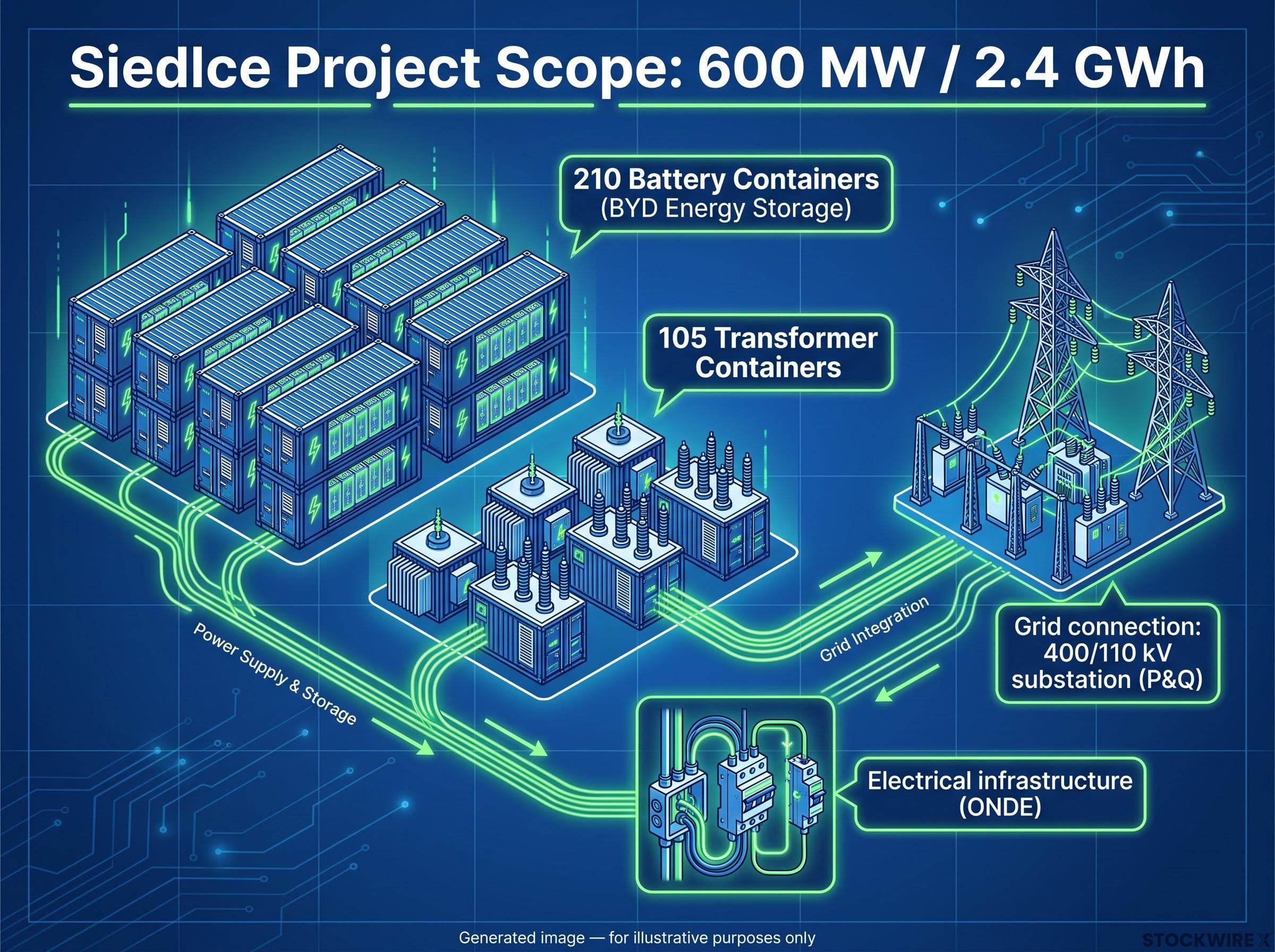
BYD’s presence across the portfolio allows Greenvolt to standardise its equipment. It also concentrates supplier exposure, a risk covered below.
When big ASX news breaks, our subscribers know first
How do grid-scale batteries earn their place in a renewable-heavy system?
Solar panels produce the most power around midday, when demand is often modest. Demand peaks in the evening, after the sun has faded. Without storage, some of that midday surplus is curtailed, meaning it is wasted because the grid cannot absorb it.
A four-hour battery absorbs that surplus and sells it back into the evening peak. Siedlce’s duration comes from simple division: 2.4 GWh divided by 600 MW equals four hours, which is long enough to cover a typical evening demand spike.
Poland makes the case sharper. Analyses from the IEA and Ember describe the Polish grid as coal-heavy and gradually decarbonising. Coal plants have traditionally supplied grid flexibility, so batteries are one of the tools for replacing that role with cleaner balancing.
The money arrives through several routes:
- Capacity payments: fees for being available when the grid is tight, as with Siedlce
- Tolling: a third party pays a fixed fee to operate and trade the battery
- Arbitrage: charging when prices are low and discharging when they are high
- Frequency and balancing services: fast responses that help system operators such as PSE keep the grid stable
Transmission-connected assets like Turośń Kościelna, which links to the grid at 110 kV, are technically well placed to sell those balancing services.
Tolling benchmark SolarQuarter reports that Statkraft’s 10-year tolling agreement over Turośń and Ełk is the largest publicly communicated BESS tolling transaction in the EU to date.
Aggregate Polish BESS capacity and capacity-market auction results for batteries were not found in the available sources.
A battery’s value comes from the stack of services it can sell, not from storing power alone. For you, that means the contract structure behind a project matters as much as its megawatt count.
Where does Siedlce sit in Greenvolt’s Polish portfolio and pipeline?
Start with the two smaller assets. Turośń Kościelna holds 200 MW/800 MWh and was inaugurated in July 2026. Ełk, also known as Nowa Wieś Ełcka, matches that size, is already grid-connected, and is expected to reach commercial operation in Q4 2026.
Together they add up to 400 MW/1.6 GWh. When Siedlce’s 600 MW/2.4 GWh is added, the total reaches 1 GW/4 GWh, with Siedlce supplying 60% of the power.
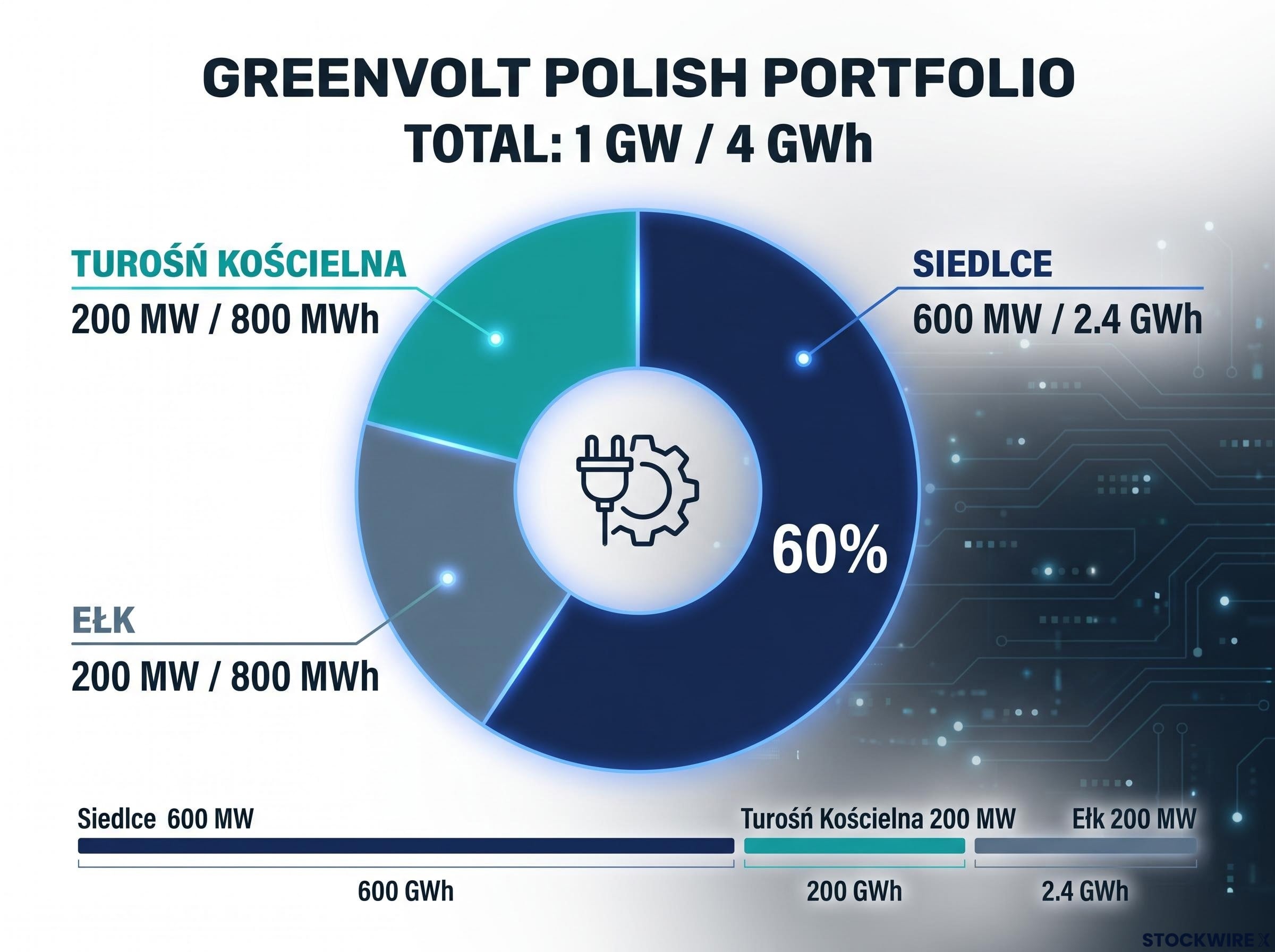
| Project | Size | Status | Financing or offtake |
|---|---|---|---|
| Siedlce | 600 MW/2.4 GWh | Construction since September 2026; COD targeted by end-2027 | Capacity market revenue; financing not disclosed |
| Turośń Kościelna | 200 MW/800 MWh | Operating; inaugurated July 2026 | UniCredit, EBRD, Statkraft tolling |
| Ełk | 200 MW/800 MWh | Grid-connected; COD expected Q4 2026 | UniCredit, EBRD, Statkraft tolling |
The two smaller projects carry heavy outside backing. UniCredit provided a €218 million financing package, the EBRD has loans covering both systems, and Statkraft holds operational and trading rights over the full 400 MW/1.6 GWh.
That backing shows you how lenders and an offtaker have already priced Greenvolt’s execution. Siedlce, at one and a half times the size of the other two combined, is the larger test of that confidence.
Greenvolt Power is the utility-scale arm of Greenvolt Group, which also sells behind-the-meter storage through Greenvolt Next. Group earnings and ownership detail were not found.
Reading the pipeline numbers
Company statements put the probability-weighted BESS pipeline at about 4.6 GW, with roughly 2.4 GW of that in Poland. ESS News reported about 5 GW of storage within a 12.8 GW European pipeline. Probability weighting discounts each project by its likelihood of being built, which may explain the gap.
Either way, you should treat pipeline gigawatts as potential capacity rather than contracted capacity.
What could erode the investment case, and what supports it?
The case for
Storage demand is structurally tied to renewable growth and electrification. Siedlce’s capacity-market income, the Statkraft toll on the smaller assets, and lender commitments from UniCredit and the EBRD all point to stacked, partly contracted revenue.
The case against
Early battery owners in the UK and Germany, running projects of roughly 100-300 MW, earned high frequency-response prices that fell as more capacity arrived. Australian batteries have also seen margins compress as competitors entered. Greenvolt is bringing 1 GW/4 GWh online in Poland within a short window, which raises the question of how quickly the same pattern could repeat there.
Ranked by relevance to Siedlce, the main risks are:
- Grid connection: the new 400/110 kV substation could delay commissioning.
- Execution: Siedlce is far larger and more complex than its predecessors.
- Supplier concentration: all three projects rely on BYD, amid growing European scrutiny of Chinese clean-tech.
- Market design: changes to capacity-market rules would flow straight into the project’s economics.
- Interest rates: higher rates raise debt costs, and lender covenants can amplify the impact of delays.
- Fire safety: an incident could force retrofits or tighter rules, although the retrieved sources reported no safety incidents.
Contracted versus merchant Capacity-market income gives Siedlce a floor. The Statkraft toll moves market and regulatory risk off Greenvolt’s books and onto Statkraft’s. Projects without either arrangement depend on uncertain price spreads.
Capex, earnings and capacity-market clearing prices all remain undisclosed. Given those gaps, judge your storage exposure by contract quality and delivery risk rather than by headline megawatts.
What to watch as Siedlce moves toward 2027
Siedlce is a large build with secured revenue, but its returns remain undisclosed. Your read on the investment therefore depends on delivery progress and on the detail of its contracts.
Watch for:
- Ełk reaching commercial operation in Q4 2026
- Any Siedlce financing or offtake announcement
- Progress on the substation and grid connection
- Polish capacity-market rule changes and auction updates
- The stability of BYD supply
If you are weighing renewable or infrastructure companies with storage exposure, the questions to ask are which revenues are contracted, who carries the market risk, and whether delivery is on schedule.
This article is for informational purposes only and should not be considered financial advice. Investors should conduct their own research and consult with financial professionals before making investment decisions. Forward-looking timelines are company targets and are subject to change based on market developments and project performance.