


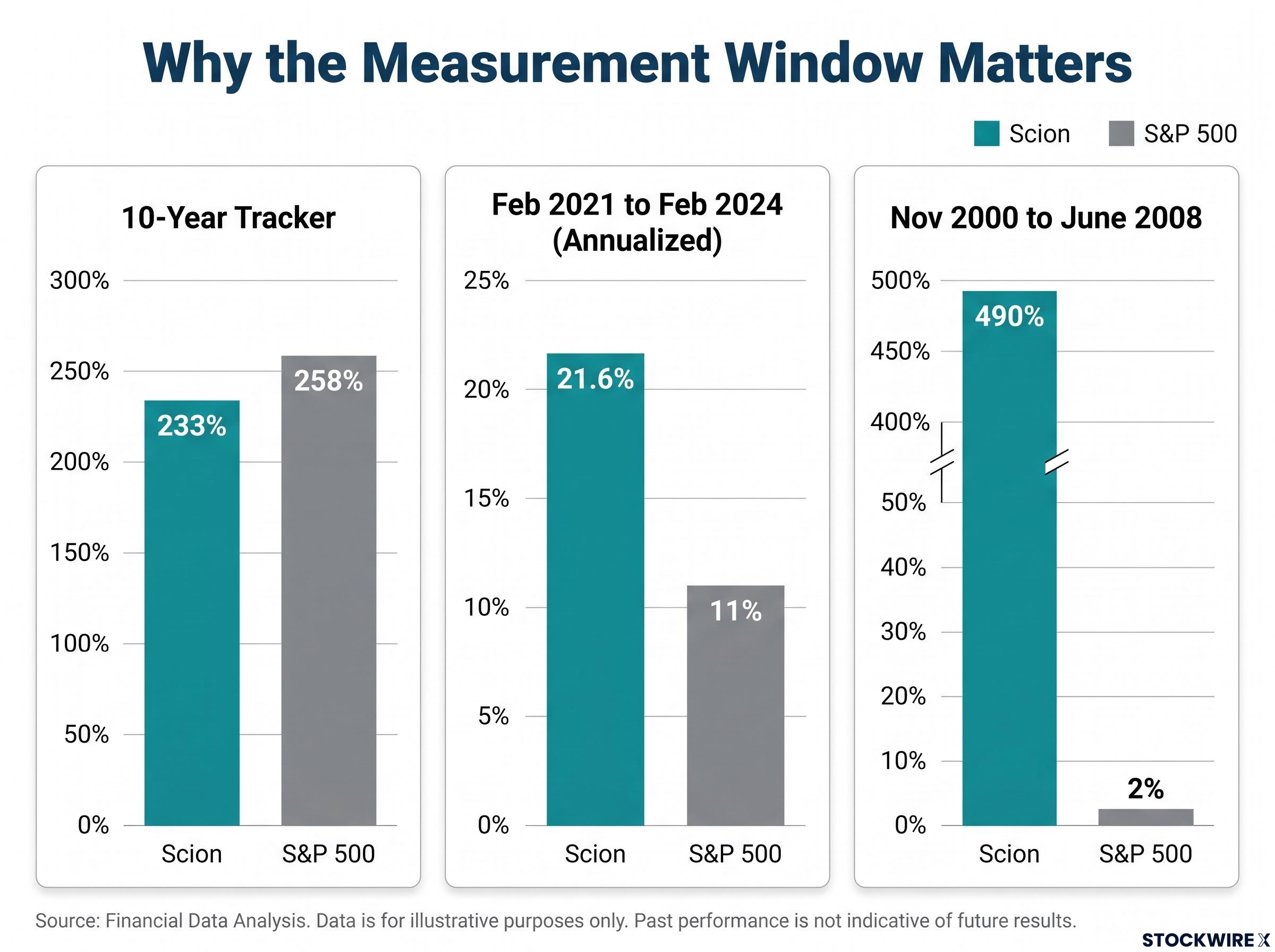
One trade turned Michael Burry into the most famous contrarian in finance. Yet his investing record looks far less untouchable under scrutiny: one tracker puts his ten-year return at about 233%, behind roughly 258% for the S&P 500 over the same stretch.
That gap does not make him a fraud or a fluke. It means the legend and the numbers tell different stories.
The timing matters. Burry has deregistered Scion Asset Management, no longer files quarterly 13F disclosures, and his put options against AI stocks still drive headlines as of 6 October 2026. A 13F is a quarterly filing that large US investment managers must submit to the Securities and Exchange Commission (SEC), listing certain holdings. With those filings gone, every claim about his positions now arrives second-hand.
Here is how to separate the repeatable lessons in his record from the survivorship glow, and how to read the claims made about him without being misled.
From hospital night shifts to Scion: how an outsider built a record
Nothing about Burry’s start suggested a hedge fund career. He trained as a doctor, with no MBA and no Wall Street contacts. He wrote about stocks online between hospital shifts.
- November 1996: He began posting on the Silicon Investor message board, eventually writing 3,304 posts over four years.
- 1999: He bought Apple as a value stock in the middle of dot-com mania.
- November 2000: Joel Greenblatt provided $1 million in seed money, and Burry left medicine to launch Scion.
- 2001: He bought scandal-hit software company Avanti at a deep discount.
The common thread was one habit: he bought companies other investors had abandoned. He thought the overall market was expensive but stayed invested, on the view that mispriced individual stocks appear in any market.
Burry’s early purchases of Apple and Avanti fit a classic value investing framework, in which the discount to intrinsic worth, not the share price itself, defines the opportunity, and the main danger is a cheap stock that stays cheap.
The early scoreboard In 2001, the S&P 500 fell 11.88%. Scion rose 55%.
The housing short: what being early cost
The housing trade applied the same method at a larger scale. Burry read thousands of pages of mortgage prospectuses and concluded that many loans would fail once their interest rates reset. On 19 May 2005, he bought his first $60 million of credit default swaps, which are contracts that pay out if a borrower defaults. By October 2005 he held at least $1 billion of them.
He paid premiums every month while the trade went nowhere. Investors called him a fraud and demanded their money back, and he restricted withdrawals.
The payoff eventually came: about $725 million in profit for investors and roughly $100 million for Burry personally. According to Michael Lewis’s The Big Short and Burry’s investor letters, Scion returned 490% after fees from November 2000 to June 2008, against about 2% for the S&P 500. Those figures have not been independently updated since.
The lesson for you is not about predicting crashes. While you hold a position, “early” and “wrong” feel exactly the same, and the real test is whether you can endure that stretch.
When big ASX news breaks, our subscribers know first
Winners, misses and a record that depends on the window
The wins after the financial crisis are impressive. The misses are just as instructive.
| Position | Outcome | Lesson |
|---|---|---|
| Charter | Bought at 300, sold at 455 | Patience on mispriced quality pays |
| Alphabet | Bought at the COVID low | Buying during panic rewards conviction |
| Samsung (2025) | Bought near tangible book | Asset backing limits downside |
| Tailored Brands | Averaged down to $1.29, then bankrupt | Cheap can get cheaper |
| Estee Lauder | Doubled down at 63, kept falling | Adding to losers compounds risk |
| January 2023 “Sell” call | Admitted wrong in March 2023; market rose over 60% | Macro calls carry high error costs |
Other wins include Maxar and Sportsman’s Warehouse. Other misses include Bed Bath & Beyond, which went bankrupt, and index puts in 2023 that he closed at a loss.
The GameStop lesson
GameStop sums up the whole record. In August 2019, Burry wrote to the board urging a buyback. Short interest stood at about 63%, and the company’s market value of roughly $290 million sat below its $480 million in cash.
He held about 3 million shares at a $3.32 cost basis and sold in the mid-teens, earning roughly 4-5x.
The counterfactual Held to the peak, that stake would have been worth more than $1.5 billion.
He later admitted he had not anticipated Roaring Kitty and the retail frenzy. A valuation can establish the worth of a company, but it cannot predict the price a crowd will chase.
Why the measurement window matters
The unnamed ten-year tracker shows Burry trailing the index. Yet following his filings from February 2021 to February 2024 returned about 21.6% a year, against about 11% for the S&P 500. No independent, methodologically explicit comparison of Scion’s post-2020 returns could be found.
The same investor looks brilliant or mediocre depending on where you start and stop the clock, so treat any single return figure for him with scepticism.
Notional value versus premium: why the option headlines misled
On 3 November 2025, Benzinga reported Burry’s “$1.1 billion short bet” against Palantir and Nvidia. Other headlines circulated a $1.6 billion figure, though its source is unclear. The real money at risk was far smaller.
Scion’s final 13F, for the quarter ended 30 September 2025, listed put options. A put gives you the right to sell a stock at a set price, so it gains value when the stock falls. Headlines sized the bet using notional value, which is the total value of the shares the options cover. A buyer’s actual outlay is the premium, the price paid for the options.
A put gives you the right to sell at a set price, and for options buyers the premium is the maximum loss, yet time decay and volatility shifts can still erase it even when the directional call is right.
Here is how the Palantir numbers shrink:
- Shares covered: 50,000 contracts × 100 shares = 5 million shares.
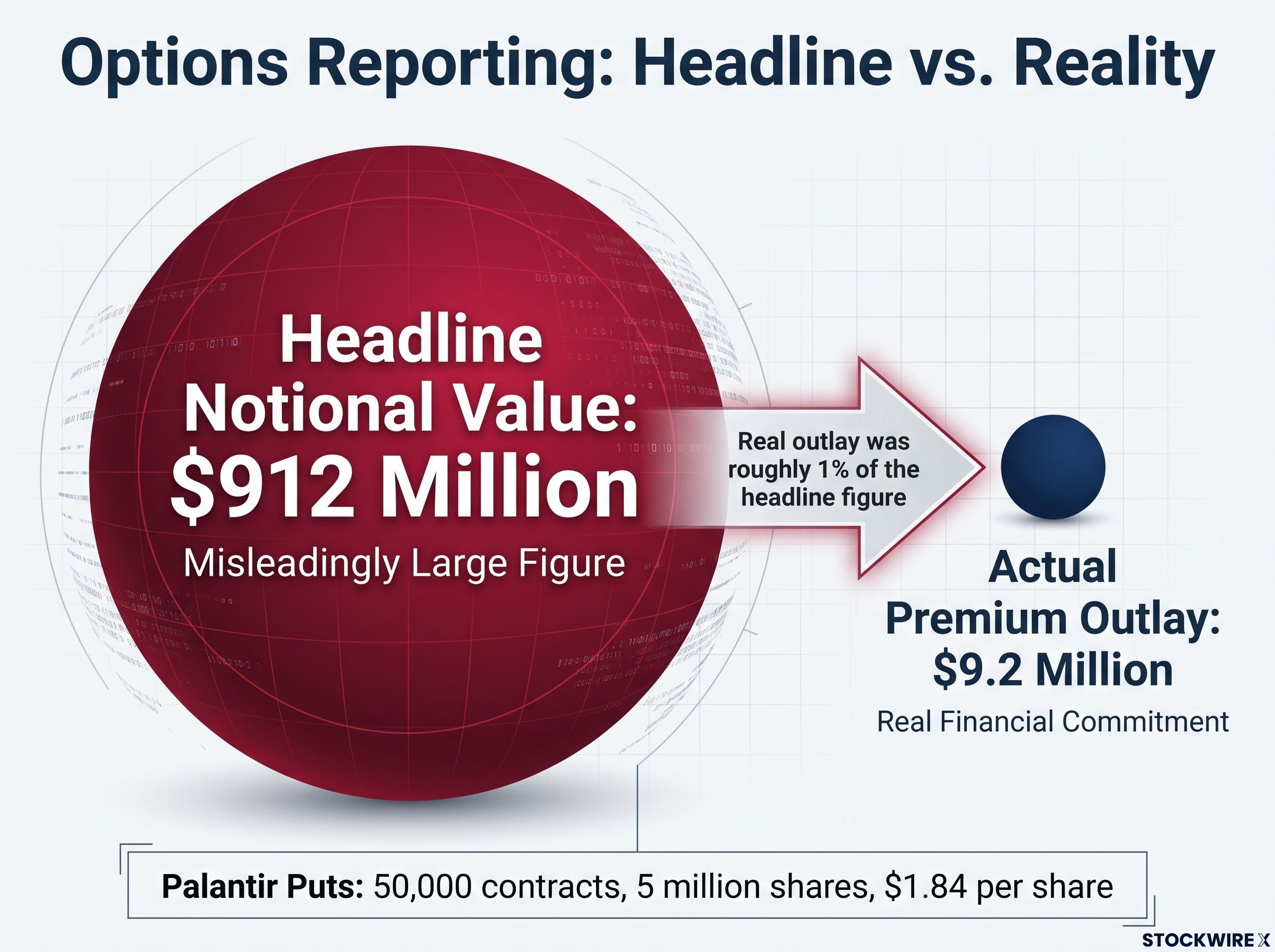
- Notional value: 5 million shares × the share price ≈ $912 million.
- Premium outlay: $1.84 per share × 5 million shares ≈ $9.2 million.
| Position | Contracts | Notional | Premium outlay |
|---|---|---|---|
| Palantir puts | 50,000 | $912M | $9.2M |
| Generic $100 stock example | Options on 1 million shares | $100M | A few million |
The real outlay was roughly 1% of the headline figure, a distortion of about two orders of magnitude. The Nvidia puts, on 10,000 contracts with about $186-187 million notional, followed the same pattern.
The 13F exchange After Palantir CEO Alex Karp called the bets “batshit crazy” on television, Burry replied on X that he was not surprised Karp “cannot crack a simple 13F.”
A 13F also leaves out hedging, so even the premium figure tells only part of the story. When you see a “billion-dollar bet” headline built on options, ask straight away what the premium was. For a put buyer, that premium is the most they can lose.
The five tenets his record illustrates
Strip away the drama and Burry’s best results rest on plain principles. The presenter whose framing this section draws on argues that his profits came from buying below value, being patient and doing the work, not from timing crashes.
- Be an investor, not a speculator. He bought Avanti on its numbers, not its narrative.
- Value equals the present value of future cash flows. He shorts Palantir and Nvidia because, in his view, their prices have outrun their cash flows.
- Do not invest in what you do not understand. The housing short rested on reading the prospectuses line by line.
- The market is a voting machine short-term and a weighing machine long-term. GameStop’s cash eventually mattered, although the crowd set the final price.
- Paying too much turns an appealing story into a poor investment. His biggest longs tend to be unglamorous, while his shorts target the most celebrated stories in the market.
Voting versus weighing In the short term, prices reflect popularity. Over longer periods, they move towards what the business actually earns.
You can apply all five tenets without copying a single Burry position. That is where the lasting value of his record sits.
What retail investors can and cannot copy from Burry
Admiring the method is one thing. Copying the trades is another, and the visible trades are the hardest part to replicate.
Scion’s SEC registration ended on 10 November 2025. Form ADV filings showed about $155 million across four accounts as of late March 2025. Reporting attributes the deregistration to Burry ending his management of outside client money, while Burry himself has said media misreadings of his filings caused turmoil in the stocks he held.
- Delay: 13F filings arrived about 45 days after each quarter ended, and Burry sold his December-expiry puts after the headlines while keeping longer-dated puts and short-stock exposure.
- Hidden hedges: Finanzmarktwelt noted on 4 November 2025 that his puts may hedge long positions that do not have to be reported, so copying them could invert his risk.
- Complexity: His AI bets reportedly use layered puts running into 2027. Secondary reports also claim around 80% of his portfolio sat in Nvidia and Palantir puts, but the primary Substack post was not accessible to confirm this.
- Behaviour: Burry acknowledges the “boy who cried wolf” label, citing his warnings in 2000, 2007, 2019, 2021 and 2023.
If you copy only the visible puts, you may be taking the opposite risk profile from Burry’s. Time decay, the steady loss of an option’s value as expiry approaches, works against you even if his thesis eventually proves right.
The same timing lag affects all 13F filings: positions are established by quarter end but disclosed weeks later, so investors reading them are always studying a snapshot, not a live trade they can replicate.
Lessons from other early callers
The same pattern shows up across other famous sceptics. John Paulson followed his subprime win with years of weaker concentrated bets. David Einhorn and Jim Chanos held shorts on high-growth names that took years to pay off, if they paid off at all. Jeremy Grantham of GMO has often called bubbles years before they broke.
Why it keeps happening Investors who trade on valuation tend to call the peak before momentum breaks, so an early trade produces the same losses as a wrong one until the correction arrives.
What Burry’s record settles, and what it leaves open
The evidence points to real skill in deep-research niches, combined with extreme concentration and a willingness to be early. That mix produces long stretches of looking wrong, broken up by very large wins.
Much remains open. His long-run results change depending on the window you measure, the housing-era figures rest on older sources, and his view that the AI boom could burst around 2028 is unproven as of 6 October 2026.
The practical takeaway is to use the five tenets on your own portfolio and run the notional-versus-premium check on any options headline. Treat his positions as a case study, not a trading signal.
Past performance does not guarantee future results. Statements about Burry’s current positions and forecasts are speculative and subject to change based on market developments.
This article is for informational purposes only and should not be considered financial advice. Investors should conduct their own research and consult with financial professionals before making investment decisions.
—






