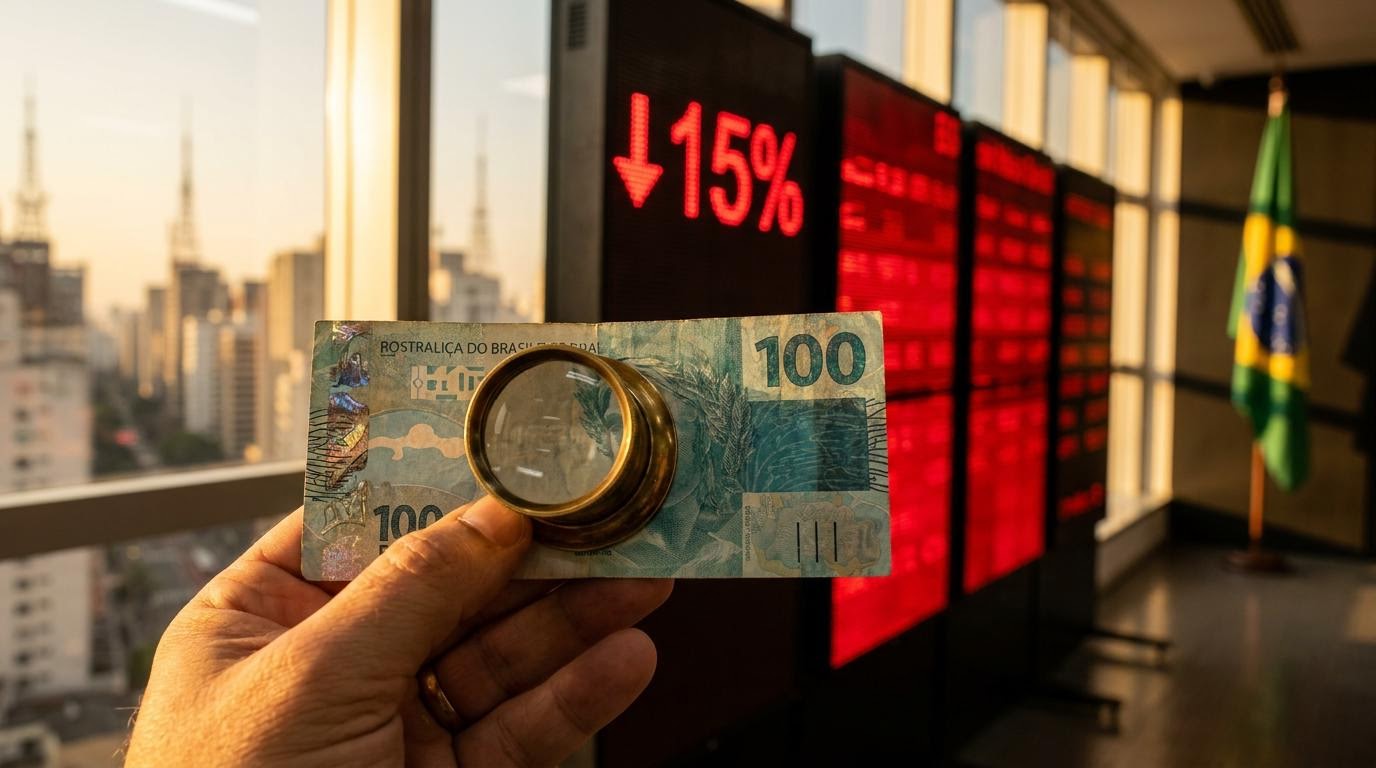
A Tokyo-listed fund tracking Brazilian shares fell about 15% within hours of the result, and real futures dropped about 10%. Those are dramatic numbers, but they came from thin Asian trading before a single Brazilian cash market opened. The Lula runoff market reaction is real. Its true size is still unknown.
Luiz Inácio Lula da Silva won Sunday’s runoff with 51.79% to Flávio Bolsonaro‘s 48.21%, a margin of more than 4 million votes. He had finished second in the first round, trailing 45.16% to 47.03%.
Markets had spent weeks positioning for a Bolsonaro win, so the surprise itself is the story. All figures here reflect reporting as of 26 October 2026, and many remain preliminary.
The sections below separate the one-off election shock from the fiscal credibility test that will shape Brazilian assets over the medium term. They also set out the signals that will show which way that test is going.
Why did Brazilian assets fall so hard, and how much of it is real?
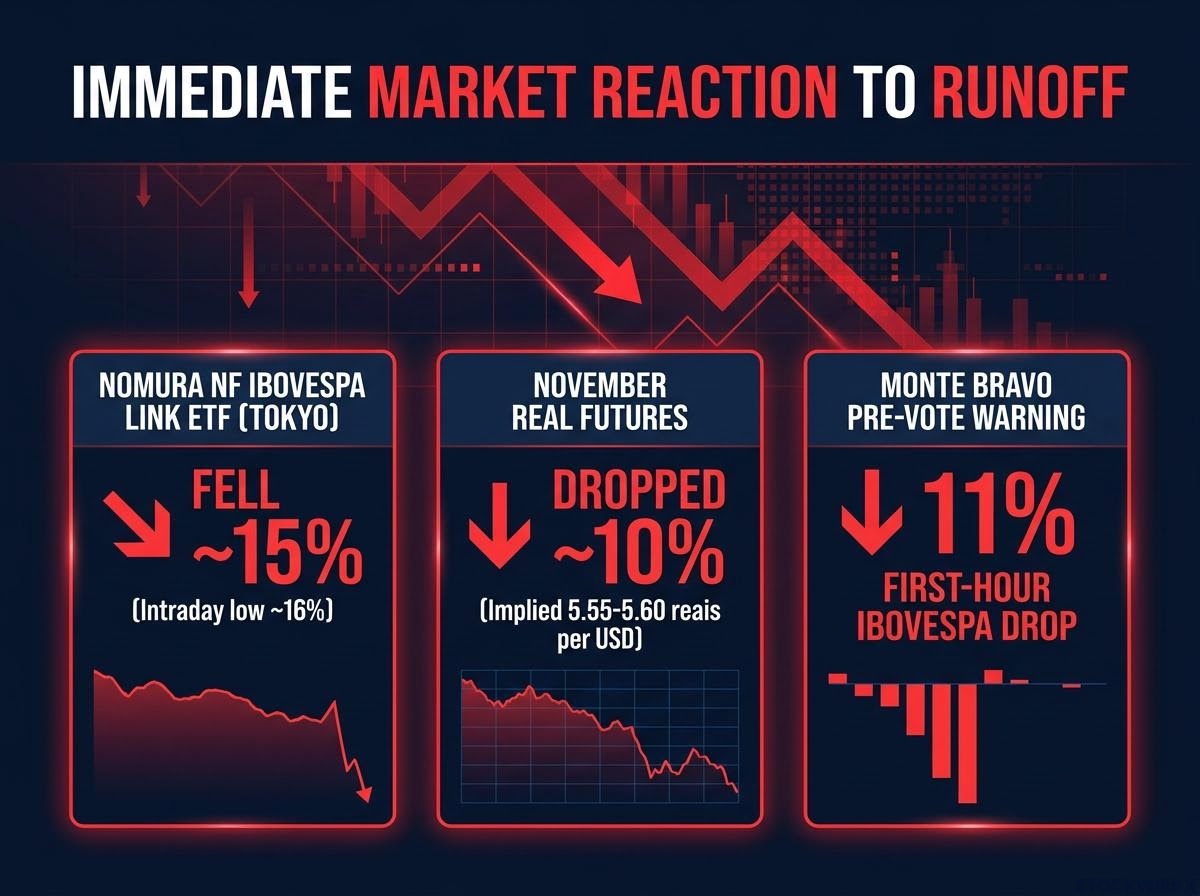
The headline moves arrived fast. The Nomura NF Ibovespa Link ETF in Tokyo fell about 15% and was down as much as 16% intraday. November real futures dropped roughly 10%, with CME pricing implying about 5.55-5.60 reais per US dollar.
Deutsche Bank strategists, quoted by FXStreet, called the result a severe negative shock for Brazilian assets. Brazilian broker Monte Bravo had warned before the vote that the Ibovespa could lose 11% in its first hour of trading on a Lula win, according to Bloomberg.
The scale of the fall comes from what markets had priced in beforehand. Reuters reported that the result blindsided prediction markets after weeks of gains in Brazilian assets. Right and centre-right parties had also expanded their Senate share in the first round, which lifted hopes of fiscal consolidation.
Before the vote, positioning had already built into a fiscal test for the real, with Deutsche Bank cutting its stance to neutral on stretched positioning, which helps explain why a surprise result produced such an outsized first reaction.
| Indicator | Reported move | What it measures | Main caveat |
|---|---|---|---|
| Nomura NF Ibovespa Link ETF (Tokyo) | Down about 15%; intraday low about 16% | Offshore proxy for Brazilian equities | Thin Asian liquidity |
| Real (November futures) | Down about 10%; implied 5.55-5.60 per US$ | Implied future exchange rate | Not an equal spot move |
| Ibovespa cash close | No confirmed move found | Domestic equity market | Awaiting first session |
| DI futures | No confirmed post-runoff move found | Market expectations for local interest rates | Only pre-runoff data available |
What the numbers do not yet tell us
A futures contract is an agreement to trade at a set price on a future date. When real futures fall 10%, that is an implied price set by a small pool of overnight traders, not proof that the spot currency will lose the same amount.
Positioning makes the gap worse. Investors who bought on a Bolsonaro victory are now being forced to sell, and that rush exaggerates the first move.
The direction of this repricing is credible; the magnitude is not yet settled. Wait for the first cash-market closes before treating 10-15% as the new fair-value gap in your Brazil exposure.
When big ASX news breaks, our subscribers know first
How fiscal credibility turns an election shock into a lasting risk premium
Why would one vote move interest rates and a currency? Because investors lending to a government care about whether it can keep paying, and an election changes who decides that.
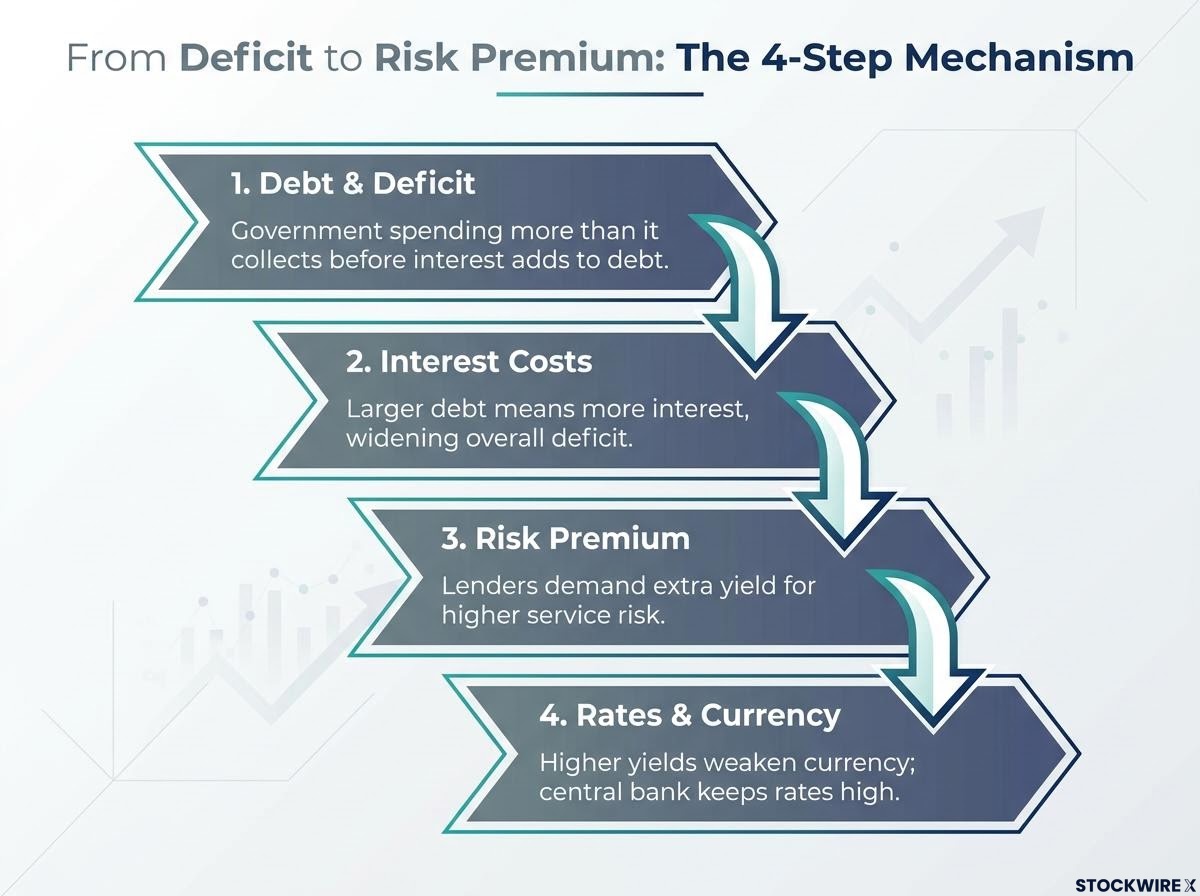
The mechanism runs in four steps:
- Debt and deficit: A government spending more than it collects, before interest, runs a primary deficit and adds to its debt.
- Interest costs: Larger debt means more interest to pay, which widens the overall deficit.
- Risk premium: Lenders demand extra yield, called a risk premium, to compensate for the chance that debt gets harder to service.
- Rates and currency: Higher yields and weaker confidence push the currency down, and the central bank may keep rates high to contain inflation.
Brazil sits uncomfortably far along that chain. JPMorgan puts gross debt at about 83% of GDP, up from about 74% at end-2022, with interest costs close to 9% of GDP.
| Indicator | Figure | Source | Note on definition |
|---|---|---|---|
| Gross public debt | 82.9% of GDP (about R$11.1 trillion), August 2026 | Valor International | Gross-government measure |
| General-government gross debt, 2026 | 98% of GDP | IMF | Broader measure; not comparable |
| Primary balance | Deficit of about 0.4% of GDP | JPMorgan | Excludes interest |
| Selic rate | 13.75%, from 14.00% in early August | Rio Times | Central bank policy rate |
| 2026 framework target | Surplus of 0.25% of GDP (about R$34.3 billion), ±0.25 pp | IMF | Federal primary balance |
Do not compare the 82.9% and 98% figures directly; they measure different things. What matters is the trend, and the trend is up.
The framework targets 0.5% in 2027 and an indicative 1.5% by 2030, yet the government has raised its own 2026 deficit estimate from R$52 billion to R$80 billion. Analyst estimates of the adjustment needed are far larger: Barclays‘ Roberto Secemski has been reported as putting it at at least 2.5 percentage points of GDP (about R$350 billion) by 2031, while Citi‘s Leonardo Porto reportedly cites 3-3.5% of GDP. Neither estimate has been independently confirmed.
Analyst view: Neuberger Berman The firm reportedly identifies “fiscal dominance” as the central medium-term vulnerability, warning that without a credible primary-balance adjustment debt could exceed 100% of GDP and term premia could stay elevated. This view has not been independently verified.
That gap between a 0.25% target and a 2.5-3.5 point requirement tells you why one announcement cannot reverse the sell-off, and why Brazilian rates may stay high for longer than your base case assumes.
The carry trade buffer matters here: a high Selic gives the real a cushion against depreciation, though crowded positioning can shrink that protection quickly once investors start to unwind.
Can a right-leaning Congress hold Lula’s spending in check?
The arithmetic looks reassuring. The Liberal Party (PL) is the largest party in both chambers, and the centre-right holds a clear majority in each.
| Chamber | PL seats | Centre-right aggregate | Key threshold |
|---|---|---|---|
| Senate | 28 of 81 (about 34.6%) | About 62% | 49 of 81 for constitutional amendments |
| Chamber of Deputies | 121 of 513 | About 57% | 308 of 513 for constitutional amendments |
JPMorgan groups the Chamber into a right opposition of 134 seats, a Lula base of 122 and the Centrão (Brazil’s bloc of pragmatic, deal-making centrist parties) at 52. Deutsche Bank reported the Senate’s right-leaning share jumping from 47% to 63%; the later figure is consistent with the roughly 62% published elsewhere, but the 47% starting point could not be confirmed.
Why Congress may constrain him
- Budget control: Congress approves and amends the budget and can extract concessions.
- Mandatory spending: More than 90% of federal primary spending is mandatory, according to JPMorgan.
- Constitutional thresholds: Structural reform needs three-fifths majorities in two rounds in each chamber.
- Budget amendments: Legislators steer funds to constituencies, limiting executive discretion.
- Spending floors: Minimum health and education allocations and indexed social transfers resist rapid change.
Deutsche Bank argues this Congress should limit looser fiscal policy. Lula has promised an adjustment but has not detailed it.
Why that may not mean austerity
- Transactional Centrão: JPMorgan describes it as pragmatic, often backing whoever holds the presidency.
- Dual opposition: Legislators may block tax rises without accepting the deep cuts needed.
- Redirection, not reduction: Amendments shift spending without improving the overall balance.
- Executive leverage: Lula controls agenda-setting, appointments and budget execution.
Blocking spending is not the same as delivering consolidation. A hostile Congress acts as a floor under fiscal discipline, not a ceiling on deficits, so track which revenue and mandatory-spending measures pass, not which ones are stopped.
What do past shocks suggest about how this resolves?
Brazil has run this experiment before, with opposite results. In 2002, markets feared Lula would break with orthodox policy, and a conservative fiscal and monetary stance restored confidence. Implementation, not campaign language, did the work.
The 2015-16 episode went the other way. Recession, fiscal deterioration, inflation and political crisis fed each other, pushing up borrowing costs and weakening the currency in a self-reinforcing loop.
The common thread across emerging-market election surprises is repricing rather than ideology. Investors positioned for a business-friendly winner reassess the primary balance, the risk premium, the currency path and how the central bank will respond.
Brazil’s oil-exporter status and record foreign inflows earlier in 2026 helped lift Brazilian equities, which is part of why the unwinding of that trade looked so sharp when the runoff result arrived.
What is different this time
The 2026 mix fits neither precedent neatly. Lula faces a right-leaning Congress, debt well above 2022 levels, a primary deficit and a budget dominated by mandatory spending, a combination that blocks new spending but also the deep adjustment markets want.
Goldman Sachs says the outlook hinges on coalition-building, budget negotiation and governability. JPMorgan noted before the vote that neither candidate had published detailed, quantified debt-stabilisation measures.
The risks to watch:
- Contested result: AFP reported that Bolsonaro refused to accept defeat and would seek annulment; this has not been independently confirmed.
- Divided government: Policy depends on deals with the opposition and the Centrão.
- Inflation expectations: Weak public finances may keep them above target and delay Selic cuts.
- Risk-premium persistence: Investors will want sustained surpluses and enforcement, not a single plan.
Analyst view: Deutsche Bank The strategists see the lasting test as Lula’s ability to turn the limits set by Congress into a believable fiscal plan, once the immediate election-driven premium has faded and the dispute raised by Bolsonaro has been dealt with.
For your purposes, the medium-term outcome turns on a quantified, enforceable primary-balance path. Detail and legislative passage are the signals; campaign rhetoric is noise.
Past performance does not guarantee future results. Forward-looking views cited here are speculative and subject to change based on market developments.
What the shock changes, and the signals that will settle it
The first move was a risk-off unwinding of a crowded Bolsonaro trade, amplified by thin liquidity. Whether it becomes a lasting discount depends on fiscal credibility.
Three signals will settle it:
- A quantified primary-balance path from Lula’s economic team.
- Evidence that a coalition can pass durable mandatory-spending or revenue measures.
- How the contested result resolves, and where Brazilian cash markets actually close.
If all three turn positive, 2002 is the closer template. If they stall, the 2015-16 dynamics become the risk to price into any Brazil allocation.
Investors tracking the currency path after the runoff can read our deep-dive into the USD/BRL outlook, which examines how the carry differential and Fed policy shape the real.
This article is for informational purposes only and should not be considered financial advice. Investors should conduct their own research and consult with financial professionals before making investment decisions.