Flávio Bolsonaro finished first in Brazil’s presidential vote, yet the label “frontrunner” may be the most misleading word you read about this Brazil run-off election. His lead was 1.87 percentage points, the polls have since tightened, and the real has already traded on the assumption that he wins. The deciding vote is still 8 days away, on 25 October 2026.
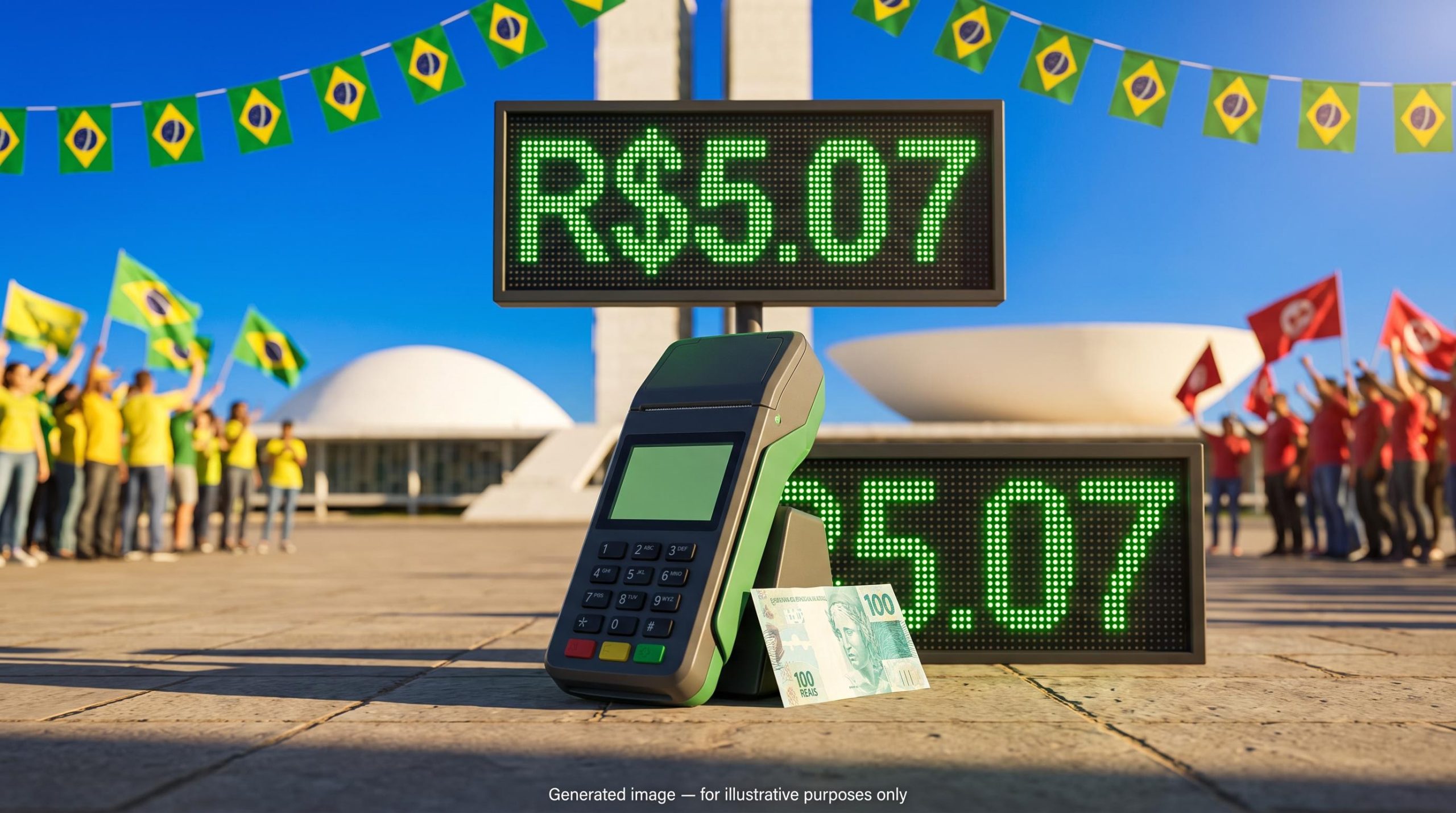
Why should a vote in Brasília matter to an investor in London, New York or Sydney? Brazil carries gross government debt of about 82.9% of GDP and offers one of the highest interest-rate carries among emerging markets, so the real works as a running scorecard of fiscal confidence. The dollar bought about R$5.07 yesterday, and that number is likely to move sharply once the result lands.
Here is what you need before polls open: how the two-round vote works, why fiscal credibility pushes the currency around, what the major banks expect under each outcome, and the signals worth watching in the final week.
How does Brazil’s two-round system work, and where does the race stand?
How the two rounds work
The rule is simple. To win outright, a candidate needs an absolute majority, meaning more than 50% of valid votes. If nobody clears that bar, the top two face each other in a run-off three weeks later.
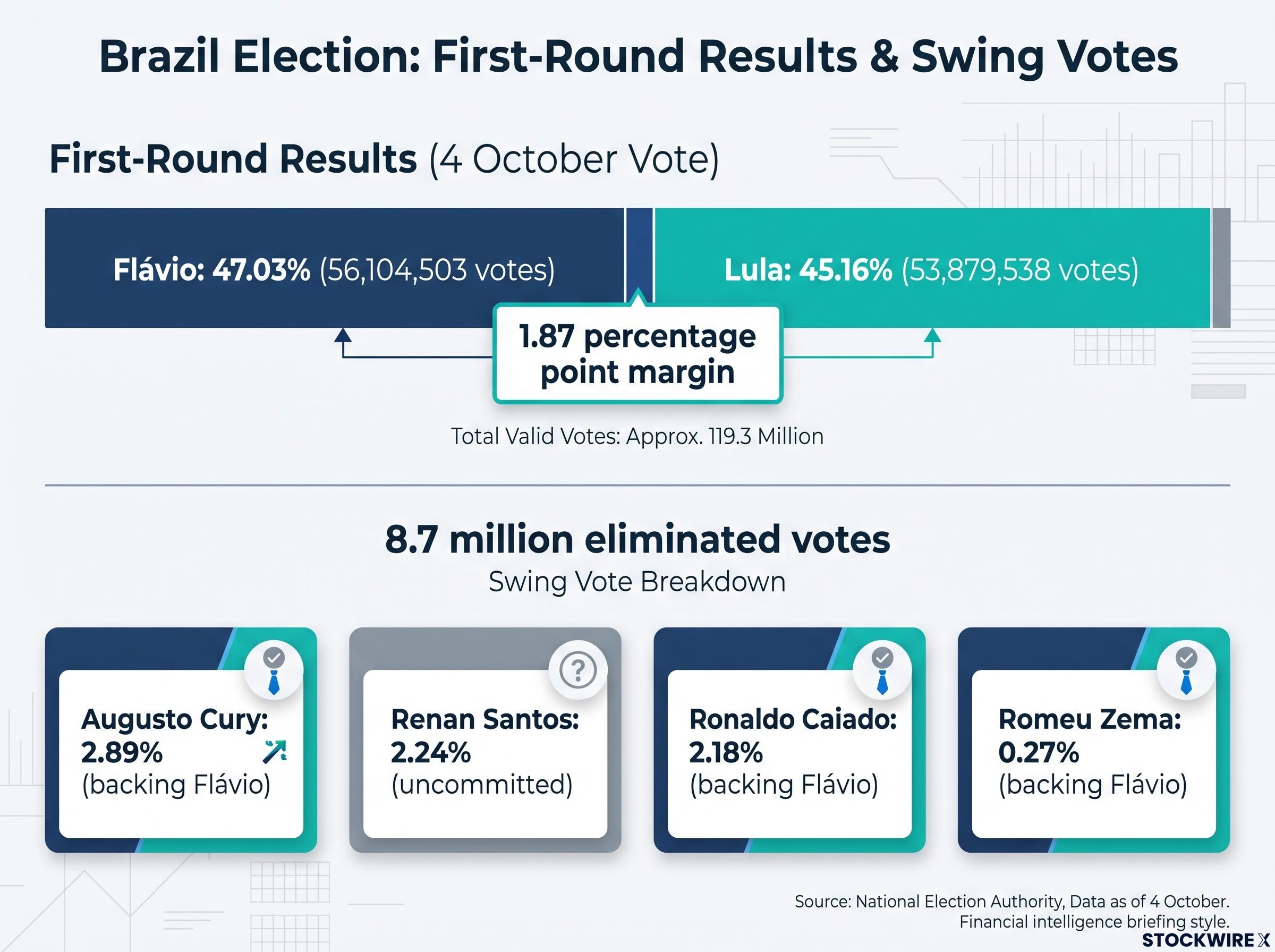
Nobody cleared it on 4 October. Flávio Bolsonaro of the Liberal Party (PL) took 56,104,503 votes (47.03%), while President Luiz Inácio Lula da Silva of the Workers’ Party (PT) took 53,879,538 (45.16%), according to figures from Brazil’s electoral court (TSE) reported by Valor. Augusto Cury (2.89%), Renan Santos (2.24%), Ronaldo Caiado (2.18%) and Romeu Zema (0.27%) were eliminated.
The map split cleanly. Flávio was strong across the South, Southeast, Centre-West and North; Lula held the Northeast.
Where the run-off polls stand
That first-round gap is a starting position, not a verdict. Look at how much the latest surveys disagree.
| Pollster | Flávio | Lula | Note |
|---|---|---|---|
| Datafolha | 52% | 48% | Valid votes; lead narrowed |
| AtlasIntel | 52.8% | 47.2% | Valid votes |
| BTG/Nexus | 48% | 45% | Flávio ahead |
| Quaest | 46% | 44% | Statistical tie |
| CNT/MDA | 46.8% | 45.9% | Within margin of error |
| Futura | 50.8% | 49.2% | Valid votes; tie within margin |
The range runs from a dead heat to roughly four points. That spread tells you a small slice of undecided or blank voters could settle this, so treat any single poll as a snapshot rather than a forecast.
The eliminated candidates also split more than 8.7 million votes, well above the top-two margin. Here is where they now sit:
- Romeu Zema: backing Flávio
- Ronaldo Caiado: backing Flávio
- Augusto Cury: backing Flávio
- Renan Santos: no clearly reported formal endorsement
Endorsements do not deliver votes automatically, but Santos’s 2.24% is the largest uncommitted bloc in play.
When big ASX news breaks, our subscribers know first
Why does fiscal credibility move the real?
The polls tell you who might win. The currency tells you what markets fear. The link between the two runs through Brazil’s public finances, and you can follow it in six steps.
- Debt trajectory: if spending outpaces revenue, investors expect debt to climb as a share of the economy.
- Risk premium: rising debt raises the odds of future tax hikes, inflation or forced cuts, so investors demand a higher return to hold Brazilian assets. That extra return is the risk premium.
- Capital flows: a higher premium deters foreign money and pushes Brazilians to buy dollars as protection.
- Exchange rate: more demand for dollars than reais weakens the currency.
- Monetary response: the Central Bank may keep its policy rate, the Selic, higher for longer.
- Carry trade: high rates attract investors who borrow cheaply elsewhere and buy real assets, which props up the currency.
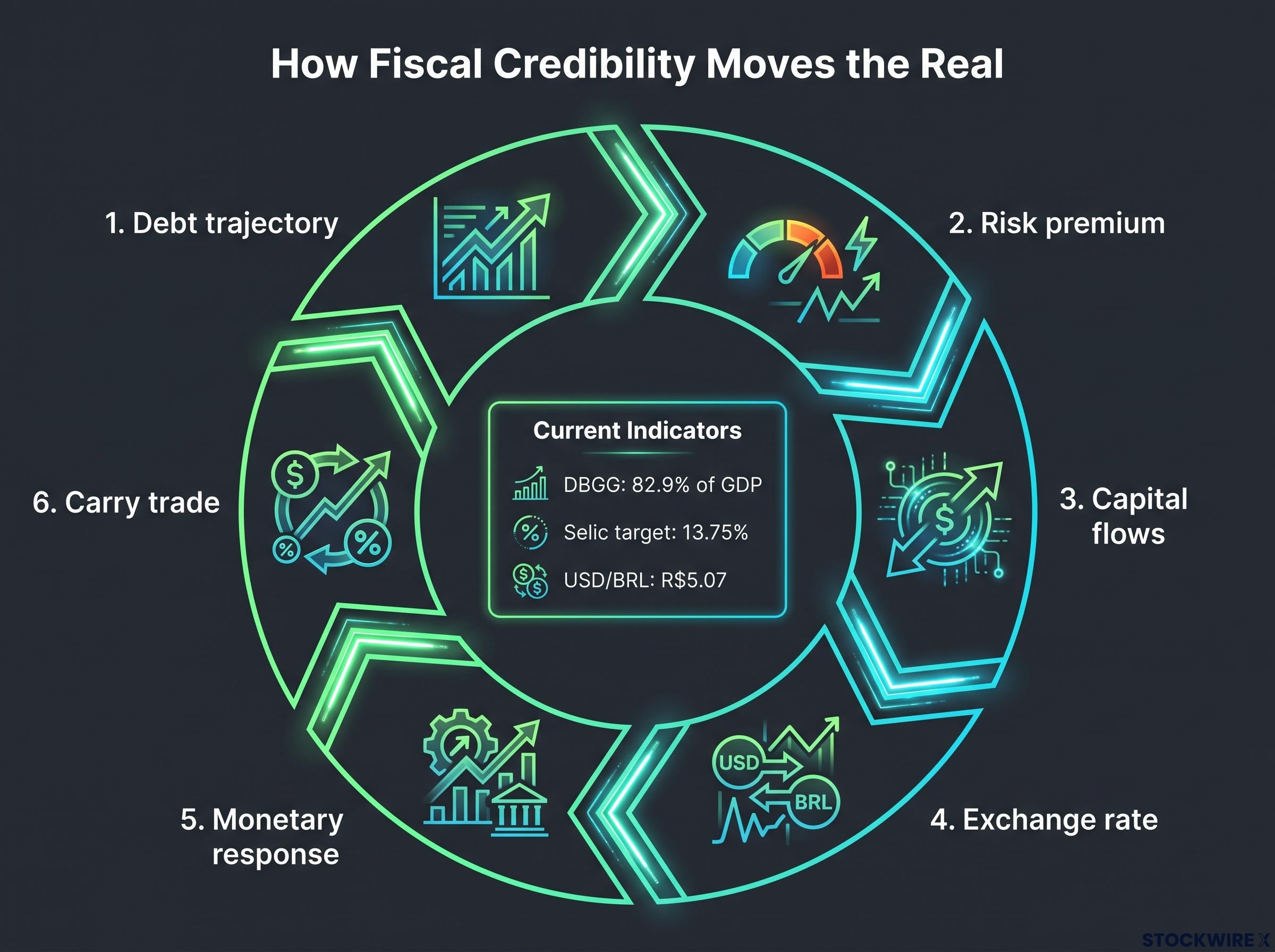
“Debt” here means gross general government debt (DBGG), the broadest standard measure of what the state owes. It sits near 82.9% of GDP, up about 4.2 percentage points year-to-date through August, a pace not seen since the pandemic, and is projected at 83.4% or higher by year-end.
That last step is the twist. A carry trade cushions the real today, but it cannot absorb a lasting loss of confidence, because the higher interest bill itself makes the debt worse.
You can think of the carry trade as a cushion with a time limit: it absorbs political noise while rates stay high, but crowded positioning means external shocks like a hawkish Fed or falling commodity prices can break it faster than domestic polling.
The carry cushion J.P. Morgan describes Brazil as having one of the highest real carries among emerging markets, with the currency’s next major move dependent on clarity over the fiscal path.
The current readings:
- DBGG: about 82.9% of GDP
- Selic target: 13.75%
- USD/BRL: about R$5.07 on 16 October, after briefly dipping below R$5 following the first round
The Brazil Focus survey of economists expects the Selic to end the year at 13.75%, the dollar at R$5.20, inflation at 5.01% and growth at 1.92%. For you, the takeaway is that a real which looks stable is leaning heavily on high interest rates, and that support can thin quickly if fiscal confidence slips.
What could each outcome mean for the real, and for US relations?
With that mechanism in hand, each bank forecast becomes a bet on fiscal credibility rather than on personality.
Fiscal path under each candidate
Commerzbank’s Norman Liebke, writing via FXStreet, frames the bullish case. Flávio’s pledge of stronger budget tightening and friendlier economic policy towards business could, as his chances improve, give the real extra backing. Liebke adds a pointed warning: the currency could fall a long way if lawmakers in opposition block most or all of his programme.
That caveat matters because a president cannot impose fiscal adjustment alone. Congress approves budgets, taxes and rule changes, and even friendly right-wing allies may demand tax cuts or regional spending that dilute any consolidation.
A Lula win would likely be read as continuity, with more social and public-investment spending and a higher risk premium. Damage need not be immediate, though; a credible economic team, strong revenue or high nominal growth could limit it.
| Institution | Flávio win | Lula win |
|---|---|---|
| Goldman Sachs | USD/BRL toward 4.50-4.80 with credible tightening | Adverse fiscal-premium scenario near 5.80 |
| Commerzbank | Supportive, with considerable downside if agenda stalls | Likely negative initial reaction |
| J.P. Morgan | Next move hinges on fiscal clarity | No automatic collapse given high carry |
| Deutsche Bank | Cut to neutral; positioning stretched | Possible sharp initial selloff, cushioned by high rates |
| SocGen / Morgan Stanley | SocGen about R$5.10 end-2026; Morgan Stanley below R$4.90, toward R$4.50 in early 2027 | Bullish projections less likely |
The gap between 4.50 and 5.80 is the story. Analysts are pricing the credibility of policy, not the man, so judge each forecast by what it assumes about Congress and the fiscal path.
You will notice the same forecast gap in other targets: Rabobank sits near 5.35 and J.P. Morgan near 5.55, because each assumes a different pace of Selic cuts and a different degree of fiscal drift.
The US trade angle
Washington adds a second layer:
- A 25% US tariff applies to thousands of Brazilian products, citing unfair trade practices.
- A further 12.5% tariff is linked to alleged lax enforcement of forced-labour rules, on top of steel and aluminium measures.
- A bilateral working group formed in September to negotiate cuts and a broader framework.
- Lula has held back Brazil’s reciprocity law while talks continue.
- Critical minerals and rare earths are central to the negotiations.
Flávio is aligned with President Trump, while Lula casts himself as defending sovereignty while negotiating directly. Either way, the winner matters less than what he can actually deliver.
What are the risks and precedents that could upset the consensus?
The comfortable story is that a Flávio win equals a real rally. Several things could break it, whoever wins:
- Polarisation: protests, institutional conflict and volatility
- Disputed result: a razor-thin margin could bring challenges or delayed acceptance
- Congressional risk: a market-friendly programme that never passes
- Tariff escalation: failed US talks hitting exports and investment
- Carry reversal: higher US yields or weaker commodity prices pulling money out
Then there is “buy the rumour, sell the fact”, where traders who bought ahead of an expected win take profits once it arrives.
Positioning warning Deutsche Bank cut its stance on the real to neutral, warning that positioning had become stretched before the election and that risks run both ways.
History backs the caution. In 2002, the prospect of Lula’s first presidency sent the real sharply lower until fiscal-responsibility pledges and a credible economic team calmed markets. In 2018, Jair Bolsonaro’s strength lifted the real and equities on hopes of pension reform.
This cycle has already shown the pattern: Reuters reported the first-round lead lifted the currency and stocks, and tightening polls reversed part of the move. For you, that means a priced-in favourite can still trigger a selloff on victory, so the 26 October reaction depends on details, not the headline.
What to watch before 25 October:
- Endorsement shifts, especially from Renan Santos
- Final polls from Datafolha, Quaest and AtlasIntel
- Economic-team announcements from either camp
- Progress in US-Brazil tariff talks
- US Treasury yields
What the vote settles, and what it leaves open for the real
The run-off decides direction, not durability. Whether any move in the real lasts depends on debt stabilisation, congressional governability and the credibility of whoever runs the economy.
Commerzbank’s two-sided framing remains the most useful lens: upside if promises become policy, downside if they stall in Congress.
In the first trading days after the vote, watch three signals. Cabinet appointments, particularly the finance minister, will show intent. Statements on fiscal rules will show commitment. Early congressional alliances will show whether any of it can pass.
Bank forecasts are projections built on assumptions, not guarantees, and the result could shift them quickly.
Past performance does not guarantee future results. Financial projections are subject to market conditions and various risk factors. This article is for informational purposes only and should not be considered financial advice. Investors should conduct their own research and consult with financial professionals before making investment decisions.
—