The Bank of Japan is expected to leave interest rates alone this week, and many people assume a central bank that holds rates leaves its currency undisturbed. That assumption may not hold here. The yen could still move on a document most casual observers never open.
Policymakers lifted the policy rate from 1.00% to 1.25% on 18 September 2026. Swaps markets now price roughly 75% odds of another increase in December. USD/JPY, the number of yen one US dollar buys, sits near 157.
That makes the Bank of Japan’s October meeting less about the next move and more about the path of rates after it. A hawkish tone means a bias towards raising rates, and the question is whether the Bank sounds hawkish enough to keep December alive.
This covers what to expect on 30 October, what the Outlook Report is, and the specific signals that would push the yen higher or lower.
What is the Bank of Japan expected to do at its October meeting, and what is already priced in?
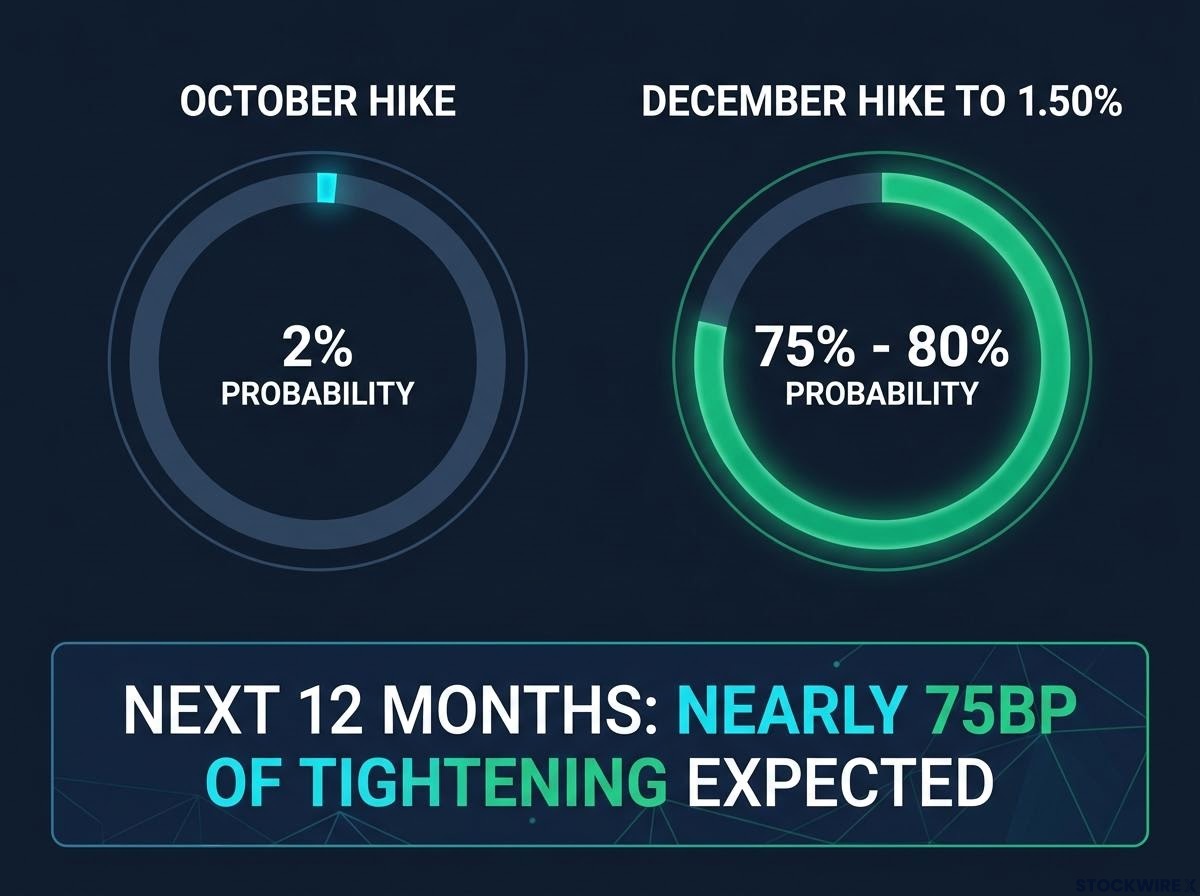
Start with the part almost nobody disputes. The Bank is expected to hold at 1.25% on 30 October. According to Brown Brothers Harriman (BBH) strategist Elias Haddad, markets price only about 2% odds of a hike at this meeting.
The pause has clear reasons behind it. September’s hike passed on a 7-2 vote. Dissenters Toichiro Asada and Ayano Sato argued that price growth had not picked up enough to justify a move, and Asada pointed to core inflation sitting below 2% at the time. Governor Kazuo Ueda then warned that rapid tightening could disrupt asset prices and that confirming durable 2% inflation could take time.
Now look further out, because that is where the market’s attention sits:
- October hike: around 2% probability
- December hike to 1.50%: about 75% (BBH’s weekly note), up to 80% in its 23 October note
- Next 12 months: nearly 75bp of tightening in the swaps curve (75bp means 0.75 percentage points)
The Reuters poll of 20-21 October points the same way. 54 of 78 economists, nearly 70%, expect 1.50% this quarter, and about 80% of those who named a month chose December.
| Source | Expected October outcome | Expected next move | Reasoning |
|---|---|---|---|
| BBH (Elias Haddad) | Hold at 1.25% | December hike to 1.50% | The September hike needs time to work through lending and asset markets |
| Reuters economist poll | Hold | December hike | Nearly 70% expect 1.50% this quarter |
| Nomura | Hike | March and July 2027 | Inflation is persistent enough to justify a faster path |
| Takahide Noguchi (former BoJ policymaker) | Hold | Likely December hike to 1.50% | Underlying inflation is near 2% and wages are becoming embedded |
With a hold almost fully expected, the decision itself tells you very little. Any yen move will come from what the Bank says about December and beyond.
Where economists disagree
Nomura stands apart from the consensus, calling for hikes in October, March and July 2027. The International Monetary Fund (IMF) has also suggested tightening may need to speed up if inflation runs ahead of forecasts. These views are in the minority, but they mark the hawkish edge of the range.
When big ASX news breaks, our subscribers know first
What is the Outlook Report, and why do traders watch it?
On a trader’s screen, the Outlook Report shows up as a grid of percentages released alongside the rate decision. It looks dry. For the yen, it may be the most important part of the day.
The Outlook Report is the Bank’s quarterly set of forecasts for economic growth and prices. The policy decision tells you where the rate is now. The forecasts tell you what the Bank expects to happen to prices, and that hints at what it may do next.
The July 2026 report forecast core inflation of 2.5% for FY2026 (the year ending March 2027) and 2.4% for FY2027. Core inflation is price growth excluding fresh food, which removes some volatile swings.
The revision to watch Reuters reported that officials may modestly raise the FY2027 forecast and signal that underlying inflation has roughly reached the 2% target.
When you read the release, focus on three items:
- The FY2027 core inflation forecast: any move above 2.4%
- The timing for durable 2% inflation: whether it is pulled closer
- Oil and weak-yen effects: whether rising energy costs and pricier imports are built into the numbers
What the latest inflation data adds
September figures, released on 23 October, showed headline and core inflation both at 2.1%. Core-core inflation, which also strips out energy, reached 2.4%. CNBC reported that core inflation was the highest reading of 2026, lifted by weak-yen import costs and energy.
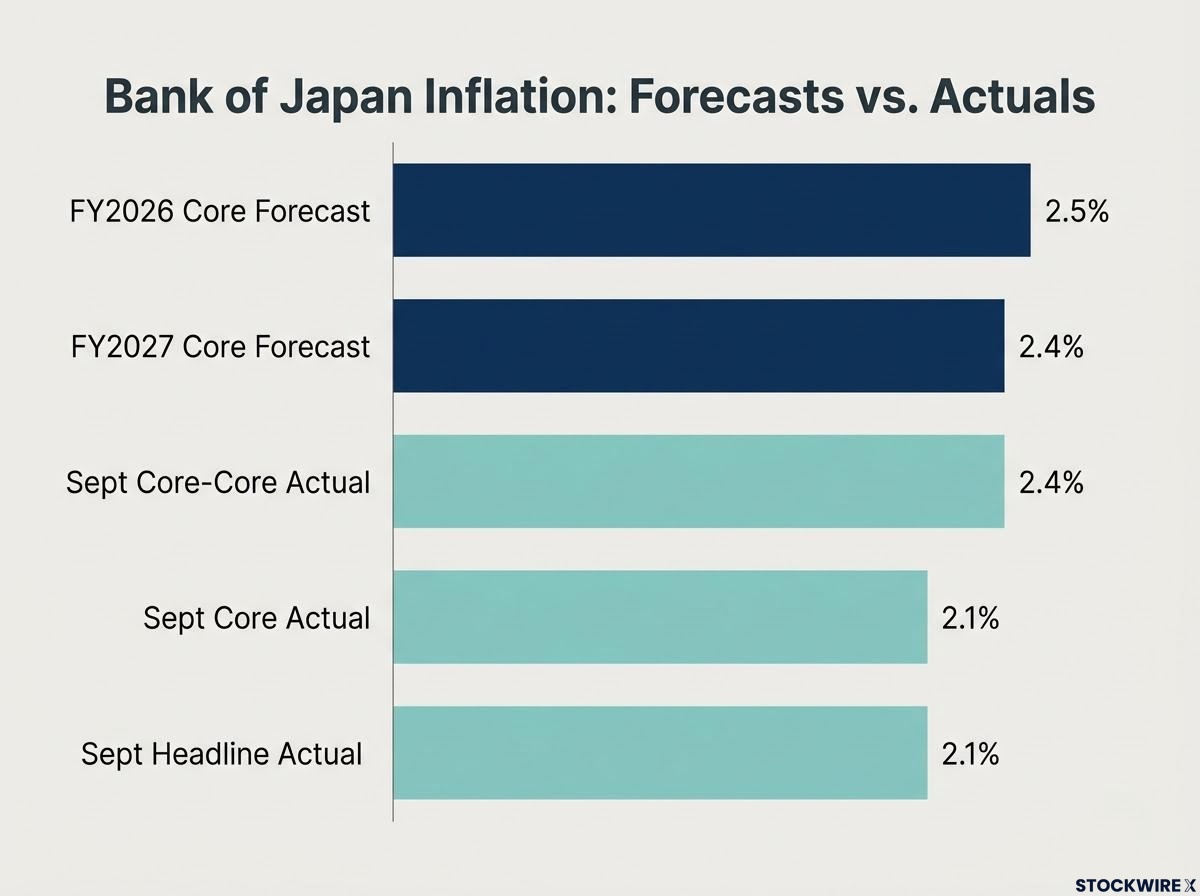
There is a catch. BBH noted that inflation still tracks below the Bank’s 2.5% projection for 2026, so the case for faster action is not settled.
That is why small revisions matter. If the FY2027 forecast rises by even a tenth of a percentage point, the market reads it as the Bank seeing less reason to wait, and that is what gets traded.
The Bank’s projected hiking path runs towards 1.75% by April 2027, but a planned food consumption tax cut could drag headline CPI lower and complicate how you read future inflation prints.
How can a hold at 1.25% still lift the yen?
The logic becomes clear when you follow it one step at a time:
- The rate stays unchanged at 1.25%.
- Expected future rates rise if forecasts and guidance point to more hikes.
- The Japan-US rate gap narrows, because Japanese yields climb relative to US yields.
- The yen strengthens, as yen assets look more rewarding to hold.
Four channels can drive step two: higher expected rates, stronger forward guidance (the Bank’s statements about future policy), a repricing of the whole rate path, and upward forecast revisions. Analysts cited by Reuters have a name for the outcome: a “hawkish pause”. The Bank skips a back-to-back hike but keeps the door to December wide open.
Haddad at BBH argues that firmer underlying inflation could produce a hawkish Outlook Report and lift rate expectations in the yen’s favour. With USD/JPY around 156.92 on 26 October, according to Reuters, and BBH forecasting a 155-160 near-term range, there is room to move in either direction.
For you, the key point is that the yen trades the expected path of rates. A hold that pushes December odds from 75% towards 90% is a bullish signal for the currency.
Rate expectations are only one of the four drivers of the yen, alongside yield differentials, safe-haven flows and Japan’s domestic fundamentals, which is why a hold can still move the currency when guidance shifts.
What the precedents show
| Date | BoJ action | Yen reaction | Lesson |
|---|---|---|---|
| 30 October 2025 | Hold, with a pledge to keep raising rates | Strengthened; December hike bets rose | A hawkish hold can support the yen |
| January 2026 | Hold, hawkish forecasts retained | Read as intent to keep hiking | A pause did not end normalisation |
| 28 April 2026 | Hold, three dissenters | Strengthened immediately | Dissents signalled pressure for tighter policy |
The recent record is consistent: holds paired with hawkish guidance have tended to support the yen. Conditions shift, though. The July 2026 hold set up a hike, while September delivered one with dovish dissents, so each meeting needs to be read on its own terms.
What could stop the yen from rising, even on a hawkish message?
The hawkish case is reasonable. It is not a sure thing, and each of these risks weakens it a little further.
- Already priced: With 75-80% of a December hike priced, a hawkish message may trigger “buy the rumour, sell the fact”, where traders take profits once the expected news arrives.
- US yields stay firm: If US yields hold up or the Federal Reserve delays cuts, the rate gap stays wide. Reuters noted that fading expectations of a US hike had already eased pressure on the Bank.
- Imported inflation: Weak-yen import costs, oil and Middle East-related energy prices are doing much of the work. If that looks temporary rather than demand-driven, the Bank may hold back.
- Wage uncertainty: A large increase in next spring’s shunto wage talks is not assured, and government fuel subsidies could lower the base for negotiations.
- Political caution: BBH reported Cabinet Office pressure to examine the effects of past hikes. The finance minister said fiscal policy would expand supply capacity without accelerating inflation.
Core inflation of 2.1% still sits below the Bank’s 2.5% projection for 2026, which gives cautious voices room to argue for patience.
Ueda’s caution Governor Kazuo Ueda has warned that rapid tightening could disrupt asset prices and that confirming durable 2% inflation could take time.
A hawkish Outlook Report raises the odds of a stronger yen, but it does not guarantee one. Your expectations, and any position sizing, should reflect a range of outcomes rather than a single bet.
The September meeting showed the same dynamic, as a priced-in hike left forward guidance as the real market driver, with hawkish language supporting the yen and cautious phrasing risking a sell-the-news reaction.
Past performance does not guarantee future results. Forecasts and market pricing are speculative and subject to change based on economic data and policy decisions.
What to watch on October 30, and how to read the outcome
The decision is almost certainly a hold. The signal sits in the forecasts and the guidance, and the yen follows the expected path of rates.
Use a simple frame. An upward revision to FY2027 core inflation, plus language that underlying inflation is near 2%, points to a hawkish read and a firmer yen. Unchanged forecasts and heavy caution point to a dovish read. Either result can be overridden by US yields.
After this week, attention moves to the 18 December meeting, where the 75% pricing faces its real test.
This article is for informational purposes only and should not be considered financial advice. Investors should conduct their own research and consult with financial professionals before making investment decisions.