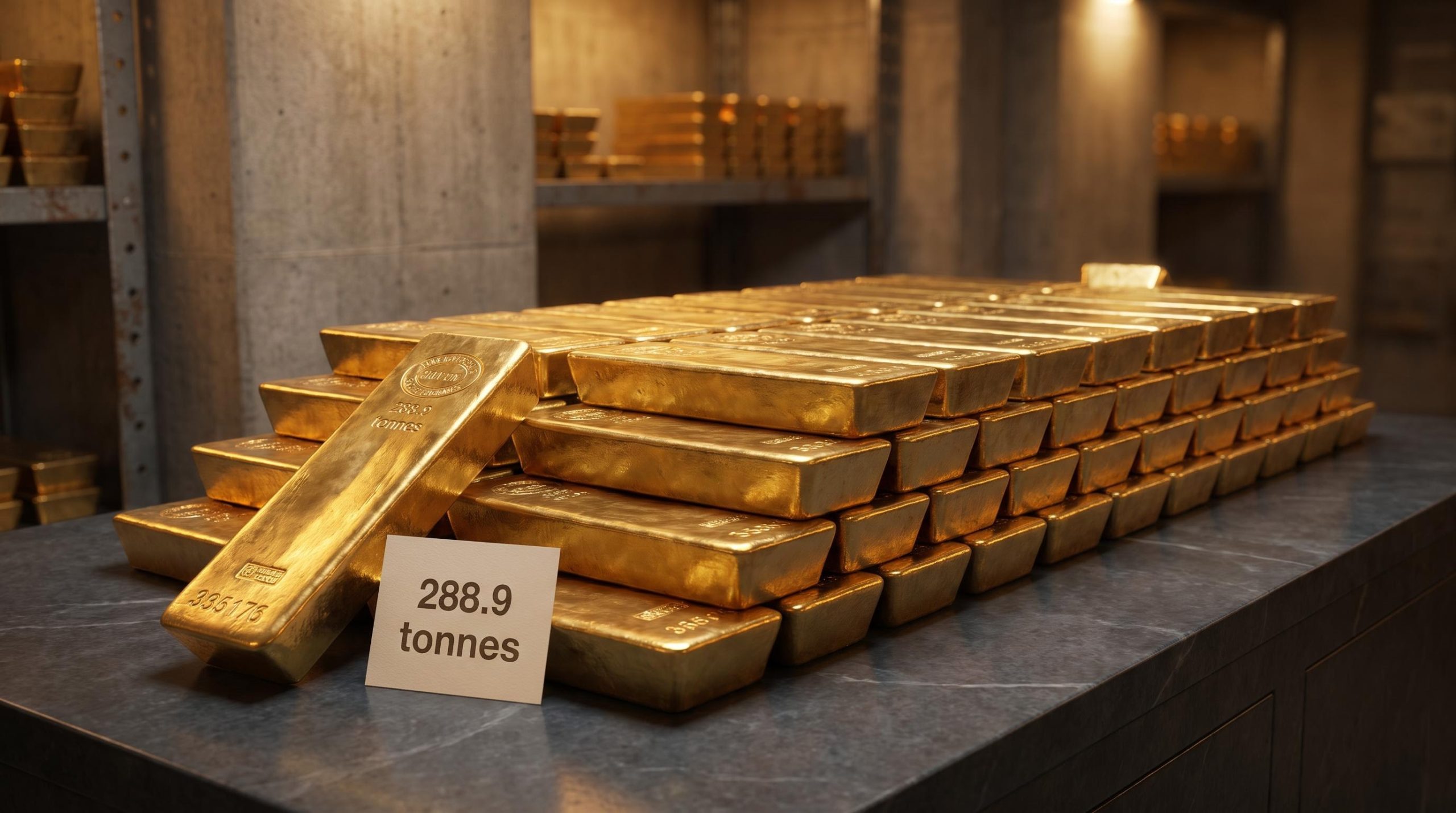
Gold has risen roughly 13-15% this month. For most assets, a move that size in a single month triggers one instinct: wait for the pullback.
That instinct is worth interrogating. The question is not whether gold has moved fast, because it obviously has. The question is whether this rally is the kind that mean-reverts, driven by a dovish Federal Reserve surprise or a geopolitical headline that fades, or whether it marks the early phase of a structural repricing with years of runway ahead. The distinction changes everything about how you respond to the current price.
Here is the structural machinery behind why a growing number of macro investors are treating gold not as a fear trade but as one of the most coherent multi-year macro expressions available today, and how they are sizing and structuring exposure to match the thesis. You will leave with both the analytical framework and the implementation logic, plus the specific conditions that would invalidate the entire case.
The four structural forces that make this look like a cycle opener, not a top
Most gold commentary explains rallies in cyclical terms. A Fed pivot expectation lifts the price. A geopolitical flare-up spikes safe-haven flows. A hot CPI print reminds everyone inflation is sticky. Those catalysts still move gold month to month, and they are probably contributing to this August 2026 move.
But macro investors anchored on structural data are reading the same price action through a different lens. They see the cyclical catalysts operating on top of four slower forces that were first publicly articulated around 2021 and described as a ten-to-twenty-year adjustment horizon. The fact that Bitcoin has also surged strongly this month, cited as a co-beneficiary of the same scarce-asset dynamic, reinforces the structural read: this is not a gold-specific momentum trade.
The four pillars are:
- Entrenched fiscal deficits across major economies, driven by political incentives that punish austerity
- The 2021 refinancing wave, with cheap debt now maturing into a much higher-rate environment
- Foreign central bank reserve reallocation away from Treasuries and toward gold
- Structural geopolitical inflation from great-power competition and deglobalisation
Any one of these individually would justify a constructive gold stance. Their simultaneous arrival is what makes the secular case, not just the tactical one.
The portfolio logic extends beyond gold’s intrinsic properties: the stock-bond correlation breakdown documented by the BIS in 2022-2023 has led institutions including BlackRock, JPMorgan, and Swiss pension funds to replace bonds with gold as a portfolio diversifier, a reallocation that reinforces structural demand independently of any single macro catalyst.
The instinct to wait for mean reversion after a 15% monthly rally is rational if you are in a cyclical trade. In a structural repricing, that instinct costs you the compounding. The rest of this article supplies the evidence to distinguish between those two regimes.
When big ASX news breaks, our subscribers know first
Why fiscal deficits are not getting fixed, and what that means for gold
Start with the spending categories that make deficit reduction politically untenable in the US and most major economies:
- Aging-population entitlements that no party can credibly propose cutting
- Defence spending that is politically untouchable in a more adversarial world
- Industrial policy subsidies with broad electoral support
- Rising interest costs on an already large debt stock
Each category has its own constituency. Together, they create a fiscal structure where any party proposing meaningful consolidation faces immediate backlash. Stanley Druckenmiller has spoken publicly about the implausibility of austerity under current political conditions, and the original macro framing goes further: supply-side policies implemented over recent decades concentrated gains at the top, deferred structural imbalances that are now coming due, and created conditions where the political correction is likely to overshoot well beyond any reasonable equilibrium before stabilising.
Populism is the root driver of fiscal expansion. The political system punishes credible austerity, making meaningful deficit reduction more a talking point than a governing programme across most major economies.
The transmission to gold is mechanical. Persistent deficits mean persistent government debt issuance. If domestic and foreign private demand cannot absorb that issuance at clean market rates, the pressure falls on central banks to suppress real yields below what fiscal fundamentals alone would justify. Gold tends to perform best precisely in that environment: when real rates are held below inflation risk, an asset with no credit risk and no counterparty liability becomes structurally more attractive.
The US Treasury’s August 2026 decision to at least double its long-end buyback capacity to $4 billion per operation illustrates the mechanics of financial repression in real time: a heavily indebted sovereign using institutional tools to hold borrowing costs below what an unfettered market would price, generating negative real returns for creditors and accelerating the relative attractiveness of assets outside the sovereign balance sheet.
For a reader with a 3-5 year horizon, the base case is continuing fiscal laxity and some form of financial repression, not a return to primary surpluses. That changes the calculus on holding gold from a tactical hedge to a structural allocation.
Geopolitical inflation as a permanent premium, not a temporary spike
The 1990-2015 era of deepening globalisation and the peace dividend was the anomaly, not the norm. Today’s geopolitical regime looks more like a reversion to a longer historical mean, and the inflation it produces is structural rather than event-driven.
Three mechanisms are locking in that premium:
- Elevated and sticky defence spending across multiple regions, with no plausible path to reduction while US-China strategic rivalry spans at least another decade
- Supply-chain duplication from reshoring in semiconductors, energy, critical minerals, and defence, which raises baseline production costs
- Export controls on critical materials and investment restrictions that unwind parts of the prior globalisation wave, adding friction costs throughout the system
The original macro framing characterises US efforts to contain China’s economic rise as generating ongoing geopolitical friction that is inherently inflationary. Projecting power to defend dollar dominance through military presence and geopolitical alliances carries real economic costs that feed through to prices persistently, sustaining inflationary pressure across the same ten-to-twenty-year adjustment horizon as the broader thesis.
For gold, what matters is not just the level of inflation but the uncertainty around the durability of the existing monetary and security architecture. When investors question the long-run sustainability of sovereign debt loads, the future of dollar dominance, and the stability of cross-border capital flows under sanctions risk, they assign increased value to an asset outside the liabilities of any state or financial institution.
Gold remains the only reserve asset at scale that sits outside every government’s balance sheet. In a world where the architecture of trade and security is being rebuilt, that quality is not a temporary premium; it is a permanent structural feature.
This pillar is the hardest of the four to falsify and the longest-dated, which makes it the structural backstop for the thesis even if fiscal consolidation surprised to the upside or the refinancing wave proved more manageable than projected.
Central banks are buying gold into weakness, and why that matters structurally
The behavioural observation that is hardest to dismiss is this: the institutions with the longest horizons and the least need to chase momentum are buying gold when prices fall.
For decades, foreign central banks acted as relatively price-insensitive buyers of US Treasuries, providing a safety valve for American deficits. That structural bid is eroding at the margin, and gold is the primary beneficiary. China and several emerging economies have signalled discomfort with expanding Treasury exposure indefinitely, for both financial and geopolitical reasons, particularly after the freezing of Russian reserves in 2022.
The OMFIF Global Public Investor survey released 30 June 2026 marked the first recorded instance where net dollar-reduction intent outnumbered net dollar-increase intent among central banks, confirming that reserve de-dollarisation is no longer a fringe thesis but a measurable institutional shift with direct consequences for gold demand.
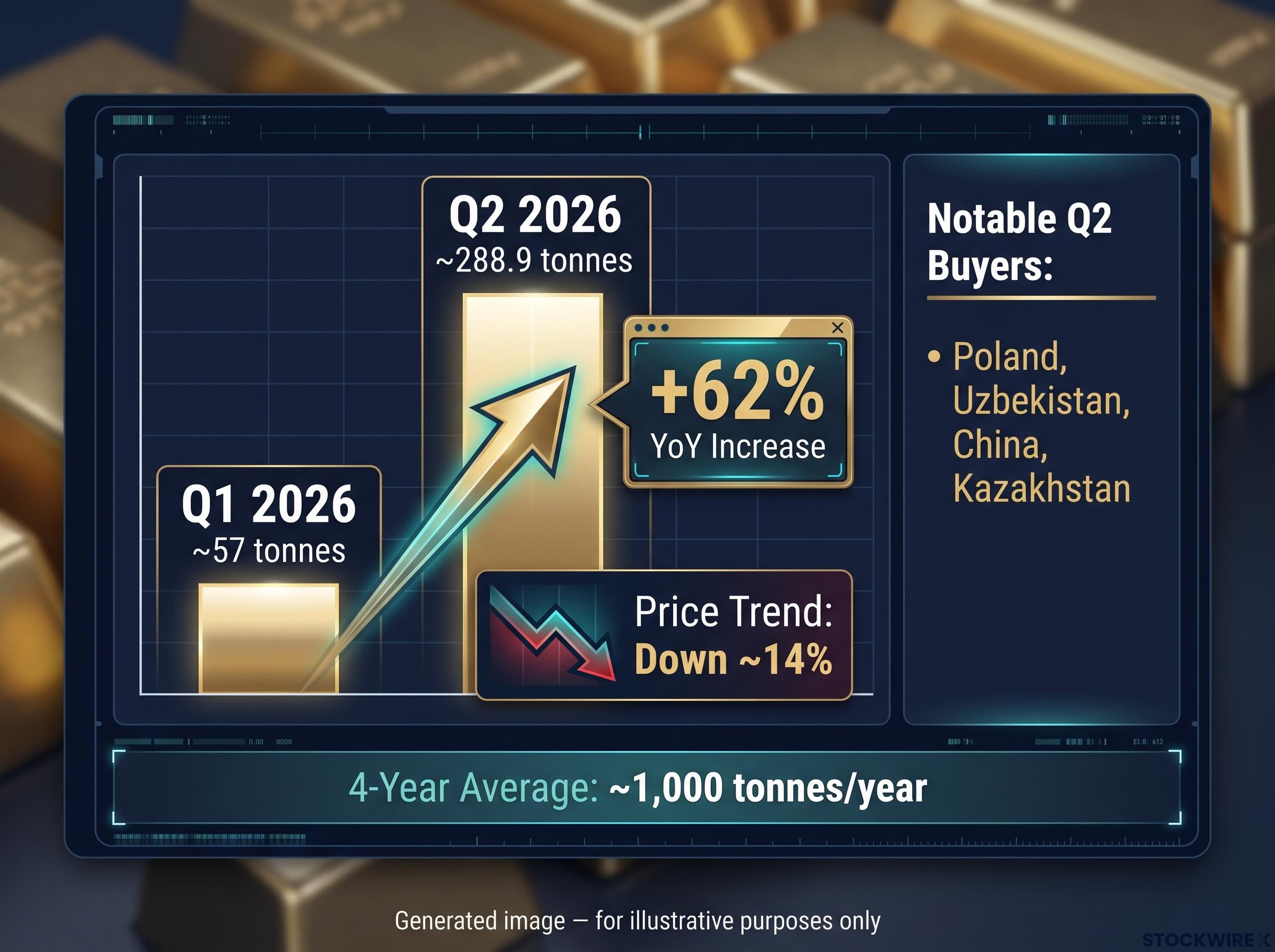
The data tells the story clearly. Q1 2026 net central bank purchases were revised down to approximately 57 tonnes before a sharp Q2 2026 rebound to approximately 288.9 tonnes, a 62% year-on-year increase and the largest second-quarter total on record. That buying occurred into a quarter when gold prices fell approximately 14%.
| Period | Net Purchases (tonnes) | Year-on-Year Change | Gold Price Trend | Notable Buyers |
|---|---|---|---|---|
| Q1 2026 (revised) | ~57 | Below prior estimates | Rising | Poland, China |
| Q2 2026 | ~288.9 | +62% | Down ~14% | Poland, Uzbekistan, China, Kazakhstan |
| Four-year average | ~1,000/year | ~2x prior decade | Mixed | Broad official sector |
Poland alone added more than 80 tonnes in H1 2026, working toward a publicly stated 700-tonne target. By late July 2026, Poland had reached approximately 640 tonnes and continued adding.
The structural attractions of gold over Treasuries for reserve managers are straightforward:
- No default or counterparty risk
- No direct exposure to unilateral financial sanctions
- High liquidity in crisis conditions
The fact that central banks bought at record second-quarter pace into a 14% price decline tells you something specific: this demand is thesis-driven and structural, not reactive to price momentum. It is unlikely to disappear when the headline environment looks less alarming.
What the 2021 debt refinancing wave actually means for gold markets
In 2020-2021, extremely easy monetary conditions allowed issuers across the capital structure to term out debt at historically low coupons. The numbers were enormous.
| Debt Segment | H1 2021 Volume | Year-on-Year Change | Approximate Maturity Window |
|---|---|---|---|
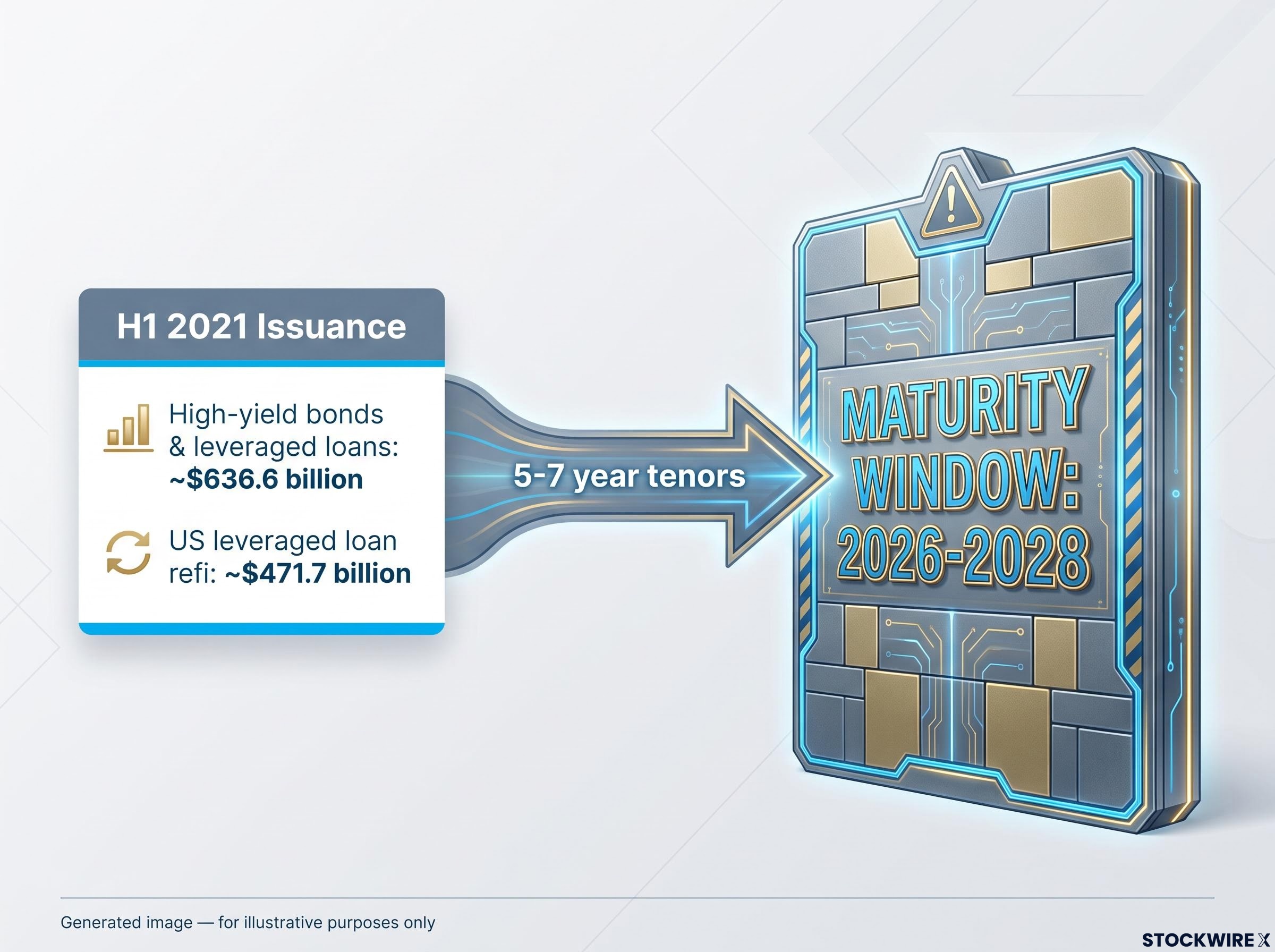
| High-yield bonds and leveraged loans (refinancing) | ~$636.6 billion | Nearly doubled | 2026-2028 |
| US leveraged loan refinancing and repricing | ~$471.7 billion | +79% | 2026-2028 |
The bulk of this issuance was structured with 5-7 year tenors, placing the resulting maturity wall firmly within the 2026-2028 period now under way. The same pattern extends across corporate credit, private equity portfolio companies, real estate vehicles, and parts of the sovereign and quasi-sovereign market.
Fitch leveraged finance maturity profile analysis published in early 2026 confirms that leveraged loan maturities rise sharply into a steep wall beginning in 2028, corroborating the refinancing pressure thesis and giving the 2026-2028 window a concrete institutional timeline rather than a modelled projection.
The mechanics are direct. Debt issued at very low coupons must be refinanced at today’s much higher rates. Aggregate interest expense rises, pressuring weaker borrowers and raising default risk. A surge of refinancing-related issuance adds to duration supply precisely when governments are also issuing heavily. Foreign nations reducing Treasury holdings add further net supply to the long end of the curve.
The outcome branches two ways, and both strengthen the gold case. Either yields adjust upward to clear the duration supply, or policy intervention keeps nominal yields in check while inflation and term premia do the work. In both scenarios, gold, with no credit risk and no counterparty liability, becomes relatively more attractive.
The refinancing wall is not a vague macro narrative. It is a scheduled, quantifiable event landing directly in the multi-year window when the gold thesis is expected to be most potent. That makes the timing of entry now, rather than in two years, strategically meaningful.
How macro investors are structuring exposure, and what to watch for thesis failure
Once the structural case is accepted, the implementation question follows. Many macro investors prefer long-dated call options over outright gold positions, for four reasons:
- Asymmetry: calls cap downside at the premium paid while preserving uncapped upside above the strike, matching a belief that long-run skew is to the upside but the short-term path is noisy
- Leverage without margin risk: options deliver embedded leverage without margin calls that can force liquidation at the worst possible moment
- Horizon matching: long-dated options (LEAPS, which are options with expiry dates typically 12-24 months out) on gold futures or ETFs align with the refinancing wall timeline without constant rollover
- Capital efficiency: allocating a low single-digit percentage of portfolio NAV as call premium can create exposure equivalent to a much larger unlevered position, keeping capital free for other trades
Peter Schiff is referenced as a long-standing gold advocate who holds the underlying asset directly. The options approach represents a more capital-efficient implementation of the same conviction, with practical design choices including slightly in- or at-the-money strikes over far out-of-the-money lottery tickets, tenors extending through 2027-2028 to capture the refinancing wall period, and instruments spanning major gold ETFs, COMEX gold futures, or diversified gold-miner indices.
The failure conditions matter as much as the implementation. Four developments would meaningfully invalidate this thesis:
- Credible, durable fiscal consolidation in the US and other major issuers, meaning implemented bipartisan programmes that narrow structural deficits over many years, not temporary caps
- A material easing of US-China tensions with genuine re-globalisation that reduces defence spending needs and re-integrates supply chains
- A technology-driven structural disinflation shock powerful enough to push real rates sustainably higher
- The emergence of a widely adopted alternative reserve asset architecture that reduces gold’s unique role
None of these trajectories is visible at scale in current data or policy as of late August 2026. They are not cosmetic hedging language; they are the specific signposts worth monitoring.
What the structural picture says about where gold goes from here
The four pillars pull into a single picture. Fiscal deficits are embedded, not transitory, driven by political incentives that punish austerity. The 2021 refinancing wall peaks in the 2026-2028 window now arriving. Central bank buying reached a record second-quarter total at approximately 288.9 tonnes, purchased into price weakness. Geopolitical inflation operates on a ten-to-twenty-year adjustment horizon with no visible resolution.
The behavioural risk in secular trades is well-documented: investors enter late into strong momentum, oversize positions, get forced out by normal corrections, and miss subsequent legs. The more durable approach is to size for multi-year holding and treat pullbacks as cost-improvement opportunities, not exit signals.
The 13-15% rally in August 2026 is not a reason to wait. It is the context in which the structural case is being publicly reassessed, with roughly 1,000 tonnes of annual central bank demand providing the demand floor and the refinancing wall providing the nearest-term catalyst.
For investors wanting to map the four structural pillars onto near-term price targets and Fed decision scenarios, our full explainer on the H2 2026 gold price outlook covers the World Bank’s $4,700 full-year average forecast and the specific Fed rate paths that determine whether $4,300-$4,500 or $3,700-$3,900 is the next meaningful range.
Gold in this environment is less a tactical fear trade and more one of the most coherent secular macro expressions available. The structural conditions that would invalidate the thesis are not visible today. The relevant question is not whether to have exposure, but how to size it so that normal volatility does not knock the position out before the thesis has time to play out.
This article is for informational purposes only and should not be considered financial advice. Investors should conduct their own research and consult with financial professionals before making investment decisions. Options and gold-related instruments can involve significant risk of loss. Past performance does not guarantee future results. Forward-looking statements are speculative and subject to change based on market developments.