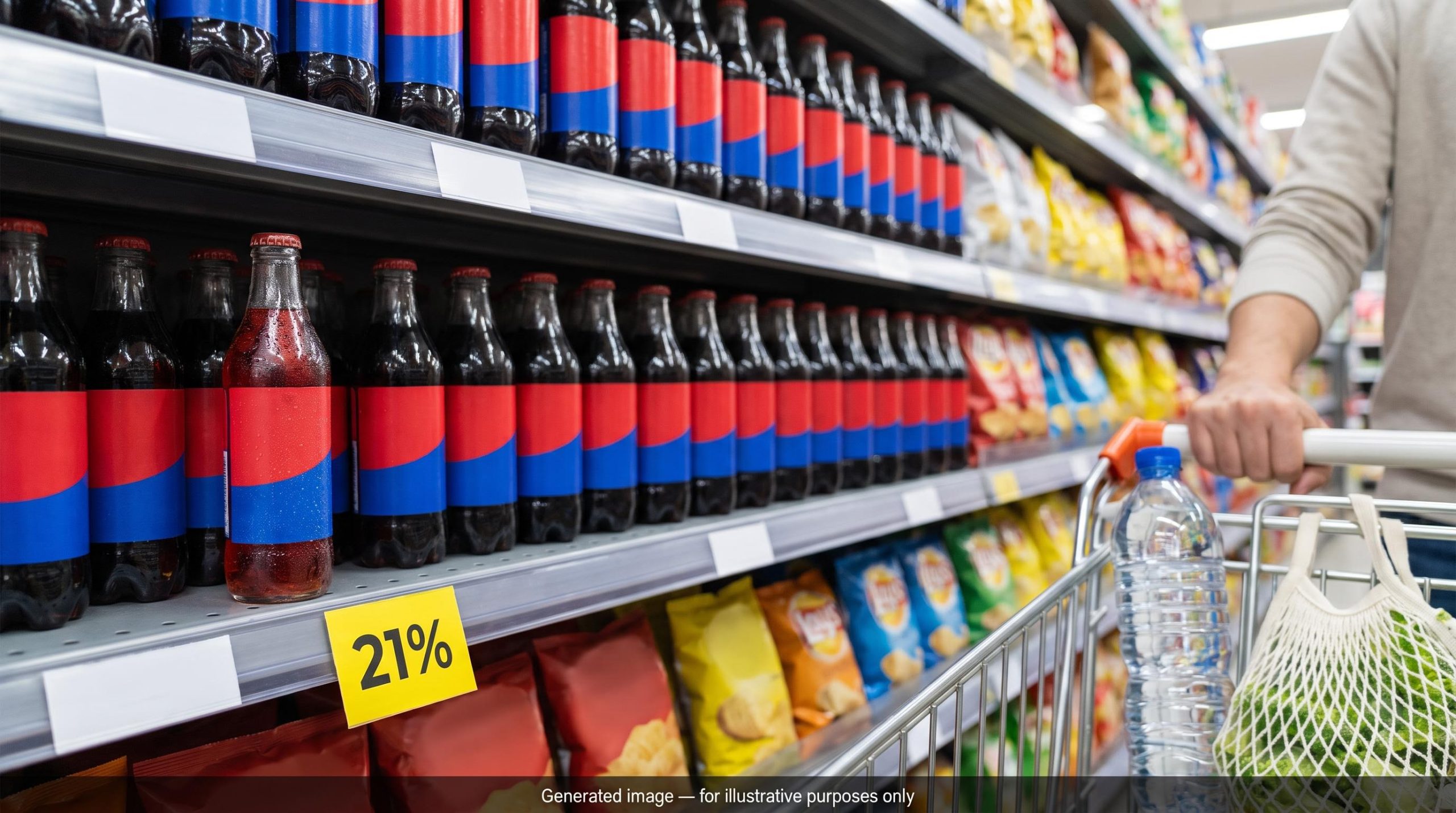
PepsiCo cut prices on several of its drinks brands this year, and North American beverage volumes still fell. A pure cost-of-living squeeze should not behave that way. Cheaper cola should sell more cola, yet the US share of households with a current GLP-1 user has climbed to 21%, up from 9% in January 2025, and that is reshuffling the debate around GLP-1 weight loss drugs and the stocks most exposed to them.
GLP-1 drugs now touch roughly one in five US households. Investors holding snack makers, soft drink giants and liquor retailers are being pushed to decide whether weak volumes are a cycle that will pass or a permanent change in how people eat and drink.
The market has not settled the question either. PepsiCo shares rose about 3.7% on its latest report day, even as beverage volumes disappointed.
Here is how to separate the appetite-drug effect from the noise, plus a four-part lens for judging how exposed your consumer staples holdings really are.
Is it the drugs or the wallet? What PepsiCo’s falling volumes actually show
Price cuts are supposed to be the cure for a stretched shopper. At PepsiCo, which holds about 14.2% of the North American soft drink market, they have not worked as planned. The Moomoo Daily podcast puts North American beverage volumes down around 3% so far this year.
Management has a ready explanation.
Ramon Laguarta, Chief Executive Officer, PepsiCo Laguarta attributed volume growth falling below plan to financial pressure on consumers.
Moomoo Daily host Tapper Strickland reads it differently. If lower prices do not lift demand, he argues, money is not the main problem, and GLP-1 use is the bigger driver that few are discussing.
The wider evidence sits between the two camps. Reuters frames PepsiCo’s challenge as three forces at once: GLP-1 adoption, surging living costs and a broader move toward healthier eating. Activist investor Elliott Investment Management has also criticised PepsiCo’s two North America divisions, pointing at execution rather than biology.
| Explanation | Supporting evidence | Who advances it |
|---|---|---|
| Cost of living | Volume shortfall versus plan; trading down | Ramon Laguarta, PepsiCo; Reuters |
| GLP-1 use | Price cuts failed to lift volumes; 21% household penetration | Tapper Strickland, Moomoo Daily; Reuters (as one factor) |
| Healthier eating | Growth in zero-sugar and functional hydration | Reuters; PepsiCo product strategy |
| Execution | Persistent North America declines | Elliott Investment Management |
The price-cut puzzle is the most telling clue. When volumes fall even after prices drop, you should treat “consumers are just stretched” as an incomplete explanation. Remember, though, that the leap to GLP-1s is Strickland’s inference, not a proven link.
Why it matters for you: a cyclical dip makes a depressed valuation an opportunity, while a structural shift can turn it into a trap.
Why the numbers differ depending on the source
You will see PepsiCo beverage declines quoted at 1%, 2%, 3% and 4%. Most of the gap comes down to scope and timing. In Q3 2025, a year ago, overall beverage volume fell 1% while North America beverage fell about 3%, on global revenue of US$23.94 billion (up 2.7%, organic growth 1.3%).
Reuters cited a 4% North American drop for a recent quarter, and one Q3 2026 report showed around 2%. MarketWatch and Morningstar described a 12th straight quarter of falling North America beverage volume, a claim not independently verified. Before you use any figure, check which quarter and which region it covers.
When big ASX news breaks, our subscribers know first
What GLP-1 households actually stop buying
To judge how far the drug explanation can stretch, start with how quickly use has spread.
The adoption curve
GLP-1 drugs mimic a gut hormone that signals fullness. In plain terms, people taking them feel less hungry and often lose interest in high-sugar, high-fat foods, which is why snacks, sugary drinks and alcohol sit in the firing line.
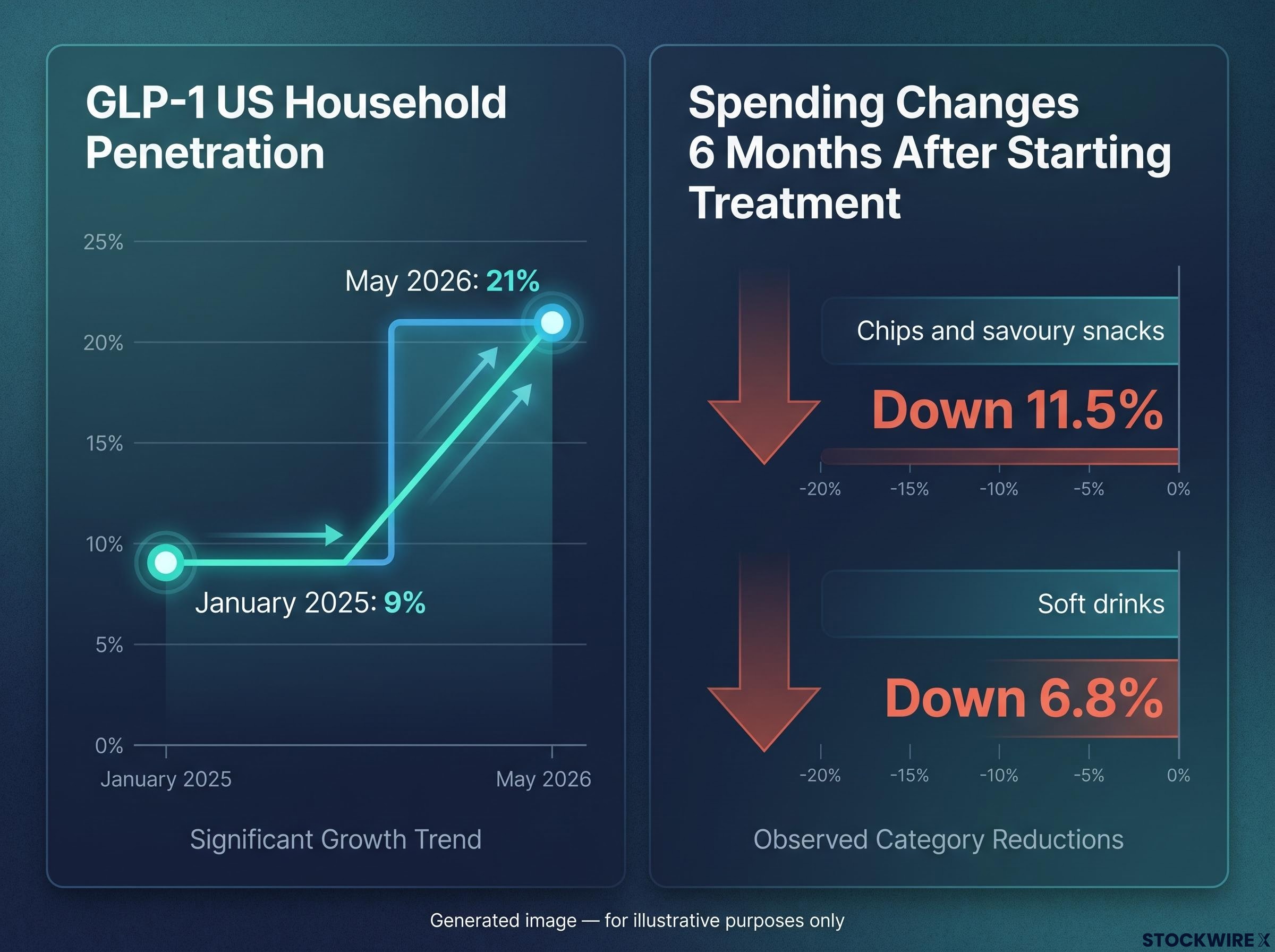
Household penetration more than doubled 21% of US households had a current GLP-1 user in May 2026, up from 9% in January 2025, according to PwC analysis of Numerator data reported by Reuters.
That is a doubling in about 18 months. The Moomoo Daily source puts the number of US adults on weight-loss drugs at about 30 million. If adoption keeps anything like this pace, the drag on indulgent categories is likely to widen over the next few years.
The household figures sit against a much lower global backdrop, since global GLP-1 penetration among people with obesity is only around 2%, which suggests the consumer staples drag has plenty of room to widen.
What changes in the basket
The spending data is the strongest evidence of a behavioural shift, with caveats attached:
- Chips and savoury snacks: spending reportedly down 11.5% six months after a household member starts treatment
- Soft drinks: spending reportedly down 6.8% over the same period
- Sweet treats and salty snacks: fewer purchases, per PwC and Numerator
- Gaining ground: protein, fresh produce, bottled water and protein drinks
The 11.5% and 6.8% figures come from Strickland citing recent studies, and the underlying study could not be independently traced. Treat them as indicative rather than settled.
Scanner data also shows what changes inside user households. It cannot prove that GLP-1s are driving whole-category declines, because budget pressure and health trends overlap.
Then there is the figure that keeps the thesis honest: roughly 79% of households are still non-users. You should read that as a warning that GLP-1s alone cannot explain every volume decline today. The speed of adoption, however, tells you the drag is likely to grow.
Three companies, three responses: PepsiCo, Coca-Cola and Endeavour
Run the same hypothesis through three businesses and the answers start to diverge.
PepsiCo and Coca-Cola: changing the drinks mix
PepsiCo is cutting costs and pushing into functional hydration, zero-sugar and energy drinks. FoodDive reported improving organic volume trends in exactly those segments.
Propel is the proof point. The functional hydration brand, launched in 2019, reached an estimated US$1 billion in annual retail sales by 2025, showing a large company can build a franchise around weight-management and wellness goals.
Coca-Cola offers a sharper contrast. Reuters reported its North America volume grew 4% in a recent quarter while PepsiCo’s fell, a comparison not independently verified. That may signal a better-aligned zero-sugar portfolio, although the research found no specific Coca-Cola protein or fibre launches.
Endeavour: a GLP-1 case study without a GLP-1 admission
Endeavour Group, owner of Dan Murphy’s and BWS, is the Australian test. Strickland flags it as a GLP-1 casualty, noting shares are down 14.7% this year and about 53% since listing.
The financials show strain. In FY25, sales were about $12.1 billion, retail liquor fell 1.2% to $9.95 billion, and net profit dropped 15.8% to $426 million (reported figures, not independently verified). A March 2026 update showed Dan Murphy’s and BWS up just 0.2% to $5.5 billion, while pubs grew 4.4% to about $1.2 billion.
Endeavour’s preliminary F26 results update the FY25 picture, with underlying NPAT of $363 million and Hotels sales up 4.2% while Retail earnings came under pressure.
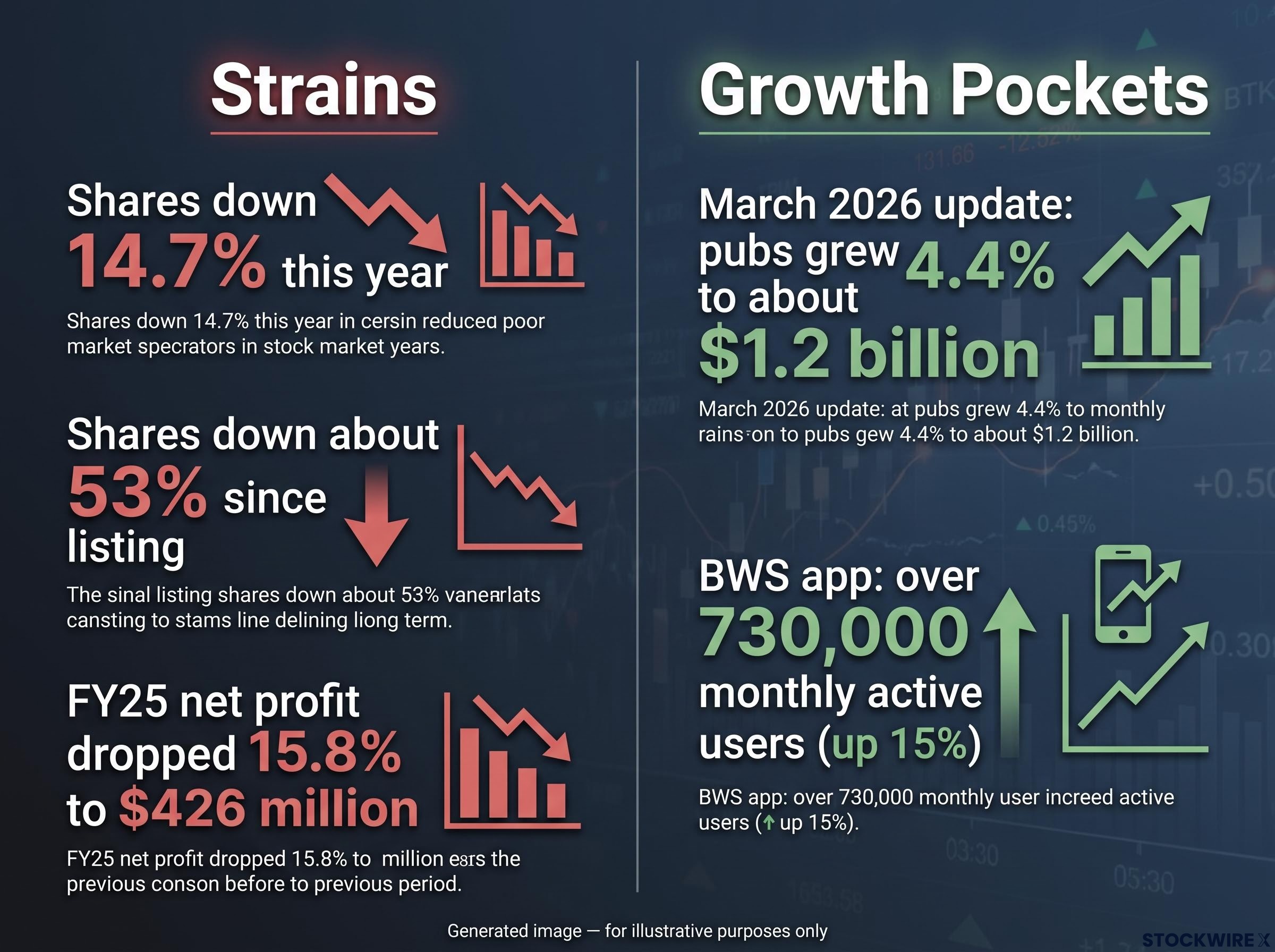
Management has never blamed GLP-1s. It points to cost of living and value-seeking, and has responded with margin trimming, value pricing and a digital push: the BWS app has more than 730,000 monthly active users (up 15%), over half of them Gen Z or Millennials.
| Company | Stated cause of weakness | Strategic response | Latest signal | GLP-1 linkage evidence |
|---|---|---|---|---|
| PepsiCo | Consumer financial pressure | Cost cuts; zero-sugar, energy, functional hydration | North America beverage volume down about 2-4% by quarter | Inferred by commentators; Reuters lists as one factor |
| Coca-Cola | Not documented | Zero-sugar mix (no protein or fibre launches found) | North America volume up 4% (unverified) | None documented |
| Endeavour Group | Cost of living, value-seeking | Value pricing, margin trimming, BWS app | Retail up 0.2%; pubs up 4.4% | None from management |
Younger drinkers drinking less, household budgets and GLP-1s could all be at work here. Attributing Endeavour’s slide to the drugs is a hypothesis you should test, not a fact you can assume.
A four-part framework for judging GLP-1 exposure in consumer staples
The evidence gets you to a usable screen. Apply these four questions to any holding:
- Category exposure: How much revenue comes from salty snacks, sugary sodas or discretionary liquor, the categories GLP-1 households are leaving?
- Credibility of the better-for-you shift: Is the pivot visible in sales, as Propel’s roughly US$1 billion is, or only in management language?
- Value formats: Can the business push smaller packs, value pricing or loyalty offers without gutting margins?
- Channel mix: Does growth lean on hospitality or retail? Endeavour’s pubs rising 4.4% against flat retail shows mix can cushion a weak core.
The synthesis GLP-1s look best understood as an accelerant of shifts already under way, healthier eating and generational change among them, rather than the sole cause.
That framing protects you from two errors: dismissing the drugs as a fad, and blaming them for every soft quarter. Some analysts citing Numerator data see lasting damage to indulgent categories, while others argue product mix changes and smarter pricing can offset it.
What would change the thesis
Several data gaps matter. Reliable figures on how many users stop taking GLP-1s, the arrival of oral versions and falling drug prices could all expand or shrink the effect. Watch, too, whether volumes recover if cost pressure eases; a rebound would favour the wallet explanation.
The arrival of oral versions could expand adoption further, and the oral GLP-1 market is already dominated by Novo Nordisk, with Lilly’s orforglipron preparing to compete on convenience and price.
This framework is general information, not personal financial advice. Past performance does not guarantee future results, and forward-looking views are speculative and subject to change.
Weighing the evidence before you act on the GLP-1 thesis
The evidence supports GLP-1s as a real and growing drag on snacks, soft drinks and alcohol. It does not yet prove they are the sole cause, and company-level proof of adaptation matters more than the headline narrative.
The practical test arrives with the next round of results. Track North American beverage volumes at PepsiCo and Coca-Cola, and Endeavour’s retail liquor sales, rather than headline guidance.
Run your own holdings through the four-part framework and keep those indicators on your watchlist.
This article is for informational purposes only and should not be considered financial advice. Investors should conduct their own research and consult with financial professionals before making investment decisions.