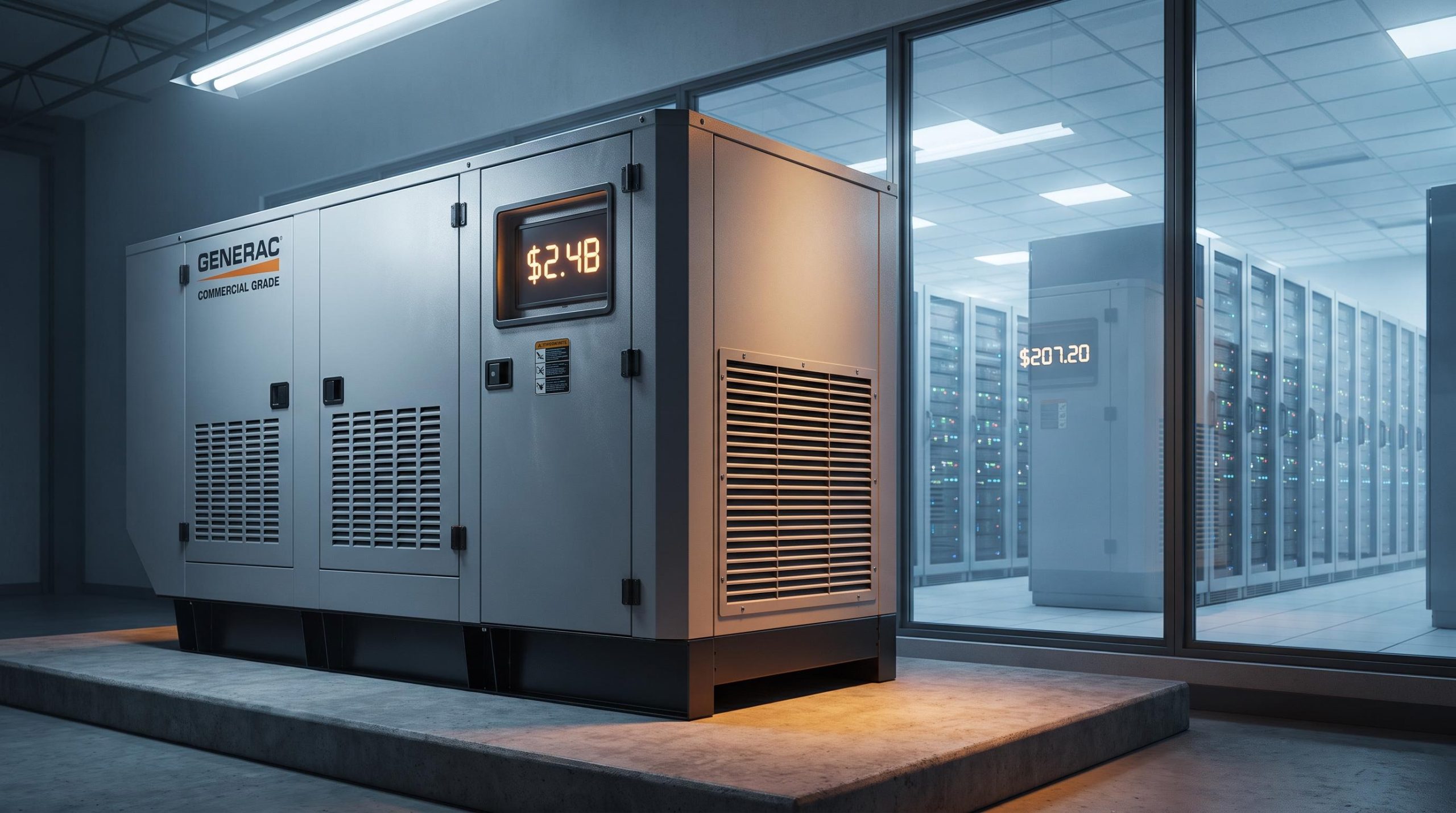
Generac Holdings surged more than 40% in after-hours trading on 16 September 2026, the moment its SEC filing landed. By the close of the next regular session, roughly half that gain was gone.
That compression, from 40% in extended trading down to an 18.3% regular-session close, is the more interesting story here, and it is the one worth reading carefully. The catalyst is a seven-year supply agreement with Amazon to provide backup power generators for its AI data centres, with initial committed deliveries of $2.4 billion through 2027-2028 and a performance ceiling of up to $8 billion. For a company that entered the year as a residential backup power brand navigating an industrial pivot, the deal is either a structural inflection point or a sentiment overshoot, depending entirely on which numbers you trust.
Here is the framework for separating the firmly committed revenue from the aspirational ceiling, understanding what Generac’s lead-time advantage actually buys it competitively, and judging whether the $207.20 close reflects a floor or a ceiling for the stock from here.
The $2.4 billion you can bank on, and the $8 billion you cannot
The headline number that drove the after-hours spike was $8 billion. The number Generac can actually rely on is $2.4 billion. Those are not the same figure, and the gap between them is written directly into the structure of the Form 8-K filed with the SEC on 16 September 2026.
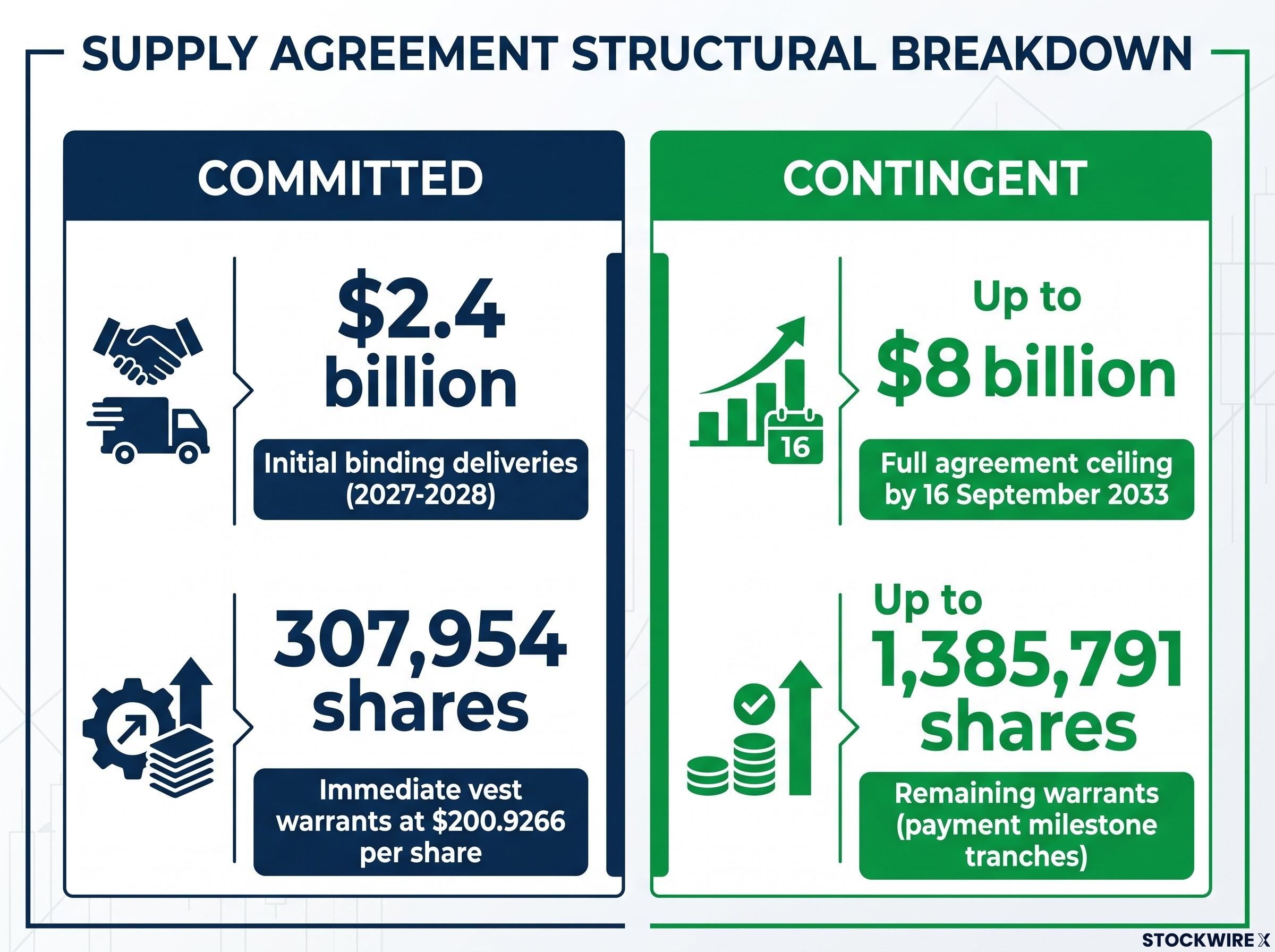
Start with what is binding. The agreement schedules approximately $2.4 billion in generator deliveries across 2027 and 2028. That is committed volume with a delivery timetable attached.
The remaining road to $8 billion runs through a warrant, and the mechanics matter. Generac issued Amazon’s affiliate the right to purchase up to 1,693,745 shares of common stock at $200.9266 per share. Of those, 307,954 shares vested immediately at signing. Everything above that unlocks only in tranches as Amazon’s cumulative qualifying payments to Generac accumulate toward the $8 billion mark.
| Component | Value | Status | Conditions |
|---|---|---|---|
| Initial binding deliveries | $2.4 billion | Committed | 2027-2028 delivery schedule |
| Full agreement ceiling | Up to $8 billion | Contingent | Cumulative qualifying payments reaching $8B |
| Warrant shares (immediate vest) | 307,954 shares | Vested | None |
| Warrant shares (remaining) | Up to 1,385,791 shares | Contingent | Payment milestone tranches |
The full warrant vests only under a specific set of conditions drawn from the filing mechanics:
- Amazon must actually place orders under the agreement, not merely retain the option to
- Those orders must be delivered and paid for, with cumulative gross payments (net of certain offsets) accruing to Generac
- Payments must reach the full $8 billion threshold across the agreement’s life through 16 September 2033
That structure tells you the $8 billion figure is an incentive alignment mechanism, not a purchase guarantee. It rewards Amazon with equity upside for buying more, but it obligates nothing beyond the committed floor.
Here is why that distinction matters to your position. Anyone building a thesis on the $8 billion number is effectively betting that Amazon’s AI infrastructure spending holds at or above its current pace for seven straight years. That is a large assumption to bake into a valuation model, and misreading the contract structure is the fastest way to overpay for the stock from here.
When big ASX news breaks, our subscribers know first
What Generac looked like before Amazon called
The Amazon deal did not land on a standing start. It landed on top of a business that was already accelerating, which is the single most important reason the rally is not purely sentiment.
The Q2 figures did not emerge from a standing start: C&I segment growth was already running at 28% year-over-year in Q1 2026, with adjusted EPS of $1.80 beating the Wall Street consensus of $1.35 by a wide margin, establishing the commercial trajectory well before Amazon entered the picture.
On the Q2 2026 earnings call on 7 August 2026, weeks before Amazon signed, Generac disclosed a data-centre product backlog of $1.6 billion. Roughly $1 billion of that had been booked in just the prior 90 days, and $1.35 billion was already scheduled for 2027 delivery. That backlog was built entirely around Generac’s first hyperscale customer, with no Amazon volume in it at all.
Commercial backlog expansion of 75% to $700 million in Q1 2026 was already signalling the data-centre pivot months before the Amazon filing, with management flagging that hyperscaler vendor authorisations were advancing and custom engineering capabilities from the Enercon acquisition were being absorbed into the production pipeline.
The industrial pivot was showing up in the reported numbers, too. The Commercial and Industrial (C&I) segment, which houses the data-centre business, grew net sales approximately 29% year-over-year to $556 million in Q2 2026, with data-centre sales exceeding $100 million in the quarter alone.
Management guidance pointed the same direction, raising C&I full-year growth guidance to the low-30% range and lifting the adjusted EBITDA margin outlook to roughly 20-21%. A $1.6 billion backlog assembled before Amazon signed tells you the hyperscaler thesis was already being validated by another major customer. The Amazon deal is additive evidence, not the single fragile pillar the bull case depends on.
How the 2027 revenue picture builds from here
Now stack the pieces in order to see where 2027 lands:
- Pre-Amazon 2027-scheduled backlog: $1.35 billion
- Amazon tranche added: $2.4 billion across 2027-2028
- Combined visible order book through 2028: approximately $4.0 billion
Split roughly half the Amazon tranche into 2027 and add it to the existing $1.35 billion, and the estimate for identifiable data-centre revenue in 2027 alone reaches approximately $2.55 billion.
Frame that against the baseline. Generac expects roughly $450 million of data-centre revenue in 2026. A jump to $2.55 billion the following year is not incremental growth; it is a step-change in the revenue base.
For investors weighing whether the 18.3% close reflects value or momentum, this matters. The order book was already compounding before the announcement, which affects both the probability that revenue actually converts and the multiple the market can reasonably justify.
The lead-time moat and why hyperscalers are paying attention
To understand why Amazon signed a seven-year deal with a challenger brand rather than an entrenched incumbent, start with the problem hyperscalers actually face: they cannot get generators fast enough.
Large-engine plants at Caterpillar and Cummins are booked out between 50 and 107 weeks for comparable products, with new allocations pushed into 2028. A hyperscaler that needs backup capacity online by 2027 has a genuine and time-sensitive problem, and the two largest suppliers in the market cannot solve it inside the required window.
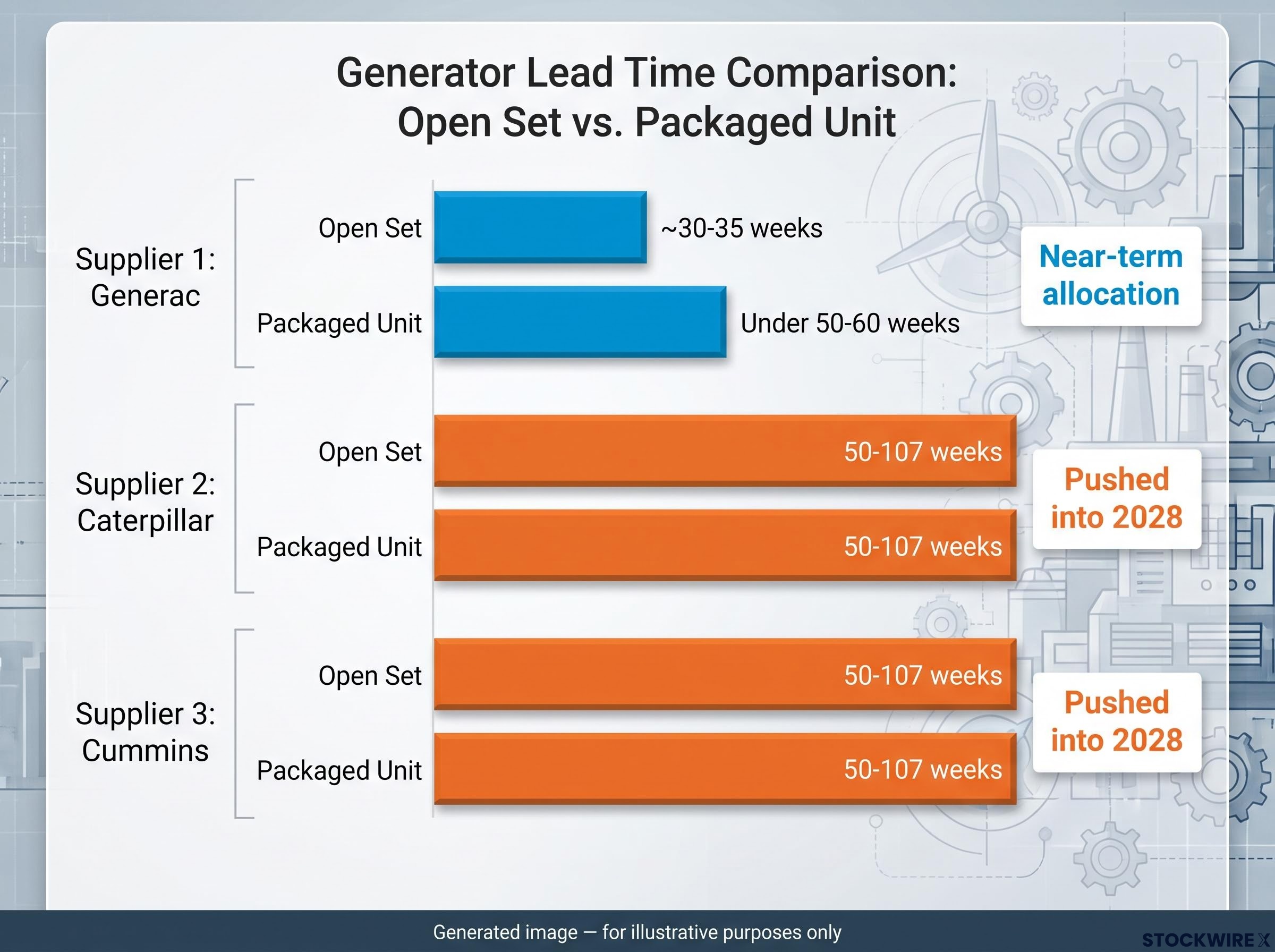
Generac’s delivery timelines are the direct answer to that gap. According to DataCenterFrontier, the company can deliver open generator sets in roughly 30-35 weeks and fully packaged units in under 50-60 weeks.
Generac’s delivery window has been described as “one-third of that lead time” compared with existing OEMs, according to DataCenterFrontier.
| Supplier | Open Set Lead Time | Packaged Unit Lead Time | New Allocation Availability |
|---|---|---|---|
| Generac | ~30-35 weeks | Under 50-60 weeks | Near-term |
| Caterpillar | 50-107 weeks | 50-107 weeks | Pushed into 2028 |
| Cummins | 50-107 weeks | 50-107 weeks | Pushed into 2028 |
The advantage is structural, not marketing spin. Generac’s engine sourcing arrangement through Weichai and Baudouin gives it access to large-bore engine inventory that Western OEM plants cannot currently match. Its Modular Power Systems architecture standardises configurations for faster production, and its supply chain is built explicitly for demand flexibility.
The demand backdrop keeps widening the gap. AI has reshaped power sizing, with rack density climbing from 5-10 kW toward as much as 100 kW per rack, while a single major hyperscale campus now requires 100MW-plus of standby generation. Generac estimates the data-centre emergency backup market alone represents a total addressable opportunity of $14-$17 billion.
When the two largest incumbents cannot deliver until 2028 and customers need capacity by 2027, lead time stops being a differentiator in the ordinary sense. It becomes the reason a hyperscaler signs a seven-year agreement with a challenger. The durability of that position now depends on whether Caterpillar or Cummins can expand capacity before the next procurement cycle, which makes their capacity announcements the clearest leading indicator of whether the moat holds.
For investors exploring how Generac secured procurement credibility with hyperscalers before the Amazon deal was signed, our full explainer on Generac’s hyperscaler authorisation process covers the vendor qualification steps, manufacturing capacity additions, and engineering acquisitions that made a seven-year supply agreement achievable.
Valuation reality check: what the analyst spread actually tells you
The stock closed at $207.20 on 17 September 2026 after touching an intraday high of $231.89. The question every investor now faces is whether that price is cheap or expensive, and the analyst target range answers it less as a consensus than as a map of the assumptions in dispute.
The spread runs from Roth Capital’s neutral $250 all the way to Canaccord Genuity’s bull-case $375. That $125 gap is not a simple valuation disagreement. It represents two genuinely different views on how much of the Amazon deal will actually convert into paid orders.
| Firm | Rating | Price Target | Key Thesis |
|---|---|---|---|
| Canaccord Genuity | Buy | $375 | Deal “landmark”; up to $8B potential volume |
| Cantor Fitzgerald | Overweight | $333 | Critical for 2028 backlog replenishment |
| Baird | Outperform | $305 | Generac a “top idea”; deal transformational |
| Stifel | Buy | $285 | Major expansion of backlog and visibility |
| Needham | Buy | $282 | Post-deal upgrade |
| Wells Fargo | Overweight | $280 | Current multiple “far too low” |
| Barclays | Equalweight | $278 | Recognises deal but not overweight |
| Roth Capital | Neutral | $250 | Risk and valuation stretch; avoids Buy |
The consensus rating sits at Moderate Buy, with an average target of $293-$295. That implies roughly 42% upside from the $207.20 close, which sounds compelling until you look at where the caution actually sits.
Wells Fargo characterised the current valuation as one that “does not yet fully reflect” the Amazon relationship, describing the multiple as “far too low.”
Here is the read that matters. Even the most cautious rated firm, Roth Capital at Neutral, still carries a target of $250, roughly 21% above the close. When the bear of the group sits a fifth above the current price, the signal is that the market has not fully digested the deal, not that it has overreacted.
That said, the risks that would push the outcome toward $250 rather than $375 are real and specific:
- Amazon order conversion rate: whether cumulative payments track toward the $8 billion ceiling or stall near the $2.4 billion committed floor
- Incumbent capacity expansion: whether Caterpillar or Cummins close the lead-time gap before the next procurement cycle
- Regulatory developments: the Trump administration Executive Order on foreign-sourced grid equipment and its potential relevance to the Weichai/Baudouin engine lines
- Macro AI capex trajectory: whether hyperscaler infrastructure spending sustains its current pace
Customer concentration sits underneath all of this. Generac’s data-centre backlog rests on two hyperscaler relationships, and plans to triple manufacturing capacity create significant operational gearing that turns into a liability the moment either customer slows spending. For an investor deciding whether to add, hold, or wait for a better entry, the spread is more useful than the consensus, because it names precisely which risks matter.
Data centre revenue concentration was already a structurally significant dynamic by Q1 2026, when the Commercial and Industrial segment had absorbed residential stagnation and become the primary driver of adjusted EBITDA margin expansion, making the segment’s hyperscaler dependency a key variable in any forward earnings model.
What the Amazon deal changes about Generac’s long-term investment case
Strip away the day-one volatility and the picture that remains is a company that has changed what it is. Generac has moved from a residential backup power brand to an infrastructure supplier embedded in the AI data-centre buildout, with revenue visibility now extending through September 2033 and a self-estimated addressable market of $14-$17 billion.
That transition is genuine. The combined visible order book of roughly $4.0 billion through 2028, the committed $2.4 billion Amazon tranche, and the lead-time advantage over incumbents are not sentiment; they are the fundamentals underpinning the analyst targets clustered around $293-$295.
Whether the bull case or the base case plays out comes down to two variables:
- Amazon order conversion pace: how quickly the company moves from the committed $2.4 billion floor toward the $8 billion ceiling
- Incumbent lead-time gap closure: whether Caterpillar or Cummins narrow the delivery advantage before the next major procurement cycle
The variables that separate the bull case from the base case
For a long-term holder, three concrete signals are worth watching in the months ahead:
- Quarterly order conversion figures disclosed in Generac’s earnings calls, which show whether payments are actually tracking toward the ceiling
- Caterpillar and Cummins capacity expansion announcements, the clearest read on whether the moat is eroding
- Amazon AWS infrastructure capex guidance, the upstream driver of Generac’s order flow
The Amazon agreement is most accurately read as a seven-year option on Generac’s ability to execute at scale in a market it did not lead three years ago. The $207.20 close is a price the market has partially, but not fully, reflected against the committed value, which means the remaining upside is asymmetrically tied to execution over the next 12-18 months. The price you pay today for that option is the central question the analyst spread cannot answer for you.
Investors who hold the distinction between the committed $2.4 billion and the contingent $8 billion clearly in mind are positioned to judge Generac on its fundamentals rather than its headlines, which is where durable returns tend to originate.
This article is for informational purposes only and should not be considered financial advice. Investors should conduct their own research and consult with financial professionals before making investment decisions.
Past performance does not guarantee future results. Financial projections are subject to market conditions and various risk factors. Forward-looking statements are speculative and subject to change based on market developments and company performance.