The European Central Bank raised rates again this month, and yet one of its most influential voices is openly weighing whether the tightening job may already be close to done.
That is the tension sitting at the centre of ECB monetary policy right now. Underlying inflation is projected to run above the 2% target all the way out to 2028, the deposit rate has just climbed to 2.50%, and Executive Board member Isabel Schnabel is simultaneously acknowledging that rising global bond yields could quietly do some of the ECB’s tightening work for it.
Schnabel has laid out this frame across two recent speeches: one in New York on 6 March 2026, the other in Luxembourg on 30 September 2026. Together they define how the Governing Council is currently reading the inflation problem, and they reveal a policymaker whose tone has hardened as the outlook has deteriorated.
Read on and you will know how to decode what her remarks actually signal about the direction of ECB rates, which financial conditions data to watch, and why the movement of global yields now sits inside the ECB’s own decision-making.
What the latest inflation numbers tell the ECB it cannot ignore
Start with the raw figure. Euro area annual inflation, measured by the Harmonised Index of Consumer Prices (HICP, the standard eurozone inflation gauge), came in at 3.2% in August 2026, up from 2.9% in July 2026, according to Eurostat data published on 17 September 2026.
Core inflation, which strips out volatile energy and food prices to show the underlying trend, edged down to 2.4% in August 2026 from 2.5% in July. Softer, but still comfortably above target.
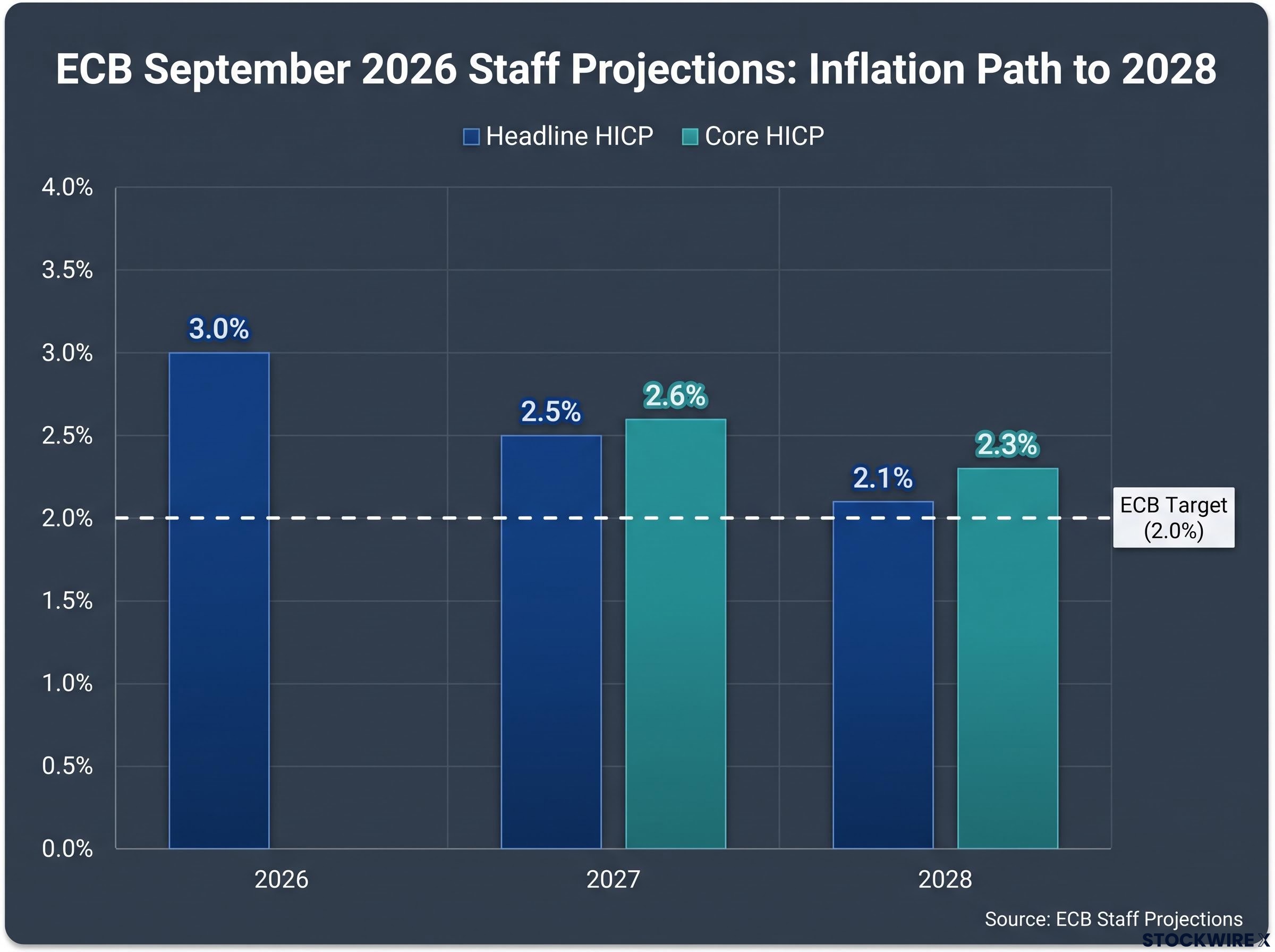
The harder problem is not the current print. It is the projection horizon. The ECB’s own September 2026 staff projections do not show the inflation problem clearing quickly.
| Year | Headline HICP | Core HICP (ex energy and food) |
|---|---|---|
| 2026 | 3.0% | Not specified |
| 2027 | 2.5% | 2.6% |
| 2028 | 2.1% | 2.3% |
Look at what those numbers say. Even in the ECB’s own base case, core inflation is still sitting at 2.3% in 2028, above the 2% objective, two full years out. This is the structural reason Schnabel’s caution is grounded rather than reflexively hawkish: her own institution’s forecasts do not show the job finished before the end of the decade.
The September 2026 ECB projections that underpin Schnabel’s caution were themselves a hawkish revision relative to June, with the energy shock scenario placing oil at US$145 per barrel and projected energy inflation near a 15% peak by end-2026, a trajectory that directly informs why the Governing Council describes the outlook as deteriorating.
Then there is energy. In Luxembourg, Schnabel flagged that energy prices are tracking closer to the ECB’s adverse scenario, describing a renewed deterioration in the inflation outlook.
Energy prices moving toward the adverse scenario constitute a renewed deterioration in the inflation outlook, Schnabel argued in Luxembourg on 30 September 2026, a shift that reinforces the case for maintaining a restrictive stance.
For investors, the takeaway is direct. If you are pricing in early ECB easing off the back of a single softening headline number, you are reading a different set of figures than the Governing Council is. The medium-term projection path, not the latest monthly print, is what is actually steering policy. That gap between market attention and ECB attention is where positioning mistakes get made.
When big ASX news breaks, our subscribers know first
How Schnabel reads the policy landscape, and what her two speeches reveal together
Place the two speeches side by side and the analytical distance between them becomes the story.
In New York in March, Schnabel’s message was about protecting credibility through temporary turbulence. Speaking at the 2026 US Monetary Policy Forum, she argued that as long as deviations from target stay small and temporary, and inflation expectations remain well-anchored, such fluctuations are “of limited relevance for policy decisions.” A gradual return to target was achievable, she suggested, precisely because expectations were holding.
By Luxembourg in September, the framing had firmed. At the 8th Annual EC-EIB-ESM Capital Markets Seminar, she described overlapping supply and demand shocks reigniting inflationary pressure just as the post-pandemic surge was fading, and signalled the ECB was prepared to adjust rates “in a timely way” to secure a return to target over the medium term.
Here is what the two speeches reveal when you compare them:
- New York, 6 March 2026: Core argument that temporary deviations are tolerable when expectations are anchored. Policy signal: gradual return to target is achievable, and global yield sensitivity could ease pressure without further ECB action.
- Luxembourg, 30 September 2026: Core argument that overlapping shocks and a deteriorating outlook are pushing inflation toward the adverse scenario. Policy signal: the ECB stands ready to adjust rates promptly to limit pass-through.
The cost pass-through logic
Running through both speeches is Schnabel’s argument about how a resilient economy behaves. In her framing, when growth holds up, elevated costs reach consumers faster, not slower. That is why holding a restrictive stance while the economy stays solid is not a contradiction. It is deliberate.
She has also acknowledged global yield sensitivity as a genuine channel for imported tightening. But she treats it as conditional, a factor that might reduce inflationary pressure, not a reason to pause.
Read together, the shift is directional rather than rhetorical. The conditionality that gave the ECB flexibility in March, resting on well-anchored expectations, has been tightened in September by a concrete deterioration in the outlook. What this tells you is that the ECB’s analytical centre of gravity has moved toward less patience, and Schnabel’s speeches are among the more reliable places to track that drift. Governing Council members rarely telegraph rate intent through a single appearance. The evolution across appearances is the signal.
Are euro area financial conditions actually restrictive enough?
This is where the analysis stops being tidy, because the data genuinely points in two directions at once.
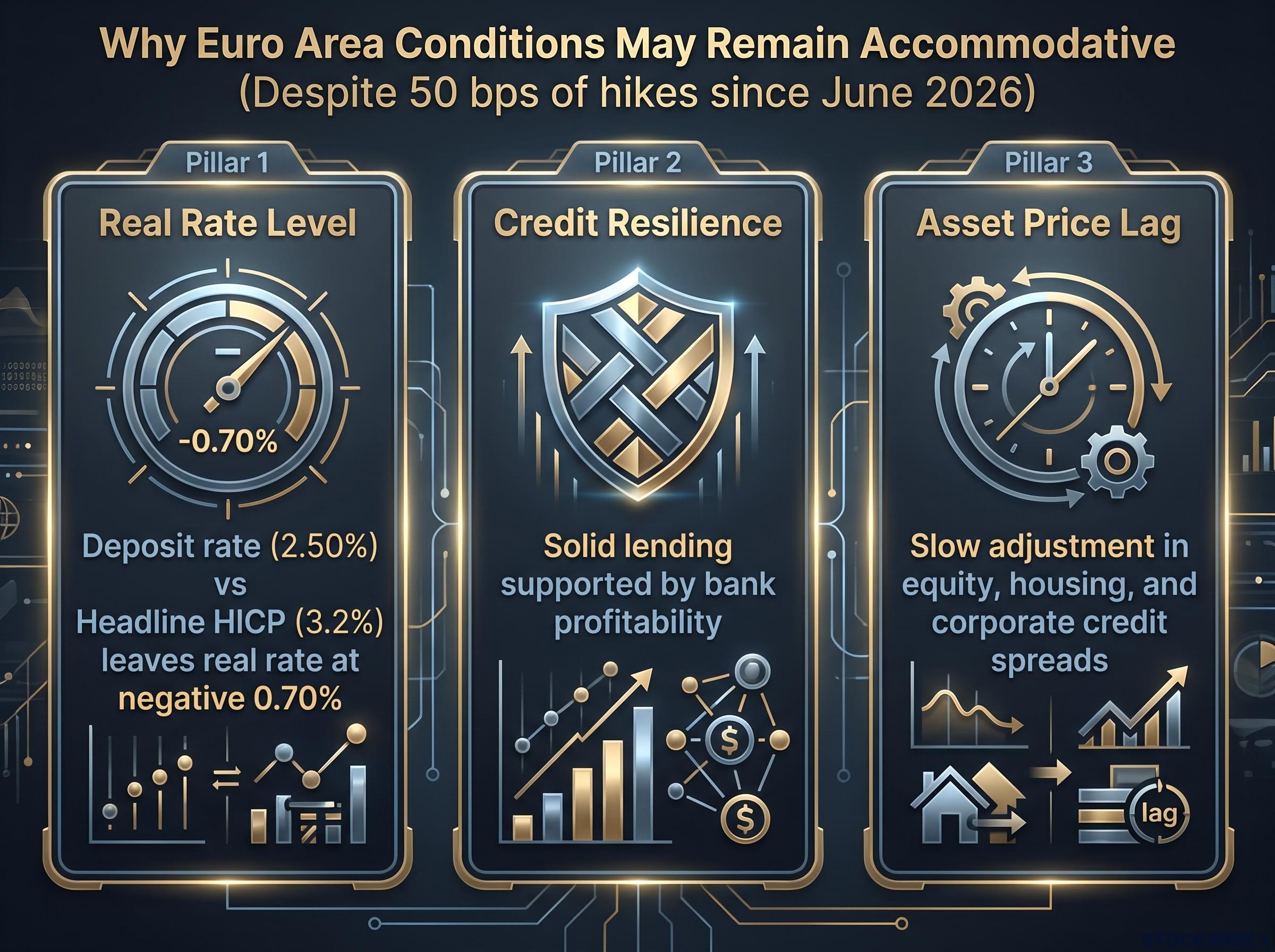
Start with real rates. With headline HICP at 3.2% and the deposit facility at 2.50%, the short-term real rate, meaning the policy rate adjusted for inflation, sits at roughly negative 0.70%. In plain terms, once you account for inflation, borrowing money still costs less than nothing in real terms. Many analysts read that as insufficiently restrictive given how persistent underlying inflation has proven.
Schnabel appears to agree, at least in part. She has pointed to strong credit dynamics as evidence that financial conditions may not yet be sufficiently restrictive.
The neutral rate debate sits directly beneath Schnabel’s caution: with the deposit rate at 2.50% and model estimates placing the nominal neutral range between 2% and 3%, the ECB cannot be certain it has moved into genuinely restrictive territory, a structural ambiguity that shapes how the Governing Council weighs further action.
Strong credit dynamics suggest financial conditions may not yet be sufficiently restrictive, Schnabel noted in her September 2026 remarks, a candid acknowledgment from within the Governing Council itself.
Yet the ECB’s September 2026 statement also confirmed that the cumulative 50 basis points of hikes since June 2026 is “being transmitted smoothly to financing conditions.” So the tightening is working. The question is whether it has worked enough.
Analysts arguing that conditions remain relatively accommodative point to three mechanisms:
- Real rate level. Short-term real rates near zero or slightly negative suggest policy is not yet clearly restrictive relative to the inflation still in the system.
- Credit resilience. Lending to households and firms remains solid, supported by bank profitability and only gradually tightening standards, meaning higher rates have not sharply choked off credit flows.
- Asset price adjustment lag. Equity valuations, housing prices, and corporate credit spreads adjust slowly, so the full tightening effect of past hikes may not yet be visible in financial conditions.
The disagreement splits cleanly. Hawks see resilient credit as proof the ECB has not done enough, arguing for further hikes or a prolonged plateau. Doves counter that the lagged effects of tightening will increasingly weigh on activity, and that pushing harder risks overdoing disinflation once energy shocks fade.
For you as an investor, the near-zero real rate is the single most actionable number in this section. It tells you that even after 50 basis points of hikes this cycle, the ECB has not moved real borrowing costs into clearly restrictive territory. That is what makes Schnabel’s caution credible rather than performative, and it is why the financial conditions debate, more than any headline print, is where ECB timing will ultimately be decided. If credit stays resilient and real rates hover near zero, the bar to further hikes is lower than market pricing may assume.
What rising global yields mean for the ECB’s next move
Follow the logic from cause to effect, because a rise in US Treasury yields is not simply an American story. It is a variable the ECB is actively embedding in its own calculus.
The mechanism runs through what economists call the global financial cycle. When long-term yields rise in the US and other core markets, they lift term premia worldwide. Term premium is the extra return investors demand for holding longer-dated bonds. As it rises globally, euro area sovereign and corporate yields get pulled up alongside, tightening financial conditions across Europe without the ECB lifting a finger.
There is also an exchange-rate channel. When US yields climb relative to euro area yields, capital tends to flow toward dollar assets, putting downward pressure on the euro. A weaker euro raises the cost of imported goods and energy, which pushes inflation up. But if those same higher global yields simultaneously suppress global demand and commodity prices, the net effect on euro area inflation can be modest or even disinflationary.
Two readings of what this means for ECB policy space
The competing interpretations matter, because they point to different rate paths:
- The dovish reading. Higher global yields tighten euro area conditions exogenously, doing some of the ECB’s work for it and reducing the need for further hikes. Schnabel acknowledged this in March, noting that if the economy proves more sensitive to the global yield uptick than expected, inflationary pressure could ease.
- The hawkish reading. The source of the yield rise matters. If yields climb because of stronger US growth rather than tighter risk premia, euro area exports may benefit while the euro weakens, complicating disinflation and forcing the ECB to hold a restrictive stance for longer.
What this means for anyone watching ECB policy is that the number of rate moves the ECB needs to make is not fixed. If global yields deliver enough tightening, the ECB may be able to hold at 2.50% for longer than the inflation data alone would imply.
For currency and fixed-income investors specifically, that is the point to internalise. ECB decisions are no longer made in isolation. The path of US Treasuries and global risk premia now sits inside the ECB’s reaction function, and ignoring that channel leaves you with a systematically incomplete view of European rate risk.
What Schnabel’s framework means for investors watching the ECB’s next step
Pull the threads together and Schnabel’s framework identifies three main risks, none of which resolves cleanly on the current data.
The first is second-round effects, where elevated wage growth feeds into persistent services inflation. The second is the stickiness of core inflation, projected to remain at 2.3% in 2028, above target. The third is the limit of well-anchored expectations as a policy anchor, since expectations can re-price quickly once households and firms repeatedly experience inflation running hot.
Here is the reframing that matters most. The ECB’s own projections have shifted the goalposts. In the base case, headline inflation returns to just 2.1% in 2028 and core is still at 2.3% that year. “Returning to target” now effectively means 2028 at the earliest, which changes the entire question of when easing becomes defensible.
So the useful question for investors is not whether the next move is a hike or a hold. It is which variables the Governing Council is actually weighting. Watch these:
The December ECB rate decision is where the analytical stakes are highest, with market pricing sitting at 40-50% probability of a follow-on hike contingent almost entirely on the trajectory of Dutch TTF natural gas prices between now and the final Governing Council meeting of the year.
- Real rate trajectory as HICP evolves relative to the 2.50% deposit rate.
- Credit growth trends, since resilient credit keeps the bar to further hikes low.
- Global yield movements, which may substitute for ECB action or complicate it depending on their source.
Schnabel’s own future speeches belong on that list too. As one of six permanent Executive Board members shaping the analytical frame, alongside President Christine Lagarde and across the eight Governing Council meetings held each year, her framing is a leading indicator of where the Council is heading.
This article is for informational purposes only and should not be considered financial advice. Investors should conduct their own research and consult with financial professionals before making investment decisions. Past performance does not guarantee future results, and financial projections are subject to market conditions and various risk factors.
Holding the line or running out of runway?
Schnabel’s framework is internally coherent and grounded in the ECB’s own data. But it rests on one load-bearing assumption: that the overlapping shocks driving inflation are being correctly read as temporary enough not to demand a sharper response.
The critiques deserve equal weight. Elevated wage dynamics could lock in services inflation regardless of headline disinflation. Well-anchored expectations are not a guarantee, and leaning on them too heavily can invite premature easing. The lagged effects of past tightening may eventually solve the problem without further hikes, but the timing risk cuts both ways.
The real test, then, is not whether the ECB hikes again in the coming months. It is whether the 2028 convergence path in its projections actually holds as the data arrives. If it does, Schnabel’s patience looks vindicated. If core inflation stays sticky and energy tracks the adverse scenario, the runway shortens fast, and the case for holding gives way to the case for doing more.
Investors who want to stress-test the ECB’s base case against an independent forecast should read our deep-dive into the Rabobank inflation forecast divergence, which models a eurozone inflation peak of 4.4-4.5% in early 2027 against the ECB’s own 2.5% projection, with the entire gap driven by differing energy price assumptions.