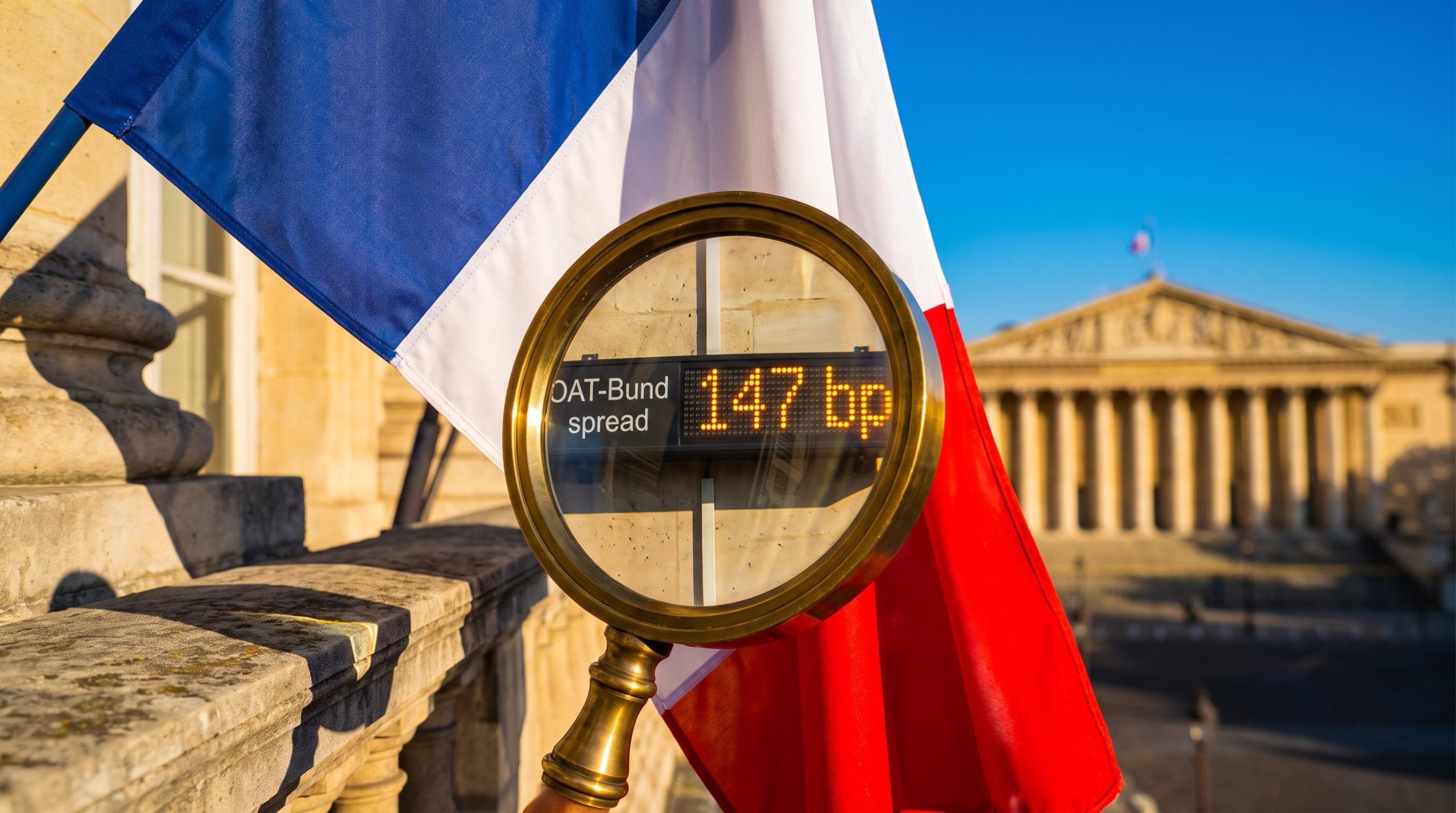
France carries credit ratings several notches above Italy’s. Yet in early October the extra yield investors demanded to hold French 10-year government bonds instead of German ones climbed to around 147 basis points, while Italy’s equivalent gap sat near 110 basis points.
A basis point is one-hundredth of a percentage point, so the market was charging France more than Italy to borrow. If you assumed a stronger rating meant cheaper money, the recent move in France bond yields says otherwise.
As of 14 October 2026, the French 10-year government bond, known as the OAT, yields roughly 4.87%. A draft 2027 budget sits before a parliament with no dependable majority, Moody’s is due to review its rating on 23 October, and presidential elections follow in 2027. Because France runs one of the largest bond markets in the euro area, any repricing reaches every global holder of euro debt, not just French investors.
Here is how to separate the risk of France failing to pay from the risk of France failing to govern, and which dated triggers will tell you which one the market is pricing.
Why has France become Europe’s bond-market worry, not Italy?
The mismatch starts with the scoreboard. Every major agency still rates France comfortably in investment-grade territory, but three of the four have tilted their view lower.
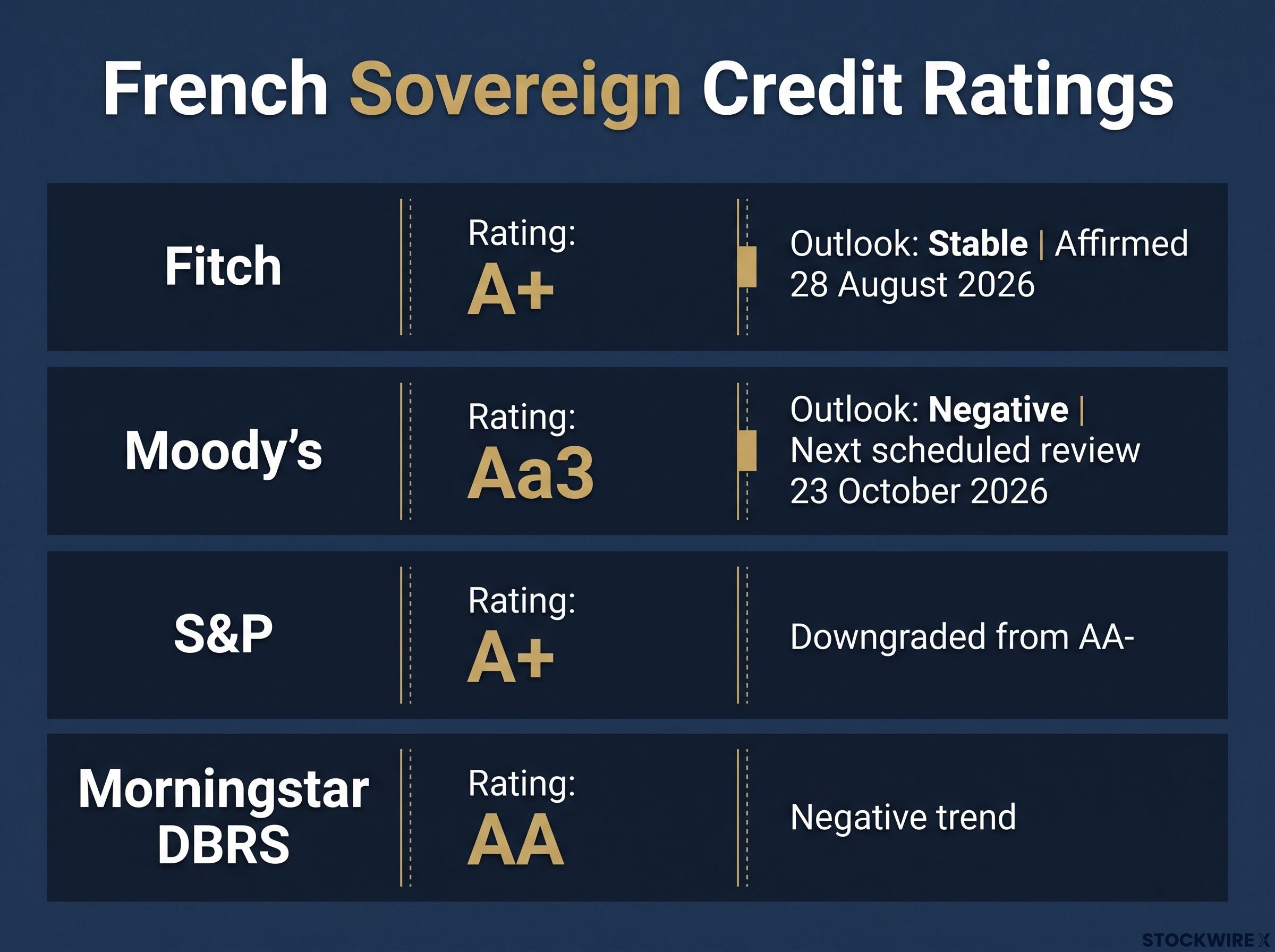
| Agency | Rating | Outlook | Latest action |
|---|---|---|---|
| Fitch | A+ | Stable | Affirmed 28 August 2026, with a warning on political fragmentation |
| Moody’s | Aa3 | Negative | Next scheduled review 23 October 2026 |
| S&P | A+ | Not specified | Downgraded from AA- |
| Morningstar DBRS | AA | Negative trend | Trend moved from stable to negative |
According to Lombard Odier, the OAT-Bund spread reached around 147bp on 13 October. Morningstar data put the Italian 10-year yield at 4.5% and its spread over Germany near 110bp on 10 October.
The French bond spread has now overtaken both Italy’s and Greece’s, and the spillover is visible in corporate credit, where roughly €215 billion of high-grade French company bonds now yield less than the government’s own debt.
“Quickly becoming the focus of the European bond selloff.” Mitch Reznick, Federated Hermes, describing France (via Morningstar)
The causes run deep. France has not posted a budget surplus since 1974, government spending has stayed above 50% of GDP, and debt has climbed since 2000, accelerating through the 2008-09 financial crisis and COVID.
Then politics turned a slow problem into an acute one. Reform has stalled repeatedly, from the 1995 strikes that sank civil-service pension changes to the backlash against the 2023 pension decree. The 2024 snap election left a three-way split Assembly that struggles to pass any real budget.
Structural, not just cyclical
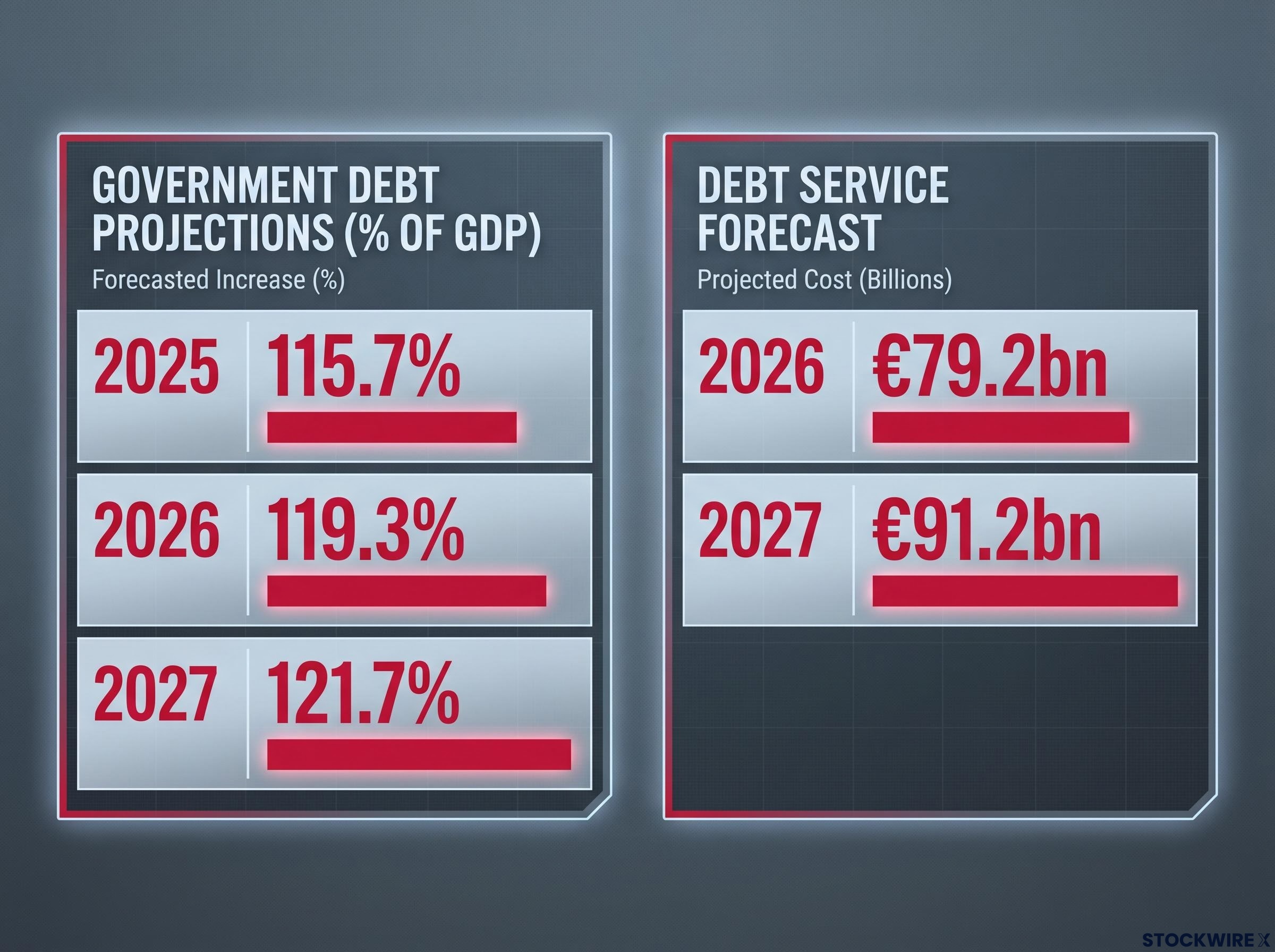
The deficit is expected at 5.4% of GDP in 2026, against the EU’s 3% reference value. Government projections show debt rising from 115.7% of GDP in 2025 to 119.3% in 2026 and 121.7% in 2027. (The OECD puts the 2025 figure slightly lower at 115.5%; the government’s newer projection is used here.)
Debt service is forecast at €79.2bn in 2026 and €91.2bn in 2027. That creates a feedback loop: higher yields lift interest costs, which widen the deficit, which forces more bond issuance, which can push yields higher again.
Weak growth and high rates are cyclical, but pension, healthcare and interest commitments remain after the cycle turns. The OECD warns debt could reach 127% of GDP by 2030 without new measures, which is not a temporary recession effect.
The read for you: the market is charging France for political-execution risk and heavy supply, not for a higher chance of default. A strong rating alone is not a reliable shield for your French bond exposure.
When big ASX news breaks, our subscribers know first
What happens if the 2027 budget fails to pass?
That governance risk now has a deadline attached. The government presented its draft 2027 budget on 1 October, and the Council of Ministers adopted it on 12 October.
The rules are simple. The government must present a budget by 13 October, and if parliament passes nothing within 70 days, the government falls.
The fallback is a loi spéciale, a special law that lets a caretaker administration keep collecting taxes and spending at the previous year’s levels. France used one in 2025 and in 1979, and none had been triggered as of 14 October.
It sounds calm. Payments continue, salaries are met and bond auctions proceed. But look at what it actually does:
- Taxes rise by stealth, because income-tax bands are not adjusted for inflation.
- Spending is neither cut nor redirected, because much of it is index-linked; planned defence increases that were meant to be funded by cuts elsewhere lose their funding source.
- Pensions, healthcare and interest costs keep rising automatically.
- The deficit stays at 5.4% of GDP in 2027, possibly higher.
Measure that against the government’s own plan: a deficit of 5.0% in 2027, delivered through about €43bn of new measures, or €54bn including those already adopted. A loi spéciale erases that consolidation entirely.
Some analysts already treat a budget rollover as the most probable outcome, with BBH warning it could push the 2027 deficit toward 6.0% of GDP as a minority government relies on National Rally support.
Banque de France warning A deficit above 5% places public finances in a vulnerable zone and raises the risk of a sharp reversal in sovereign markets.
A loi spéciale would not trigger a funding crisis. What it would tell you is that the market’s consolidation assumption has failed, so expect rating agencies and spreads to respond, with Moody’s on 23 October the first test.
Could the 2027 runoff change how investors price French debt?
Even a passed budget only buys time until the 2027 presidential and Assembly elections in May and June. Here, many investors lean on one comforting precedent.
The runoff assumption under strain
In 2002, Jacques Chirac scraped through the first round with 19.9%, the weakest score ever, yet crushed Jean-Marie Le Pen 82.2% to 17.8% in the runoff as voters rallied against the far right. That “republican front” is the safety net the market has relied on.
The current polling frays it. Odoxa’s survey (24 September to 7 October) puts Marine Le Pen on 37-38% in the first round, with Jean-Luc Mélenchon on 18-18.5% and Édouard Philippe on 17%. Toluna Harris Interactive (5-8 October) has Le Pen on 35-37%, beating Mélenchon 67% in a runoff and Philippe 56%; aggregated polling sits around 33.5-34% for Le Pen.
Split centrist candidacies could keep a centrist out of the runoff altogether. A Le Pen versus Mélenchon contest would hand bond markets a choice between two uncertain programmes.
Two programmes, two credibility gaps
| Dimension | RN plan | Left programme | Key caveat |
|---|---|---|---|
| Deficit goal | Cut 0.5% of GDP a year; below 3% by 2030; 60% debt target | No deficit plan | Franklin Templeton’s Michael Browne estimates a left deficit of 7% in 2027 and 8.4% in 2030 |
| Main funding source | €140bn of savings by 2032, alongside up to €30bn of tax cuts | 2% Zucman wealth tax, claimed at about €50bn a year | OFCE estimates €19.4bn mechanical revenue and about €5bn structural improvement |
| Verification status | RN’s own figure; no independent audit located | No independently verified costing located | Both rest on proponents’ claims |
| Market risk | Tax cuts are concrete; savings need legal and political change | Proposal to restructure ECB-held debt (about 18%) breaches ECB rules | Browne sees left-scenario debt above 130% of GDP |
The National Rally (RN) plan, published on 6 October, reads well on paper, but its spending is clearer than its savings. The left’s revenue claims are heavily discounted by the OFCE, a French economic research institute, and its ECB idea faces near-certain institutional resistance.
Whichever programme prevails, you should weight the credibility of delivery, meaning a parliamentary mandate and legal feasibility, more heavily than any headline deficit target. The bigger risk is a government that cannot legislate, not simply who wins.
What do the 1980s devaluations and past bond shocks teach investors?
France has been here before. Between 1981 and 1983, François Mitterrand’s government devalued the franc three times in two years before Jacques Delors imposed austerity in 1983, ushering in the strong-franc policy.
Back then, currency devaluation absorbed the fiscal strain. Inside the euro, that release valve is gone, so the adjustment must come through yields and spreads instead.
| Episode | What happened | Lesson for OATs |
|---|---|---|
| France 1981-83 | Three devaluations, then the 1983 Delors austerity turn | Expansion can win elections but end in a forced credibility reset |
| Italy 2018 | Coalition uncertainty and expansionary plans drove a sharp BTP spread shock without immediate default risk | Spreads can widen fast, pressuring banks and insurers before policy shifts |
| UK 2022 | Unfunded tax cuts sparked a rapid loss of confidence and policy reversal | An exact repeat is unlikely in the euro framework, but unfunded pledges could trigger a similar credibility shock |
The pattern repeats: expansion, then a market constraint, then a reversal. The euro changes the mechanism, not the logic.
Three forces cut both ways:
- ECB backstop: The Transmission Protection Instrument, an ECB tool for calming disorderly spread widening, is conditional, not a bailout. Eligibility depends on EU fiscal compliance, which French slippage undermines.
- Domestic savings: A deep household savings base supports auctions, but banks, insurers and pension funds holding OATs create a feedback loop if prices fall sharply.
- Contagion: Italy, Spain and other indebted issuers have already shown spillover, so a French repricing would lift the euro-area term premium (the extra yield for holding longer-dated debt).
Browne expects a new government in mid-2027 may stabilise the finances; otherwise, in his view, markets will force it. History suggests discipline arrives slowly and then abruptly, so expect a sustained risk premium and a forced pivot rather than an overnight funding crisis.
The ECB’s public warning on French debt broke with the central bank’s habit of avoiding criticism of individual sovereigns, and Deutsche Bank argues much of the political and fiscal risk is already priced into current spreads.
What the budget fight changes for OAT investors, and what it does not
The evidence does not point to imminent French default. It points to a prolonged stretch of volatile OAT-Bund spreads, recurring rating warnings and an election risk premium running into 2027.
Three variables will tell you which way that premium moves:
- Whether the 2027 budget passes without a loi spéciale
- The outcome of Moody’s review on 23 October 2026
- Whether the eventual winner can legislate durable consolidation, not just promise it
The decision in front of you is not whether France pays its debts. It is how much governance risk you are willing to be paid for, and whether today’s spread compensates you for it.
This article is for informational purposes only and should not be considered financial advice. Investors should conduct their own research and consult with financial professionals before making investment decisions. Past performance does not guarantee future results. Financial projections and forward-looking statements are speculative and subject to change based on market and political developments.