EUR/USD just touched its lowest level since mid-2025, and the explanation most traders reach for is also the one most likely to lead them astray: the Fed raised rates, so the Dollar climbed.
That framing is incomplete. The September FOMC delivered a 25 basis point hike to 3.75-4.00% on 16 September 2026, but markets had already assigned over 90% probability to that outcome before the meeting gavel came down. When the result is never in doubt, the decision itself is not the driver. What moves the pair from here is not what the Fed just did, but what traders believe it will do next, and how credibly it signals that path in an environment where Chair Kevin Warsh has been notably sparing with explicit forward guidance.
The Federal Reserve’s September 2026 FOMC statement confirmed the 25 basis point hike to the 3.75-4.00% target range, providing the primary source text against which traders can read Chair Warsh’s precise guidance language rather than relying on paraphrased market summaries.
What follows here maps the three distinct Fed scenarios now defining the Dollar’s near-term trajectory, unpacks the specific mechanism through which each transmits into currency markets, and surfaces the structural reason why current Dollar strength may be more brittle than the rate story alone suggests. The aim is simple: here is how to read the next Fed signal before the market prices it in.
Why the Dollar moved before the Fed did
To understand where EUR/USD goes next, start with a question most coverage skips. If the September hike was such a Dollar-positive event, why had the pair already fallen to its lowest since mid-2025 before the meeting even happened?
The answer is that the market did the work in advance. By the time the FOMC voted, the outcome was so heavily anticipated that the decision carried almost no surprise value. The pricing tells the story:
- CME FedWatch put the probability of a September quarter-point hike above 90% as of 14 September 2026 (Yahoo Finance / CME).
- The Kalshi prediction market assigned an 83% probability that the federal funds rate would sit above 3.75% after the meeting (Yahoo Finance / Kalshi).
- The July FOMC minutes, published 19 August 2026, confirmed markets had already priced not just September but a second move by early 2027.
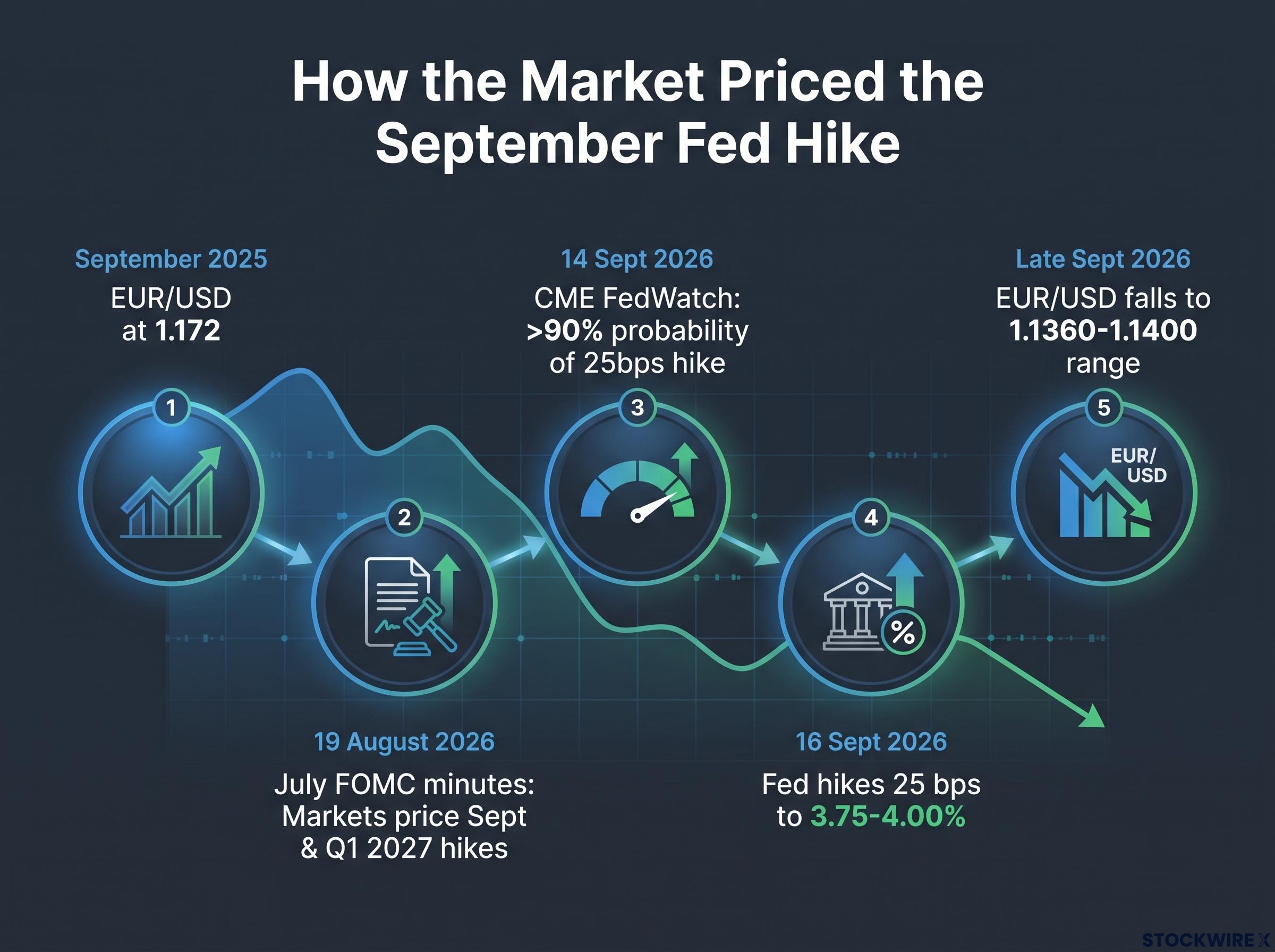
That last point matters most. According to the Federal Reserve’s July minutes, futures markets were fully pricing a September hike and another by the end of Q1 2027 at the time of publication.
The July 2026 minutes recorded that “the market was fully pricing in a 25 basis point hike by the September meeting and another one by the end of the first quarter of next year.”
Read that carefully. Two full moves were baked into the spot rate before the September decision landed. The Dollar’s recent gains reflect a bet already placed, not a bet being placed now.
That reframes the question you should be asking. It is no longer “will the Fed hike?” but “what happens when the next hike delivers nothing more than the market already expects?” This is the mechanism behind the “buy the rumour, sell the fact” dynamic, and it means the asymmetric risk from here runs toward disappointment rather than further upside surprise. The euro’s fall to 1.136 in late September 2026, down from 1.172 a year earlier, is the accumulated cost of a story the market has been telling itself for months.
When big ASX news breaks, our subscribers know first
How interest-rate differentials actually transmit into EUR/USD
The mechanism driving all of this is more concrete than headlines suggest. When US yields rise relative to Euro Area yields, Dollar-denominated assets offer a higher return, which attracts capital and pushes the Dollar higher. The euro weakens not because Europe is broken, but because its yields are comparatively less attractive.
Investing.com’s analysis of 28 September 2026 attributed EUR/USD weakness directly to rate differentials widening against the euro, with expectations for further Fed tightening set against a comparatively less aggressive ECB. This is the immediate engine behind the pair’s moves.
The rate-differential mechanism driving EUR/USD today follows the same structural logic that sent the pair from 1.137 to an intraday low near 0.9537 in 2022, when central bank divergence between the Fed and ECB accelerated alongside Europe’s energy shock and surging USD safe-haven demand.
The important point is what this makes EUR/USD: a spread trade. You are not betting on the Dollar in isolation. You are betting on the gap between two central banks. Here is how that gap has evolved through the current cycle.
| Date | Fed funds target | Policy stance gap | EUR/USD spot |
|---|---|---|---|
| September 2025 | Pre-hike (below 3.75%) | Narrower | 1.172 |
| Early September 2026 | Pre-September hike | Widening on hike expectations | ~1.14 range |
| Late September 2026 | 3.75-4.00% | Widest of cycle | 1.1360-1.1400 |
J.P. Morgan Global Research, in its 25 September 2026 note, framed the September hike as a modest upward repricing of the terminal rate toward roughly 3.75-4.00% plus one further increment, not the opening of a prolonged campaign. That distinction is the anchor for everything that follows.
The ECB side of the equation
The euro leg of the trade is just as important as the Dollar leg. The ECB is perceived as running a less aggressive path than the Fed, which widens the differential from both ends at once.
Commerzbank analyst Thu Lan Nguyen frames this as an asymmetry rather than a simple sum: the probability of a Fed move in October is assessed as higher than the probability of a comparable ECB action. That asymmetry compounds the differential effect rather than merely adding to it.
The read you should take from this is that current Dollar strength is a policy-rate story on both sides, not a structural collapse in Euro Area fundamentals. That makes it conditional and reversible the moment the differential narrative shifts. For anyone holding Dollar-denominated positions on a multi-month horizon, that is the difference between a durable repositioning and a trade with a shelf life.
Three Fed scenarios, three Dollar outcomes
If the direction from here depends on guidance rather than the rate number, the useful question becomes: which guidance, and what does each version do to the Dollar? Commerzbank’s Nguyen maps three scenarios, and they are not a menu of equal outcomes. They are conditions with different thresholds.
| Scenario | Fed action and guidance tone | Expected Dollar response |
|---|---|---|
| 1. Most Dollar-supportive | Hike plus signal of readiness to tighten further | Dollar sustains recent gains |
| 2. Middle case | Hike with reduced guidance on near-term follow-through | Moderate Dollar weakness as follow-through repricing sets in |
| 3. Most ambiguous | Hold, with December indicated as next probable move | Depends on whether markets delay or reassess |
The first scenario is the cleanest for Dollar bulls. A hike paired with an open door to more tightening keeps the differential story alive and lets the recent gains hold.
The second is the trap. A hike is delivered, but the Fed pulls back on signalling more. That removes the fuel from the “next move” trade, and markets begin unwinding the additional increments they had priced. This is the outcome most likely to wrong-foot traders positioned for a clean Dollar continuation, because the headline (a hike) looks bullish while the substance (softer guidance) is not.
The third scenario is where the widest range of outcomes lives.
Nguyen’s framing places the central uncertainty inside the hold scenario: the Dollar’s response hinges on whether markets simply delay their rate expectations, which limits the impact, or fundamentally reassess the Fed’s broader trajectory, which implies significant downward pressure.
That split is the crux. A delay is a timing adjustment. A reassessment is a regime change in how the market values the Dollar. J.P. Morgan’s dot-plot reading of one more hike, likely in December, sets the baseline each scenario deviates from. And because Chair Warsh has offered less explicit guidance than prior chairs, the ambiguity around which path the market chooses is higher this cycle than usual. The direction from here is not a binary hike-or-hold bet. It is a three-way fork.
Warsh’s communication overhaul, which involved scrapping forward guidance at his first press conference on 17 June 2026 and launching five internal task forces to review the dot plot’s future role, is the institutional context behind the guidance ambiguity that now sits at the centre of every scenario in this analysis.
Why the Dollar rally may already be running on borrowed time
Set the scenarios aside for a moment and ask a harder question: what would have to stay true for the current level to hold? The honest answer is a lot, and some of it is already looking stretched.
Nguyen characterises the current Dollar strength as overstretched even when measured against the moves in the Euro Area-US rate differential.
A fiscal risk premium on rising US 10-year yields near 4.77% is being cited by analysts at Convera, Nomura, and Bank of America as a reason the yield-strength relationship has inverted, suggesting that some portion of the Dollar’s ceiling is structural rather than purely a function of where the Fed signals next.
Commerzbank’s Nguyen describes Dollar strength as overstretched relative to the rate differential itself, suggesting the rally has moved ahead of the fundamental driver that is supposed to justify it.
That is a specific and uncomfortable claim. It means the rally has outrun the very mechanism the first half of this analysis established as its engine. When price runs ahead of its driver, it needs continuous fresh fuel to stay elevated.
The front-loaded pricing problem compounds this. Because markets had already priced the September hike and a Q1 2027 move by the time the July minutes were published, the Fed can deliver those increments in full and still disappoint, simply by not adding anything new to the hawkish story. Deliver the expected, add nothing, and the policy impulse fades.
J.P. Morgan reinforces the ceiling. Its 25 September 2026 note stressed the September hike is unlikely to herald a lengthy hiking cycle, with the dot plot pointing to a cycle near completion. That caps the upside even in Nguyen’s most hawkish scenario.
The three fragility factors sit together like this:
- Overstretched relative to differentials: the rally has outpaced the rate gap that is meant to justify it (Commerzbank / Nguyen).
- Front-loaded pricing: both remaining moves were priced before September, leaving little room for positive surprise.
- Limited cycle scope: J.P. Morgan expects the cycle near its end, capping how far the hawkish case can push.
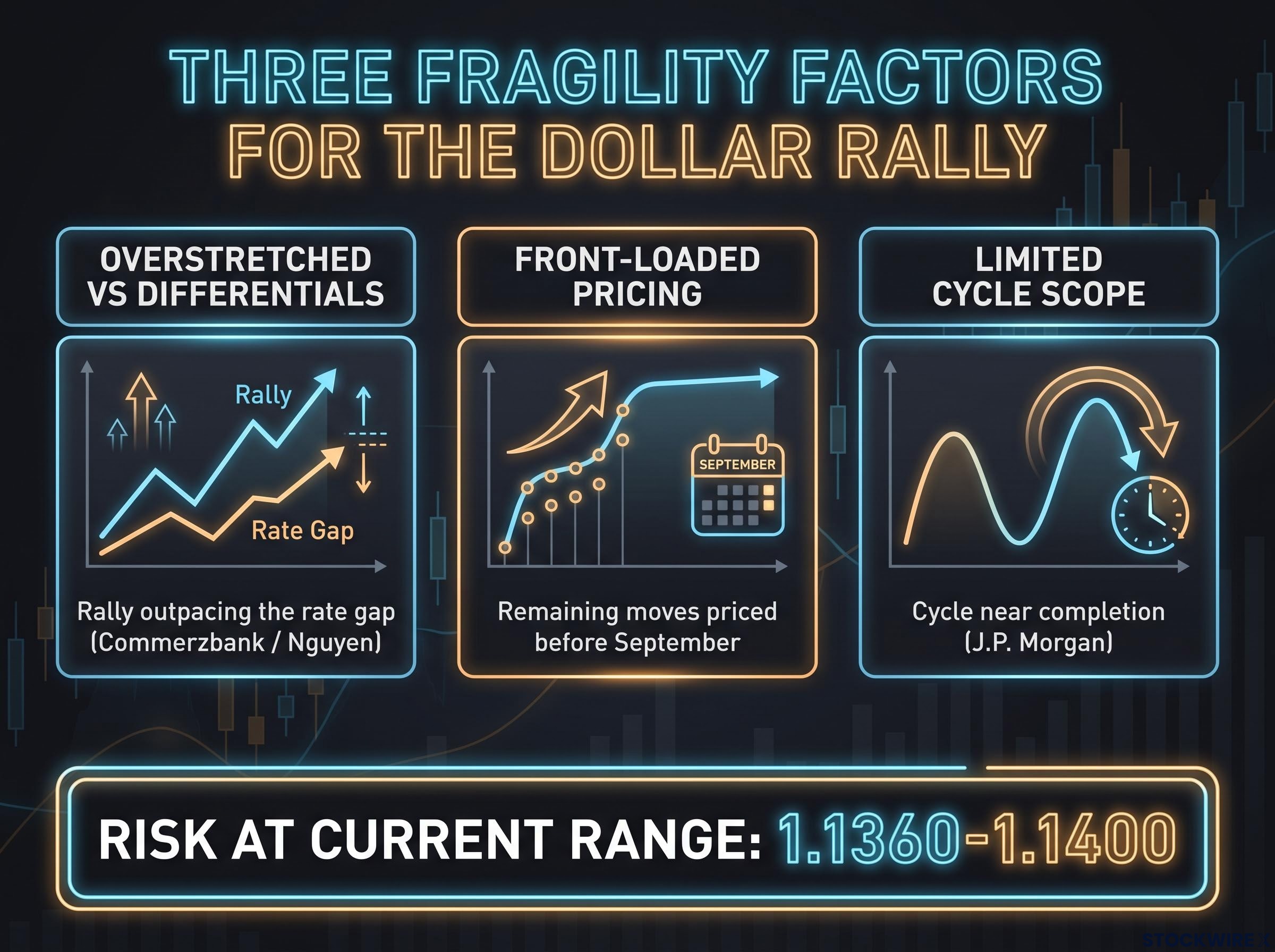
For a reader holding Dollar-denominated assets or watching EUR/USD, the takeaway is direct. The risk-reward of adding USD exposure at the tight 1.1360-1.1400 range is skewed toward the downside, because the bullish case is already reflected in the price. Sustaining this level requires a run of positive Fed surprises that grow harder to deliver precisely because expectations are already so stretched.
What the next Fed signal actually changes, and what it does not
The practical conclusion is narrower than the uncertainty makes it feel. The base case, one more hike in December as signalled by the dot plot, is largely priced. So the next meaningful Dollar move will be made by guidance language, not by the rate number itself.
That means reading the statement and the press conference carefully matters more than watching the CME FedWatch probability the night before. With Chair Warsh offering less direct guidance, market pricing tools like FedWatch and Kalshi become the primary read, but they tell you the “what” of the decision, not the “how” of the signal that actually moves the pair.
Here is the checklist to carry into the next communication, mapped to Nguyen’s three scenarios:
- Watch for explicit readiness to tighten further. Language keeping the door open to additional hikes confirms Scenario 1 and supports the Dollar holding its ground.
- Watch for softened follow-through guidance. A hike delivered alongside a step back from signalling more confirms Scenario 2, and points to moderate Dollar weakness as the “next move” trade unwinds.
- Watch what the absence of guidance implies. Consistent with Warsh’s style, sparse forward guidance leaves markets to choose between delaying expectations, which limits the impact, and reassessing the trajectory, which pressures the Dollar lower.
Treat the 1.13-1.14 range as a conditional equilibrium rather than a floor. It holds if rate expectations stay anchored. It breaks lower on a genuinely hawkish surprise. And it can reverse toward 1.15 and above if the Fed signals a softer path than the dot plot implies. Against a year-ago level of 1.172, the scale of the move already in the market is exactly why the marginal risk now sits with the guidance, not the decision.
For investors wanting to pair the fundamental scenario framework with a technical read, our dedicated guide to dollar cycle technical patterns examines how EUR/USD at 1.1447, USD/JPY, GBP/USD, and USD/CNY are simultaneously compressing into configurations that analysts read as a shared macro inflection point.
This article is for informational purposes only and should not be considered financial advice. Investors should conduct their own research and consult with financial professionals before making investment decisions. Past performance does not guarantee future results, and financial projections are subject to market conditions and various risk factors. Forward-looking scenarios described here are speculative and subject to change based on central bank policy and market developments.