Crude oil is priced right now as if a supply crisis is already underway. The Federal Reserve, meanwhile, is priced as if it can tighten its way out of the inflation that same crisis is causing. Both assumptions cannot hold at once, and the tension between them is the real story for investors this week.
The week ahead is a genuine decision point. US core PCE for August, forecast at 3.3% year-over-year and 0.3% month-over-month, lands Wednesday, with September nonfarm payrolls following Friday. Brent crude sits near $106.72 per barrel after touching $108.83 intraday on 28 September 2026, and the Fed has just lifted rates 25 basis points to a 3.75%-4.00% target range, with markets pricing roughly another 100 basis points of hikes over the coming year.
These data points do not sit in separate boxes. They feed each other. What follows here is a framework for reading Wednesday’s PCE print and Friday’s payrolls through the lens of oil-driven inflation, rather than treating each release as an isolated number on a calendar.
What the oil market is actually pricing right now
Start with where the benchmarks sit today, because the price is the market’s summary of everything it fears.
- Brent crude: $106.72 per barrel (29 September 2026), after an intraday high of $108.83 on 28 September
- WTI crude: $92.11 per barrel (29 September 2026), after an intraday high of $96.54 on 28 September
- East-West pipeline: approximately 3.5 million barrels per day restored, roughly 50% of its 7 mb/d maximum capacity
- Strait of Hormuz flows: running at approximately 50% of pre-conflict levels
The retreat from the intraday highs tells you what moved. Saudi Aramco resumed operations on its repaired East-West pipeline after drone strikes earlier in September, and that news pulled Brent back off $108.83 toward the $106 handle. The gap between the spike and the close is the market recalculating how much relief the pipeline restart actually delivers.
That relief is real but partial, and understanding why is the whole point.
The global inventory drawdown has accelerated far beyond what emergency reserve releases can offset, with JPMorgan estimating the usable buffer at roughly 800 million barrels against draw rates exceeding 8 million barrels per day in Q2 2026, a structural deficit that explains why the risk premium in Brent is not a trader overreaction.
| Benchmark | Earlier level (pre-escalation) | 28 Sep intraday high | 29 Sep level |
|---|---|---|---|
| Brent | $98.47 | $108.83 | $106.72 |
| WTI | Low $90s | $96.54 | $92.11 |
The East-West pipeline matters because it bypasses the Strait of Hormuz entirely, giving Saudi crude an export route that does not depend on the contested chokepoint. Flows have come back to roughly 3.5 mb/d against a 7 mb/d ceiling, which is a valve releasing pressure, not a repair to the system. The market is pricing the remaining 50% of unused capacity as live supply risk, not a problem already solved.
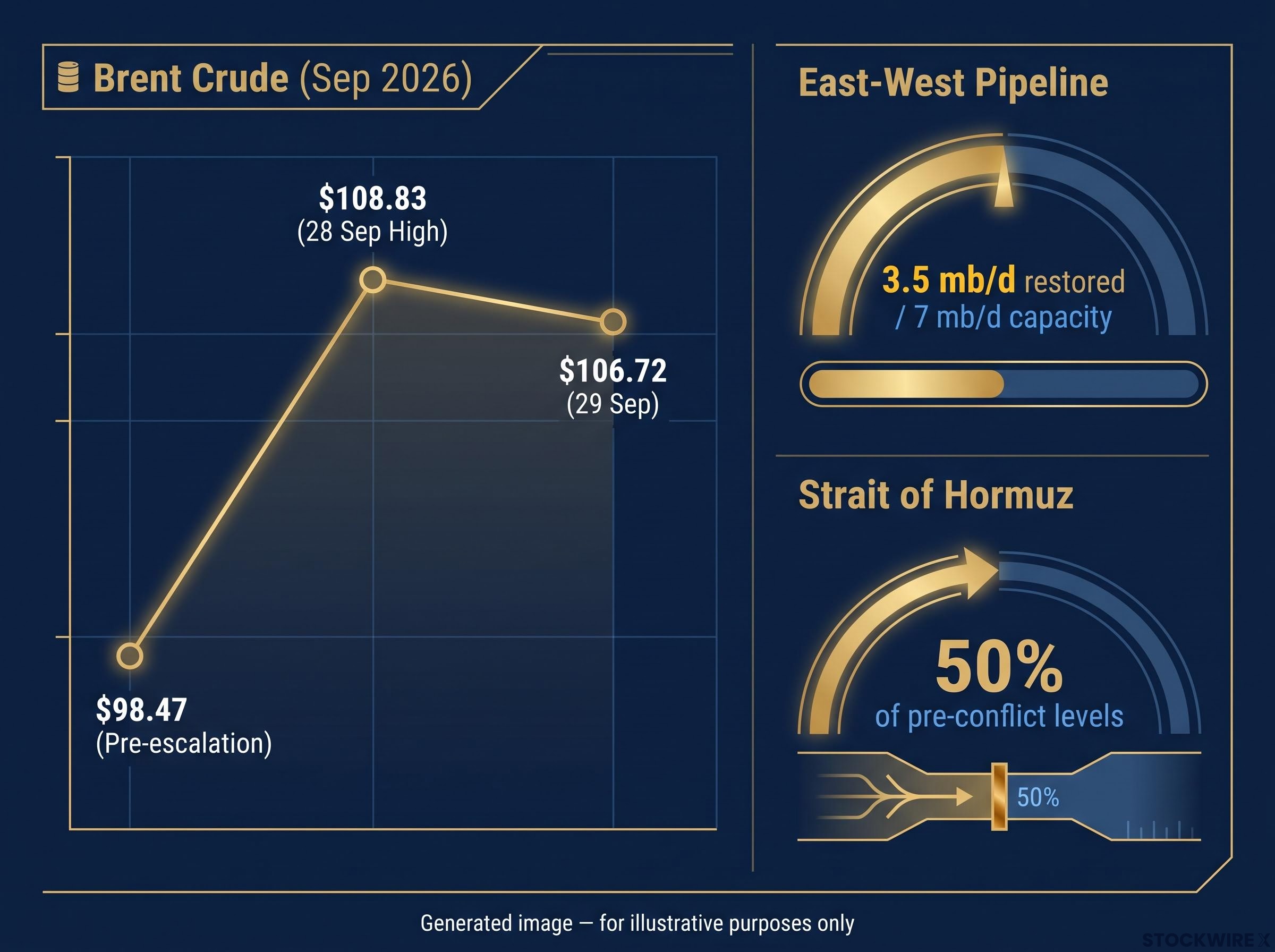
Hormuz itself is the structural issue. Flows are running at about half of pre-conflict levels, and this is not a passing spike waiting to normalise. Iranian President Masoud Pezeshkian has tied navigation restrictions directly to the continuation of US sanctions, which converts a shipping question into a diplomatic one.
Goldman Sachs estimate Persian Gulf oil exports, including undisclosed shipments, are estimated to have rebounded to their 2025 average level after doubling over the course of September.
That recovery sounds reassuring until you place it against the Hormuz shortfall. For you as an investor, the price levels are the message: the market has already built a risk premium into crude, and the question that decides everything else is what could actually release it.
When big ASX news breaks, our subscribers know first
Why the Fed cannot simply hike its way out of energy-driven inflation
Here is the uncomfortable part of the setup. The inflation pushing Brent toward $106 is supply-side in origin, and interest rate policy operates almost entirely on the demand side.
Rate hikes can cool demand. They can slow borrowing, soften spending, and take some heat out of the demand component of oil prices. What they cannot do is repair a pipeline, reopen a shipping lane, or resolve a standoff between Washington and Tehran. That is the structural mismatch sitting underneath the Fed’s decision.
At the September 2026 FOMC meeting, the Committee raised the federal funds target range to 3.75%-4.00%, a 25 basis point move and the first hike in more than three years. Rate markets, according to MUFG/BTMU analysts, now anticipate roughly another 100 basis points of increases over the coming year. This is a cycle opening, not a one-off adjustment.
The forward guidance removal by Chair Kevin Warsh concentrates repricing risk into individual data releases rather than spreading it gradually across the inter-meeting period, which is precisely why Wednesday’s core PCE print carries more weight than a single inflation reading normally would in a conventional tightening cycle.
The projections make the direction explicit.
| Year | FOMC rate mid-point projection | FOMC core PCE forecast |
|---|---|---|
| 2026 | 3.8% (revised up from 3.4%) | 3.3% |
| 2027 | 3.6% (revised higher) | 2.5% |
| 2028 | 3.4% (revised higher) | 2.1% |
Wellington Management, in its September commentary, framed the July core PCE reading of 0.25% month-over-month as approaching a pace some dovish Committee members would consider acceptable, yet insufficient to shift the dominant view. The read you should take from the rate path is this: policymakers are committed to tightening straight through the supply shock, which means the risk is not merely expensive oil. It is a policy error that layers demand destruction on top of a supply-side problem the rate tool was never built to fix.
The FOMC Summary of Economic Projections released alongside the September decision places the 2026 rate mid-point at 3.8%, revised upward from 3.4%, with core PCE expected to remain at 3.3% before easing gradually toward 2.1% by 2028, a path that embeds restrictive policy well beyond the current supply shock.
The overtightening scenario the market is not fully pricing
Now run the other branch. Suppose supply routes stabilise, or US-Iran diplomacy makes progress, and the energy-driven inflation impulse fades.
In that world, rates at 4.75%-5.00%, the level implied after another 100 basis points of hikes, would represent a policy overshoot into a deflating supply shock. The Fed’s projected mid-points of 3.8% in 2026 and 3.6% in 2027 keep policy well above the pre-tightening equilibrium for years, and restrictive settings are slow to unwind once the original inflation cause has evaporated.
This is not the consensus outcome. It is a meaningful tail risk, and its probability hangs entirely on the conditional nature of Iran’s navigation stance, which is precisely why diplomacy sits at the centre of the picture.
Iran diplomacy as the hidden variable in both the oil price and the rate outlook
Most investors this week are watching two numbers. The variable with the larger potential swing is not on the data calendar at all.
US-Iran diplomacy is the swing factor connecting the oil market and the Fed’s inflation problem. A resolution compresses the risk premium and eases headline inflation, loosening the pressure on the Fed to stay maximally hawkish. A deterioration entrenches the premium and reinforces the tightening mandate. The same headline moves both Brent and rate expectations in one motion.
Goldman Sachs estimates $14 per barrel of the current crude price is attributable to the Hormuz risk premium, which means a credible de-escalation signal can collapse the triple-digit Brent price within 24 hours, independent of any change in physical supply or OPEC policy.
The current state of play is an impasse. A three-hour meeting between US and Iranian officials on the sidelines of an international assembly produced no path to reopening the strait, and Qatari mediation has made minimal headway, with neither side willing to compromise.
The mechanism, stated plainly Iranian President Masoud Pezeshkian has said Tehran will restrict freedom of navigation through the Strait of Hormuz for as long as US sanctions and a blockade remain in place, while indicating Iran is ready to talk but will not respond to threats.
That single conditional is the geopolitical risk mechanism in its most precise form. It ties the crude risk premium directly to a diplomatic outcome, which gives you two scenarios worth monitoring.
Resolution scenario:
- Compressed risk premium and lower Brent as supply fears ease
- Reduced headline inflation pressure feeding through to core readings over time
- Less pressure on the Fed to maintain its most restrictive posture
Deterioration scenario:
- Entrenched or deepened Hormuz restrictions with alternative routes still under threat
- Sustained elevated Brent and continued inflationary pressure
- A reinforced case for holding or extending restrictive policy
For you, the takeaway is a monitoring adjustment. A diplomatic headline in either direction this week would reprice both oil and the rate outlook at the same time, and anyone watching only Wednesday and Friday is tracking one input while ignoring the one with the widest swing.
Reading this week’s data calendar through an oil-supply lens
So how do you actually read the two prints when they land? The answer is to interpret each through the energy backdrop rather than in isolation.
August core PCE is forecast at 0.3% month-over-month, up from July’s 0.2% actual, and 3.3% year-over-year, per MUFG/BTMU. A hot print in line with that forecast reinforces the Fed’s tightening case. What it does not do is answer whether the inflation is even addressable by rate hikes, because a meaningful chunk of the pressure is coming from Brent near $106.72, not from overheated domestic demand.
A soft print would be more interesting. It would open space for the dovish case Wellington Management identified around the July 0.25% reading. Yet energy-driven headline pressure caps how far that case can travel while crude sits near $107, because the Committee knows the supply impulse has not gone anywhere.
Three interpretive scenarios are worth setting up before Wednesday:
- Hot PCE plus diplomatic stalemate: The most straightforward path to continued hawkishness. The Fed reads the print as validation and the market prices the implied 100 basis points with more conviction.
- Soft PCE plus pipeline progress: The dovish window opens. Softening core data alongside easing supply pressure gives the Committee room to slow, and rate expectations ease.
- Mixed signals: A soft core print with Brent holding near $107, or a hot print with visible diplomatic movement. This is the messiest outcome, and it likely produces choppy repricing rather than a clean directional move.
What September payrolls add to the picture
Friday’s payrolls turn the reading from a snapshot into a calculus about forward guidance.
A strong payrolls print alongside a hot PCE reading narrows the room for any dovish pivot language, because it tells the Fed the labour market can absorb further tightening without an immediate recession signal. A weak print alongside a hot PCE reading is the harder combination: it signals stagflationary conditions, softening growth against sticky inflation, which complicates the rate path rather than clarifying it.
The payrolls release follows PCE by roughly 48 hours. You will need to synthesise both inputs quickly, because meaningful repricing is unlikely to settle until the market has seen the pair together.
What the convergence of these forces means for positioning now
The honest summary is that the distribution of outcomes here is wider than usual. The rate path, Brent’s trajectory, and the diplomatic result are all genuinely contested, and their interaction stretches the range of plausible outcomes for risk assets.
The oil-Fed interaction lands most directly in three places: equities with high energy input costs that cannot hedge the increase quickly, credit spreads sensitive to how far the rate path extends, and energy sector equities that can act as a partial hedge against further supply-driven upside in crude.
For investors wanting to map the rate path to specific asset class exposures, our full explainer on rate hike portfolio implications covers duration risk in existing bond holdings, equity multiple compression via discount rate changes, and the structural constraint that US federal debt at 122% of GDP places on how far the tightening cycle can extend.
As directional context, Investing.com has flagged an estimated 400 million-barrel global inventory draw for 2026, and the EIA is reported to have revised its Brent forecast to an average of $90 per barrel for the second half of 2026. Both figures remain unverified in the research base, so treat them as background colour rather than hard anchors. The firmer base case for financial conditions is the FOMC’s own path: mid-points of 3.8% in 2026, 3.6% in 2027, and 3.4% in 2028.
The EIA Short-Term Energy Outlook for September 2026 provides the official US government baseline for Brent price trajectories and global supply-demand balances, including inventory draw projections that underpin the risk-premium estimates currently baked into crude futures.
The key analytical takeaway The two dominant macro forces are reinforcing rather than offsetting each other. Supply shocks sustain the inflation the Fed is trying to solve, while rate hikes address demand but leave the supply-side cause untouched. There is no single resolution path that makes both problems disappear at once.
That is why a watchlist beats a forecast here. Four variables will decide whether the risk premium in markets widens or compresses in the days ahead:
- Brent and WTI: The live gauge of supply fear; a sustained move above the recent highs signals the premium is widening
- Core PCE (Wednesday): Validates or pressures the current rate path, read against the energy backdrop rather than alone
- Payrolls (Friday): Confirms whether the labour market can absorb more tightening, or flashes a stagflation warning
- US-Iran diplomatic headlines: The widest-swing variable, capable of moving oil and rates simultaneously in either direction
This article is for informational purposes only and should not be considered financial advice. Investors should conduct their own research and consult with financial professionals before making investment decisions. Past performance does not guarantee future results, and financial projections are subject to market conditions and various risk factors. Forward-looking scenarios described here are speculative and subject to change based on market developments and geopolitical events.