In February 2026, Cleveland Fed President Beth Hammack looked at a federal funds rate of 3.50-3.75% and called it “in the vicinity of neutral, meaning it’s not meaningfully restraining the economy.” Seven months later, she was casting a dissent vote arguing that same policy setting was insufficiently restrictive.
The rate itself barely moved in the interim. What changed was the Fed’s judgment about whether that rate was doing enough.
Hammack’s publicly documented shift across 2026, from patient hold advocate to dissenter for a hike to a policymaker warning of upside inflation risks, is not a contradiction that needs explaining away. It is a signal about how quickly the Fed’s collective read on its own posture can move within a single calendar year, and it matters directly to anyone trying to work out where rates go next.
What follows here is a structured reading of the Fed monetary policy stance through four distinct public moments Hammack put on the record in 2026. By the end, you will have a clear picture of where the Fed’s thinking on restraint, inflation, and fiscal risk currently sits, and a concrete framework for reading what comes after.
From “near neutral” to dissent: how Hammack’s stance shifted across 2026
Start with the record itself, because the progression tells the story before any interpretation is layered on top.
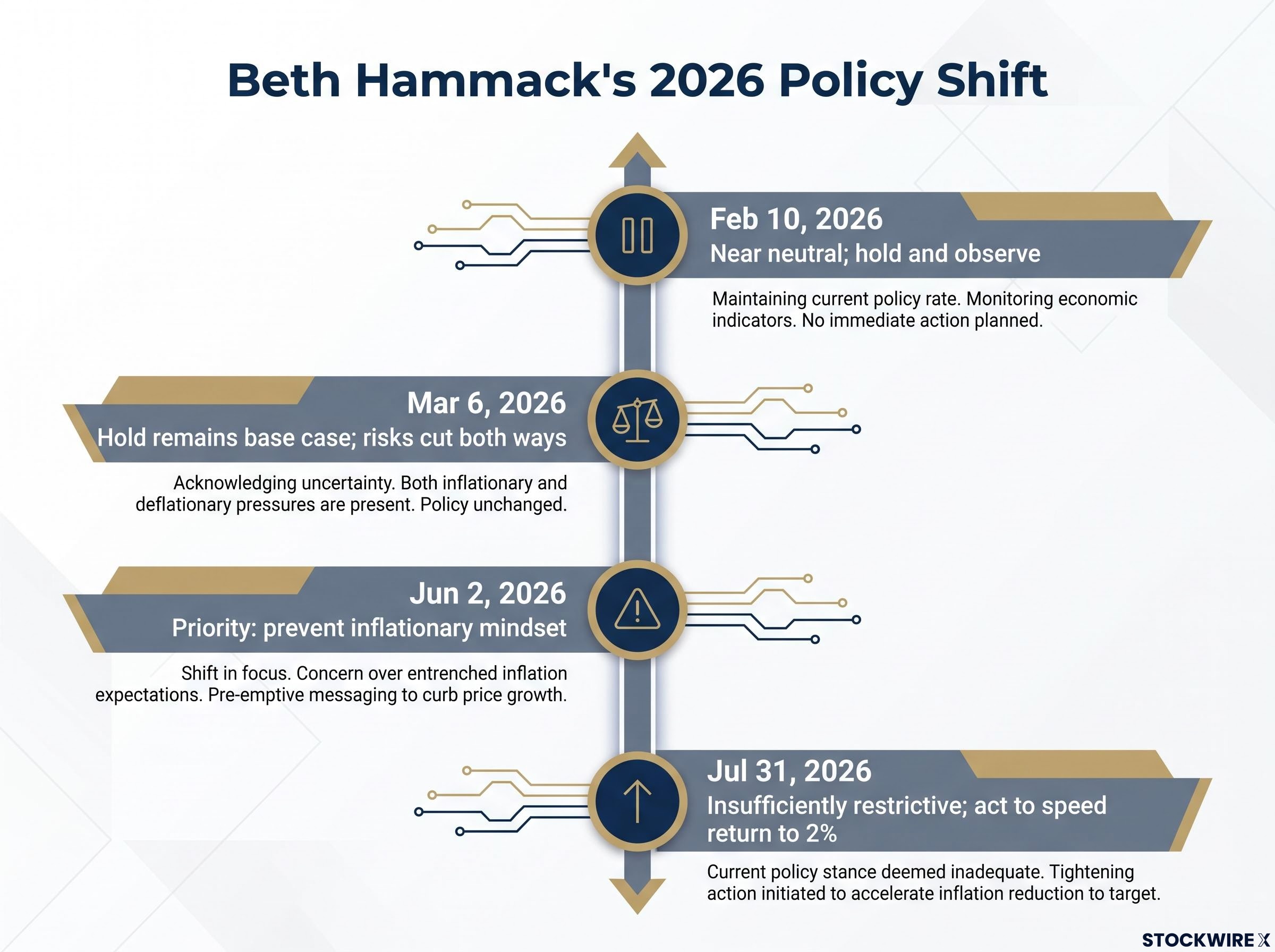
On 10 February 2026, speaking at the Ohio Bankers League summit in Columbus, Hammack backed the FOMC’s decision from two weeks earlier to hold the target range at 3.50-3.75%. She described policy as near neutral and said plainly: “I believe we are in a good position to keep the funds rate at this level and see how things play out.” Her forecast, she added, suggested the Fed “could be on hold for quite some time.”
By 6 March 2026, at the US Monetary Policy Forum in New York, the base case was still a hold, though she flagged “two-sided risks to rates,” leaving room for both hikes and cuts.
Then came the turn. In her 2 June 2026 Cleveland speech, she zeroed in on the danger of an entrenched inflation mindset. And on 31 July 2026, she dissented from the FOMC’s decision, arguing for a rate increase outright.
Here is the four-point arc, stated in her own framing at each stage:
- February: Policy is near neutral; hold and observe.
- March: Hold remains the base case, but risks cut both ways.
- June: The priority is preventing an inflationary mindset from taking hold.
- July: The stance is now insufficiently restrictive; act to speed inflation’s return to 2%.
Her July dissent statement made the reversal unmistakable.
“Inflation has been too high for too long.”
She paired that with a warning that “the longer that high inflation persists, the more challenging and costly it can be to bring it back down.” By 24 September 2026, at a Cleveland Fed conference, she described output growing solidly, the labour market near maximum employment, and the inflation outlook as “highly uncertain, with risks tilted to the upside.”
The significance for you is not any single quote. It is the pattern. The same rate went from being labelled near neutral to being judged too loose without the rate itself moving much at all. That tells you the Fed’s assessment of “restrictive” is not anchored to a number. It moves with the incoming inflation data. A rate held steady is not evidence of consistency if the price backdrop underneath it is shifting.
When big ASX news breaks, our subscribers know first
Why inflation expectations are the variable the Fed is most worried about losing
Underneath the factual record sits a specific institutional fear, and it explains why Hammack keeps returning to the word “timely.”
Inflation expectations are the mechanism. When workers and firms come to believe that above-target inflation is here to stay, they act on it. Workers push for larger pay rises to protect their spending power. Firms raise prices more aggressively, confident their competitors will do the same. Contracts and long-run plans start to bake in higher inflation assumptions. Once that happens, the central bank loses the quiet help that stable expectations normally provide, and it has to fight the psychology as well as the prices.
Her 2 June 2026 speech was built around exactly this: why returning to 2% in a timely manner matters, and why it is critical to stop an inflationary mindset before it forms. Her July dissent reinforced the point, warning that the longer high inflation lingers, the harder and more expensive the eventual correction becomes. Her September framing of “risks tilted to the upside” carried the same undercurrent.
The practical read for you is that Hammack’s communication is itself a policy tool. Every speech stressing a “timely” return to 2% is doing active work to prevent the very drift she is warning about. The urgency in her language is calibrated to that job, not to rhetoric.
What “well-anchored” actually means, and why it is not permanent
It helps to be precise about what “well-anchored” describes. It is a relative assessment, meaning expectations are currently stable and close to target, not a permanent state the Fed can bank on.
Anchoring erodes incrementally, not in a single break. That is why Hammack frames the risk as a function of time spent above target rather than one threshold being crossed. The longer inflation runs hot, the more the anchor loosens.
The US experience of the 1970s is the standard illustration of what de-anchoring looks like, and of how costly it is to reverse once expectations have shifted. Several conditions tend to precede that kind of erosion:
- Sustained above-target inflation, even if only moderate
- Mixed or shifting policy signals that raise doubts about the speed of convergence
- Structural supply pressures the public believes policy cannot fully offset
- Perceived fiscal accommodation that undermines confidence in the target
Read together, these are the warning signs Hammack’s language is designed to head off before they take hold.
The September hike and what the CPI data tell you about the rate path
The conceptual stakes met the current data on 16 September 2026, when the FOMC raised the target range by 25 basis points to 3.75-4.00% in a unanimous 12-0 vote. Unanimity matters. It signals broad conviction across the Committee rather than a narrow, contested call.
The inflation read that informed the decision was the Bureau of Labor Statistics Consumer Price Index for August 2026, published on 11 September 2026. Headline CPI came in at 3.4% year-on-year, well above the Fed’s 2% goal. Core CPI, which strips out volatile food and energy prices, sat at 2.4%, much closer to target.
That gap between the two numbers is where the real analytical tension lives.
The August 2026 CPI breakdown complicates the headline read: gasoline accounted for more than a third of the monthly all-items increase, while core CPI hit a five-year low of 2.4%, meaning the 1.4-percentage-point gap between headline and target reflects energy volatility as much as persistent demand pressure.
| Measure | Year-on-Year | Monthly (SA) | Gap to 2% target |
|---|---|---|---|
| Headline CPI | +3.4% | +0.4% | +1.4 pts |
| Core CPI | +2.4% | +0.3% | +0.4 pts |
The FOMC statement left little doubt about the intent behind the move.
“Today’s policy action will support a timelier return to the Committee’s 2 percent goal.”
Why does the core-headline split matter to you? Because it determines what the next decision hinges on. Core CPI captures persistent services inflation, the sticky kind that responds to interest rates. Headline reflects energy and food, which swing on supply shocks the Fed cannot directly tame. If the pressure is concentrated in headline, the Fed may lean toward patience once volatility fades. If core starts drifting higher, the case for further tightening strengthens. Knowing which measure is driving the gap puts you ahead of the consensus commentary on whether the next meeting is live for another hike.
Fiscal sustainability, bond yields, and the longer-run complication for the Fed
The Fed’s task does not end at getting CPI to 2%. Whether it can hold inflation there depends partly on conditions it does not control, and Hammack has been unusually direct about one of them.
In her 6 March 2026 remarks on the dollar’s safe-haven status, she cautioned that the US fiscal trajectory is not sustainable over the long term. She tied the dollar’s global standing to institutional strengths: rule of law, deep and liquid capital markets, and an independent central bank. Read as a whole, that is a coherent signal about the conditions underpinning confidence in US assets, not a stray comment.
Fiscal sustainability concerns sit at the edge of the Fed’s formal mandate, yet they shape the environment monetary policy operates within: the US debt-to-GDP ratio crossing 100% has alarmed many commentators, though international evidence from Japan and the UK suggests the threshold alone does not predict market crises, and trajectory metrics carry more signal than the ratio itself.
Why the Fed’s mandate and fiscal policy are formally separate but practically linked
The Fed’s statutory mandate, price stability and maximum employment, keeps its decisions formally independent of how the government manages its debt. It does not set fiscal policy and does not manage Treasury issuance.
In practice, though, fiscal dynamics shape the environment monetary policy operates within. Deficits affect yields and inflation pressure regardless of what the Fed does, which is precisely why you should not overstate the Fed’s grip on the long end of the curve.
The mechanism runs like this. Sustained deficits mean more Treasury issuance, which can push up the term premium (the extra yield investors demand for holding longer-dated bonds) and lift long-term rates. Large deficits can also be inflationary if they stoke demand beyond what the economy can produce. And if markets start doubting fiscal sustainability, the risk premium on US assets rises, making the Fed’s job of anchoring expectations harder.
Hammack has pointed to three channels behind upward pressure on bond yields, a useful lens for reading current moves:
- Rate-path expectations: markets pricing in a higher future path for short-term rates
- Term premium shifts: driven by uncertainty and the supply-demand balance tied to deficit financing
- Structural demand competition: large-scale private investment, including AI-related capital expenditure, competing with government borrowing for available capital
For anyone planning around rates, the takeaway is that the funds rate and the long end can diverge. Even if the Fed hits 2% inflation, long-term yields may stay elevated relative to the 3.75-4.00% policy rate, because term premia driven by deficit financing sit outside the Fed’s direct control. That distinction shapes planning for mortgages, corporate borrowing, and fixed-income positioning.
What Hammack’s signals actually imply for US rate expectations from here
Pull the threads together and a coherent, if two-sided, outlook emerges.
Hammack’s current position describes elevated inflation, upside risks, a labour market near maximum employment, and output growing solidly. That combination means the conditions for resuming patience are not yet met. It also means the case for relentless, aggressive tightening is not unambiguous. The Fed is acting, but it is watching.
The Fed dual mandate creates the structural tension that shapes every decision in Hammack’s arc: with the September hike delivered at 3.4% headline inflation and 4.1% unemployment, the Committee is simultaneously missing both sides of its mandate, and the Bostic principle, leaning hardest on the farthest-off target, explains why price stability is dominating the current calculus.
Back in March she framed the situation as carrying “two-sided risks to rates,” seeing plausible paths for both hikes and cuts. That framing still holds structurally. What has changed by September is the balance, which has tilted firmly toward the hike side, with the inflation outlook now “highly uncertain, with risks tilted to the upside.”
“The inflation outlook continues to be highly uncertain, with risks tilted to the upside.”
The primary distance still to travel is the 1.4-percentage-point gap between headline CPI at 3.4% and the 2% target. That gap, more than anything, defines how long the tightening bias persists.
Rather than leaving you with vague uncertainty, Hammack’s record points to a specific watchlist:
- Headline CPI trajectory: whether it keeps running above 3% or starts converging toward core.
- Inflation expectations surveys: any sign the anchor is slipping.
- FOMC statement language: whether the “timelier return” phrasing persists or softens.
Those three signals are the live variables. Track them and you are reading the same dashboard the Committee is.
Where the balance of risks sits, and what it means for planning ahead
The core finding is straightforward. The Fed has moved from calling its stance near neutral to acting on the view that it was too loose, and the data support the shift: headline CPI at 3.4%, well above target, met by a unanimous September hike to 3.75-4.00%. That is a Committee with conviction, not a Committee splitting hairs.
The uncertainty Hammack herself flags is genuine and cuts both ways. A faster-than-expected fall in inflation could reopen the patient-hold posture she held in February. A persistence or re-acceleration could push the Fed toward further hikes.
Her repeated emphasis on central bank independence and fiscal credibility is itself the tell. The Fed knows its effectiveness depends on conditions it does not fully control, from deficit financing to public psychology, and that awareness is shaping how it communicates as much as how it sets rates. For any rate-sensitive decision you are weighing, plan for a tightening bias that holds until the headline number moves, while keeping one eye on the long end the Fed cannot command.
This article is for informational purposes only and should not be considered financial advice. Investors should conduct their own research and consult with financial professionals before making investment decisions. Past performance does not guarantee future results. Financial projections are subject to market conditions and various risk factors.