
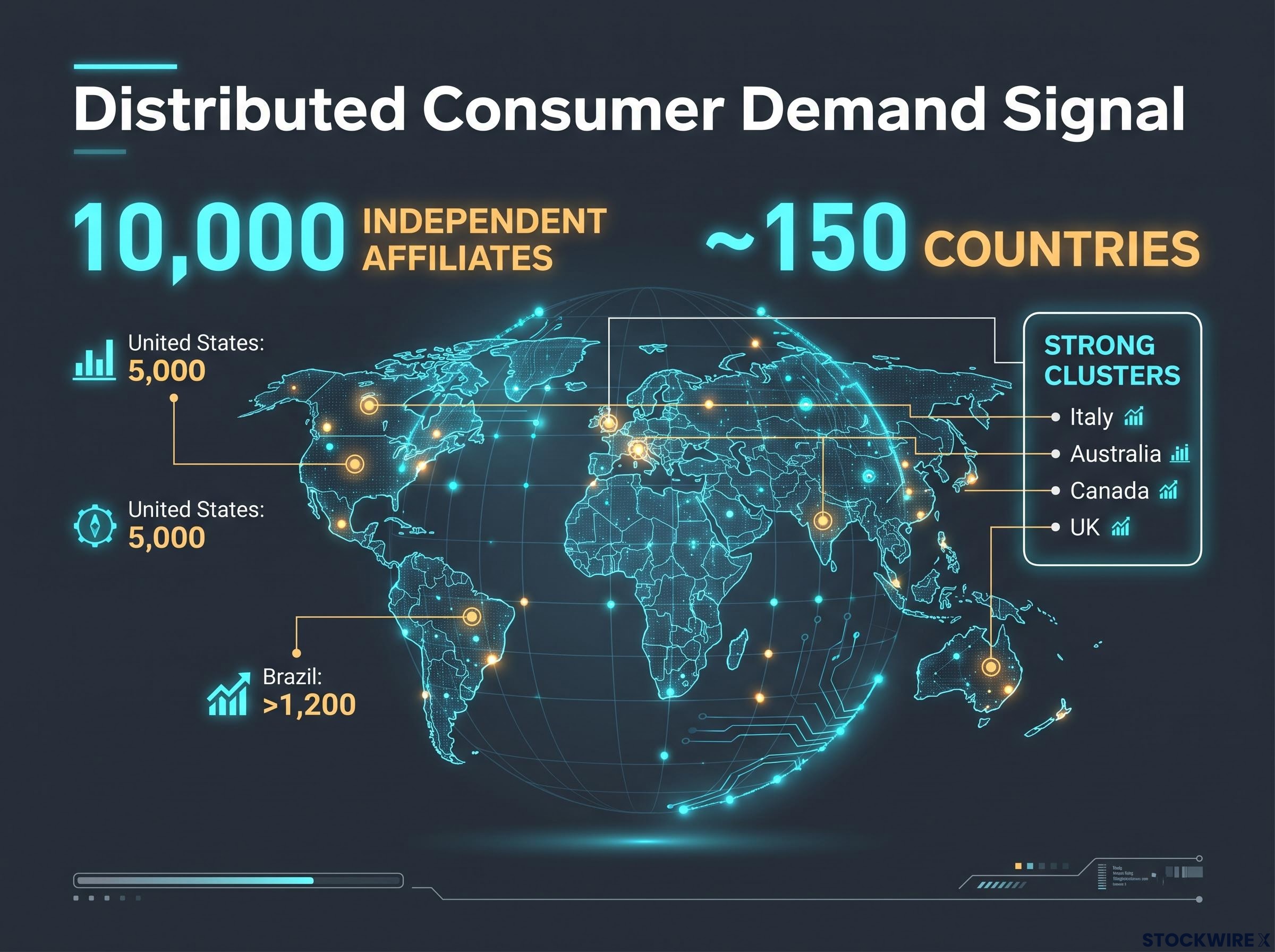
Ten thousand independently owned gyms across roughly 150 countries represent something equity investors rarely see: a distributed, ground-level willingness-to-pay signal built entirely on private capital. No single corporate rollout funded this expansion. No venture capital round dictated where the next location opened. Each of CrossFit’s approximately 10,000 affiliates is a separate operator who staked real money on the conviction that their local market would sustain premium coached fitness.
That structural distinction matters more than the headline number. CrossFit’s affiliate model is not a franchise and not a corporate chain, which makes its global footprint a particularly clean consumer demand signal. The question worth putting to the data is not whether functional fitness commands a following. It is whether that following translates into equity upside within Consumer Discretionary and Healthcare, and whether listed markets have already done the work of pricing that in.
This piece maps that demand data onto the listed equity landscape and tells you where the functional fitness theme is likely priced in, where it is not, and what a disciplined screening framework looks like when you sit down to do the work yourself.
What CrossFit’s affiliate model reveals that corporate gym chains cannot
Every CrossFit affiliate is independently owned. The operator pays a licensing fee, bears all operating risk, and makes the local capital commitment: lease, equipment, coaching staff, insurance. CrossFit itself earns affiliation revenue without owning a single gym. The model is asset-light at the centre and capital-intensive at the edges, which is precisely why the footprint carries inferential weight.
When a company-owned chain opens 50 new locations in a quarter, that growth can reflect a board-level capital allocation decision, a real estate strategy, or a private equity mandate. It does not necessarily reflect local consumer willingness to pay. When 10,000 independent operators across roughly 150 countries each make that bet with their own capital, the aggregate signal is structurally different.
- Capital ownership: Affiliate operators fund their own buildout; corporate chains deploy centralised capital
- Expansion driver: Affiliates open where local demand justifies the risk; corporate chains open where headquarters targets growth
- Operational risk bearer: Individual affiliate owner versus parent company balance sheet
- Geographic signal quality: Each affiliate is an independent data point on local demand; corporate locations are correlated decisions from a single strategy team
Why this matters for reading consumer demand
Approximately 5,000 affiliates operate in the United States. More than 1,200 are in Brazil. Strong clusters exist in Italy, Australia, Canada, and the UK. What you are reading when you look at this map is not brand penetration. It is distributed consumer conviction, validated by thousands of separate capital-at-risk decisions, and that carries more inferential weight than a comparable corporate location count.
When big ASX news breaks, our subscribers know first
How functional fitness growth maps onto two distinct equity sectors
The CrossFit demand signal points toward two structurally separate investment theses, and conflating them is one of the most common analytical errors investors make with this theme.
The Consumer Discretionary angle is the more intuitive one. It covers gym operators whose economics are built around coached group training and functional programming, connected fitness platforms that have repositioned away from pure at-home cardio toward methodology-driven formats, and equipment and apparel manufacturers whose product lines serve high-intensity training environments. This is a near-term revenue and format-quality thesis.
The Healthcare angle is different in kind, not just in degree. CrossFit launched the CrossFit Medical Society in 2024 and developed the Healthcare Professional Level 1 (HCP-L1) course to teach physicians how to integrate functional fitness into clinical treatment. The stated justification is chronic disease prevention: obesity, type 2 diabetes, and cardiovascular disease are the same lifestyle conditions that industry reports cite as primary drivers of health and fitness club market growth globally. Research supports the case that high-intensity functional training (HIFT) delivers superior improvements in strength, endurance, and metabolic fitness compared with moderate-intensity exercise.
For you as an investor, the Healthcare angle is not a marketing overlay on a Consumer Discretionary story. It is a structurally separate thesis about whether preventive fitness eventually earns a place in clinical reimbursement pathways, and that question carries a different time horizon and a different risk profile.
The Healthcare integration thesis for functional fitness sits within a broader capital reallocation already underway: clinical health tech investment in Q1 2026 reached $4 billion as payors and providers shifted toward outcomes-validated digital health tools, a trend that makes payor and employer fitness partnerships with measurable metabolic data a credible candidate for the next wave of contract structures.
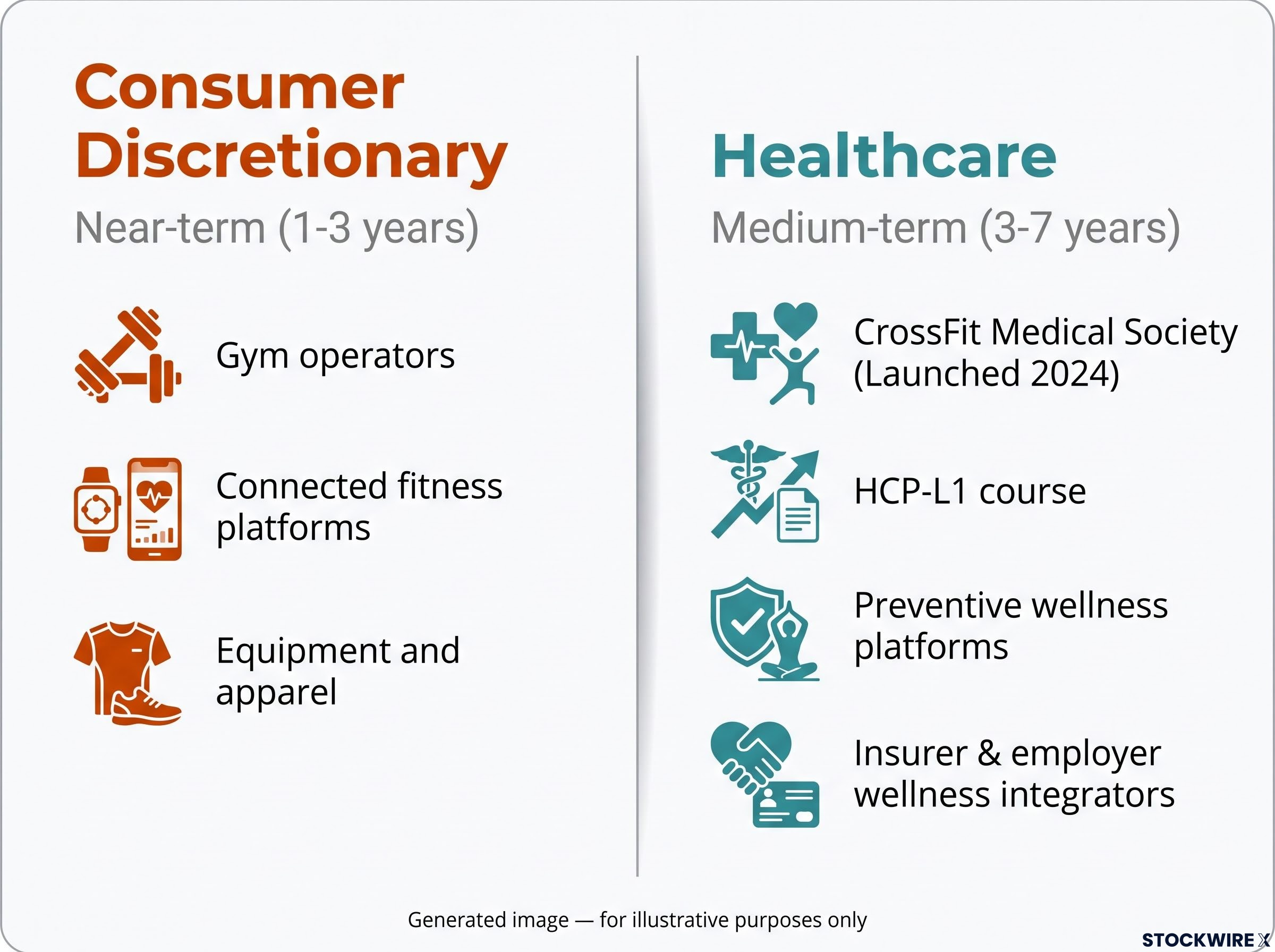
| Sector | Equity Category | Alignment to CrossFit Signal | Time Horizon | Key Risk |
|---|---|---|---|---|
| Consumer Discretionary | Gym operators (coached group training) | Direct: format and retention economics | Near-term (1-3 years) | Format saturation in mature markets |
| Consumer Discretionary | Connected fitness platforms | Moderate: methodology repositioning | Near-term (1-3 years) | Post-reset valuations; execution risk |
| Consumer Discretionary | Equipment and apparel | Indirect: sustained functional equipment demand | Near-term (1-3 years) | Cyclical discretionary exposure |
| Healthcare | Preventive wellness platforms | Direct: outcome-based fitness integration | Medium-term (3-7 years) | Reimbursement pathway uncertainty |
| Healthcare | Insurer and employer wellness integrators | Emerging: payor partnership structures | Medium-term (3-7 years) | Contract structure evolution |
Understanding fitness as a consumer spending category
Consumer Discretionary is the sector classification applied to companies whose products and services people want but do not strictly need. Gym memberships fall into this bucket. In theory, they are optional spending, cut early in a downturn.
In practice, the story is more nuanced, and the distinction matters for how you read the financials of listed fitness operators.
CrossFit’s coached, community-driven format produces measurably different retention dynamics compared with low-engagement gym memberships. Research supports the finding that CrossFit participants demonstrate strong outcomes in cardiorespiratory capacity, muscular endurance, and mental health, with community engagement functioning as a retention mechanism. When a membership delivers measurable health outcomes and a sense of belonging, it behaves less like a discretionary luxury and more like a recurring health service. That distinction should change how you read churn rates and pricing power across listed operators.
Functional fitness and high-intensity interval training have been dominant global trends for more than a decade. The format is not new. What is still underappreciated in equity analysis is the valuation gap between operators whose economics depend on coached community formats and those relying on equipment-floor access alone.
- Durable discretionary characteristics: Community accountability, coached programming, measurable health outcomes, high switching costs, strong retention
- Cyclical discretionary characteristics: Equipment-floor access, low engagement, price-sensitive membership, high churn, minimal differentiation
Research shows CrossFit participants demonstrate strong outcome and engagement markers, implying sustained equipment use and recurring membership revenue. When a fitness format generates both measurable results and community belonging, the membership economics look structurally different from a standard gym subscription.
Have public markets already absorbed the functional fitness re-rating?
This is the question that separates a thesis from a trade. Functional fitness is popular. The demand signal is real. But popularity alone does not create equity upside if the market has already priced it.
The evidence for absorption is genuine. HIIT and functional training have been dominant trends for over a decade. Major listed gym chains and wellness brands almost certainly reflect this in current multiples. Well-telegraphed growth rarely sustains premium valuations for long, and the first wave of repricing for early-mover fitness stocks has likely already occurred in developed markets.
The functional fitness thesis carries the same structural risk that any demand-led theme carries: a real underlying trend does not guarantee a profitable investment, and a rigorous thematic investing framework that tests problem size, addressable market realism, and competitive moat is the difference between catching a durable re-rating and buying into fully priced momentum.
The evidence for remaining upside is equally real, but it sits in different places. Emerging markets show earlier-stage penetration: Latin America, Asia, the Middle East, and parts of Africa have seen double-digit annual growth in CrossFit affiliate presence and participation. The Healthcare integration thesis is structurally underdeveloped in public markets because reimbursement and contract structures are still evolving. And the longevity and performance optimisation segment is emerging in consumer behaviour faster than in traditional sector classification.
The core Consumer Discretionary trade in developed markets is likely absorbed. The geographic optionality in emerging markets and the Healthcare integration thesis represent the portions of this theme not yet fully embedded in valuations. That is the partial pricing thesis, and it is where disciplined screening should focus.
| Theme | Likely Pricing Status | Geographic Focus | Upside Catalyst | Risk |
|---|---|---|---|---|
| Mature-market gym operators | Largely priced in | North America, Western Europe | Format repositioning toward coaching economics | Multiple compression if growth decelerates |
| Emerging-market expansion plays | Partially priced | Latin America, Asia, Middle East, Africa | Rising penetration and affiliate density | Macro volatility, regulatory variation |
| Connected fitness platforms | Post-reset, selectively priced | Global | Methodology repositioning with retention data | Execution risk, capital discipline |
| Healthcare integration names | Structurally underpriced | Global (US-led reimbursement pathways) | Payor and employer partnerships with outcome data | Reimbursement uncertainty, long time horizon |
| Equipment and apparel | Broadly priced in mature markets | Global | Emerging-market volume growth | Cyclical discretionary sensitivity |
Investors who have held developed-market gym operators through the functional fitness re-rating cycle should now be asking whether the multiple is justified by incremental growth or legacy positioning. Those looking for the next leg should be screening emerging-market and Healthcare-integration names instead.
Risk factors investors cannot ignore in high-intensity fitness plays
Injury risk is not a footnote for this thesis. It is a live monitoring variable. Research indicates CrossFit participants may be approximately 1.3 times more likely to be injured and approximately 1.86 times more likely to seek medical attention compared with traditional weightlifters (directionally consistent with the literature, though specific figures are not independently verified at those precise numbers). Sports physicians expect higher injury incidence in beginners.
For companies explicitly marketing high-intensity training to an increasingly mainstream audience, this creates three distinct risk vectors:
- Liability and insurance exposure: As participant populations shift from self-selected athletes to less-experienced mainstream consumers, injury frequency may increase, raising insurance costs and legal exposure
- Regulatory and reputational risk: Safety incidents attract regulatory attention and brand damage, particularly for listed companies whose share price reflects consumer trust
- Coach training and programming standards: Companies with documented coach certification, programming protocols, and participant screening procedures are better positioned to manage this risk than those marketing intensity without infrastructure
Macro and competitive risks
- Macro-discretionary cycle sensitivity: Even sticky fitness spending is not immune to income shocks. The question for each listed name is how much cyclical exposure remains in the membership base and pricing model
- Competitive intensity and format saturation: In mature markets, big-box chains are adding functional training zones. The first-mover premium for dedicated functional fitness operators may be eroding, and generic operators without strong coaching or community may already reflect mature-category economics rather than functional fitness upside
Each of these is a monitoring variable, not a dealbreaker. Your job as an investor is to assess whether a specific company has adequate safeguards or exposure that makes the risk material to the thesis.
Building a disciplined equity screen from the CrossFit signal
The demand signal is real. The partial pricing thesis tells you where to look. The screening framework tells you what to look for when you get there.
Consumer Discretionary screen
- Format quality: High share of coached group training and functional programming relative to total revenue; operators built around community and methodology, not equipment-floor access
- Retention and pricing power: Evidence of membership stickiness tied to measurable outcomes or community belonging, not promotional pricing
- Geographic exposure: Meaningful revenue from markets where CrossFit and health club participation are growing fastest, particularly Latin America, Asia-Pacific, and the Middle East
- Competitive positioning: Differentiation from big-box chains adding functional zones as a feature rather than a format
Healthcare screen
- Programme integration: Structured fitness integrated into chronic disease management or metabolic health programmes, not bolted on as a wellness perk
- Outcome tracking: Measurable health data (metabolic markers, utilisation reduction) tied to fitness participation
- Partnership structure: Active or developing payor, employer, or health system partnerships with contractual outcome accountability
Valuation discipline remains the overlay on both screens. A stock that passes the format-quality and geographic-optionality filters still requires multiple discipline relative to realistic long-term earnings power. Monitor continuously for macro cycle exposure, competitive intensity, and safety and regulatory profile changes.
A stock that passes both the format-quality screen and the geographic-optionality filter represents the most direct alignment with the unpriced portion of the functional fitness thesis. That combination is where a disproportionate share of remaining re-rating potential is likely concentrated.
The screening framework described above narrows the universe to structurally aligned companies, but sourcing undervalued names in emerging-market fitness and Healthcare-integration categories requires the same discipline applied to any thinly covered sector: analyst attention is sparse, mispricings concentrate where coverage is absent, and the methods pioneered by Buffett, Lynch, and Greenblatt remain directly applicable.
Where the CrossFit signal points, and what a disciplined investor does with it
The analytical move this piece has made is specific: from a private-market expansion signal, 10,000 independently capitalised affiliates across roughly 150 countries, to a structured public-equity thesis spanning two sectors, a partial pricing assessment, and a screening framework you can apply at the company level.
The developed-market Consumer Discretionary trade is largely absorbed. The geographic optionality in emerging markets and the Healthcare integration thesis represent the least-priced portions of this theme. The CrossFit signal is a starting point for a screen, not a stock tip, and your edge is in applying format-quality and geographic-optionality filters before committing capital.
For investors wanting to build the geographic optionality leg of this thesis through listed vehicles, our full explainer on emerging market investing covers index classification differences, currency risk mechanics, and the concentration dynamics that mean broad EM ETFs often behave more like concentrated Asian technology positions than diversified developing-economy exposures.
The watch variable for the next re-rating cycle sits on the Healthcare side. Payor and employer fitness partnerships with outcome data are the catalyst. When reimbursement structures begin formally recognising structured functional fitness as a preventive intervention, the Healthcare angle of this thesis moves from structurally underdeveloped to re-rated. That is the signal worth tracking.
This article is for informational purposes only and should not be considered financial advice. Investors should conduct their own research and consult with financial professionals before making investment decisions. Forward-looking statements regarding market trends and sector growth are speculative and subject to change based on market developments and company performance.
—