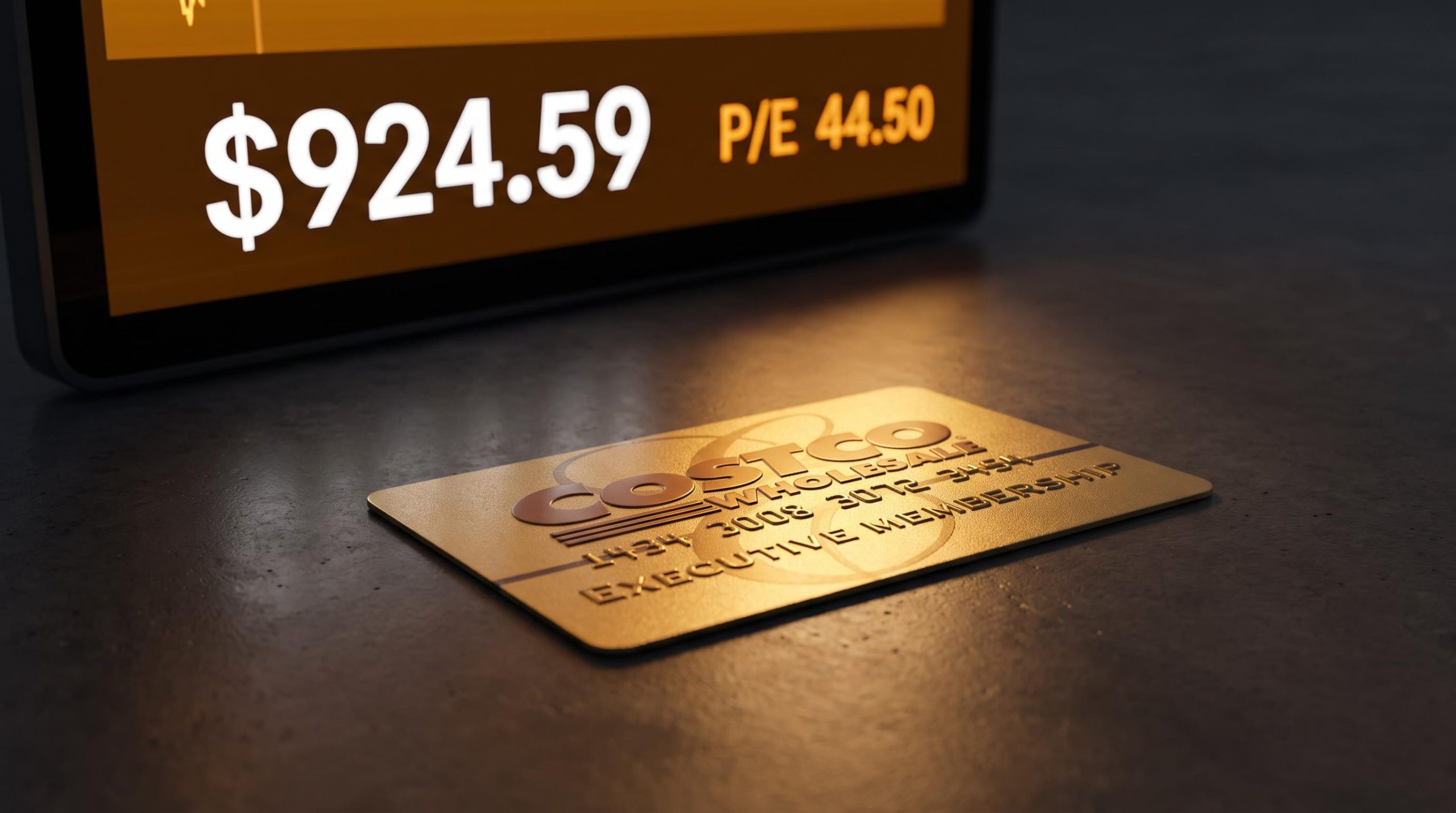
Costco is one of the businesses American investors most love to admire and least agree on how to price. The stock closed at $924.59 on 29 September 2026, and it carries a trailing price-to-earnings ratio of 44.50, roughly triple what a conventional grocer commands.
That gap between reputation and valuation is not academic right now. Fiscal 2026 results are in, showing $297.2 billion in net sales and diluted earnings per share of $20.76, up 14% year-over-year, yet professional analysts cannot settle on a price target, splitting between $955 and $1,095. The stock has also pulled back from recent highs, which some read as an entry point and others read as the beginning of a de-rating.
This piece works through the four components of the Costco investment case in sequence: how the business actually earns its money, what the latest results reveal, why two respected valuation methods reach opposite verdicts, and which risks would puncture the premium. The goal is to let you decide whether today’s price is an opportunity or a trap dressed in a great company’s reputation.
How Costco actually makes money (and why the model is harder to replicate than it looks)
Most people picture Costco as a discount warehouse with wafer-thin margins. That picture is accurate and completely misses the point. The thin margin is not a weakness Costco tolerates. It is the deliberate design of the moat, and understanding that flips the entire valuation conversation on its head.
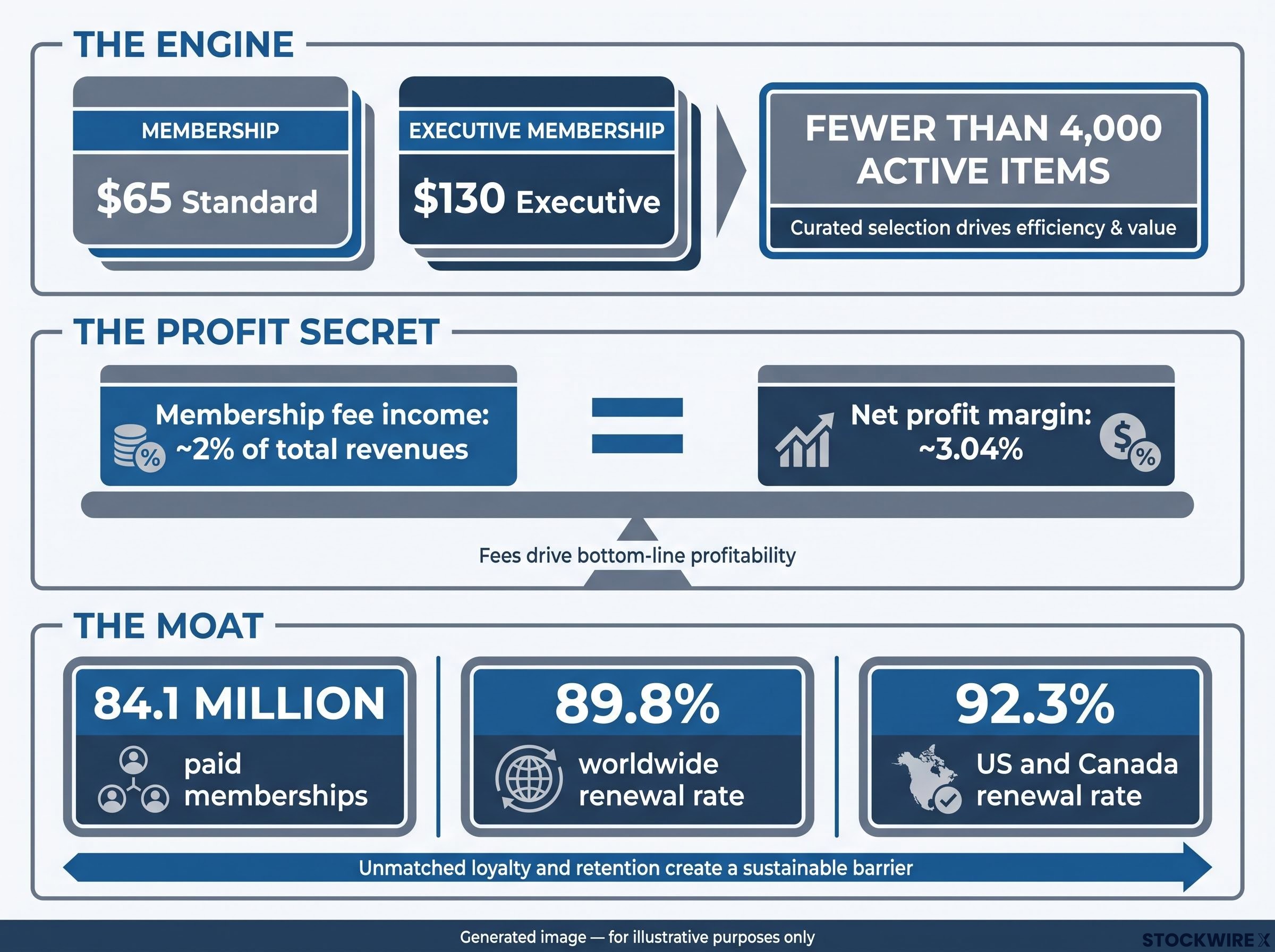
Start with where the profit actually comes from. Customers pay an annual fee before they are allowed to shop, which turns a chunk of revenue into a recurring, subscription-like layer that arrives regardless of what happens on the sales floor. There are two tiers in the United States: a $65 standard membership and a $130 executive membership, the latter offering purchase rewards that function as an operational cost rather than pure profit.
The structure rests on three pillars:
- Membership revenue mechanics: fees are collected upfront and behave like an annuity, covering close to the whole of Costco’s net profit.
- SKU discipline and supplier leverage: most warehouses stock fewer than 4,000 active items at once, so each product moves in enormous volume. That volume gives Costco genuine negotiating power with suppliers like Coca-Cola, because a place on the shelf represents national-scale sales.
- Retention anchors: the Kirkland Signature private label and competitively priced fuel are not just product lines. They reinforce the reason to renew with every single visit.
The number that matters most sits right here.
Membership fee income makes up roughly 2% of total revenues, which lands remarkably close to Costco’s net profit margin of about 3.04%. The subscription layer is, in effect, most of the profit.
What this tells you is that Costco is closer to a membership subscription business that happens to run a colossal retail operation at near-breakeven than it is to a conventional retailer. That is a fundamentally different risk profile. The retail floor exists to keep members renewing, and with 939 warehouses worldwide (647 in the US and Puerto Rico, 115 in Canada) and management guiding toward roughly 967 by the end of fiscal 2027, the network keeps widening the funnel of people paying that fee.
Membership fees, SKU discipline, and private-label retention anchors each map to distinct economic moat sources identified in competitive analysis frameworks: intangible assets, cost advantage, and switching costs, with multiple reinforcing sources generally considered more durable than any single driver.
When big ASX news breaks, our subscribers know first
What FY2026 results reveal about financial health and where the growth is slowing
The headline figures from fiscal 2026, reported on 24 September 2026 for the 52 weeks ended 30 August 2026, read like genuine operational momentum rather than a company coasting on its reputation.
Net sales climbed 10.1%, diluted EPS rose 14%, and free cash flow expanded roughly 19.8% to $9.39 billion. Operating cash flow reached $15.83 billion. Costco also carries more cash and investments than debt, giving it a net cash position that removes balance-sheet fragility from the list of things to worry about.
| Metric | FY2026 | FY2025 | Change |
|---|---|---|---|
| Net sales | $297.247B | $269.912B | +10.1% |
| Net income | $9.226B | – | – |
| Diluted EPS | $20.76 | $18.21 | +14.0% |
| Free cash flow | $9.390B | – | ~+19.8% |
Before crediting the full 14% EPS jump to core operations, one adjustment is needed.
The Q4 FY2026 figure includes a $0.15 per diluted share non-recurring benefit from IEEPA tariff refunds. It flatters the reported EPS, and future earnings will have to stand without it.
Now to the number that actually decides the investment thesis. Paid memberships reached 84.1 million, up 3.8% year-over-year, with executive memberships at 42.3 million. Renewal rates stayed exceptional: 89.8% worldwide and 92.3% across the US and Canada. Those renewal figures are the moat holding firm.
The growth rate of new members, however, has been fading for four straight quarters:
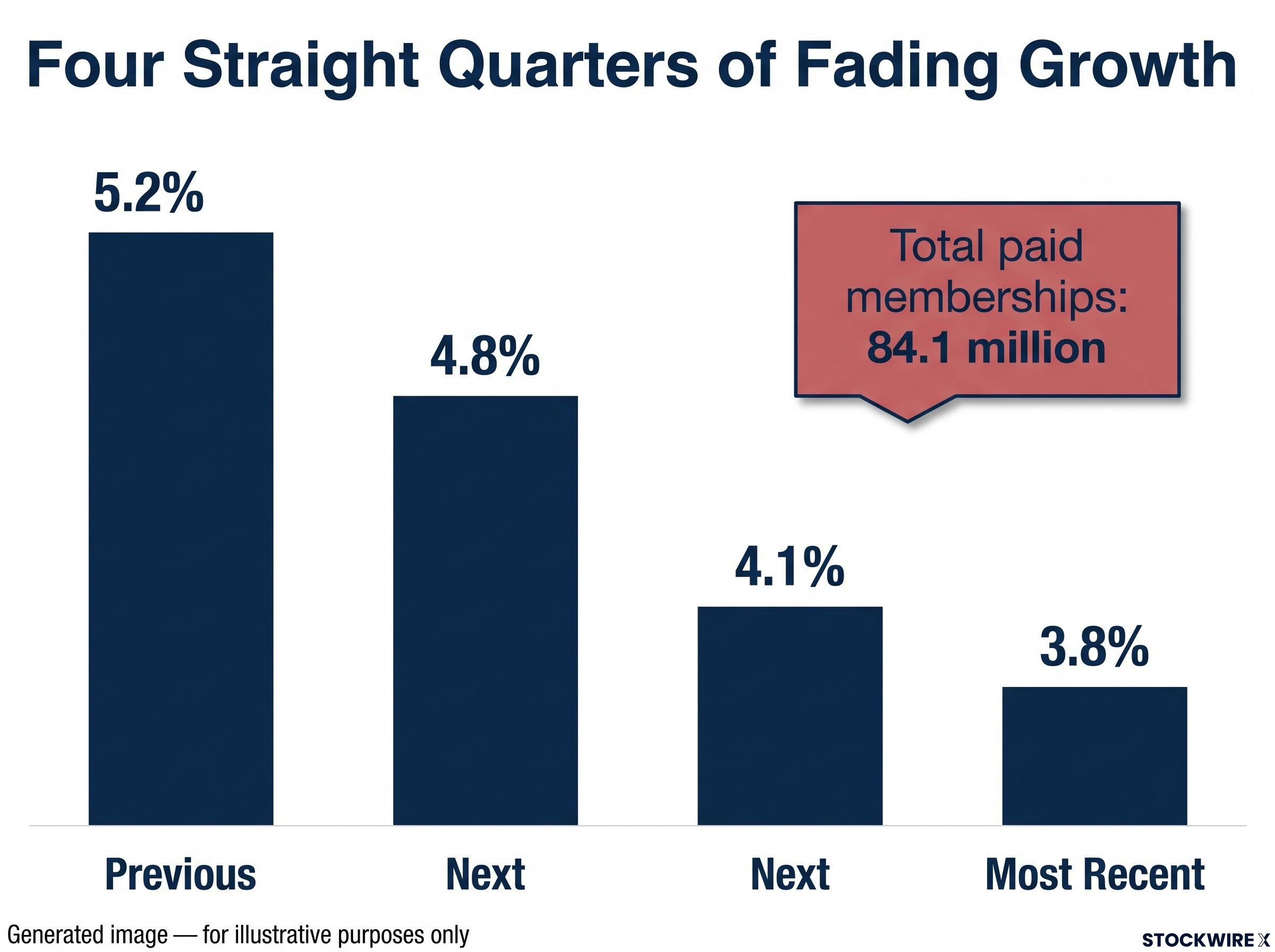
- 5.2% year-over-year
- 4.8% year-over-year
- 4.1% year-over-year
- 3.8% year-over-year
CNBC’s Investing Club flagged this deceleration directly, noting the 84.1 million paid-member figure came in below expectations.
Here is why this matters to you personally. The entire premium valuation assumes the membership base keeps expanding. If that assumption is being quietly tested, an investor buying at a mid-40s P/E has far less margin for error than the glossy 14% EPS growth suggests. The renewal rates tell you the members Costco has are staying; the growth rate tells you it is getting harder to add new ones.
Two valuation frameworks, two very different verdicts
Here is what makes the “buy or hold” question genuinely unresolved rather than a matter of taste: two respected valuation methods look at the same stock and disagree completely. This is not one bull and one bear talking past each other. It is two analytical lenses producing opposite answers.
The relative P/E case: Costco looks historically reasonable
The bull’s preferred lens compares Costco’s current multiple against its own history. A trailing P/E of 44.50 is punishing in absolute terms, but measured against the stock’s five-year average multiple, shares sit at or slightly below their historical norm. On that basis, today’s price looks modestly undervalued rather than stretched.
The backtest gives this argument teeth.
Over the prior five years, buying Costco during periods of relative undervaluation produced returns roughly 40% higher than buying during overvalued periods. Buying at elevated multiples delivered roughly flat to slightly negative returns, around -0.5%.
For a bull, that is the case for treating the recent pullback as an entry window rather than a warning.
The DCF case: intrinsic value tells a different story
The discounted cash flow (DCF) method ignores history entirely and asks what the future cash the business generates is worth today. Feeding analyst consensus free-cash-flow estimates for the next five years into that model produces a jarring result: the stock appears overvalued by roughly 60% relative to its estimated intrinsic value.
Intrinsic value estimation using discounted cash flow relies heavily on terminal value assumptions, which alone can drive 60-80% of the model’s implied output; that sensitivity is precisely why the DCF verdict on Costco, pointing to roughly 60% overvaluation, carries wide uncertainty bands alongside its bearish signal.
A DCF does not award any bonus for brand quality or a durable moat, because those things are assumed to be already baked into the price. The five-year PEG ratio (which measures P/E against earnings growth) sitting above 4 points in the same direction. A PEG above 1 already suggests you are paying up for growth; above 4 means the market is pricing in a great deal of it.
The two lenses side by side:
- Relative P/E verdict: modestly undervalued versus Costco’s own history, a defensible entry point.
- DCF verdict: materially overvalued, around 60% above intrinsic value, with the PEG reinforcing the caution.
The analyst community expresses this split in real dollars.
| Firm | Rating | Price target |
|---|---|---|
| Bank of America | Buy | $1,095 |
| Unnamed firm | Neutral | $1,040 |
| CNBC Investing Club | Hold | $1,050 |
| Truist | Hold | $955 |
Bank of America justifies its $1,095 target on the membership moat and international runway. Truist, at $955 with a hold, weighs the same moat against slowing membership growth and lands on balanced risk-reward. What this tells you is that your entry price is not a rounding error in the Costco case. The DCF signal makes it the central risk variable, arguably mattering more than the business quality that everyone already agrees on.
The three risks that could pressure Costco’s premium and what would change the calculus
Move from framework to the forward view, and three specific risks stand between today’s price and a comfortable buy. Ranked by how soon they could bite:
- Membership growth deceleration. The four-quarter slide from 5.2% to 3.8% is the clearest near-term threat to the premium. The open question is whether the core US market is approaching saturation or simply pausing. If it is saturation, earnings growth cannot stay fast enough to justify the multiple.
- Tariff and trade policy exposure. The $0.15 per diluted share tariff refund was a one-off, and its presence signals that reported earnings are temporarily elevated. New tariffs on Costco’s global supply chain would press directly on a net margin already sitting near 3%, where there is little room to absorb cost.
- Valuation multiple compression. With a PEG above 4 and a trailing P/E near 44.50, the stock carries essentially no valuation cushion. A single disappointing growth quarter or a broader shift in sentiment could trigger a swift de-rating, even if the business itself stays perfectly healthy.
US consumer spending trends feed directly into Costco’s membership growth assumptions: a sustained pullback in discretionary household budgets raises the saturation question earlier than management’s international expansion timeline would suggest.
The counterweight to the saturation fear is international expansion, with the warehouse count guided toward roughly 967 by the end of fiscal 2027. New markets outside North America are where fresh membership growth is meant to come from.
The bull case, meanwhile, has a specific earnings hurdle to clear.
Bank of America has raised its FY2027 EPS estimate to $22.83, the kind of forward growth the premium multiple needs in order to hold.
Combine the three risks and they collapse into one honest question for anyone weighing an entry today. Do you believe membership growth can re-accelerate, that the supply chain can absorb future trade shifts without margin damage, and that the market will keep awarding a mid-40s P/E to a business growing EPS in the low-to-mid teens? Answer yes and the bull case holds. Answer no, and waiting for a better price has five years of backtested return data on its side.
A quality business at a demanding price: what it takes to be a buyer here
Strip away the noise and the two-sided case is unusually clean. Costco’s business quality is not in dispute. The membership moat, the cash generation of $9.39 billion in free cash flow, and the durability of a 89.8% worldwide renewal rate are all real and all sustainable.
Renewal rates of 89.8% worldwide and 92.3% across the US and Canada are the anchor of the long-term bull case. They tell you the members Costco has are not going anywhere.
What is in dispute is the price. The relative P/E lens calls the current $924.59 marginally acceptable; the DCF lens, pointing to roughly 60% overvaluation, calls it materially too high. That divergence is why position sizing and entry discipline matter more here than any buy-or-sell binary.
The original analyst reviewing the stock preferred to wait for further price weakness before buying, a stance the roughly 40% better returns from undervalued entry points supports. An investor with a long horizon building a position gradually faces a very different risk profile from someone deploying a lump sum at today’s multiple, inside an analyst target range of $955 to $1,095.
Two developments would tilt the calculus toward a clearer buy:
- A re-acceleration of membership growth in the fiscal Q1 FY2027 data, breaking the four-quarter downtrend.
- A price pullback to a multiple more in line with the historical relative P/E “green zone.”
Until one of those arrives, the honest read is that Costco is a stock worth owning at the right price, and the current price is a question of discipline, not conviction in the business.
For investors wanting to apply a structured valuation discipline to Costco before committing capital, our comprehensive walkthrough of margin of safety stock valuation covers the 15% return hurdle, how moat quality calibrates the required discount, and the full DCF calculation method with worked steps.
This article is for informational purposes only and should not be considered financial advice. Investors should conduct their own research and consult with financial professionals before making investment decisions. Past performance does not guarantee future results, and financial projections are subject to market conditions and various risk factors.