Chinese gold imports crossed 1,000 tonnes in just the first eight months of 2026, exceeding the entire prior year’s total before the calendar turned to September. That figure is not a market anomaly.
It is a policy signal, and for long-term investors in gold, understanding what is driving it matters more than tracking the daily price chart.
China’s role in global gold markets has moved from participant to primary driver. The People’s Bank of China (PBoC) has now logged 20 consecutive months of net gold purchases, and its Q2 2026 addition of 33 tonnes was its largest quarterly increase since late 2023. The physical import surge points to structural demand that runs well beyond central-bank reserve management alone.
At the same time, global central banks collectively bought 863 tonnes in 2025, with a record 45% planning to raise their own holdings over the next 12 months. These are not short-term trades.
What follows is a clear-eyed examination of the forces driving China gold demand, how they interact with gold’s characteristics as a reserve asset, and where the realistic limits of that demand picture sit. After reading, you will have the framework to judge whether China’s buying represents durable structural support for gold prices or a momentum trade that high prices will eventually erode.
China’s gold accumulation in 2026 by the numbers
Start with the figure that reframes everything else.
The lead fact: Chinese gold imports exceeded 1,000 tonnes in the first eight months of 2026, surpassing the entire prior full-year total, according to Commerzbank analysts citing Chinese customs authority data.
That single number puts the central-bank purchases in context. Official reserve additions, large as they are, sit inside a far bigger flow of physical metal moving into the country.
The PBoC’s own reserve buying has been steady and programmatic. It added 7 tonnes in Q1 2026, then a further 33 tonnes in Q2 2026, its largest quarterly addition since Q4 2023, according to the World Gold Council’s Q2 2026 Gold Demand Trends report. That brought first-half purchases to 40 tonnes and reported holdings to 2,346 tonnes.
Commerzbank data puts total PBoC acquisitions between January and August 2026 at roughly 80 tonnes, with the August volume registering as the highest monthly level in nearly three years.
The WGC Gold Demand Trends Q2 2026 report confirmed the 33-tonne PBoC addition as the largest quarterly central-bank increase since Q4 2023, and projected full-year 2026 official-sector purchases at approximately 850 tonnes, below 2025 levels as elevated prices moderate the pace of accumulation.
| Period | Tonnes Added | Cumulative 2026 Additions | Reported Total Reserves (tonnes) | Reserves as % of FX Holdings |
|---|---|---|---|---|
| Q1 2026 | 7 | 7 | 2,313 | ~9% |
| Q2 2026 | 33 | 40 | 2,346 | ~9% |
| Jan-Aug 2026 (cumulative) | ~80 | ~80 | ~2,346 (end-Q2 benchmark) | ~9% |
The reported reserves now represent approximately 9% of China’s total foreign-exchange holdings, a figure worth remembering when assessing how much further this could run.
Here is what the combination of a 1,000-tonne import surge and a 20-month buying streak tells you. This is not a speculative position being built and unwound on price signals. It is a policy programme being executed month after month, and that distinction should change how you think about its durability. If you have been reading the gold demand picture through US rate expectations or Western ETF flows alone, you have been reading an incomplete story.
When big ASX news breaks, our subscribers know first
Three structural forces behind the PBoC’s buying programme
Knowing the scale is one thing. Understanding why China keeps buying, even at record prices, is what tells you whether the demand holds.
Gold’s appeal to an official-sector buyer rests on a specific set of properties. Before applying the three motivations, it helps to have them in front of you:
- No counterparty risk, with no dependence on any government or issuing authority
- A hedge against inflation
- A currency diversifier
- An inverse relationship with the US Dollar
- A safe-haven asset during geopolitical stress
Each of China’s motivations maps directly onto one or more of these. They do not stand alone; they reinforce one another.

Reserve diversification and dollar concentration risk
Any central bank holding a large pile of US Dollar reserves faces a structural incentive to spread that exposure. Concentration in a single currency is a risk in itself.
Reserve de-dollarisation has now crossed from a fringe thesis to a measurable institutional shift: the OMFIF Global Public Investor survey released in June 2026 recorded the first instance on record where more central banks planned to reduce dollar holdings than increase them, placing China’s accumulation inside a far broader sovereign rebalancing.
Gold answers that concern precisely because it moves inversely to the Dollar and depends on no issuing authority. The WGC Central Bank Gold Reserves Survey 2026 found that emerging-market central banks name diversification away from major-currency exposure, the US Dollar in particular, as a core rationale for building gold buffers. China is the largest expression of that pattern, not an outlier within it.
Geopolitical and sanctions-risk hedging
This is the motivation that separates China’s buying from ordinary portfolio rebalancing.
Russia’s central bank substantially increased its gold holdings ahead of Western sanctions in 2014 and again later in the decade, using the metal as a hedge against restrictions on its foreign-currency reserves. Market analysts have drawn on that precedent repeatedly when framing China’s motives. The logic is straightforward: gold cannot be frozen or sanctioned the way Dollar-denominated assets can, because it carries no counterparty.
That is why this buying is far less price-sensitive than a standard allocation decision. A central bank hedging against the risk of its reserves being immobilised does not stop hedging because the hedge got more expensive.
Domestic macro hedging and consumer demand
The third force sits closer to home. Concerns about domestic inflation and currency depreciation drive both the PBoC’s reserve-building and the wave of ordinary Chinese buyers purchasing bars and coins.
This is where that 1,000-tonne import figure earns its place. It reflects more than official purchases; it captures a domestic population reaching for gold’s inflation-hedge and safe-haven characteristics. The survey data confirms the breadth of the trend: 89% of central banks surveyed expect global official gold reserves to rise over the next 12 months, and a record 45% plan to add to their own, up from 43% in 2025. Poland’s formal 700-tonne reserve target shows how formalised this accumulation has become across the official sector.
Knowing which force is primary matters for you, because it defines the conditions under which China’s demand might genuinely slow. The sanctions-risk motive, in particular, is not one that high prices easily unwind.
How China’s buying fits the wider central-bank gold cycle
Pull back from China and a longer pattern comes into focus. The official sector has been a net buyer of gold for 16 consecutive years, and China is simply the largest current expression of that shift.
The 16-year net-buying trend in the official sector reflects a demand base that has nearly doubled from roughly 500 tonnes per year in the prior decade, with three consecutive years above 1,000 tonnes following the 2022 freezing of Russian sovereign assets confirming the shift is structural rather than cyclical.
Full-year 2025 purchases came to 863 tonnes, according to the WGC. That sat 82% above the 2010-2021 average but well below the 2022 record of 1,136 tonnes (some WGC summaries round this to approximately 1,092 tonnes). The current level, in other words, is elevated but off its peak.
| Period | Net Purchases (tonnes) | Notable Context |
|---|---|---|
| 2010-2021 average | Baseline | Long-run pre-surge reference |
| 2022 (record) | 1,136 | Largest annual total on record |
| 2025 (full year) | 863 | 82% above 2010-2021 average |
| Q1 2026 | 57 (revised) | Weakest start to a year in over a decade |
| Q2 2026 | 289 | Largest second quarter on record, +62% YoY |
The cycle is not smooth, and the 2026 quarterly data proves it. The WGC revised its Q1 2026 estimate down hard, from an initial 244 tonnes to just 57 tonnes, the weakest opening to any year in over a decade.
That revision is the single most important data point in this section. It shows that even inside a 16-year structural buying trend, price-driven demand weakness can appear suddenly and at scale. When you read a single strong month of PBoC buying, remember how quickly the aggregate can swing the other way.
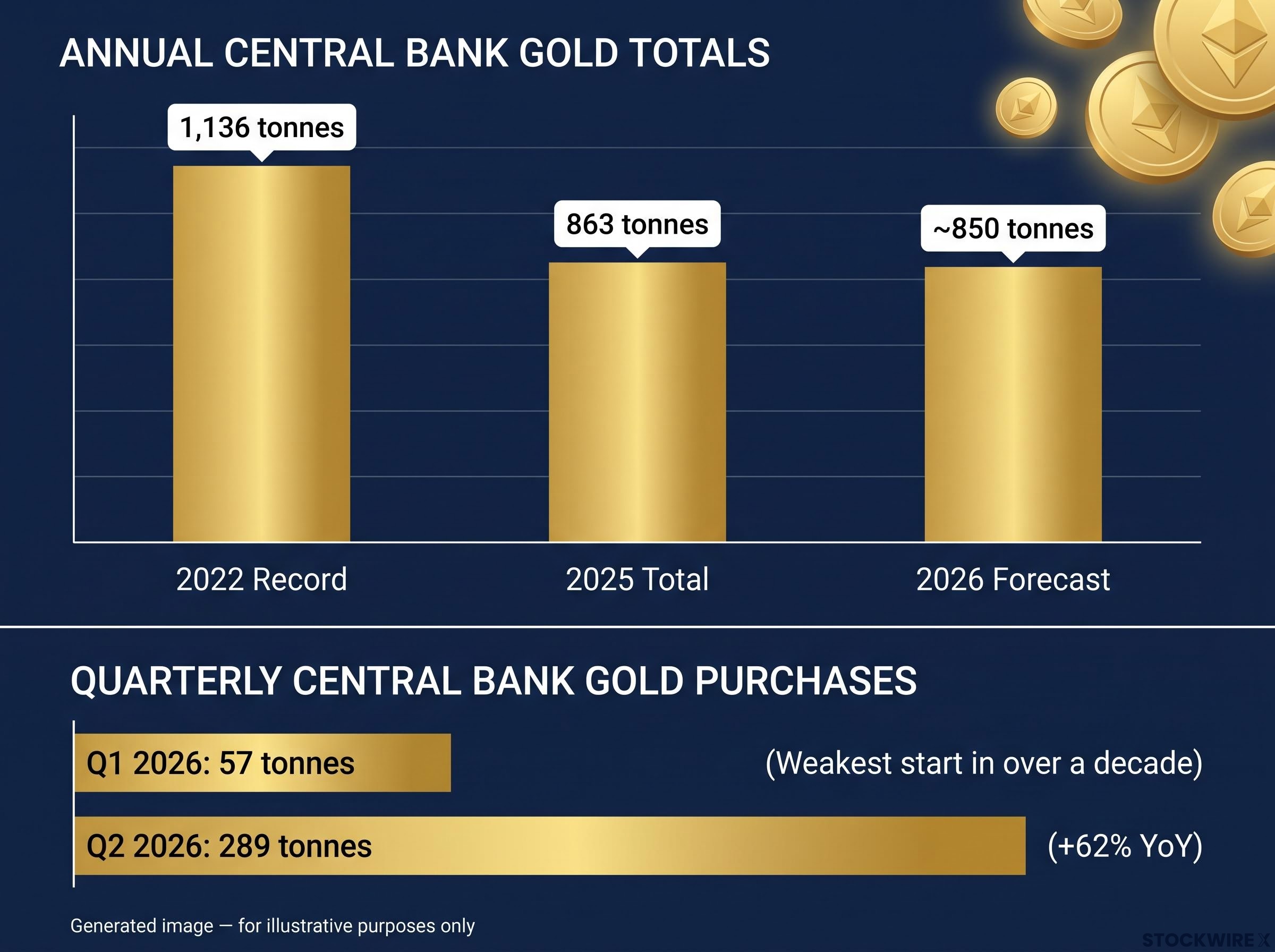
The counterpoint: Net central-bank buying rebounded to 289 tonnes in Q2 2026, the largest second-quarter total on record and a 62% year-on-year increase.
The WGC’s forecast for full-year 2026 is approximately 850 tonnes, below the 2025 total, as high prices curb demand. That points to a cycle plateauing at an elevated level rather than accelerating further. For you, the read is twofold: the broader central-bank cycle provides genuine floor support for gold prices, but that floor can generate turbulence on the way down as readily as on the way up.
What the risks look like for sustained Chinese demand
The structural case is strong. It is not airtight, and taking the counterarguments seriously is what makes it worth trusting. Four risks stand out:
- High prices producing demand fatigue, already visible in the weak Q1 2026 figure
- The opportunity cost of holding zero-yield gold if interest rates stay elevated
- PBoC disclosure limits that make a pause hard to distinguish from a reversal
- Broader policy uncertainty, with a 55% majority of surveyed central banks not actively planning to add over the next year
Price fatigue and opportunity cost
The first risk is already materialising. The revised Q1 2026 figure of 57 tonnes is direct evidence that record prices have dampened official-sector buying, and the WGC expects full-year 2026 purchases to fall to roughly 850 tonnes for the same reason.
The second risk is prospective but real. Gold yields nothing, so holding large reserves carries an opportunity cost against interest-bearing alternatives such as US Treasuries. If global rates stay high or climb, the PBoC could rebalance marginal flows toward yielding instruments, even while keeping its structural preference for gold intact.
Data transparency and policy uncertainty
The China-specific risk is one of visibility. The PBoC reports reserve changes monthly but offers no strategic detail or forward guidance, which makes it genuinely hard for anyone outside Beijing to tell a temporary pause from a policy shift.
The fourth risk is institutional. While 89% of surveyed central banks expect global reserves to rise, only 45% plan to add themselves, meaning a 55% majority may hold steady rather than accumulate. That is a prospective concern rather than a present one, but it caps how far the broader trend can accelerate.
Here is the distinction that matters most for you. There is a meaningful difference between a China that slows its buying because prices are temporarily high and a China that has changed its reserve-management policy. The evidence so far points clearly at the former. The risks are real, but they are risks to the pace of buying, not to the direction of policy.
For investors wanting to stress-test the structural thesis against the four conditions that would invalidate it entirely, our full explainer on gold’s secular bull case examines the 2021 debt refinancing wall, fiscal deficit dynamics, and the specific macro triggers that would unwind the current demand regime.
What China’s accumulation actually signals for gold’s long-run price floor
Bring the threads together and a clear conclusion emerges for anyone thinking in years rather than quarters.
China’s buying sits inside a 16-year net-buying trend that runs 82% above the prior decade’s average. That represents a demand base capable of holding up a meaningful price floor even without Western ETF flows or retail buying re-entering the picture. The floor is structural, not sentiment-driven.
The key to why this holds at high prices lies in separating the price signal from the yield signal. Gold’s ongoing appeal to official buyers is precisely its zero-counterparty-risk, non-sanctionable status, and those properties do not weaken when interest rates rise. The yield opportunity cost climbs, yes, but the strategic rationale does not.
So the forward-looking question is not whether China buys gold forever at a fixed rate. It is whether the structural shift in reserve management that China embodies constitutes a durable demand regime.
The forward anchor: 89% of surveyed central banks expect global official gold reserves to rise over the next 12 months, according to the WGC Central Bank Gold Reserves Survey 2026.
With the PBoC at 2,346 tonnes and gold still only around 9% of its FX reserves, there is considerable theoretical room for further accumulation if China moves toward reserve compositions closer to Western benchmarks. What this signals for you is that the structural demand floor for gold has been raised, and the conditions that raised it are not resolving soon.
If you want to track whether this thesis holds, watch these indicators:
- Monthly PBoC reserve disclosures for signs of a genuine pause
- WGC quarterly Gold Demand Trends for the aggregate official-sector pace
- The US Dollar’s trajectory, given gold’s inverse relationship to it
- The global interest-rate direction, which drives gold’s opportunity cost
This article is for informational purposes only and should not be considered financial advice. Investors should conduct their own research and consult with financial professionals before making investment decisions.
Past performance does not guarantee future results. Financial projections are subject to market conditions and various risk factors, and forward-looking statements are speculative and subject to change based on market developments.
Reading China’s gold strategy for what it is, not what investors hope it to be
The evidence supports treating China’s accumulation as a structural, policy-driven programme that raises gold’s demand floor over a multi-year horizon. It does not, however, guarantee sustained price appreciation independent of rate, dollar, and price-level dynamics.
Hold both lenses at once. China can carry a genuine long-run preference for more gold and still slow its pace of buying when prices are very high or when yielding alternatives look more attractive. The structural and cyclical views are not in conflict.
The practical implication for you is this. If you understand the demand-side architecture, gold’s role as a portfolio hedge is better supported now than at any point in the prior decade. Your position sizing should still account for the cyclical variables that can interrupt the structural trend, but the floor beneath it is more solid than the daily price chart suggests.