Three separate shocks hit Central and Eastern European currency markets in the same week, and the koruna, zloty, and forint each absorbed the blow differently. US Treasury yields brushed the 5% threshold. European gas prices touched a three-year high. The dollar strengthened against nearly everything. All of it landed in mid-September 2026.
That simultaneity is the story. A single external shock is manageable; three arriving together, into a region already sensitive to capital flows and energy imports, is a different kind of test.
What makes this moment worth dissecting rather than filing under routine emerging-market risk-off is policy divergence. The three CEE central banks sit at different points in their rate cycles, which means the same shock produces three different currency trajectories.
This is a country-by-country read on the CEE currency outlook: which pressures are shared across the bloc, which are specific to individual currencies, and which upcoming central bank decisions could shift the path for each one.
How the compound macro shock reached CEE markets
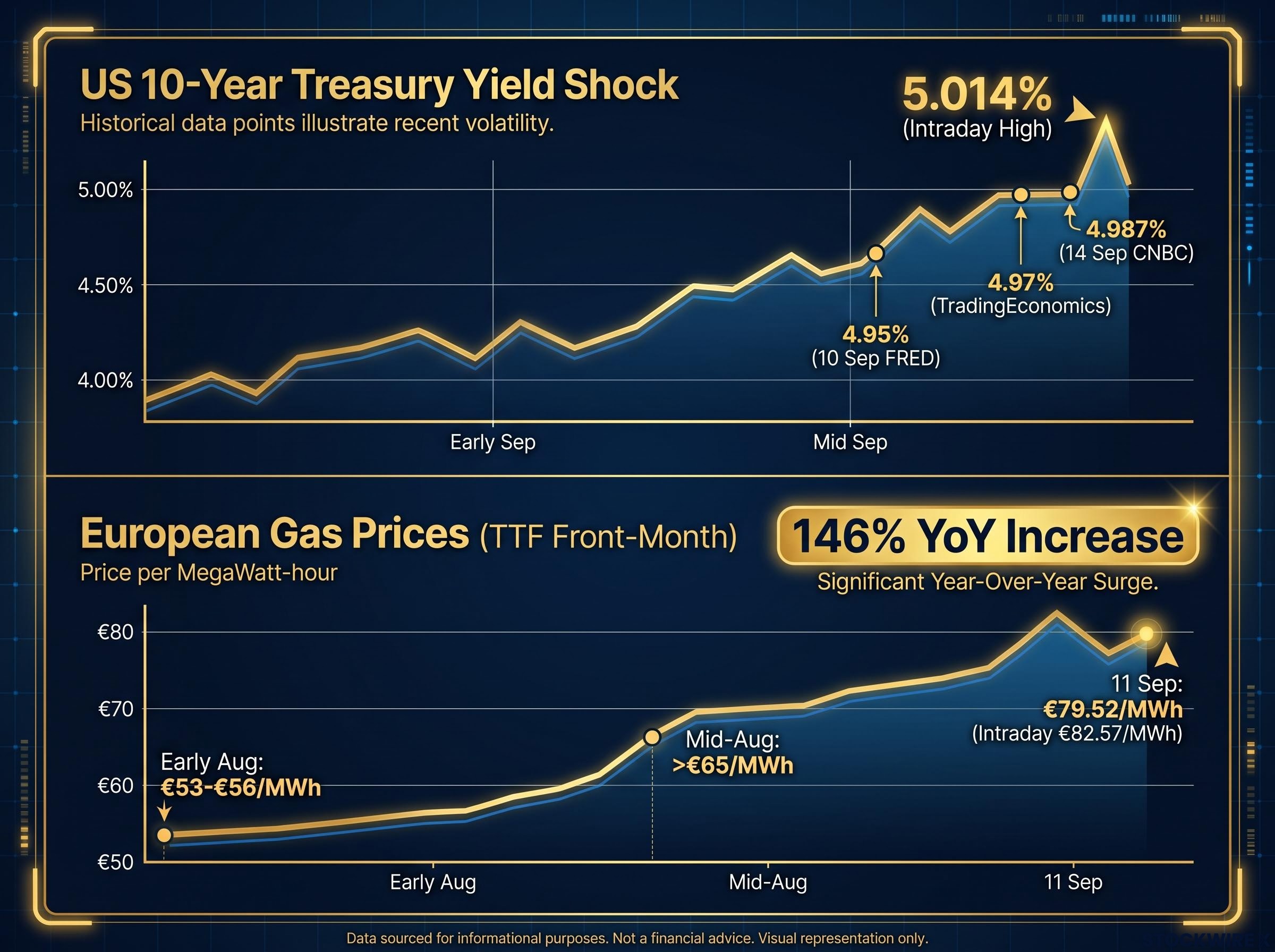
The initiating shock came from US Treasuries. A sharp sell-off in late August and early September drove the US 10-year yield toward and briefly through the 5% mark. Sources disagree slightly on the exact print: CNBC reported live trading at 4.987% on 14 September 2026 after an intraday touch of 5.014%, its highest since October 2023, while TradingEconomics put the yield at 4.97% the same day and the Federal Reserve’s FRED series recorded 4.95% on 10 September 2026. The discrepancy is small; the direction is not.
The US Treasury sell-off that triggered the CEE repricing was itself driven by four converging forces: a hotter-than-expected core CPI print, structural fiscal deficit anxiety, AI infrastructure spending uncertainty, and simultaneous curve-wide selling across the 2-year, 10-year, and 30-year, a combination that pushed the 10-year 19.1 basis points higher in a single week.
FRED’s DGS10 series provides the daily 10-year Treasury Constant Maturity Rate used as the reference benchmark here, with readings for early September 2026 confirming the upward trajectory that preceded the intraday 5% touches reported by market data providers.
Once US yields move like that, the transmission into CEE currencies follows a predictable sequence:
- Carry trade unwinding: Higher US yields reduce the relative reward for holding CEE local-currency bonds, so global investors rotate back toward Treasuries and sell regional FX to do it.
- Capital flow reversals: A stronger dollar and lingering Fed hike risk make inflows fragile, which amplifies currency volatility.
- Rising funding costs: Higher global discount rates push up hedging and cross-currency funding costs, making it more expensive for foreign investors to hold CEE bonds and for sovereigns to issue new debt.
- Dollar strength: A broadly firmer dollar compresses the carry premium that made CEE currencies attractive in the first place.
Front-end rate markets across the CEE3 responded by repricing an average of 10-20 basis points of additional hikes. That repricing cuts both ways: it raises borrowing costs across the region, but it also rebuilds part of the rate cushion that supports the currencies. Knowing which effect dominates, and when, is the difference between reading this as a stress signal and reading it as a stabiliser.
Analysts have reached for a specific historical template here: the 2013 Taper Tantrum, when the US 10-year moved from roughly 1.6% to 3.0% and triggered 10-20% currency depreciation across broad emerging markets. That comparison is a warning, not a footnote. It tells you this is not a routine volatility episode, and that stress-testing CEE exposure against that precedent is more prudent than discounting it.
Why European gas prices amplify the yield shock
The yield shock did not arrive alone. European gas prices climbed steadily through late summer, and the two pressures compound rather than run in parallel.
TTF front-month futures traded around €53-€56/MWh in early August, pushed above €65/MWh by mid-August, and spiked further into September. Bloomberg and Tacto placed the ICE TTF front-month contract at €79.52/MWh on 11 September 2026, with an intraday high of €82.57/MWh.
A three-year high in gas prices: The September peak represents roughly a 146% year-on-year increase, the highest level in three years, though still well below the 2022 crisis peak that exceeded €230/MWh.
The mechanism that matters is timing. Higher gas prices widen current account deficits by raising the import bill at precisely the moment capital outflow pressure is intensifying. One shock erodes the trade balance; the other drains the capital account. For energy-importing economies, that combination is what turns a manageable sell-off into a sharper one.
The European gas price trajectory matters differently from crude oil pressure because Ras Laffan LNG export capacity sustained physical damage requiring three to five years to repair, making this an inflationary supply constraint measured in years rather than a logistical disruption that diplomacy can reverse in weeks.
When big ASX news breaks, our subscribers know first
Czech koruna and Polish zloty: shared pressure, different floors
On paper, the koruna and the zloty look like the same trade. Both sit on 3.75% policy rates. Both faced the same yield and dollar pressure this month. That surface equivalence is analytically misleading.
The koruna’s position rests on a hawkish central bank. The Czech National Bank (CNB) held its two-week repo rate at 3.75% on 6 August 2026, following a 25 basis point hike in June, and did so on a unanimous vote. EUR/CZK reflected that commitment, with the ECB reference rate at 24.294 on 14 September 2026 and live trading around 24.3176.
A 7-0 vote signals consensus, not compromise: The CNB’s unanimous decision to hold tells you the policy floor under the koruna is firmly held. The risk is not a divided board; it is a dovish surprise at the next meeting that disappoints hawkish positioning.
The zloty’s floor is built differently. The National Bank of Poland (NBP) kept its reference rate at 3.75% on 9 September 2026, the fifth consecutive hold since a 25 basis point cut in March. During the initial shock, EUR/PLN registered the largest single-session rate differential move among the CEE3, yet the stabilisation case depends on markets looking past dovish Monetary Policy Council commentary. The ECB reference rate printed at 4.3418 on 14 September 2026, slightly above the sub-4.340 level the original forecast anticipated.
| Currency | EUR spot (14 Sep 2026) | Policy rate | Last decision | Primary near-term risk |
|---|---|---|---|---|
| Czech koruna | 24.294 (EUR/CZK) | 3.75% | Held 6 Aug 2026, 7-0 vote | Dovish CNB surprise |
| Polish zloty | 4.3418 (EUR/PLN) | 3.75% | Held 9 Sep 2026, fifth hold | Dovish MPC commentary |
The common thread is fragility of a specific kind. For both currencies, the stabilisation thesis holds only as long as the respective central bank avoids a dovish surprise at its next meeting. If Prague or Warsaw removes the rate-level support that markets are leaning on, the floor becomes the ceiling. That is the read you should take into the next decision cycle: rate parity today does not mean equivalent rate support tomorrow.
The zloty’s fragility is partly a communication problem, not just a rate problem. NBP monetary policy has produced the steepest yield curve among major emerging market peers, with Poland’s 2-year to 10-year spread running 144-173 basis points above comparable economies, a structural overhang that amplifies the currency’s sensitivity to any dovish signal from the governor.
Hungary’s forint: why the same shock hits harder here
The forint’s vulnerability is not a matter of degree. It is structural, and it starts with energy dependence.
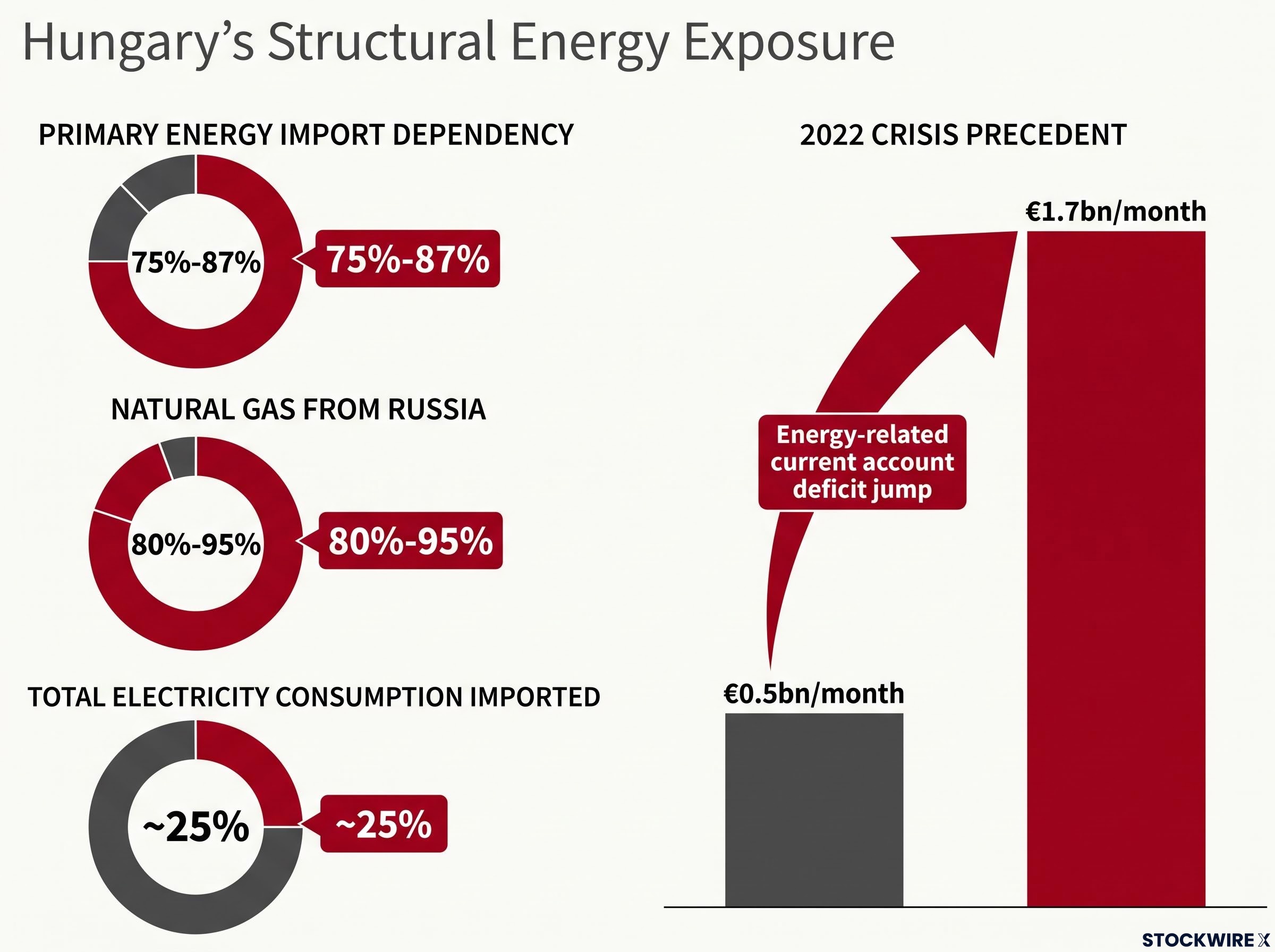
Hungary relies on imported hydrocarbons more heavily than its neighbours, with primary energy import dependency estimated between 75% and 87%. Between 80% and 95% of its natural gas comes from Russia, and roughly one-quarter of total electricity consumption is imported. When gas prices spike, Hungary feels it first and feels it most.
That dependence transmits into the currency through three reinforcing channels:
- Current account pressure: Heavy net gas imports and gas-intensive industry mean energy price spikes widen the external deficit directly, creating persistent forint-negative flows.
- Inflation and fiscal burden: Regulated domestic energy prices and fuel subsidies convert energy shocks into fiscal and quasi-fiscal costs, forcing markets to price higher risk into Hungarian assets.
- Carry positioning reversals: High yields make the forint attractive as a carry trade, but large external financing needs tied to energy imports mean gas spikes quickly erode that appeal and trigger rapid position unwinds.
The 2022 precedent shows the mechanism at scale: During that energy crisis, Hungary’s energy-related current account deficit jumped from roughly €0.5bn per month to around €1.7bn, putting sustained downward pressure on the forint.
This is why the forint should be treated as a qualitatively different risk instrument, not a peer of the koruna and zloty. The energy-to-carry-to-FX chain is self-reinforcing: a gas spike widens the current account, which undermines carry, which triggers selling, which raises import costs further. Drawdowns during energy shocks tend to overshoot and take longer to recover.
The market levels reflect that. EUR/HUF stood at an ECB reference rate of 365.33 on 14 September 2026, with live quotes around 365.676, and the original analysis flags scope to extend above 368 before meaningful support materialises.
It is worth noting the forint’s weakness is not purely an energy story. Analysts at Commerzbank, BNY, and UniCredit argue that Hungary’s high debt-servicing costs, persistent core inflation risk, and political uncertainty ahead of the 2026 elections are equally responsible for eroding carry appeal. On some short-term fuel-price metrics, Czechia, Poland, and Romania even screen as more exposed to immediate pump shocks. The structural energy argument is the dominant frame, but it is not the only one.
What the NBH’s easing cycle means for the forint’s rate buffer
Here the policy divergence sharpens the picture. While Prague and Warsaw held, the National Bank of Hungary (NBH) cut its base rate by 25 basis points to 5.50% on 25 August 2026, its fourth cut of the year.
That divergence matters because rate support is the one tool that could interrupt the energy-to-FX feedback loop, and the NBH is actively removing it. Market pricing reflects roughly one further cut, which leaves a thin buffer.
Any additional easing surprise, or growth weakness that pressures the NBH to cut faster, would strip out the residual rate support quickly. For the forint, the defensive mechanism is being dismantled at the exact moment the shock demands it.
What the downside risks mean for each currency from here
The baseline case is that elevated short-end rates across the CEE3 provide a partial buffer and the currencies stabilise. That thesis is plausible, but it has explicit failure conditions worth tracking, ranked from most systemic to most idiosyncratic:
- Prolonged US yield highs: If the 10-year holds near or above 5%, dollar strength persists and CEE carry premia stay compressed. This hits the whole bloc.
- Persistent energy shocks: A sustained “Energy Shock 2.0” would fall hardest on the forint, then the zloty, given their thinner fiscal buffers.
- Geopolitical escalation: Renewed Russia-Europe or Middle East tension could weaken all three currencies abruptly, regardless of supportive domestic rates.
- Fiscal deterioration: Diverging fiscal paths make blanket CEE carry trades risky, with Poland and Hungary most exposed to a repricing of country risk.
- Premature central bank easing: Concentrated in Hungary, where continued NBH cuts on weak growth could undermine real-rate support fastest.
Poland’s deficit is the quiet complication: Poland and Romania are running fiscal deficits above 5% of GDP, a risk that undercuts what might otherwise look like a more stable policy posture for the zloty.
The important point is that these risks are not symmetric across the bloc. Yield and geopolitical risk are shared; the fiscal path is a Poland and Hungary problem; easing risk is concentrated in Hungary; and dovish-surprise risk sits with the CNB. For anyone long CEE FX, the real danger is co-occurrence: sustained yields plus an energy extension arriving together would activate two failure conditions at once, which is what makes the current environment more hazardous than any single currency level suggests.
EM local-currency bond positioning is one of the cleaner expressions of a CEE stabilisation thesis: if short-end rates hold and the dollar retreats from the 5% yield threshold, the carry yield of approximately 6.9% on the J.P. Morgan GBI-EM index compounds with FX appreciation, a combination that attracted $11.4 billion in Q1 2026 flows before the current shock reset the calculus.
Which signals matter most before the next central bank cycle
CEE currency direction in the near term is being set outside the region. That reframes what to watch. Three external and semi-external signals carry more weight right now than any domestic data release:
- The NBH meeting outcome: A hawkish surprise would support the forint; a dovish outcome or further cut removes the residual rate buffer, with roughly one cut already priced.
- The US 10-year yield versus 5%: Sustained readings at or above the threshold keep the dollar firm and carry compressed across all three currencies; a decisive move below eases the pressure bloc-wide.
- TTF gas versus €80/MWh: With the front-month at €79.52/MWh on 11 September 2026 and an intraday high of €82.57/MWh, prices holding above the €80 level sustain current account pressure, hitting the forint hardest.
The most useful takeaway is what is not yet priced. The baseline carry buffer from elevated short-end rates is in the market. A simultaneous energy-shock extension and a US yield plateau is not. That gap is where the market’s own assumptions are most fragile, and it is where a reader with active exposure should focus attention.
This article is for informational purposes only and should not be considered financial advice. Investors should conduct their own research and consult with financial professionals before making investment decisions.
Past performance does not guarantee future results, and the forecasts referenced here are subject to market conditions and various risk factors.
Country-specific signals for koruna, zloty, and forint watchers
Beyond the three headline signals, each currency has its own tell heading into the next decision.
For the koruna, watch the CNB vote composition and guidance language: another unanimous hawkish hold supports the floor, while any dovish dissent or softer guidance would flag the disappointment risk that positioning is exposed to. For the zloty, the signal is NBP rhetoric on the timing of future cuts: firm hold-and-signal language is supportive, while a pivot toward near-term easing would erode the stabilisation case.
For the forint, the NBH decision outcome and any revision to the easing path are decisive: a hawkish hold or slower cut trajectory would rebuild the buffer, while a further cut or a faster easing signal would remove it.
Three signals, three currencies, one framework for what comes next
The CEE bloc is absorbing one shared macro shock, but the currency outcomes are meaningfully differentiated by energy exposure, policy cycle position, and fiscal trajectory. The koruna and zloty share a 3.75% rate floor whose durability depends on avoiding a dovish surprise. The forint carries a structural disadvantage that its central bank is actively deepening.
That structural difference is not just a shock-phase story. It shapes the recovery phase too: because the forint’s vulnerability is self-reinforcing, it tends to overshoot on the way down and lag on the way back, which means HUF behaves differently from its peers even after the initial pressure eases.
The stabilisation thesis is credible, but it is contingent, and its failure conditions are now clearly mapped. Three central bank decisions are approaching in Prague, Warsaw, and Budapest. Read them through the NBH outcome, the US 10-year relative to 5%, and TTF gas relative to €80/MWh, and the direction for each currency should come into focus as those decisions land.