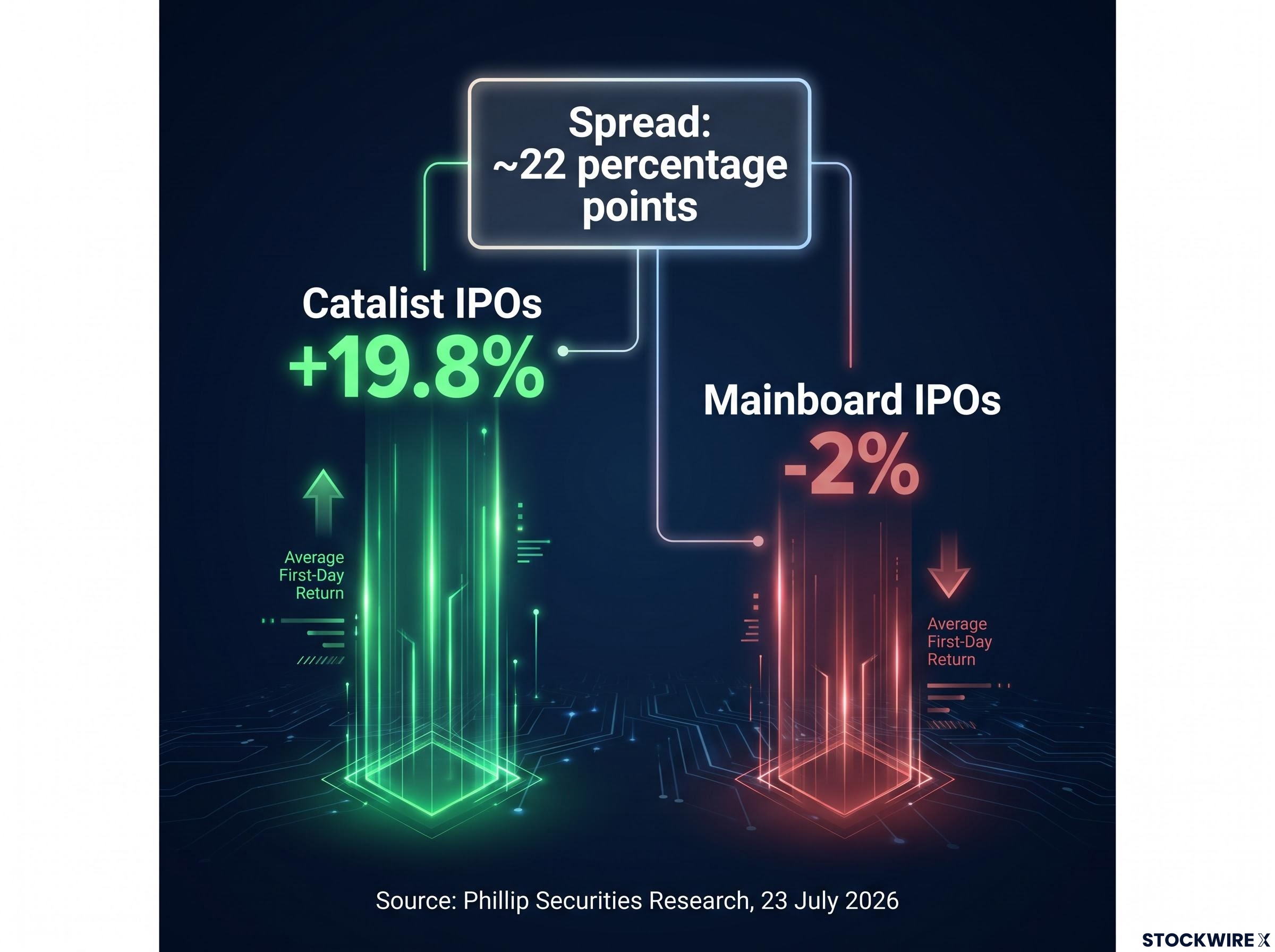
Catalist IPOs on the Singapore Exchange have averaged a +19.8% gain on opening day. Mainboard IPOs have averaged a -2% first-day return. That is a spread of nearly 22 percentage points between two listing venues operated by the same exchange.
The SGX runs two distinct boards with materially different issuer profiles, investor bases, and pricing dynamics. The Catalist board serves smaller-cap issuers with sponsor-supervised listings; the Mainboard handles larger, institutionally priced deals. The performance divergence between them is documented in a Phillip Securities Research report published on 23 July 2026, and the data covers recent IPO cohorts across both boards.
Here is what the comparative data actually shows, where the performance gap comes from structurally, what the multi-period return figures reveal across holding periods out to six months, and what a short-term trader needs to understand before assuming the edge is permanent. The goal is a calibrated view of Singapore IPO performance, not a headline number stripped of context.
The opening-day gap between Catalist and Mainboard is not marginal
+19.8% average opening-day gain for Catalist IPOs vs -2% for Mainboard IPOs, a spread of nearly 22 percentage points. (Phillip Securities Research, 23 July 2026)
That spread is not driven by a single disastrous Mainboard listing dragging down an otherwise neutral average. Approximately two-thirds of Mainboard IPOs closed below their issue price on debut, meaning the negative average reflects a broad pattern, not an outlier problem.
The core data points:
- Catalist average opening-day gain: +19.8%
- Mainboard average first-day return: -2%
- Only approximately one-third of Mainboard IPOs finished day one above their issue price
What this tells you in practical terms: the base case for someone participating in a typical Mainboard IPO is a small loss on the first trading day. That reframes how you should think about IPO access as a strategy. Participating broadly across Mainboard listings has not been a winning short-term trade in recent cohorts; participating across Catalist listings has delivered a materially different outcome.
When big ASX news breaks, our subscribers know first
Why the mechanics of smaller-cap listings produce bigger opening pops
The performance gap is not random good fortune in the small-cap universe. It is the logical output of three structural factors that compound on one another, each identified by Phillip Securities Research:
- Smaller float sizes limit the supply of shares available on listing day, meaning even moderate demand produces outsized price moves.
- Higher retail participation in Catalist order books amplifies opening-day momentum, because retail-dominated demand tends to be less price-disciplined than institutional bidding.
- Conservative IPO pricing by Catalist sponsors leaves a wider spread between the offer price and fair value, creating what amounts to “money left on the table” that early buyers capture.
These drivers are mechanical rather than fundamental. They reflect how Catalist listings are constructed, not whether the underlying businesses are superior to Mainboard issuers. The same dynamics that create the opening-day pop also explain why the edge is time-bound: once the early momentum generated by constrained supply and retail enthusiasm fades, the structural tailwinds no longer apply.
Conservative pricing and the sponsor dynamic on Catalist
Catalist listings require a sponsor, a licensed firm that supervises the listing process and ongoing compliance. The sponsor’s incentive structure favours a successful debut: a listing that pops on day one reflects well on the sponsor and attracts future mandates. This creates a systematic tendency toward conservative offer pricing, where the IPO is priced with enough room below fair value to ensure strong opening-day demand. The result is a reliable “money on the table” effect that retail investors capture.
What this means for you is straightforward: capturing the Catalist edge requires timing, not stock-picking skill. The advantage is baked into the mechanics of how these listings reach the market.
The multi-period return data: what holding beyond day one has looked like
The opening-day figure is striking enough. The holding-period data from Phillip Securities Research extends the surprise further.
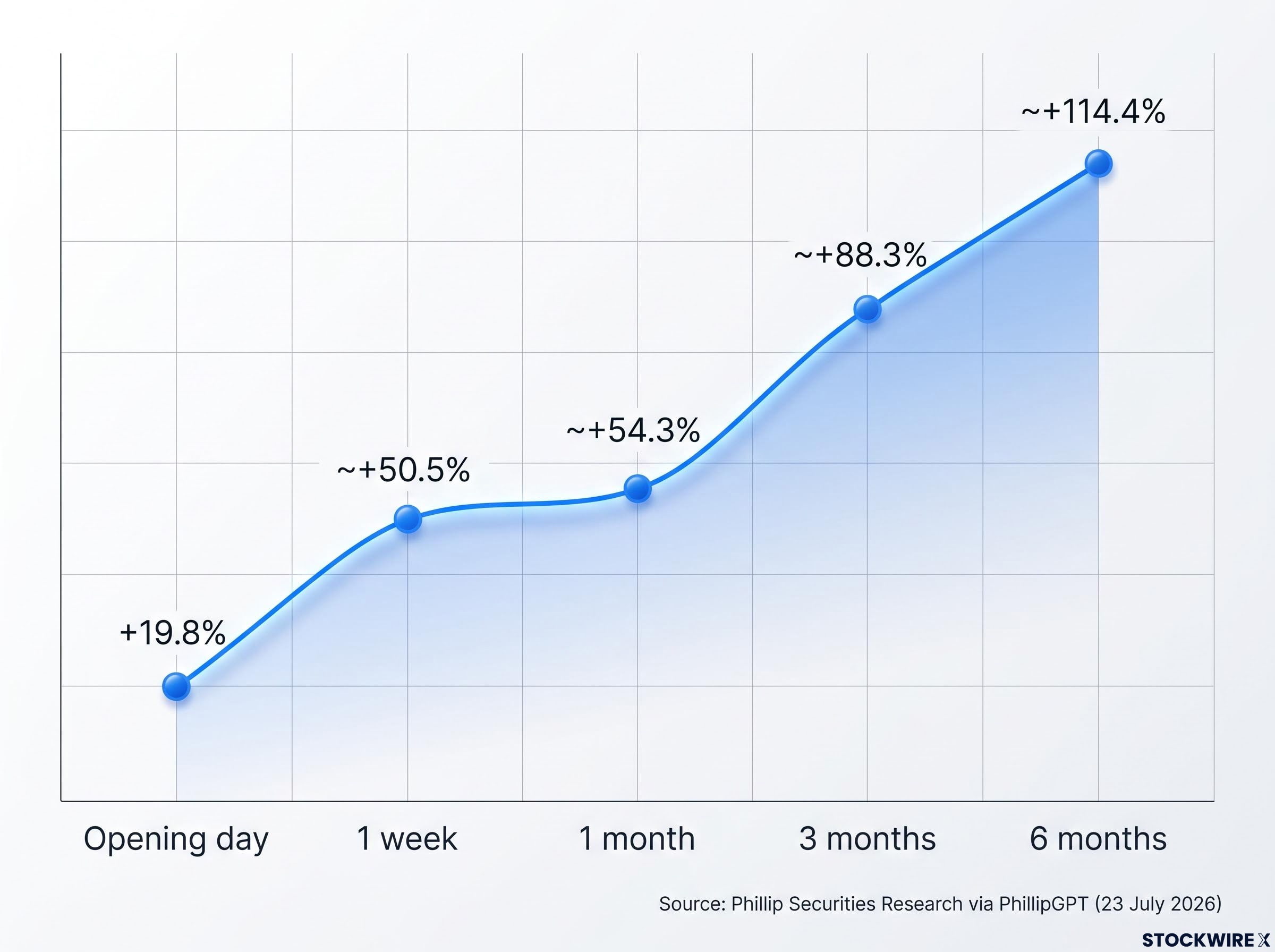
Catalist IPOs have averaged +114.4% at the six-month mark, according to Phillip Securities Research internal data. That is not a typo.
The full progression, attributed explicitly to Phillip Securities Research internal analysis referenced via PhillipGPT (published 23 July 2026), shows sustained momentum well beyond the first trading session:
| Holding Period | Average Return (Phillip Securities Research) |
|---|---|
| Opening day | +19.8% |
| 1 week | ~+50.5% |
| 1 month | ~+54.3% |
| 3 months | ~+88.3% |
| 6 months | ~+114.4% |
Source: Phillip Securities Research internal data, referenced via PhillipGPT (23 July 2026). These figures are not independently verifiable from public market data.
The acceleration from +19.8% on day one to +114.4% at six months represents sustained post-listing momentum, not just a one-day spike. But averages at this level are almost certainly skewed upward by a small number of breakout performers. The median experience, the return the typical Catalist IPO participant actually received, is likely materially lower. Understanding that skew is what separates informed use of this data from naive extrapolation.
Dezign Format Group as a concrete example of the pattern in action
Dezign Format Group Ltd provides a concrete illustration of what the stronger end of the Catalist cohort looks like. According to Phillip Securities Research data referenced via PhillipGPT, the company delivered a +40% gain on its first trading day and a cumulative +72.5% gain within one week of listing.
| Metric | Dezign Format Group | Catalist Cohort Average |
|---|---|---|
| Day-one return | +40% | +19.8% |
| One-week return | +72.5% | ~+50.5% |
Source: Phillip Securities Research via PhillipGPT (23 July 2026). These figures are not independently verifiable from public market data.
The +40% day-one gain is double the cohort average of +19.8%, placing Dezign in the upper range of recent Catalist listings. It shows that the cohort average is achievable, and then some, in a single name. But chasing this outcome by extrapolating from headline cases is a different risk proposition from participating systematically across the cohort. Dezign is an example, not a blueprint, and certainly not a stock recommendation.
What the six-month data does not capture: the longer-term picture
The return table is compelling. It is also incomplete. The Catalist performance advantage documented by Phillip Securities is explicitly a short-term trading phenomenon, and broader market evidence shows many Catalist stocks face significant challenges in sustaining value over extended holding periods.
Business Times commentary through 2025-2026 has highlighted persistent structural issues among many Catalist stocks, including low liquidity, thin trading volumes, and sustained price weakness over longer time horizons.
Once early post-IPO momentum fades, the characteristics that produced the opening pop, constrained float, retail enthusiasm, conservative pricing, no longer operate. What remains are small-cap stocks with limited analyst coverage and, in many cases, trading volumes too thin to exit at favourable prices.
Three caveats that the return averages do not disclose:
- Outlier skew: A small number of breakout performers can significantly elevate cohort averages, masking a weaker median experience across the group.
- Allocation constraints: In oversubscribed Catalist deals, retail investors may receive very small allocations, limiting the practical dollar gain even when percentage returns are strong.
- The six-month horizon is where the data stops: The multi-period return table captures momentum. It does not capture what happens to these stocks at the two- or three-year mark.
For historical context, the SGX highlighted ten Catalist companies in 2017 that averaged 56.2% gains from their offer prices, with a median return of 43.6% and nine of ten trading above issue price. That is encouraging as a directional reference, but it is 2017 data, not current evidence.
The practical implication is clear: a Catalist IPO strategy requires an exit discipline, not just an entry thesis. The investor who captured the six-month average but held for three years is likely to have experienced a materially different outcome.
This article is for informational purposes only and should not be considered financial advice. Investors should conduct their own research and consult with financial professionals before making investment decisions.
How to calibrate the Catalist edge as a trading tool, not an investment thesis
The Phillip Securities data makes a strong case for Catalist IPOs as a short-term trading vehicle within a defined window: +19.8% on day one, sustained through to +114.4% at six months, with Dezign Format Group illustrating the upper range. It makes a weaker case for anything beyond that window.
Using this data responsibly in practice means meeting three conditions:
- IPO access via a broker with SGX Catalist coverage. For international investors, access to Singapore IPOs, particularly Catalist listings, may be limited by broker availability, residency requirements, and allocation mechanics that differ from those available to domestic retail investors.
- An explicit exit horizon defined before entry. The data supports a short-term momentum trade, not an indefinite hold. Deciding when to exit before you enter is what separates a strategy from a hope.
- Realistic allocation expectations in oversubscribed deals. Strong percentage returns on a small allocation produce modest dollar outcomes. Size the opportunity honestly.
The Catalist edge is real, documented, and worth understanding. It is also time-bound, structurally driven, and accessible only to participants who can meet the practical requirements.
What the divergence signals about Singapore’s two-board structure going forward
The persistent gap between Catalist and Mainboard opening-day performance raises a structural question about Singapore’s market design: does the spread reflect healthy segmentation between two distinct investor audiences, or a pricing inefficiency that will narrow as more data enters public view?
Two forward-looking questions are worth watching:
- The pricing efficiency question: Two-thirds of Mainboard IPOs closed below issue price on day one. That is not a run of bad luck; it suggests institutionally priced deals are leaving retail investors little immediate upside, which has implications for retail participation in Singapore’s primary market over time.
- The demand-inflation risk to the Catalist premium: As Catalist’s short-term track record becomes better known, partly through reports like the Phillip Securities analysis published on 23 July 2026, demand for Catalist IPO allocations may increase. If that wider awareness causes sponsors to price future listings more aggressively, the very edge this data documents could compress.
That makes this a time-sensitive insight rather than a permanent market feature. The cohorts that follow the publication of this data will tell you whether the structural advantage persists or whether its own visibility erodes it.
The data is clear on timing, and less clear on everything else
The Phillip Securities data tells a specific and time-limited story. Catalist IPOs have delivered materially stronger returns than Mainboard listings across holding periods from day one through six months, driven by structural mechanics rather than fundamental superiority. That makes the pattern relevant for short-term momentum traders with IPO access and an exit plan.
Beyond that window, the picture is less clear and less encouraging. Strong short-term data combined with structural long-term fragility produces a clear-eyed opportunity for the right kind of participant, not a reason to rotate a portfolio toward Singapore small-caps broadly.
This analysis rests primarily on Phillip Securities Research data, which readers should review directly for the full methodology and cohort composition. Individual IPO outcomes will vary significantly from cohort averages, and past performance does not guarantee future results.
Past performance does not guarantee future results. Financial projections and return averages are subject to market conditions and various risk factors.