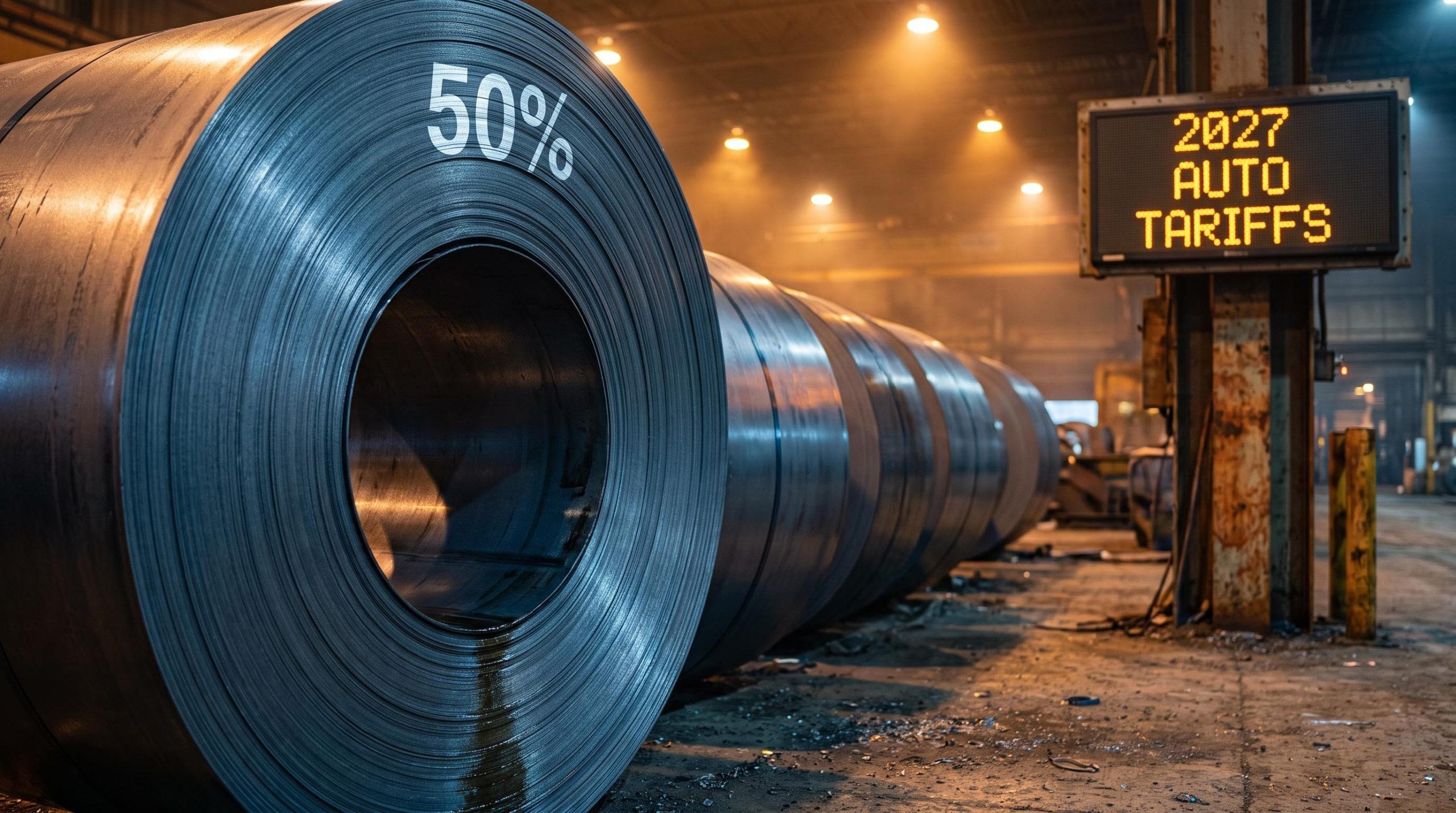
Most investors watching the Canada-US trade escalation are focused on the tariff headlines themselves: 50% on steel, retaliatory lists, political theatre between capitals. The real portfolio risk sits elsewhere. It is not the 5-6% of bilateral trade now carrying elevated duties. It is the inflation compounding effect those tariffs create, the bond market pressure that follows, and the 2027 auto tariff threat that equity valuations have barely begun to price.
As of late August 2026, the United States has imposed 50% tariffs on approximately CA$27.6 billion of Canadian goods under Section 338 of the Tariff Act. In response, Canada introduced retaliatory duties ranging from 15% to 50% across more than 700 American product lines, with those measures taking effect on 8 September. Inflation in both countries had already climbed to 3% or above before this latest round of escalation, with no signs of abating. The dispute remains bounded for now, but the trajectory points toward a potentially severe escalation in auto tariffs early next year.
This piece maps the specific transmission channels from tariff escalation to portfolio outcomes: the inflation dynamics that keep central banks pinned, the sectors carrying the heaviest exposure, the concrete positioning moves the analysis supports, and the structural diversification opportunity embedded in the disruption itself.
How tariffs become inflation and why bond markets are already reacting
Start with what tariffs actually do at the transaction level. A 50% tariff on imported steel is a 50% cost increase for every Canadian or American manufacturer buying that steel across the border. That cost flows downstream: into appliance prices, construction budgets, machinery quotes, and eventually into consumer prices across affected categories including dairy, home appliances, and agricultural equipment.
Consumer prices in both Canada and the United States were already running at 3% or higher as of August 2026, and that level marks a starting point rather than a peak given the compounding effect of tariff-driven costs, fiscal stimulus measures, and ongoing geopolitical conflict.
Here is where the mechanism turns from intuitive to consequential. When tariff-driven cost increases push inflation above central bank targets, rate cuts become structurally difficult even when growth is softening. Canada’s CA$7.5 billion support package for affected businesses adds fiscal stimulus that compounds rather than offsets the price pressure. Layer in additional inflationary force from ongoing conflict in Iran, and the Yale Budget Lab’s projection that effective US tariff rates continue climbing despite the IEEPA court ruling, and you have an environment where central banks in both countries are stuck.
Tariff-driven inflation transmission into housing costs is particularly persistent because lumber duty impacts work through construction pipelines over 12-18 months, meaning the shelter CPI contribution from 2025-2026 tariff rounds has not yet fully appeared in official data even as new cost pressures accumulate.
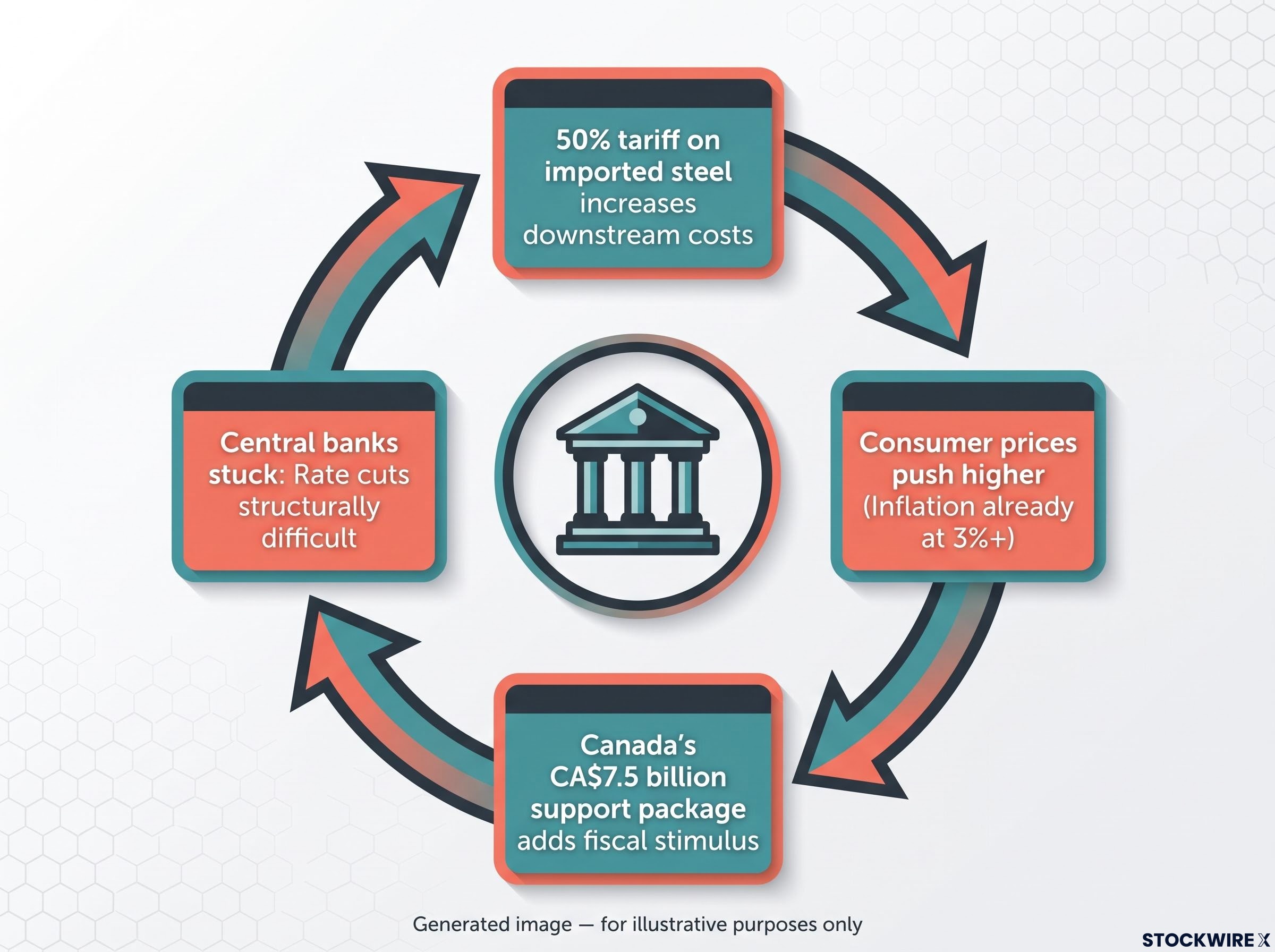
That bind carries direct implications for three categories of rate-sensitive assets that investors typically hold as defensive positions:
- Utilities, which rely on cheap long-term borrowing to fund capital programmes
- REITs, whose valuations compress when bond yields compete for income-seeking capital
- Highly leveraged firms, where elevated refinancing costs squeeze margins regardless of revenue performance
The compounding of tariff-driven inflation with geopolitical price pressures means central banks are navigating something closer to stagflation than a conventional slowdown. The standard recession response of cutting rates and rotating into long-duration bonds is not available in this cycle. That single constraint reshapes the entire positioning conversation that follows.
When big ASX news breaks, our subscribers know first
Which sectors carry the heaviest tariff exposure right now
Metals and autos: the core of cross-border supply chain risk
Steel and aluminium sit at the centre of the immediate disruption. Canada raised its steel and aluminium duties to 50%, bringing them in line with the US rate and leaving both sides of the border subject to equivalent bilateral levies on metals. The direct hit falls on cross-border supply chains for auto parts, machinery, and aerospace, where input costs have risen materially with no near-term relief in sight.
The Section 338 product exclusions covering crude oil, critical minerals, and potash reflect US domestic supply chain self-interest rather than diplomatic concession, a distinction that matters for investors trying to separate structurally exposed sectors from those operating outside the tariff perimeter.
Autos represent the forward-looking risk rather than the current one. North American auto production is built on deeply integrated supply chains where parts and sub-assemblies cross the Canada-US border multiple times before final assembly. The threatened 50% US tariff on Canadian auto imports beginning in early 2027 is not a future problem alone; it is a present-day valuation uncertainty for OEMs and Tier-1 suppliers. GM, Ford, and Stellantis all operate Canadian plants that would be directly affected, and narrowly focused suppliers with limited ability to reroute production carry even greater vulnerability.
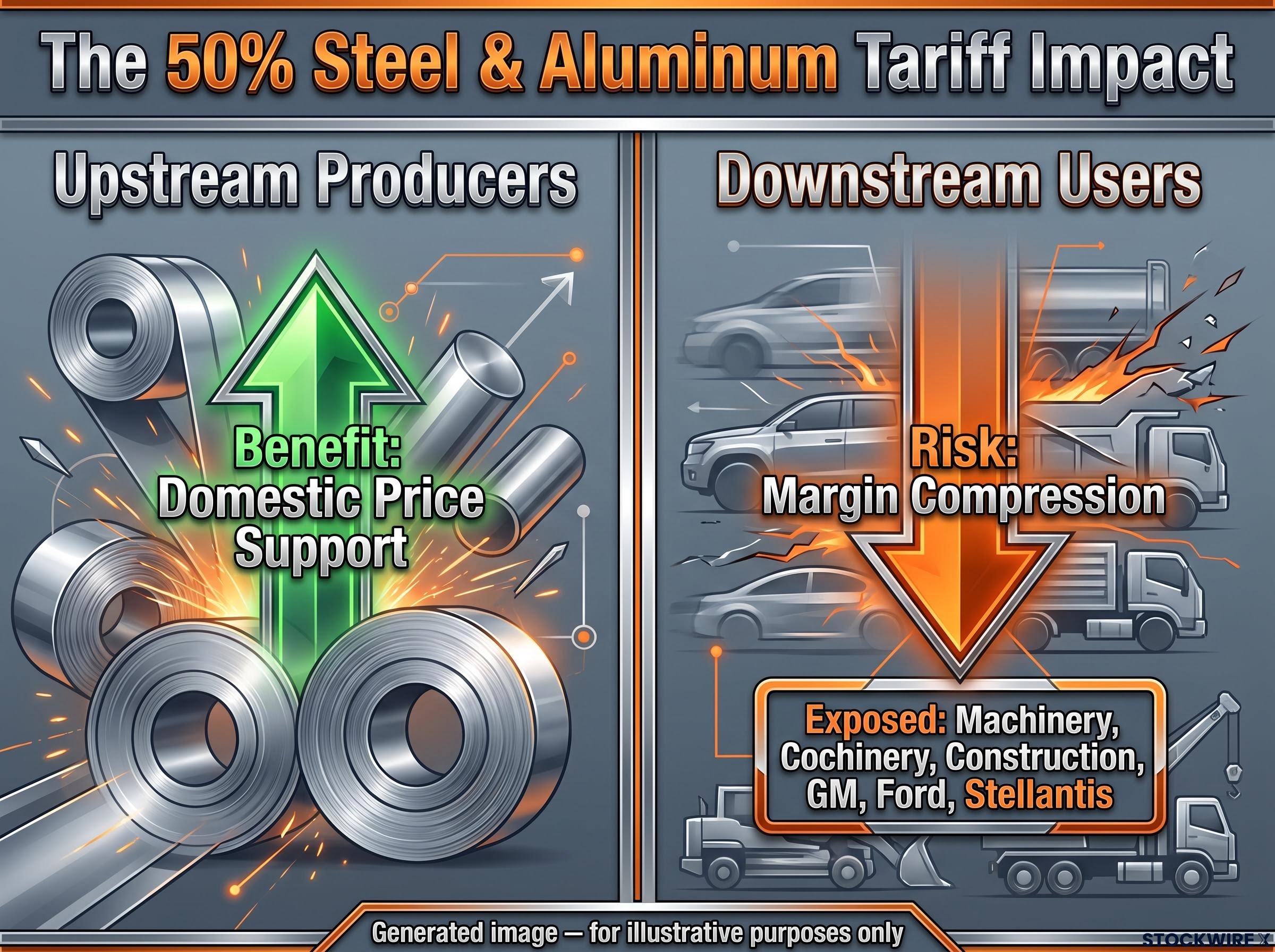
The distinction that matters for portfolios sits between upstream and downstream. Domestic metal producers receive tariff-driven price support as imported competition becomes more expensive. Downstream users of those metals, including industrial manufacturers, construction firms, and auto suppliers, absorb higher input costs that compress margins unless they can pass them through to customers. Owning “industrials” is not a single exposure; it is two opposing ones depending on where in the value chain your holdings sit.
Agriculture, appliances, and the political targeting strategy
Canada’s counter-tariff list was not designed purely for economic impact. It was explicitly constructed to concentrate pain in politically sensitive US regions, targeting goods from key farming and manufacturing states. Goods on the list include dairy, construction materials, home appliances, and motorcycle and railway parts, along with a range of agricultural products, with applied duty rates sitting at 15%, 25%, or 50% depending on the category.
That political targeting adds durability to the disruption. Product categories chosen to create domestic political pressure in the United States are unlikely to be quietly removed from tariff lists before elections. US dairy producers reliant on Canadian export markets face reduced competitiveness, while Canadian food processors and retailers using targeted US inputs see higher costs that flow through to consumers.
| Sector | Tariff level | Position in value chain | Portfolio implication |
|---|---|---|---|
| Autos (OEMs and Tier-1 suppliers) | 50% threatened for 2027 | Downstream (assembly and components) | Reduce concentrated exposure; favour diversified production footprints |
| Steel and aluminium (producers) | 50% both directions | Upstream (domestic price support) | Benefit from tariff protection but face demand risk if downstream slows |
| Steel and aluminium (downstream users) | 50% on inputs | Downstream (margin compression) | Monitor earnings revisions and pass-through ability |
| Agriculture and dairy | 15-25% | Mixed (producers and processors) | Favour globally diversified agribusinesses over North America-concentrated names |
| Appliances and consumer durables | 15-50% | Downstream (cost absorption) | Thin-margin exporters with heavy Canadian sales most vulnerable |
The upstream-versus-downstream frame is where the portfolio differentiation within a single sector lives. When reviewing holdings in industrials, construction, and auto supply chains, identifying which side of that line each position sits on determines whether tariff escalation is a headwind or a tailwind.
What the analysis points toward for portfolio positioning
The inflation mechanism and sector mapping established above point toward a specific sequence of portfolio audit steps rather than a generic risk checklist. Each move traces directly to the analytical evidence.
- Map cross-border revenue and supply-chain exposure across your holdings, focusing on tariff-targeted goods: steel, aluminium, appliances, dairy, agricultural equipment, and construction materials.
- Assess auto and tariff-hit industrial concentration. Reduce overweights to OEMs and suppliers that rely heavily on Canada-US cross-border flows, particularly those with narrow product lines and limited production flexibility.
- Shorten fixed income duration. The inflation and yield dynamics make long-dated nominal bonds structurally unattractive. Prefer short- to intermediate-duration government bonds and consider inflation-linked or floating-rate instruments.
- Elevate credit quality. High-yield issuers in tariff-exposed sectors face the twin pressure of weaker earnings and higher refinancing costs. Credit spreads in those names could widen materially.
- Review CAD FX hedging policy. For non-Canadian investors, unhedged Canadian dollar exposure adds volatility that may not be compensated. Ensure currency risk is an intentional position rather than an unexamined by-product of security selection.
- Build a monitoring plan around key dates and legal developments. 8 September 2026 (Canadian counter-tariffs effective) and early 2027 (auto tariff escalation threat) are the two dates that should sit alongside inflation prints, bond yields, and earnings guidance from exposed companies.
A single court ruling can materially shift effective tariff rates within days. The IEEPA court ruling precedent demonstrates that legal challenges to US tariff authority create asymmetric headline risk in either direction, making legal and regulatory monitoring as important as macro monitoring.
The IEEPA precedent tells you something specific about how to build that monitoring plan. Effective tariff rates are not fixed by political announcement alone. A court ruling, a regulatory interpretation, or a legislative challenge can reset the entire tariff landscape within days, creating moves that sector fundamentals alone would never predict. Your watchlist needs to include court calendars alongside earnings calendars.
Executive tariff authority has become one of the fastest-moving variables in the current environment, with the Supreme Court’s February 2026 IEEPA ruling shifting the administration toward Section 232 and litigation-resistant statutory instruments rather than reducing the overall volume of tariff activity.
Canada’s trade diversification pivot as a medium-term investment angle
The disruption carries an embedded structural opportunity that moves beyond pure risk reduction. Prime Minister Mark Carney has publicly committed to a “dollar-for-dollar” response on tariffs and, more significantly for medium-term positioning, to expanding Canada’s non-US trade channels as a strategic priority.
Prior to the current escalation, estimates indicated that roughly 90% of Canadian goods moved into the US market without attracting any duties under CUSMA. That concentration, once a source of efficiency, has become a source of vulnerability. The current dispute creates stronger incentives to diversify, and Canada holds the legal infrastructure to do it. Existing agreements with the EU (CETA), CPTPP partners across the Asia-Pacific, and the United Kingdom provide the trade architecture for accelerated reallocation of export flows.
Three investment angles emerge from this structural shift:
- Export-oriented Canadian firms with existing meaningful revenue in Europe or Asia. These companies are positioned to benefit directly from any policy push to widen non-US market access.
- Critical minerals and energy companies aligned with allied-country supply diversification. Geopolitical demand from allied nations seeking stable, reliable suppliers creates a demand tailwind that aligns with Canada’s export capacity.
- Globally diversified agribusinesses over North America-concentrated ones. The agricultural counter-tariff exposure reinforces the case for geographic spread in food and commodity holdings.
This is a multi-year structural trend requiring position-building over time rather than a tactical trade. Investors who identify globally diversified Canadian companies early in this shift stand to benefit as policy support and trade flows follow the stated political direction. The legal runway is already built; the capital flows are beginning to follow.
Navigating a dispute that is designed not to resolve quickly
The through-line across every section of this analysis is trajectory. Roughly 5% of Canadian exports and 6% of American exports to each other now sit in the high-tariff zone, concentrated in metals, industrial inputs, and selected consumer goods. Most bilateral trade continues under CUSMA rules. This is a targeted disruption, not a trade rupture.
But the political architecture surrounding it makes near-term resolution structurally unlikely. Canada’s counter-tariff list was explicitly designed to create domestic political pain in the United States. Ontario Premier Doug Ford has previously indicated a readiness to restrict electricity flowing to American states as a retaliatory measure. US Trade Representative Jameson Greer has indicated that Washington stands ready to impose additional measures should Canada press ahead with further retaliation. Canada’s CA$7.5 billion support package signals that Ottawa expects the disruption to persist long enough to require sustained domestic compensation.
Canada’s structural energy leverage, supplying roughly 99% of US natural gas imports, 85% of electricity imports, and 60% of crude oil, creates an asymmetry that the tariff headline narrative consistently underweights and that investors should factor into any assessment of how far escalation can realistically proceed.
Three variables determine whether the escalation accelerates or plateaus from here:
- The 2027 auto tariff decision: confirmation of 50% tariffs on Canadian auto imports would represent a qualitative escalation given the depth of cross-border supply chain integration
- Court rulings affecting US tariff legal authority: any judicial challenge that succeeds or fails can shift effective rates materially and quickly
- Inflation trajectory and central bank rate signals in both countries: persistent above-target inflation closes the door on the rate-cut relief valve that equity markets have been waiting for
Structural positioning across duration, sector concentration, currency, and geographic diversification is more durable than headline-reactive trading in this environment. The political signals from both governments tell you this dispute is structured to persist through at least the next US electoral cycle. Position for duration rather than hoping for a rapid reset.
This article is for informational purposes only and should not be considered financial advice. Investors should conduct their own research and consult with financial professionals before making investment decisions. Forward-looking statements regarding tariff escalation, inflation trajectories, and policy decisions are speculative and subject to change based on political, legal, and market developments.