The Bank of Canada will almost certainly hold its overnight target rate at 2.75% when it announces its decision on 2 September 2026. Every major forecaster, overnight index swap (OIS) market, and the National Bank of Canada’s own rates desk agrees. The hold is not the story.
The story is what comes after. OIS markets are currently pricing a roughly 65% probability that the BoC raises rates before the end of 2026. NBC analysts Taylor Schleich and Ethan Currie think that number is significantly too high, and they have laid out a specific argument for why: it rests on an assumption that Canada-U.S. trade tensions resolve, and that assumption is not well supported by current conditions.
What follows equips you to evaluate whether the market’s Bank of Canada interest rate expectations are reasonable, what the BoC’s statement language will signal either way, and where the fixed income opportunity sits if NBC’s thesis proves correct. The 2 September statement is the catalyst. The analytical framework below is the lens.
Tomorrow’s decision is settled. The rate path is not.
The BoC’s overnight target rate sits at 2.25%, where it has been since 29 October 2025. If the 2 September decision comes in as a hold, it will extend the uninterrupted pause to seven meetings, and no credible forecaster is calling for anything else. OIS pricing, consensus surveys, and NBC’s own rates desk are all aligned. The decision itself is unlikely to move a single basis point.
That unanimity is precisely what shifts the focus. When a central bank decision is fully priced, the statement becomes the market event. You are not watching for a rate change tomorrow; you are watching for a narrative shift that could reprice the entire forward curve.
Central bank rate mechanics clarify why the statement language matters more than the decision itself: because the policy rate transmits through bank funding costs, mortgage rates, and business loan rates, even a shift in forward guidance framing, without any change to the overnight target, can reprice the forward curve and move bond markets.
A timeline of BoC rate moves since early 2025
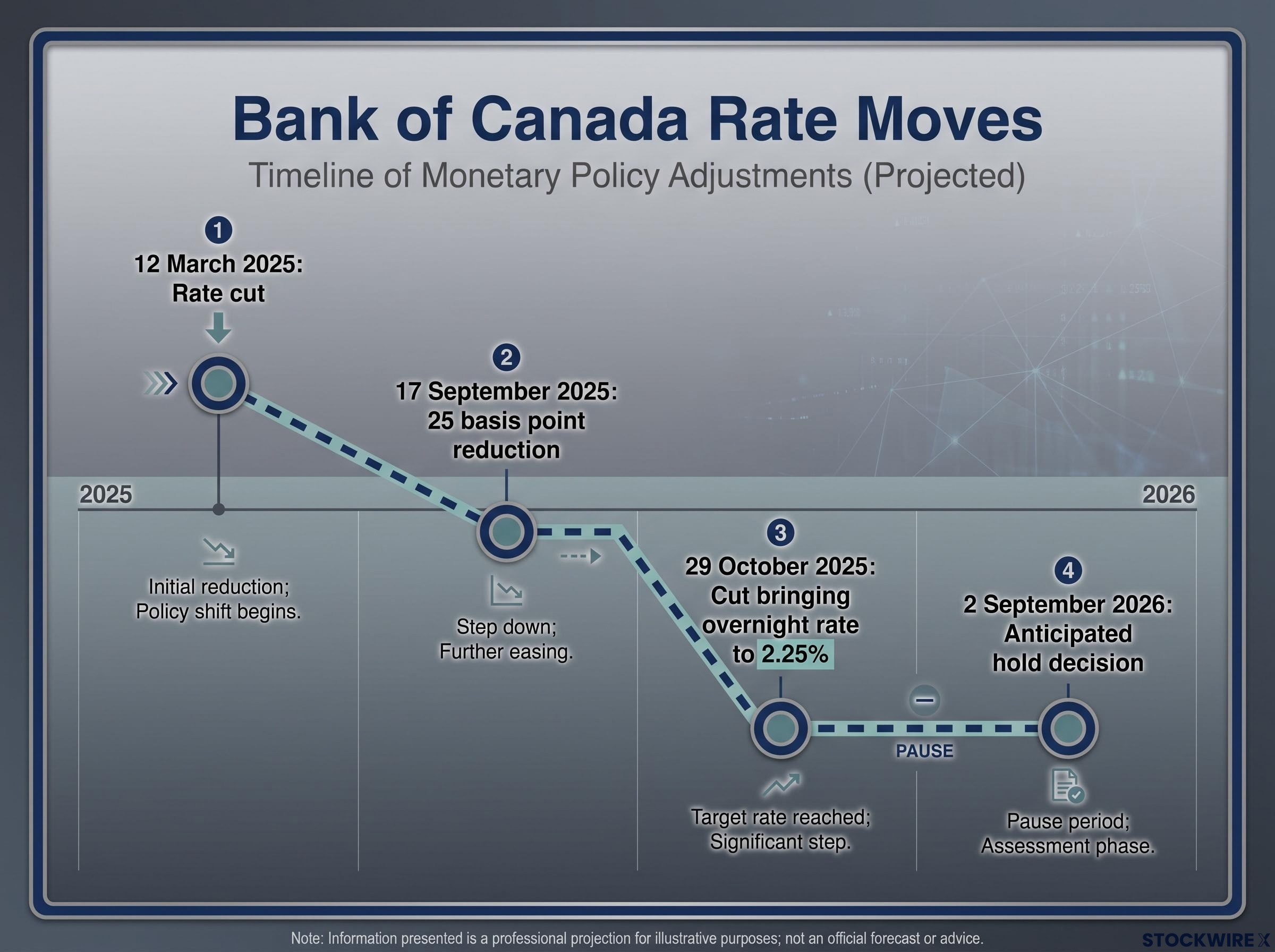
The BoC arrived at 2.25% through three cuts spaced across 2025, each separated by multi-month pauses:
- 12 March 2025: Rate cut, continuing the easing cycle that began in the prior year
- 17 September 2025: A further 25 basis point reduction after a prolonged hold
- 29 October 2025: The most recent cut, bringing the overnight rate to 2.25%
That stepwise, pause-heavy pattern matters. It tells you the BoC does not move in rapid sequences. It pauses, assesses, and then acts again only when the data compels it. The seven-month hold since October fits the same cadence. What breaks that cadence, if anything, is what the statement on 2 September needs to address.
The Bank of Canada’s October 2025 rate decision confirmed the 25 basis point reduction that brought the overnight rate to 2.25%, accompanied by language that underscored the institution’s preference for measured, data-driven adjustments over rapid sequential moves.
The only live variable tomorrow is the forward guidance embedded in the BoC’s language. Specifically: does the statement lean into trade-related downside risks, or does it leave the door open to tightening? That distinction is worth more to bond markets than the hold itself.
When big ASX news breaks, our subscribers know first
Why a 65% hike probability looks like the wrong number
OIS markets currently price roughly a 65% chance of a BoC rate increase before the close of 2026. That pricing is not an outlier view; it is where the forward curve sits, and embedded within it is a particular macro assumption: that the Canada-U.S. trade dispute either resolves outright or softens enough to allow growth and inflation to recover before year-end.
Schleich and Currie at NBC think the market is treating trade resolution as the base case rather than one scenario in a wider distribution. Their argument runs in three steps.
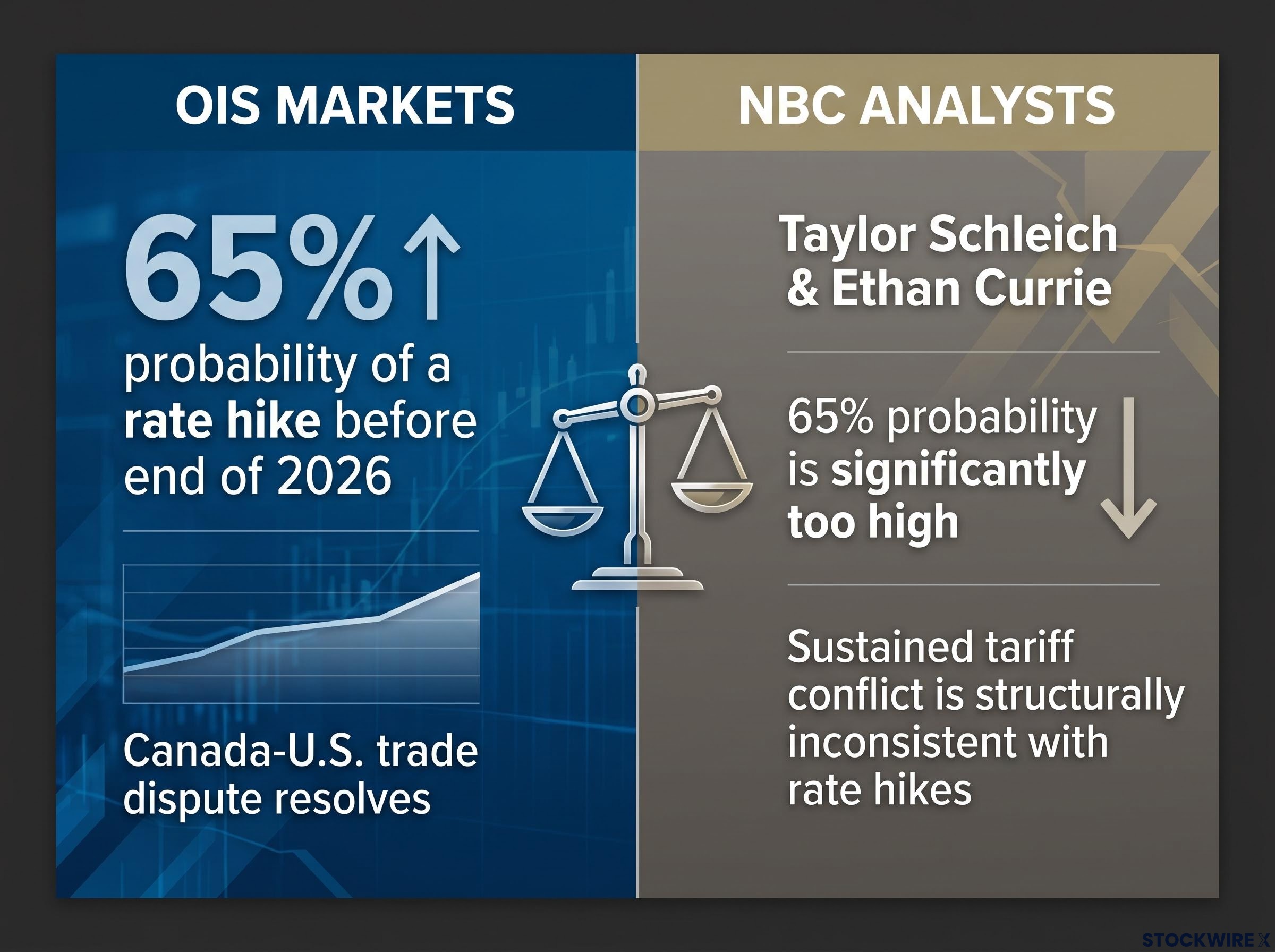
First, a sustained trade war is structurally inconsistent with rate hikes. Tariff drag weighs on growth. Business investment contracts when policy uncertainty is elevated. Export-sensitive sectors shed jobs. In that environment, a central bank does not tighten; it holds or eases. Rate hikes require a growth and inflation backdrop that a trade war actively undermines.
Second, according to NBC, the adjustment in rate pricing that has occurred as trade friction has escalated has been limited in scale relative to the severity of the disruption.
According to Schleich and Currie, late-2026 hike odds have held close to 65% even as the Canada-U.S. trade dispute has deepened, a disconnect they regard as significant given that sustained tariff conflict is fundamentally at odds with a tightening cycle.
That gap between the severity of the trade dispute and the market’s pricing response is the core of the mispricing argument.
Third, NBC is not arguing that hikes are impossible. They are arguing that the distribution of outcomes skews toward hold or cut rather than tighten, and that current pricing does not reflect that skew. Two scenario branches clarify the distinction:
- Trade dispute resolves or de-escalates: Growth stabilises, inflation pressures build, and the 65% hike probability could prove correct. Hikes become compatible with the macro backdrop.
- Trade tensions persist or worsen: Growth softens, investment contracts, and the BoC’s demonstrated preference (as shown in 2025) is to pause and then ease, not to pivot to tightening. The 65% figure overstates the probability of hikes in this scenario.
What this tells you is that the 65% figure is not just a forecast disagreement. It is a signal that professional fixed income markets are, in NBC’s view, implicitly pricing trade resolution as the most likely outcome. If your own assessment of the trade dispute’s trajectory is less optimistic than that, the market’s rate expectations may be miscalibrated relative to your view, and that gap is where investment opportunities in Canadian fixed income could emerge.
TD Securities’ read on the BoC rate outlook reinforces the same structural point: even a full tariff resolution cannot trigger a 2026 policy change because trade-related data covering export volumes, business investment, and GDP effects would not be available for BoC assessment until November at the earliest.
How trade war economics constrain the rate path
The connection between trade friction and monetary policy is not abstract. It operates through three specific channels, each of which pushes the BoC toward caution rather than tightening.
| Transmission channel | Economic effect | Policy implication |
|---|---|---|
| Tariff drag on growth and investment | Higher input costs compress margins; firms delay capital expenditure | Weaker growth removes the inflationary pressure that would justify hikes |
| Employment risk in export-sensitive sectors | Retaliatory tariffs reduce demand for Canadian exports; job losses follow | Rising unemployment shifts the BoC’s mandate focus from inflation to growth |
| Uncertainty-driven caution | Households and firms pull back spending and hiring when the policy environment is unpredictable | Central banks historically favour patience over tightening during elevated uncertainty |
Each of these channels reinforces the others. Tariff drag slows growth, which softens the labour market, which increases uncertainty, which slows growth further. The feedback loop is why NBC argues the risk balance pushes toward caution, not tightening.
Canadian core inflation adds a second constraint on the hike scenario: with CPI-trim tracking around 1.8% and CPI-median near 1.9%, both below the BoC’s 2% target and beneath the Bank’s own quarterly forecasts, the inflation data as of August 2026 does not independently justify tightening even before trade-related growth drag is factored in.
The 2025 easing pattern as a policy template
The 2025 easing cycle is not ancient history. It is a live template for how the BoC behaves when growth is threatened by external shocks, and you should treat it as the more relevant precedent for the next 12 months than any pre-trade-war tightening cycle.
The three cuts in 2025 were spaced months apart, with prolonged pauses between each move. The BoC did not commit to a rapid easing sequence. It cut, paused, assessed the data, and cut again only when conditions warranted. That pattern tells you something specific about the institution’s decision-making rhythm: it is designed for uncertainty.
If trade tensions persist or worsen from here, NBC’s view is that a similar sequence unfolds. An extended pause at 2.25%, followed by renewed cuts if the data deteriorates, rather than a pivot to hikes. The 2025 template is the roadmap.
What to read in the September 2 statement, and what it means for GoC bonds
The rate decision is settled. The statement is where the signal lives. NBC identifies four specific areas to monitor, and each functions as a binary test for whether the BoC is validating or contradicting the 65% hike probability.
| Statement signal | Dovish reading | Hawkish reading | Bond market implication |
|---|---|---|---|
| Trade-risk language | Explicit references to trade conflict as a downside risk | Minimal or generic trade references | Dovish language supports GoC bond prices as hike expectations fall |
| Forward guidance framing | Emphasis on data dependence and balanced scenarios | Language that leans toward tightening bias | Data-dependent framing undermines the case for near-term hikes |
| Balance sheet stance | No changes to quantitative policy | Hints at balance sheet tightening | Balance sheet neutrality avoids adding a hawkish signal |
| Domestic growth tone | Cautious or concerned about momentum under external headwinds | Confident about domestic resilience | Cautious growth tone reinforces the hold-or-ease thesis |
If the statement leans dovish across these four dimensions, markets may revise down the probability of late-2026 hikes. That repricing is structurally supportive for Government of Canada (GoC) bond prices, because yields fall when hike expectations are marked down.
The relative-value setup against U.S. Treasuries is where NBC sees the clearest opportunity.
NBC characterises GoC bond outperformance relative to U.S. Treasuries as a “risk-skewed opportunity” given current positioning and the anticipated repricing around the 2 September decision.
If the BoC’s tone validates the cautious thesis, GoC bonds could rally relative to Treasuries as the Canadian forward rate path gets marked down while U.S. rate expectations remain anchored to the Federal Reserve’s own trajectory.
There is a secondary Canadian dollar implication. A dovish BoC statement could, counterintuitively, support the loonie if it reduces the perceived probability of policy error. But the FX read is more complicated than the bond read, because rate differentials interact with the trade dispute itself in ways that make the currency outlook less linear. The bond trade is the cleaner expression of NBC’s thesis.
What the mispricing argument means for investors watching September 2
NBC’s argument distils to three connected claims: the 2 September decision is noise; the statement’s trade-risk framing is the signal; and the fixed income opportunity in GoC bonds relative to Treasuries is the actionable implication if that signal is dovish.
The two scenarios that bracket the outcome are straightforward:
- Scenario A: Trade tensions persist or worsen. The BoC holds at 2.25% for an extended period and eventually cuts again if data deteriorates. The 65% hike probability gets repriced lower. GoC bonds rally relative to U.S. Treasuries.
- Scenario B: The trade dispute resolves. Growth stabilises, inflation pressures rebuild, and the 65% hike probability could prove correct. The GoC bond outperformance trade does not materialise, and investors positioned for it underperform.
NBC describes itself as “cautiously hopeful” that the trade dispute can be resolved, but unwilling to treat resolution as the base case for rate pricing. That distinction matters. It means the risk to their thesis is not that hikes are impossible, but that trade conditions improve faster than they currently expect.
The question for you is not whether to believe NBC over the market. It is whether your current fixed income positioning already reflects a more optimistic trade-resolution scenario than the evidence currently supports. If it does, the 2 September statement is a time-bounded catalyst to reassess.
September 2 gives the BoC its first clean opportunity to push back against the market’s forward rate path. Whether it takes that opportunity, and how forcefully, will determine whether the 65% hike probability holds or begins to unwind.
For investors ready to translate the GoC bond thesis into a broader portfolio structure, our comprehensive walkthrough of fixed income positioning covers duration choice, blended allocation frameworks across nominal government bonds and inflation-linked instruments, and how to size rate-hold exposure across a laddered maturity structure.
This article is for informational purposes only and should not be considered financial advice. Investors should conduct their own research and consult with financial professionals before making investment decisions. Past performance does not guarantee future results. Financial projections are subject to market conditions and various risk factors.