The Case Against Thematic ETFs After 2026’s Sector Rotation
2 mins ago


The Nasdaq 100 has compounded at 22.77% per annum over the past decade. For Australian investors, a single ASX ticker provides access to that return engine for 0.48% a year in management fees. The BetaShares Nasdaq 100 ETF (ASX: NDQ), trading at A$56.11 as at 30 April 2026 and managing A$8.008 billion in Australian investor capital, remains one of the most concentrated bets available on the ASX that the world’s largest technology companies will continue to compound earnings over the next decade. What follows is an analysis of what NDQ actually delivers, what it costs in fees and currency exposure, how its top holdings position the fund for the AI era, and what Australian investors need to weigh before committing to a long-term hold.
A fund does not reach A$8 billion in assets under management on retail enthusiasm alone. NDQ’s scale signals institutional-grade adoption by Australian investors who have assessed the vehicle’s liquidity, tracking accuracy, and cost structure and committed capital accordingly.
The Australian investor shift toward international equities has accelerated in 2026, with international ETFs overtaking domestic funds as the most purchased category on major platforms, a structural change across every generational cohort that reflects growing recognition of the ASX’s limited exposure to technology and AI-driven growth.
The structural anchor of the investment case is the underlying index. The Nasdaq 100 has delivered 22.77% per annum over the decade to 31 March 2026, a compounding rate that has survived multiple corrections, rate-hiking cycles, and geopolitical disruptions.
10-year Nasdaq 100 index return: 22.77% p.a. (to 31 March 2026). NDQ provides ASX-listed access to this compounding profile for a management expense ratio of 0.48% per annum.
NDQ’s 0.48% MER is the friction cost of that access. Against a 22.77% annual return, the fee consumes roughly two basis points for every dollar of performance, a ratio that favours the long-term holder. Key fund facts for current reference:
The fund sits 4.42% below its October 2025 high, having recovered substantially from its 52-week low. That range itself tells a story about the volatility investors must accept.
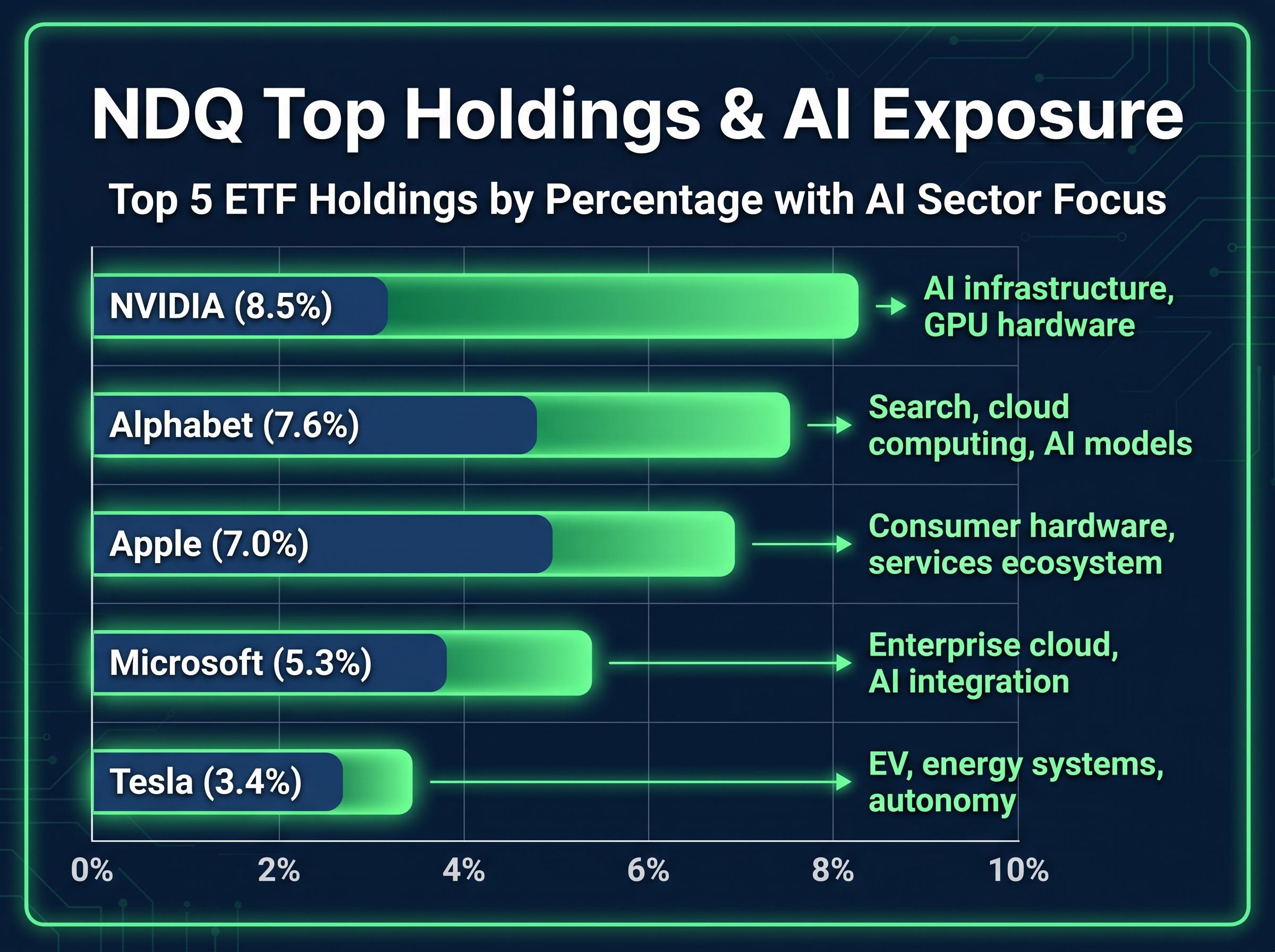
NDQ’s top holdings are not a random sample of technology companies. Each position represents a specific claim about which businesses will dominate the next phase of the digital economy, and together they form a thesis about structural growth across multiple layers of the technology stack.
| Company | Approximate Weighting (%) | Primary Sector Exposure |
|---|---|---|
| NVIDIA | 8.5% | AI infrastructure, GPU hardware |
| Alphabet (Class A + C) | 7.6% | Search, cloud computing, AI models |
| Apple | 7.0% | Consumer hardware, services ecosystem |
| Microsoft | 5.3% | Enterprise cloud, AI integration |
| Tesla | 3.4% | EV, energy systems, autonomy |
This concentration is not a fund manager’s active choice. It reflects index construction rules that weight toward the largest, most liquid names on the Nasdaq exchange. These five companies are among the most cash-generative large-cap businesses on the planet, and their dominance within the index is a structural feature of how the Nasdaq 100 is built.
What connects these holdings is exposure to different layers of the artificial intelligence economy. NVIDIA supplies the chips that train and run large-scale AI models. Alphabet and Microsoft deploy those models at enterprise scale through cloud infrastructure and productivity software. Apple is positioned as the consumer interface layer, integrating AI capabilities into devices carried by over a billion users.
Tesla’s inclusion adds the autonomous systems and energy layer. Its positioning within the index reflects a bet on AI-driven transportation and energy management rather than vehicle manufacturing alone.
The result is that NDQ’s AI exposure is diversified across the stack, from silicon to software to consumer deployment, rather than concentrated at any single layer.
The Nasdaq 100 is not a static list. It operates through a three-stage governance cycle that functions as a self-correcting quality filter, systematically rotating the index toward winners and removing companies that no longer qualify.
This mechanism means the index is structurally biased toward compounding winners. Companies that grow claim a larger share of the index; companies that shrink are eventually removed. For long-term holders, this reconstitution cycle distinguishes NDQ from a static portfolio of individual stock picks that require active management.
The Nasdaq-100 index methodology published by Nasdaq Global Indexes specifies the exact eligibility criteria, weighting caps, and reconstitution schedule that govern how the index evolves over time, confirming that the self-correcting quality filter described above operates according to a rules-based framework rather than discretionary judgment.
NDQ 1-year return (after fees): 12.15% (to 31 March 2026). 6-month return: -6.88%. The divergence between these two figures illustrates why index construction rules matter: short-term drawdowns occur within a longer-term framework that has consistently recovered and compounded.
The -6.88% six-month figure reflects a correction period in late 2025 and early 2026 that tested investor conviction. The 12.15% one-year return shows the fund delivering its mandate net of fees across a full annual cycle that included that same drawdown.
NDQ’s return profile comes with three distinct risk layers that investors must assess before committing capital:
Mega-cap concentration in US index products has reached levels that surpass the 1930s historical peak, with five stocks controlling approximately 23% of the broad US market index and accounting for more than 70% of Q1 2026 losses, a dynamic that amplifies both drawdowns and recoveries in ways that NDQ investors experience in concentrated form given the fund’s top-five weighting.
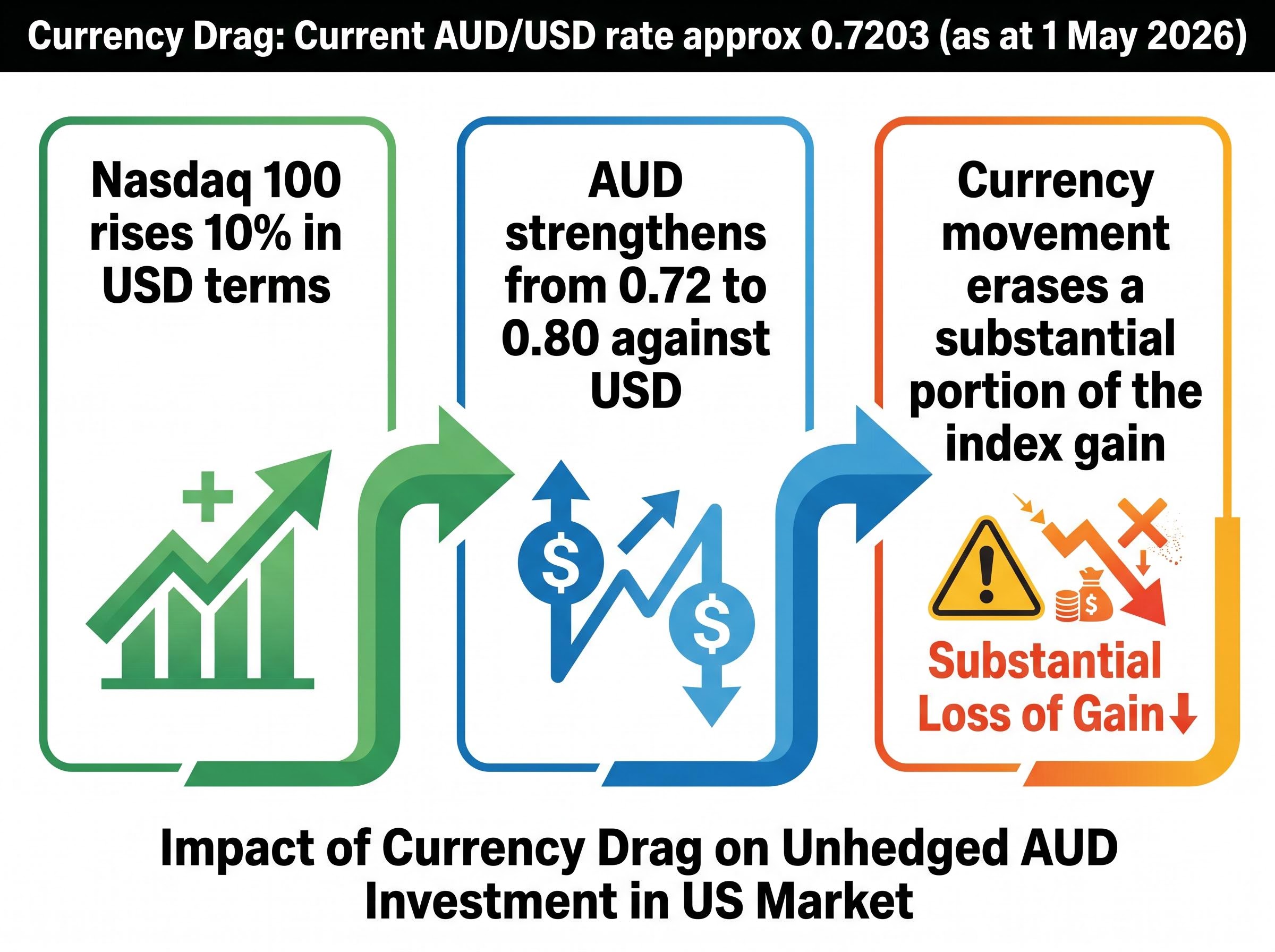
The AUD/USD rate sat at approximately 0.7203 as at 1 May 2026. Because NDQ is unhedged, this exchange rate directly affects the return Australian investors receive.
Consider a simplified example: if the Nasdaq 100 rises 10% in USD terms but the AUD strengthens from 0.72 to 0.80 against the USD, the currency movement erases a substantial portion of the index gain when converted back to Australian dollars. At the current rate, further AUD appreciation would act as a headwind for unhedged holders.
Hedged alternatives exist in the market for investors who wish to neutralise currency risk, though these products carry their own cost structures and tracking considerations. The choice between hedged and unhedged exposure is itself an active investment decision.
NDQ pays semi-annual distributions with a 12-month trailing yield of 1.0% (to 31 March 2026). The yield reflects the fund’s technology-heavy composition, where constituent companies tend to prioritise reinvestment over dividend payments.
The Distribution Reinvestment Plan (DRP) allows unitholders to reinvest distributions into additional NDQ units without incurring brokerage costs, a mechanism that supports long-term compounding by eliminating transaction friction on reinvested income.
CGT advantage for long-term holders: Individual Australian investors who hold NDQ units for more than 12 months may be eligible for the 50% capital gains tax discount, materially improving after-tax returns on a long-term position.
The CGT discount mechanics for ASX ETF holders are more nuanced than the 50% headline figure suggests, with outcomes varying materially depending on whether the investor holds through a personal account, a family trust, or an SMSF in accumulation versus pension phase, each of which applies a different effective tax rate to the same capital gain.
Accessing NDQ is straightforward:
Recent trading volume of approximately 246,198 units confirms the fund’s liquidity on the ASX, supporting efficient entry and exit for investors of varying position sizes.
The ATO CGT discount rules set out the specific eligibility conditions Australian individual investors must satisfy to access the 50% reduction, including the 12-month minimum holding period and the requirement that the asset be acquired after 19 September 1999, conditions that ETF unitholders holding NDQ in their own name can generally meet.
The 22.77% per annum Nasdaq 100 return over the decade to 31 March 2026 is not a projection. It is a realised outcome that includes the COVID drawdown, the 2022 rate-hiking correction, and the 2025-2026 softness reflected in NDQ’s 52-week range.
An investor who held through every one of those drawdowns captured the full compounding effect. An investor who exited during any of them did not. That is the trade-off NDQ demands.
The fund’s construction supports patient capital. At 0.48% per annum, the MER imposes minimal friction over a decade. The quarterly rebalancing and annual reconstitution cycle means the portfolio self-corrects without requiring active management decisions. The A$8 billion in FUM provides deep liquidity for investors who need to adjust position sizes over time.
NDQ suits investors who meet three conditions:
The 1-year return of 12.15% after fees demonstrates that the fund delivers its mandate net of costs. The current price of A$56.11 sits within a 52-week range that illustrates exactly the volatility envelope investors must be prepared to accept.
NDQ’s combination of scale (A$8.008 billion FUM), low cost (0.48% MER), and structural exposure to the companies that dominate global technology makes it one of the most compelling single-ticket options for Australian investors seeking long-term technology allocation.
The fund is not for all investors. Volatility, currency drag, and sector concentration mean NDQ suits patient, risk-tolerant capital deployed with a genuine long horizon. Periods of negative returns lasting several months are a structural feature, not an anomaly to be avoided.
The forward case rests on the same structural forces that have driven the index over the past decade: the continued buildout of AI infrastructure, the expansion of cloud computing, and the deepening integration of digital systems into the global economy. These themes are embedded in the index’s largest constituents and reinforced by the reconstitution mechanism that rotates the portfolio toward winners.
AI-driven software repricing has destroyed an estimated $2 trillion in market value among legacy per-user licensing businesses in early 2026, a structural shift that affects how investors should interpret the software and cloud positions within NDQ given that Microsoft and Alphabet derive meaningful revenue from enterprise software models now facing algorithmic displacement pressure.
This article is for informational purposes only and should not be considered financial advice. Investors should conduct their own research and consult with financial professionals before making investment decisions. Past performance does not guarantee future results.
The BetaShares Nasdaq 100 ETF (ASX: NDQ) is an ASX-listed fund that tracks the Nasdaq 100 index, giving Australian investors exposure to the 100 largest non-financial companies on the Nasdaq exchange, including NVIDIA, Apple, Alphabet, and Microsoft, for a management expense ratio of 0.48% per annum.
The underlying Nasdaq 100 index has compounded at 22.77% per annum over the decade to 31 March 2026, while NDQ's 1-year after-fee return to the same date was 12.15%, reflecting a period that included a significant short-term drawdown of 6.88% over six months.
Yes, because NDQ is unhedged, all returns are exposed to AUD/USD movements; if the Australian dollar strengthens against the US dollar, it reduces the AUD-denominated return even when the underlying Nasdaq 100 index rises in USD terms.
Australian individual investors who hold NDQ units for more than 12 months may be eligible for the 50% capital gains tax discount, though the effective tax rate varies depending on whether the investment is held through a personal account, family trust, or SMSF.
NDQ is best suited to investors with a genuine 10-year investment horizon, high tolerance for volatility including peak-to-trough swings of around 30%, and an awareness of currency risk from unhedged USD exposure.