How Hormuz Closure at $104 Oil Is Reshaping Every Asset Class
5 hrs ago


XTL, a $218 million pure-play telecom fund that most investors have never encountered, has outperformed every peer in the telecom and connectivity ETF universe across every measured timeframe. That includes XLC, the category’s dominant name with $26 billion in assets, and SIXG, the rebranded next-generation connectivity fund that returned 100.3% over the past year. With Big Tech firms committing an estimated $650 billion to AI infrastructure in 2026 alone, the best telecom ETFs have shifted from niche thematic products to serious portfolio considerations. The performance divergence across the category, however, is now too wide to ignore.
This analysis ranks 12 telecom and connectivity ETFs by three-year and five-year annualised returns using LSEG data, examines what each fund actually holds, and maps the cost-return trade-offs that separate the top performers from the rest. The goal: a clear, data-backed view of which funds have delivered and which investor profiles each one serves.
The AI trade is not only a semiconductor story. Every large language model inference, every real-time AI application, and every hyperscaler training run depends on high-speed data transmission, fibre networks, and next-generation wireless infrastructure. The connectivity layer sits directly beneath the compute layer, and in 2026, capital is flowing into both.
According to Bridgewater Associates estimates cited by Reuters, Big Tech companies are on course to spend roughly $650 billion on AI in 2026. That figure represents the demand signal pulling institutional attention toward telecom beneficiaries: the equipment makers, tower operators, satellite companies, and network service providers whose revenue scales with data transmission volume.
The scale of that commitment, however, does not guarantee the pace of deployment: physical bottlenecks constraining AI infrastructure delivery, from HBM3e memory shortages to US grid interconnection queues exceeding 2,100 GW, are pushing a significant share of planned 2026 capacity into 2028 and beyond.
Defiance ETFs CIO Sylvia Jablonski noted that demand for AI, energy, and infrastructure significantly exceeds available supply.
The returns reflect the thesis. SIXG gained 29.4% year-to-date through late April, outpacing Nvidia’s 11.7% YTD return over the same period. Investors anchored to semiconductor names as the sole AI play have been missing the infrastructure layer where returns have been comparably strong.
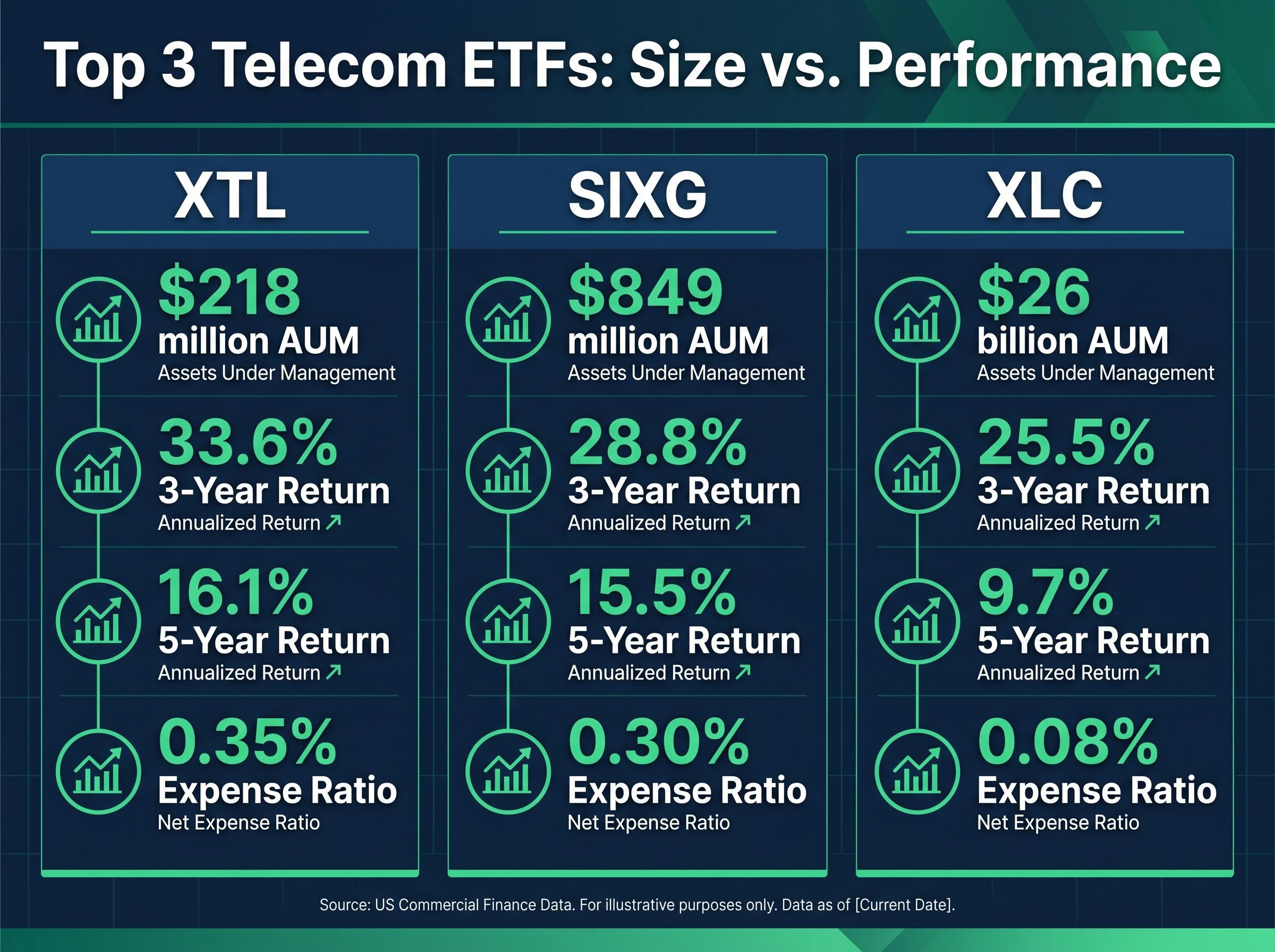
XTL delivered a 33.6% annualised three-year return, the highest in the 12-fund peer group.
The table below ranks all 12 telecom and connectivity ETFs by three-year annualised return, with five-year return and expense ratio alongside each fund. Returns are calculated through the most recent month-end prior to 27 April 2026; the peer group is limited to ETFs with a minimum three-year track record.
| Ticker | Fund Name | 3-Year Ann. Return | 5-Year Ann. Return | Expense Ratio |
|---|---|---|---|---|
| XTL | SPDR S&P Telecom ETF | 33.6% | 16.1% | 0.35% |
| SIXG | Defiance Next Gen Connectivity ETF | 28.8% | 15.5% | 0.30% |
| XLC | Communication Services Select Sector SPDR | 25.5% | 9.7% | 0.08% |
| FCOM | Fidelity MSCI Communication Services ETF | 24.2% | 7.7% | 0.08% |
| IXP | iShares Global Comm Services ETF | 23.8% | 9.4% | 0.40% |
| IYZ | iShares U.S. Telecommunications ETF | 21.9% | 6.3% | 0.38% |
| FDCF | Fidelity Disruptive Communications ETF | 21.8% | 7.1% | 0.50% |
| NXTG | First Trust Indxx NextG ETF | 19.3% | 11.1% | 0.70% |
| BNGE | First Trust S-Network Streaming & Gaming ETF | 13.7% | N/A | 0.70% |
| RSPC | Invesco S&P 500 Equal Weight Comm Svcs ETF | 12.3% | 1.4% | 0.40% |
| IDGT | iShares U.S. Digital Infrastructure & RE ETF | 12.3% | 8.7% | 0.39% |
| HERO | Global X Video Games & Esports ETF | 9.2% | -3.1% | 0.50% |
Three findings stand out. First, XTL leads across both timeframes, a 33.6% three-year return paired with a 16.1% five-year return that no peer matches. Second, SIXG holds the second position on three-year performance and nearly matches XTL over five years, making it the closest competitor in the group.
Third, and perhaps most telling: XLC, the largest fund by assets at $26 billion, ranks third on three-year returns at 25.5% but drops sharply to 9.7% over five years. Fund size and past dominance have not guaranteed return consistency. Investors who defaulted to the biggest name in the category missed the top two performers by a wide margin.
The performance gap between XTL and XLC is not a matter of manager skill. It is a mandate difference.
XTL tracks the S&P Telecom Select Industry Index, a narrow pure-play U.S. telecom benchmark focused on equipment makers and service providers. That concentration means every dollar in the fund is exposed directly to telecom revenue. XLC, by contrast, tracks the S&P Communication Services Select Sector Index, a broad mandate that includes Meta and Alphabet alongside traditional telecom names. The mega-cap tech weighting dilutes telecom exposure and likely explains why XLC’s five-year return of 9.7% lags its three-year figure, as those large-cap names have underperformed narrower telecom in recent years.
XTL’s narrow focus amplified sector tailwinds. XLC’s breadth smoothed them out. The rankings are a direct reflection of what each fund owns.
Verizon’s subscriber growth reversal in Q1 2026, its first positive first-quarter postpaid result in 13 years, illustrates the kind of underlying operational improvement that can flow through to sector ETFs like IYZ and XTL when the largest US telecom operators demonstrate durable revenue momentum rather than short-term promotional gains.
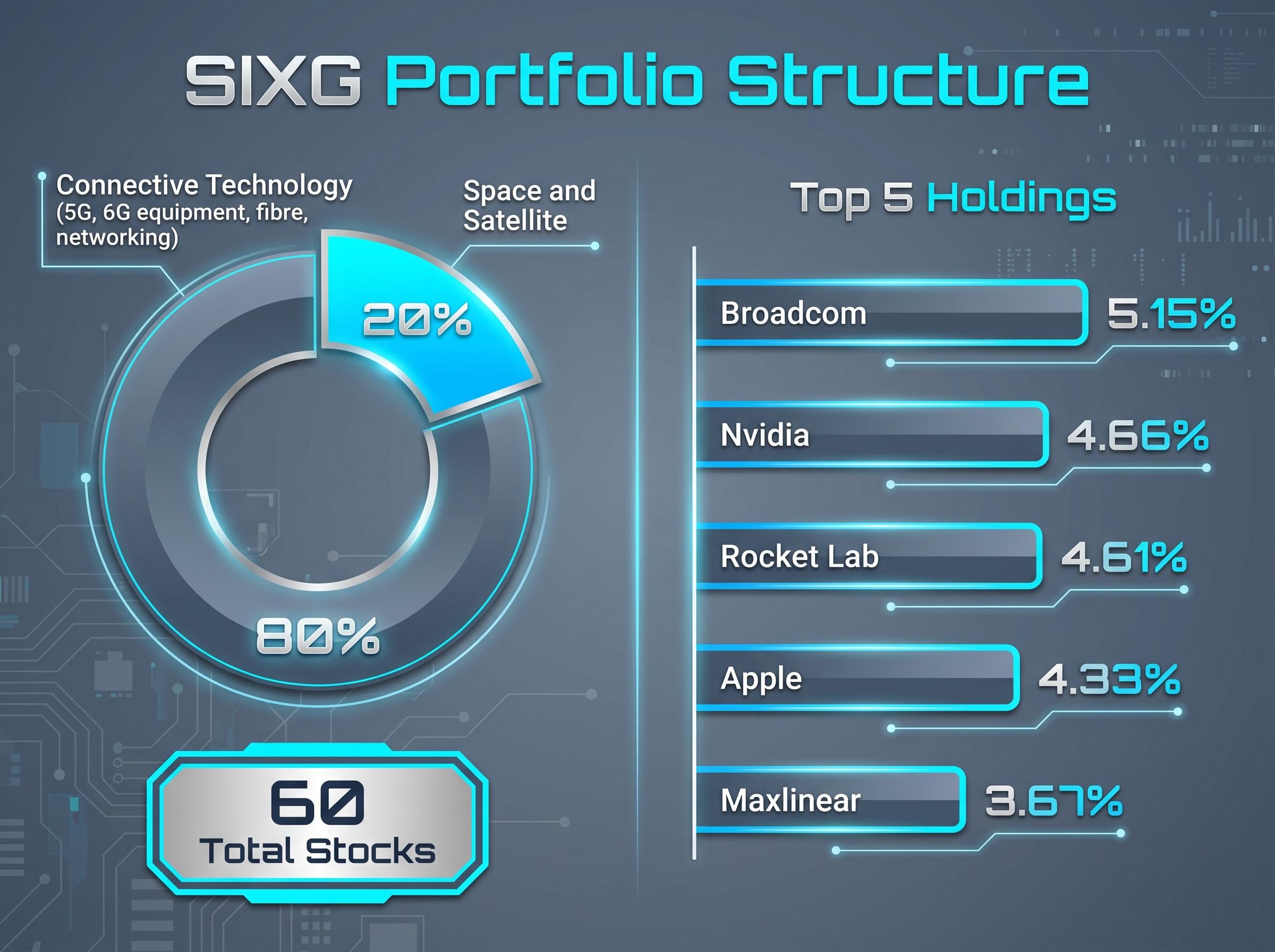
SIXG takes a different structural approach. The fund allocates approximately 80% to connective technology companies (5G and 6G equipment, fibre, and networking) and 20% to space and satellite names. It holds 60 stocks, rebalanced in March and September each year.
Position caps enforce diversification discipline: individual holdings are capped at 5%, while REITs and mobile network operators face tighter 1.5% caps. The current top five holdings illustrate the fund’s reach across the connectivity chain:
That mix places semiconductor, satellite launch, and consumer hardware names in one portfolio. SIXG’s weighted forward P/E of 24 (versus the S&P 500 at 20.8) reflects the growth orientation embedded in the mandate.
NXTG is worth noting separately. Despite the highest expense ratio in the group at 0.70%, its 10-year annualised return of 13.3% suggests the global next-generation connectivity mandate has sustained long-run performance, even at a cost premium.
Expense ratios across this 12-fund peer group range from 0.08% (XLC and FCOM) to 0.70% (NXTG and BNGE). The intuitive expectation, that the cheapest funds would cluster at the top of the return rankings, does not hold.
An expense ratio is the annual fee a fund charges as a percentage of assets under management. At 0.30%, SIXG costs approximately $30 per year on a $10,000 investment. That fee is deducted from fund returns automatically; investors never write a separate cheque.
The SEC guidance on ETF expense ratios and fee disclosures establishes that all fund fees must be reflected in the daily net asset value, meaning the stated expense ratio represents the full annualised drag on returns before any trading costs are added.
The cost-return relationship becomes clearer when mapped directly.
| Ticker | Expense Ratio | 3-Year Ann. Return | Cost Tier |
|---|---|---|---|
| XTL | 0.35% | 33.6% | Mid |
| SIXG | 0.30% | 28.8% | Mid |
| XLC | 0.08% | 25.5% | Low |
| FCOM | 0.08% | 24.2% | Low |
| NXTG | 0.70% | 19.3% | High |
| HERO | 0.50% | 9.2% | High |
The two lowest-cost funds (XLC and FCOM) sit in third and fourth place. The two top performers (XTL and SIXG) charge mid-tier fees. HERO delivers the clearest cautionary case: a 0.50% expense ratio paired with a five-year annualised return of -3.1%, meaning investors paid a premium for losses.
SIXG arguably offers the strongest risk-return-cost profile in the group. Its second-place three-year return arrives at a below-median fee, making cost a minor drag rather than a material headwind.
The data narrows the field, but the right fund depends on the investor’s objective. Three profiles map to three distinct choices:
Liquidity merits attention. XTL’s $218 million AUM makes it a smaller fund where bid-ask spreads and daily volume should be checked before large purchases. SIXG at $849 million sits in a more comfortable range. XLC’s $26 billion in assets makes execution straightforward at virtually any position size.
SIXG launched in March 2019 as FIVG, a pure 5G exposure vehicle. In July 2024, Defiance ETFs rebranded the fund to SIXG, formally broadening the mandate to encompass 6G and satellite communications. The space and satellite 20% allocation is now a structural feature of the portfolio, not an incidental position.
Investors who bought the fund for 5G exposure should recognise that the mandate has evolved. The connectivity thesis is wider now; the fund’s return profile going forward will reflect that expanded scope.
Strong recent returns carry their own risks. Three specific concerns deserve attention before position sizing:
AI capex ROI sustainability is a live debate among institutional investors: Vanguard has flagged material US equity downside risk if hyperscaler spending fails to deliver proportionate returns, and a KPMG survey found 75% of large-company CEOs believe generative AI has been overhyped even as they continue allocating capital to it.
SIXG’s forward P/E of 24 versus the S&P 500’s 20.8 reflects a premium that leaves less room for earnings disappointment.
HERO serves as a cautionary precedent for thematic ETF risk. A five-year annualised return of -3.1% at a 0.50% expense ratio illustrates what happens when the underlying theme underdelivers. XTL’s 165% gain from its 52-week low to its 52-week high signals momentum, but momentum works in both directions.
Past performance does not guarantee future results. The conditions that drove these returns, an AI capex surge, 5G buildout acceleration, and satellite expansion, are not guaranteed to persist at the same pace.
XTL’s leadership across every measured timeframe is the headline finding, but SIXG’s combination of second-place performance, a competitive 0.30% expense ratio, and a forward-looking mandate covering 5G through 6G and satellite positions it as the fund with the broadest strategic case for investors focused on AI-era connectivity infrastructure. XLC and FCOM serve investors who want communication services exposure at minimum cost but are willing to accept diluted telecom returns.
The 12-ETF comparison reveals that neither the largest fund nor the cheapest fund has delivered the strongest returns. The funds with the most tightly defined mandates, XTL and SIXG, have outperformed their broader, lower-cost peers over three and five years. Thematic specificity has carried genuine return value in this category.
Investors should verify current holdings, expense ratios, and AUM directly with fund providers before acting on this analysis, as portfolio compositions shift at each semi-annual rebalancing. All return data is sourced from LSEG and calculated through the most recent month-end prior to 27 April 2026.
This article is for informational purposes only and should not be considered financial advice. Investors should conduct their own research and consult with financial professionals before making investment decisions.
A telecom ETF tracks companies focused on telecommunications equipment and services, while a communication services ETF typically includes a broader range of companies such as social media and entertainment giants like Meta and Alphabet alongside traditional telecom names, diluting pure telecom exposure.
XTL, the SPDR S&P Telecom ETF, delivered the highest three-year annualised return in the peer group at 33.6%, outperforming all 11 other telecom and connectivity ETFs including SIXG at 28.8% and XLC at 25.5%.
XTL offers concentrated pure-play US telecom exposure that has benefited from AI infrastructure spending on fibre, networks, and equipment, but its $218 million AUM means investors should check bid-ask spreads and daily volume before making large purchases.
SIXG allocates approximately 80% to connective technology companies covering 5G, 6G, fibre, and networking, and 20% to space and satellite names, with top holdings including Broadcom, Nvidia, Rocket Lab, Apple, and Maxlinear across a 60-stock portfolio.
Not in this category: the two cheapest funds, XLC and FCOM at 0.08% each, ranked third and fourth on three-year returns, while the top two performers, XTL at 0.35% and SIXG at 0.30%, both charge mid-tier fees, showing that mandate focus mattered more than cost in driving returns.