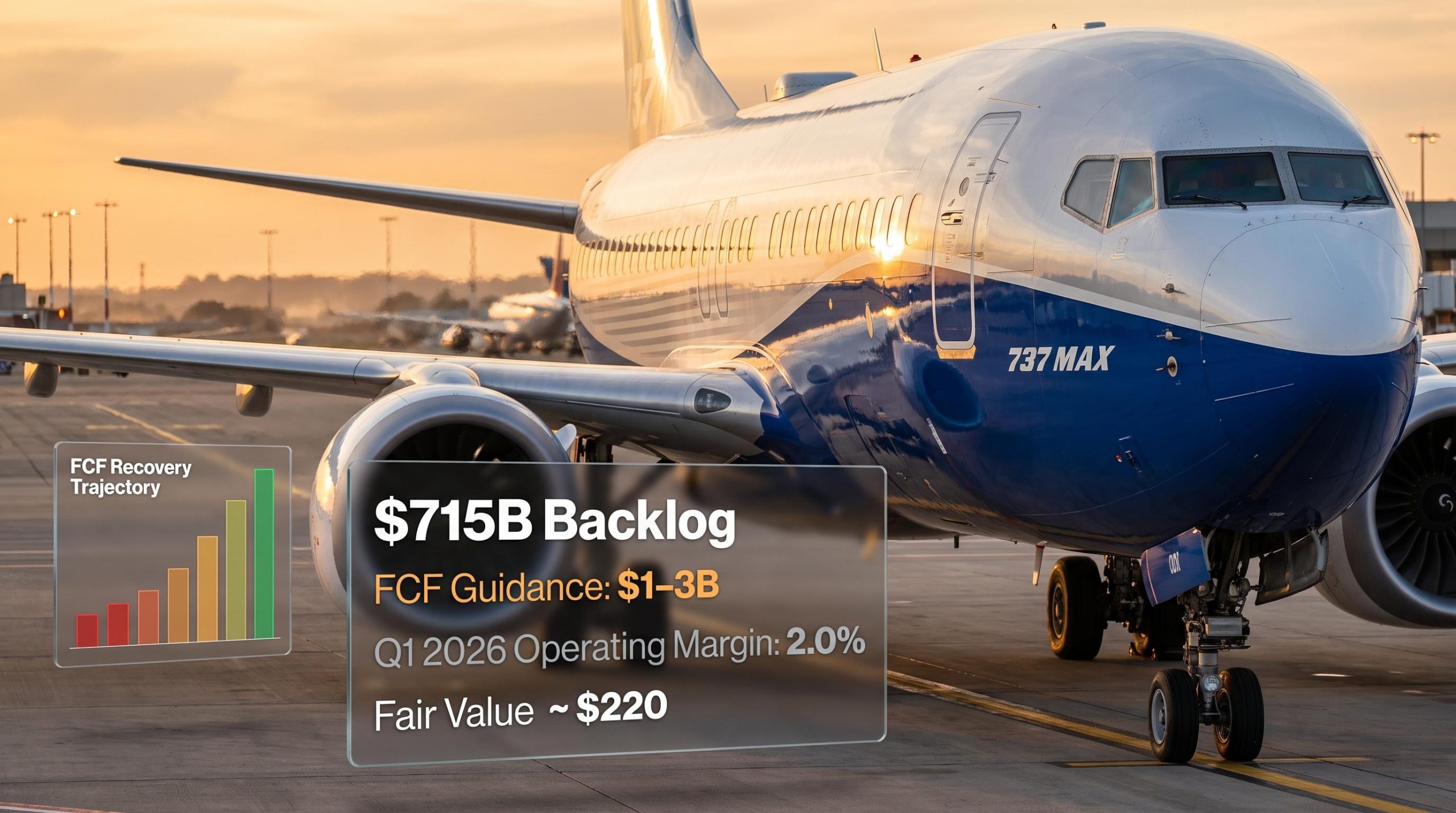
Boeing is sitting on a $715 billion backlog, delivered more aircraft in 2025 than in any year since 2018, and just posted its first positive operating quarter in years. Across one, three, and five-year timeframes, the share price has produced returns that are close to flat.
The question finance-educated investors are asking is not whether Boeing is recovering. It is whether the recovery is already priced in. This Boeing stock analysis walks through the company’s key financial recovery metrics as of mid-2026, isolates the distortions created by the $10.5 billion Digital Aviation Solutions divestiture, and applies a conservative discounted cash flow (DCF) framework to arrive at an estimate of intrinsic value. The answer that emerges is uncomfortable for anyone looking for a clear buy signal: current prices may reflect fair value, not a discount to it.
Here is the framework for determining at what price Boeing becomes a genuinely compelling long-term opportunity, rather than merely an interesting one. The distinction matters considerably when the turnaround is still fragile.
The demand story is real, but it is the wrong story to anchor your thesis on
Start with the numbers that make the bull case feel obvious:
- Total company backlog reached $695 billion in Q1 2026, growing to $715 billion in Q2 2026
- The order book holds more than 6,200 commercial aircraft pending delivery, a figure that exceeds the previous 2018 high
- Boeing delivered 600 commercial aircraft in 2025, the highest annual total since 2018
- The expanding backlog is a consequence of Boeing’s intentional output restraint, not a lack of customer interest
That is a genuine demand floor. No one is cancelling orders. Airlines need the aircraft. The pipeline is recovering, not merely accumulating.
Boeing’s Commercial Market Outlook projects demand for nearly 44,000 new aircraft by 2045, a structural tailwind that explains why order cancellations remain rare even as delivery schedules slip, and why the backlog figure, while not a proxy for execution capability, represents a genuine long-duration revenue floor.
But here is where the analytical redirect matters. The backlog number is reassuring, yet it does not reduce your execution risk by a single dollar. What it tells you is that if Boeing can solve its production problems, the revenue will be there waiting. If it cannot, that $715 billion figure is an impressive queue of promises the company is unable to fulfil on schedule.
The investment risk lives entirely on the supply and production side: rate ramps, quality control, regulatory approval for higher output, and supply-chain reliability. Every section that follows is about whether the execution side of the equation justifies paying current prices.
When big ASX news breaks, our subscribers know first
Reading Boeing’s 2026 income statement without the distortions
The top line is moving in the right direction. Q1 2026 revenue came in at $22.2 billion, up 14% year-over-year. Full-year 2025 revenue reached $89.5 billion on the back of those 600 deliveries. Revenue is trending back toward the 2018 peak of $101.1 billion, though that high-water mark has not yet been reclaimed, and replicating that figure under today’s tighter safety regime will be harder than it was the first time.
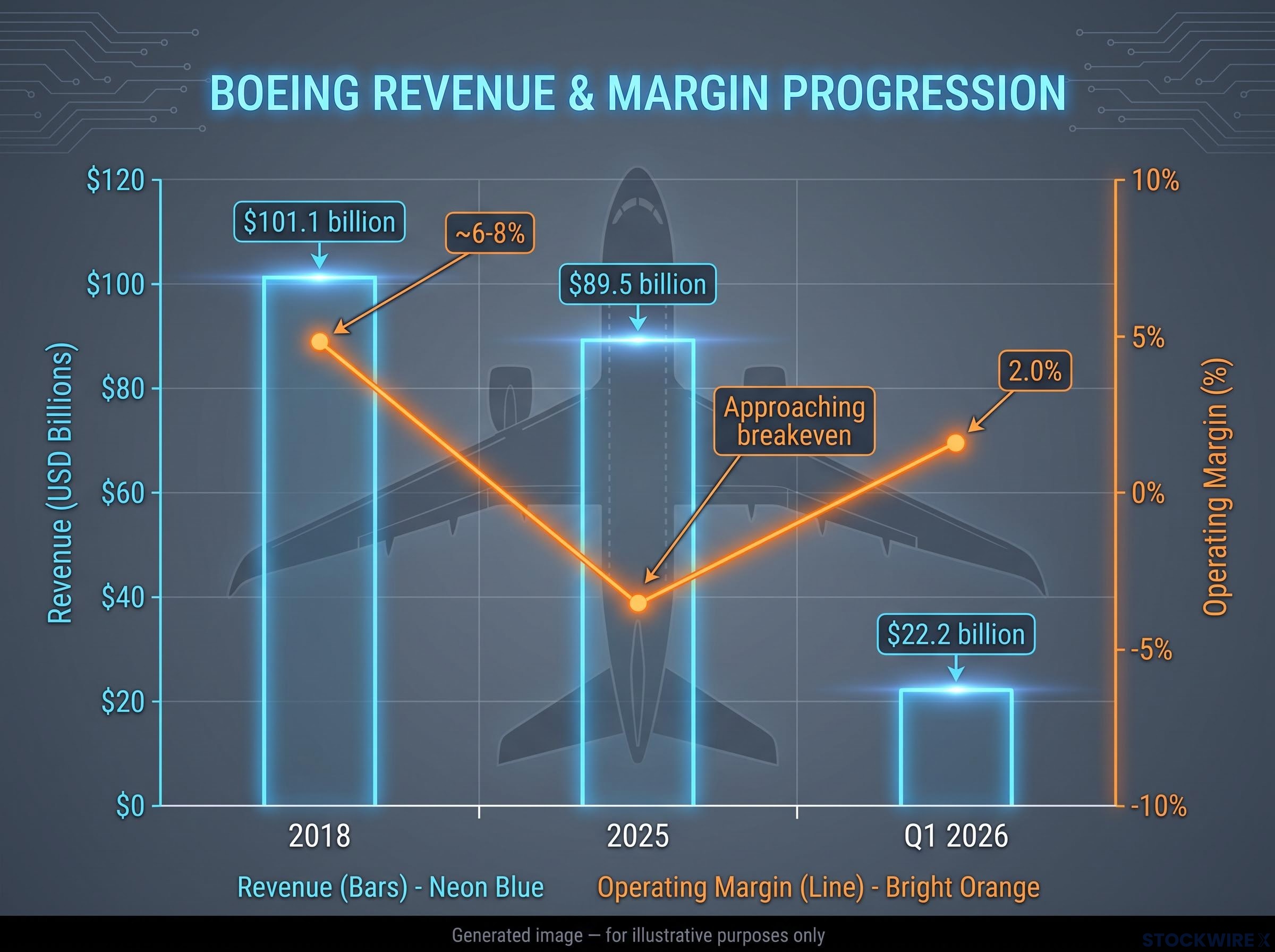
| Period | Revenue | Operating Margin |
|---|---|---|
| 2018 (pre-crisis peak) | $101.1 billion | ~6-8% (normalised) |
| 2022-2023 (loss trough) | Recovering | Negative |
| 2025 (full year) | $89.5 billion | Approaching breakeven |
| Q1 2026 | $22.2 billion | 2.0% |
Now the twist. In Q4 2025, Boeing completed the sale of its Digital Aviation Solutions business, generating proceeds of around $10.5 billion and booking a gain of approximately $9.5 billion that passed through the income statement. Anyone scanning headline net income for 2025 without stripping out this one-time item would materially overestimate where Boeing actually stands on underlying profitability.
The $9.5 billion divestiture gain sits within investing cash flows rather than operating cash flows, meaning it has no bearing on operating cash generation. When assessing Boeing’s true earning capacity, this item should be excluded entirely.
The number that matters is Q1 2026 operating income: $448 million, producing a 2.0% operating margin. That is genuinely significant as a directional signal, the first sustained positive inflection after years of losses. But at a fraction of the 6-8% long-run normalised target, it tells you the income statement is still several years from reflecting the company that the backlog implies.
Why free cash flow is the metric that matters most here, and what it currently shows
Free cash flow, the actual cash a company generates after accounting for capital expenditures, is the right valuation anchor for Boeing at this stage. Net income is distorted by one-time charges, divestiture gains, and defence programme write-downs. FCF cuts through all of that and tells you how much real cash the business is producing.
Right now, the FCF picture is improving but fragile. Q1 2026 FCF was negative $1.5 billion (non-GAAP). Full-year 2025 FCF remained negative but showed substantial improvement versus prior years. Management’s guidance for full-year 2026 is $1-3 billion positive, with the second half more heavily weighted as deliveries ramp.
TD Cowen has framed the bull case around “enhanced execution, increasing production rates, and a multi-year free cash flow growth trajectory.” That is the right lens. But guidance for $1-3 billion of FCF in 2026 sounds like progress, and it is, until you measure it against the balance sheet. Boeing carries approximately $47.2 billion in total debt. Against that load, and a market capitalisation in the $160-170 billion range, the FCF recovery has very little margin for error.
Three specific risks could push FCF toward the low end of guidance or below:
- Regulatory action from the Federal Aviation Administration (FAA) slowing or blocking production rate increases
- Quality control failures triggering new delivery pauses or customer compensation
- Supply-chain disruptions delaying the second-half delivery ramp that the guidance depends on
Each of these has materialised at least once in the past six years. Assuming none of them recur is not a conservative assumption.
The dilution most investors overlook, and why it matters for per-share recovery
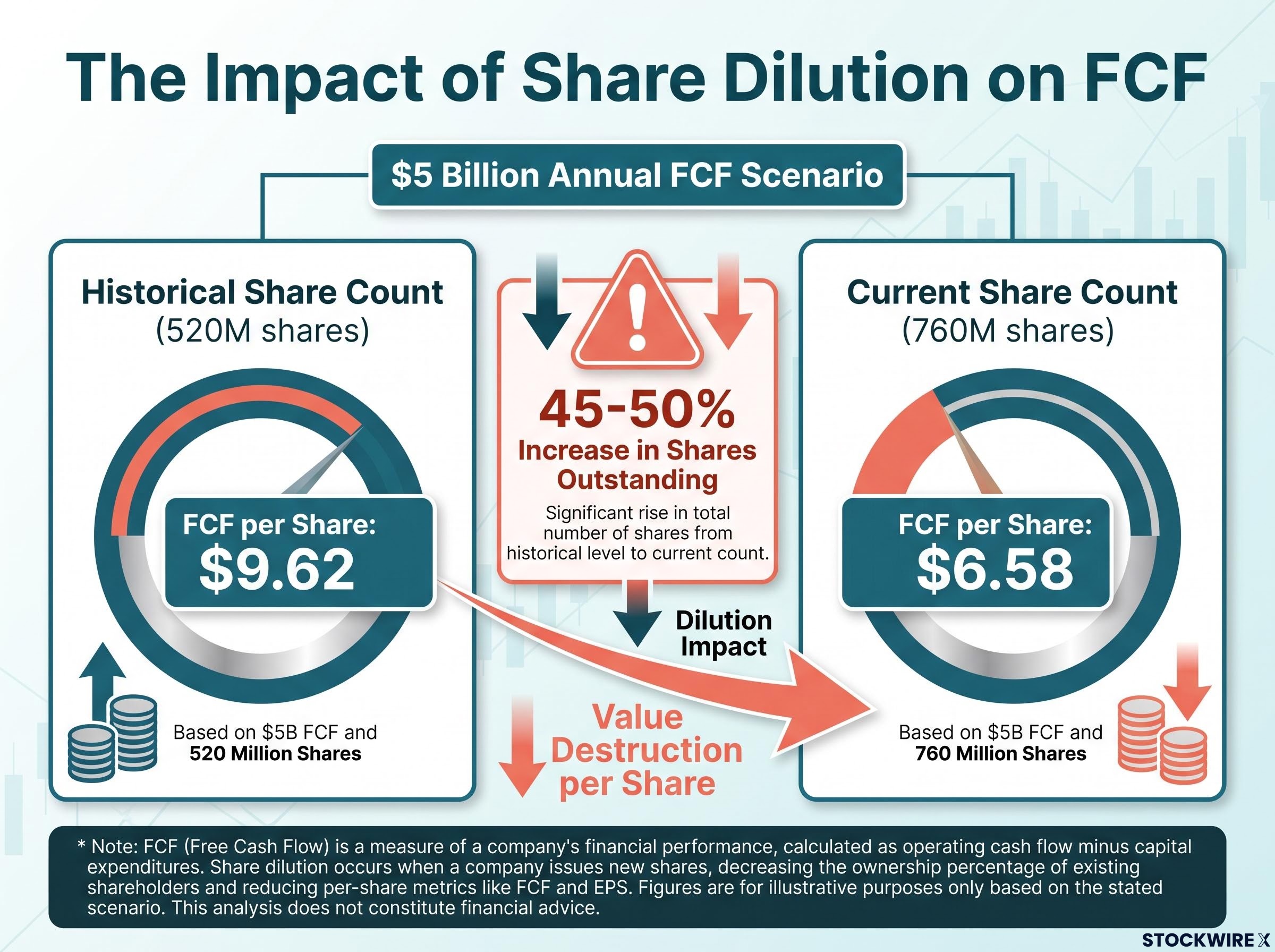
Prior to 2019, Boeing had been on a consistent path of share count reduction via buybacks, the kind of gradual capital return activity typical of a large, mature industrial company. The crisis years reversed that trend entirely. Capital raises during the 2019-2025 period pushed the weighted-average share count from approximately 500-550 million to roughly 760 million shares outstanding today.
That 45-50% increase in shares outstanding is a structural headwind that most casual Boeing coverage buries in the footnotes. It means that even a full recovery to 2018 absolute FCF levels would produce a per-share figure substantially below what 2018 shareholders experienced.
Share dilution mechanics operate differently depending on whether new shares enter through secondary offerings, convertible instruments, or private placements, and each route carries different regulatory thresholds and shareholder approval requirements that determine how much warning investors receive before the per-share FCF impact materialises.
A concrete example makes the impact visible:
| Annual FCF | FCF per Share (760M shares) | FCF per Share (520M shares) |
|---|---|---|
| $2 billion | $2.63 | $3.85 |
| $5 billion | $6.58 | $9.62 |
| $10 billion | $13.16 | $19.23 |
At every FCF level, the per-share figure is roughly 30-45% lower with the current share count. Any investor benchmarking Boeing’s upside against its pre-crisis peak needs to adjust for this explicitly. Combined with the $47.2 billion debt load, the dilution creates a compounding per-share burden that does not appear in most headline recovery narratives.
What a conservative DCF actually says about Boeing’s intrinsic value
A DCF model values a company by estimating its future cash flows and discounting them back to today’s dollars. The inputs determine everything, so transparency matters more than precision. Here are the assumptions behind a conservative framework:
The terminal value assumption alone typically drives 60-80% of a DCF model’s total implied value, which is precisely why DCF model inputs deserve more scrutiny than the headline intrinsic value figure they produce; a 1-2 percentage point change in the terminal growth rate can shift Boeing’s implied fair value by $30-50 per share.
- Starting FCF: approximately $2 billion (midpoint of 2026 guidance)
- Early-stage growth: roughly 15% per year across the first three to four years, building off a depressed starting point as delivery volumes increase
- Growth tapering: stepping down each year across a 10-year projection period until reaching a long-run terminal rate of 2-2.5%
- Long-run operating margin: 6-8%, reflecting the level Boeing consistently achieved before the quality and safety failures of the crisis era
- Weighted average cost of capital (WACC): 8-9%, reflecting high leverage, regulatory risk, and safety-critical complexity
Under these inputs, the present value of projected FCF produces an intrinsic value in the low-to-mid $200s per share. That is broadly consistent with Morningstar’s fair value estimate of $246 (3-star rating, wide moat, high uncertainty) and with independent DCF analyses producing estimates in the $185-$200 range (these figures are not independently verified by StockWire X).
CrossFund’s DCF analysis, which assumes an 8% WACC, arrives at approximately $199 per share with a Hold rating above that level and a Buy only below it (this figure is not independently verified by StockWire X). The sell-side consensus 12-month price target sits higher, at approximately $260-270, implying roughly 15-25% upside from current prices.
The gap between conservative DCF work and sell-side targets reflects the difference between what the numbers support and what optimistic execution assumptions can justify.
At approximately $220, Boeing is priced for a near-base-case outcome, not for the risk that the recovery stalls. The margin between current price and conservative intrinsic value provides almost no cushion if a single assumption proves wrong.
When your own conservative DCF produces a fair value that is only 0-20% above the current share price, the honest conclusion is not that the stock is cheap. It is that the stock is approximately fairly valued, and the distance between price and intrinsic value offers almost no protection if any production disruption delays the FCF trajectory.
Translating fair value into a disciplined entry price framework
For a complex, leveraged turnaround with a documented history of repeated operational disruptions, most disciplined value investors require a 30-50% discount to fair value. That margin of safety is not conservatism for its own sake. It is compensation for the demonstrated risk that things go wrong again.
Margin of safety calibration is not a uniform percentage applied across all equity types; cyclical or highly leveraged businesses, the category Boeing occupies today, typically require a 40-50% discount to intrinsic value because their FCF trajectories are more sensitive to single-point execution failures than predictable, high-moat compounders.
Here is what that framework produces:
| Fair Value Estimate | Discount | Entry Price |
|---|---|---|
| $220 | 20% | ~$176 |
| $220 | 30% | ~$154 |
| $220 | 40% | ~$132 |
| $220 | 50% | ~$110 |
The stock did trade in the $100-120 range during 2020, so a return to that territory, while not certain, is not without historical precedent. At that range, representing a 45-55% discount to a $220 fair value estimate, the risk/reward becomes genuinely compelling because you are compensated even if the recovery is slower and messier than expected.
The distinction matters. At current prices near $220, you are paying essentially fair value for a company where the central risk, repeated execution failure, has materialised multiple times in the past six years. At $150 or below, you are being paid to take that risk.
Permanent capital loss is qualitatively different from temporary drawdowns: a position purchased at fair value in a leveraged turnaround that then misses its FCF trajectory by two years does not simply underperform, it can destroy the compounding base that would have been better deployed elsewhere during the recovery lag.
For existing shareholders, the calculus is different. The improving FCF trajectory, revenue growth, and record backlog support maintaining a position. Selling now transfers embedded cost to a new buyer without necessarily improving your risk-adjusted outcome.
For prospective new investors, the watchlist is not a hedge against missing a rally. It is the analytically appropriate response to being offered no discount for genuine uncertainty. Monitor these four variables for signals of change:
- Quarterly operating margin progression toward the 6-8% normalised range
- FCF realisation versus the $1-3 billion 2026 guidance
- FAA responses to production rate increase requests
- Defence programme charge stabilisation (particularly the KC-46 tanker programme)
This article is for informational purposes only and should not be considered financial advice. Investors should conduct their own research and consult with financial professionals before making investment decisions. Past performance does not guarantee future results. Financial projections are subject to market conditions and various risk factors.
Operational progress confirmed, valuation comfort still absent
Boeing’s operational recovery across backlog, deliveries, revenue, and the FCF trajectory is genuine and material. That is not in dispute. What is in dispute is whether the current share price compensates you adequately for the risk that any one of the assumptions underpinning that recovery proves wrong.
The framework you now hold has three parts: normalise the income statement for one-time items like the $9.5 billion divestiture gain, adjust per-share metrics for the 45-50% dilution in share count, and require a margin of safety that the current price near $220 does not provide. Applied together, these three adjustments move Boeing from “obviously recovering” to “fairly valued with limited downside protection.”
Patience is the analytical virtue the facts require. Boeing belongs on a watchlist, monitored closely against execution milestones, with capital committed only when price declines to a level that genuinely compensates for the uncertainty that six years of operational disruption have demonstrated is not hypothetical.