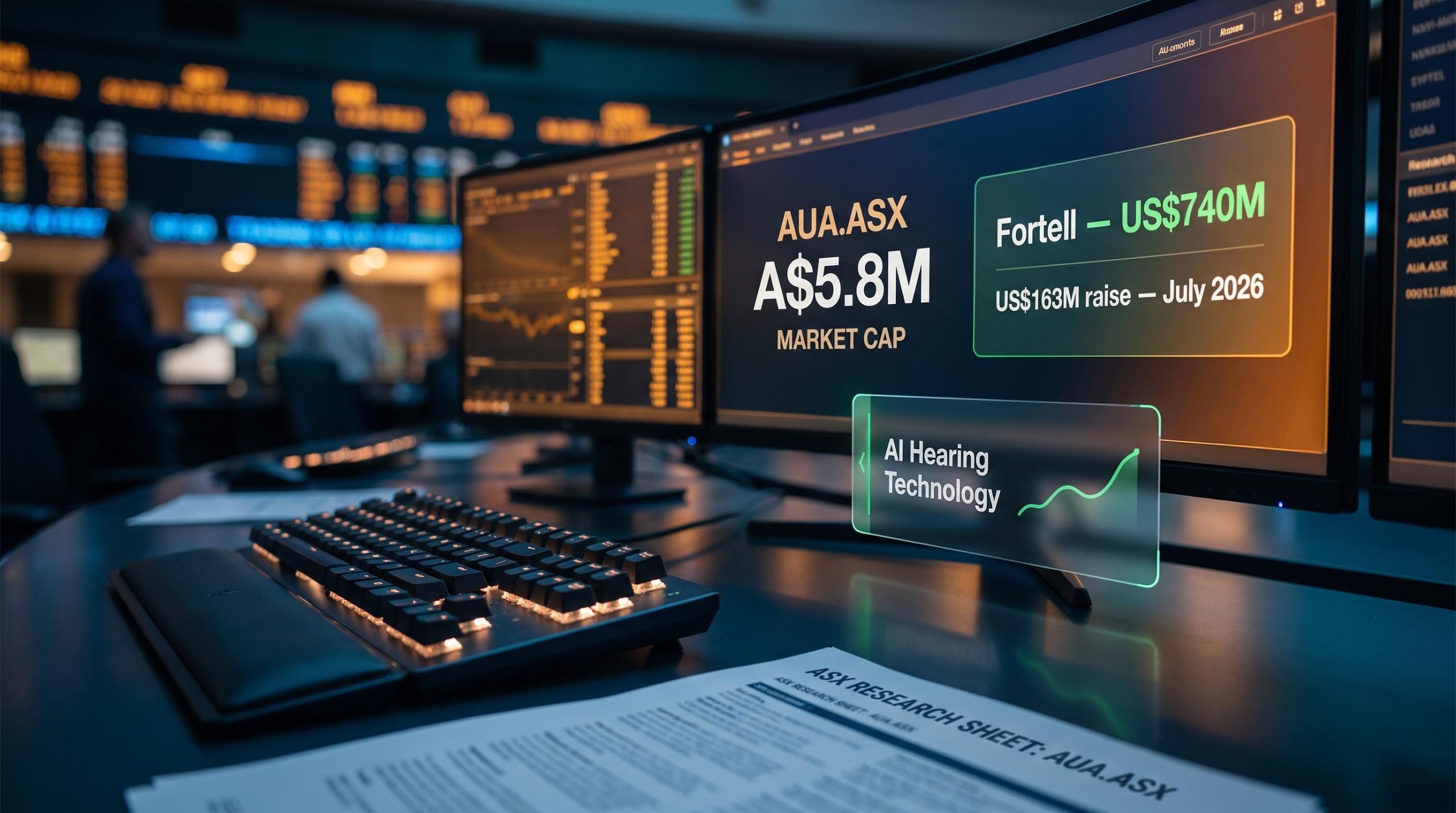
A New York startup that has barely begun selling its product was assigned a private-market valuation of roughly US$740 million in July 2026, as reported by Forbes. The company is Fortell, and it builds hearing aids powered by artificial intelligence. That figure poses a question the Australian market appears to have overlooked: a Brisbane-based company called Audeara (ASX: AUA), which has spent a decade building related AI hearing technology, is currently listed on the ASX at a market capitalisation below A$6 million.
Hearing technology has been a slow-moving industry for decades, dominated by large incumbents selling incremental upgrades. AI is now repricing the entire category. Fortell’s raise is not just a startup funding story. What it signals is that well-informed private capital considers AI-driven speech enhancement to have the potential to become core infrastructure across the entire global hearing sector, rather than simply one feature inside a single product line.
This piece gives you a clear framework for understanding where AI hearing technology is heading, what Audeara has built and where it sits inside that landscape, and what questions you should be asking before deciding whether the current ASX valuation reflects genuine underpricing or legitimate risk.
Why a US$740 million AI hearing startup is the news Australian investors should be reading
According to Forbes reporting in July 2026, Fortell secured US$163 million in a funding round that placed its valuation at around US$740 million. The company’s technology is aimed at one of the most stubborn challenges in audiology: allowing people to follow speech clearly when surrounded by competing noise.
The cocktail party problem is the term audiologists use for the challenge of isolating one voice from surrounding noise. Your brain does it naturally. Conventional hearing aids cannot. They amplify everything, including the background noise, often making comprehension worse rather than better.
The company’s devices carry a retail price of US$6,800 per pair. They launched through a single clinic in Manhattan before rolling out to additional sites in New York, Greenwich and Palm Beach. According to Forbes, early demand has been strong, with prospective buyers joining waitlists.
What matters for you is not the headline number. It is what investors were paying for. The US$163 million did not just fund a premium hearing aid. It backed a broader conviction: that the ability to isolate and enhance speech in real time using AI could sit at the heart of the entire global hearing industry, rather than being one manufacturer’s differentiating feature. If that conviction holds, it changes how you should think about every company working in this category, not just Fortell.
When big ASX news breaks, our subscribers know first
What the cocktail party problem actually is, and why solving it requires AI at the chip level
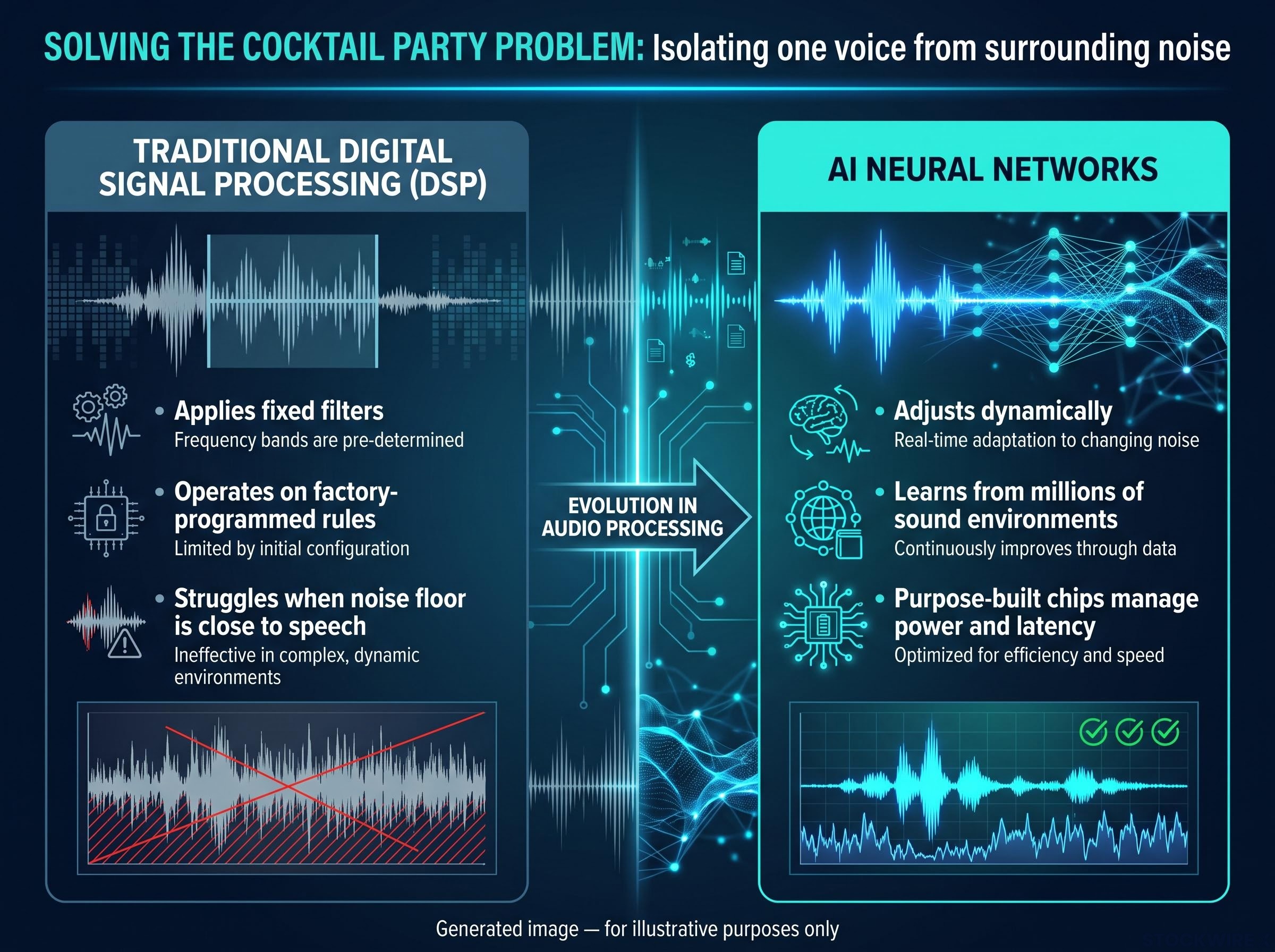
You have experienced the cocktail party problem yourself. A busy restaurant, a crowded office, a family gathering where three conversations overlap. Your auditory system can focus on one voice and suppress the rest. Traditional hearing aids cannot do this. They work on fixed rules, amplifying sound uniformly or filtering within rigid frequency bands. The noisier the environment, the worse they perform.
AI changes the architecture. Neural network models learn to identify the characteristics of human speech and distinguish them from background noise in real time. Instead of following pre-programmed rules, the system adapts to each acoustic environment as it encounters it.
Here is how the two approaches differ across the dimensions that matter:
- Adaptability: Traditional digital signal processing (DSP) applies fixed filters. AI models adjust dynamically to each environment.
- Learning: DSP operates on rules programmed at the factory. Neural networks learn from exposure to millions of sound environments.
- Latency management: DSP is fast but rigid. AI models require purpose-built chips to run complex calculations fast enough for real-time conversation.
- Noise floor handling: DSP struggles when background noise is close in frequency to speech. Neural networks can distinguish speech patterns even in dense noise environments.
Why the chip matters as much as the algorithm
An algorithm running on a general-purpose processor draws too much power and introduces too much delay for a wearable device. Embedding the AI model directly into a purpose-built chip solves both problems. Power draw drops. Latency falls below the threshold where delay becomes perceptible. And the device operates independently, with no need for cloud connectivity or a paired smartphone.
There is a second reason the chip matters. When the algorithm lives on the chip, it travels with every device that uses that chip. This creates a natural scaling mechanism. Every manufacturer that adopts the chip deploys the technology automatically, across every unit they ship.
If solving the cocktail party problem at chip level is genuinely viable, the implications reach well beyond premium hearing aids. Producers of headphones, televisions, communication equipment and assistive-listening products would all have strong reason to seek out that capability. The addressable market expands from hearing-impaired consumers to anyone who needs clearer audio in a noisy environment.
What Audeara has built and how it is trying to compete without replicating Fortell’s model
Audeara did not set out to build what Fortell built. The company’s origins lie in personalised audio headphones that adjust their output based on each listener’s individual hearing characteristics, building clinical relationships across the audiology sector along the way, including reported connections with Amplifon, Demant and WS Audiology, and product availability through Hearing Australia.
The strategic shift came with the AUA Technology division, which was established to take Audeara’s hearing personalisation, AI noise reduction and media enhancement capabilities to market through licensing arrangements with outside manufacturers rather than purely through Audeara-branded products. Rather than manufacturing and selling every device, Audeara is positioning itself as an embedded technology provider.
The proof point is the OPTEK Microelectronics agreement. Under this arrangement, Audeara’s algorithms are integrated at the silicon level into system-on-chip platforms that span categories including televisions, headphones and hearing devices. The agreement has entered commercial production, generating initial fee-per-chip licensing revenue, according to Audeara’s ASX announcement.
The OPTEK commercial production milestone generated initial fee-per-chip purchase orders of approximately A$31,000 across two customer programs, a figure Audeara itself described as not financially material but which established that its AI audio algorithms can be deployed directly on third-party semiconductor platforms.
What the OPTEK arrangement ultimately tests is whether a decade of proprietary development can be converted into revenue that grows independently of device-by-device manufacturing costs, clinical fitting overheads and retail distribution investment for every product carrying Audeara’s code.
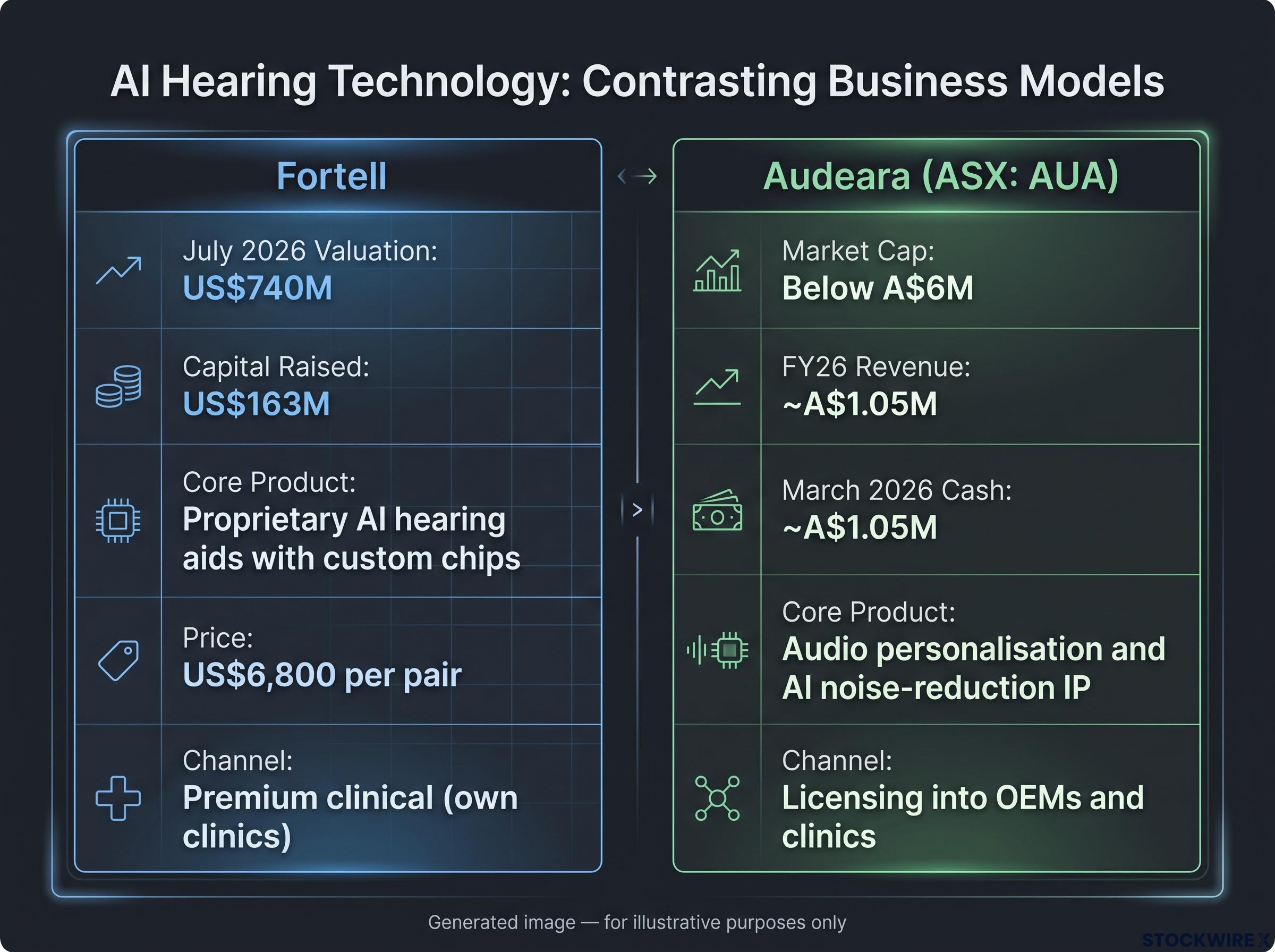
| Dimension | Fortell | Audeara |
|---|---|---|
| Core product | Proprietary AI hearing aids with custom chips | Audio personalisation and AI noise-reduction IP, plus own headphones |
| Go-to-market model | Premium clinical channel (own clinics) | Licensing into OEMs, clinics and distributors |
| Revenue mechanism | Device sales at US$6,800 per pair | Licence/royalty fees plus product sales |
| Capital intensity | High (hardware, clinics, clinical fitting) | Lower per unit if licensing scales; high R&D risk |
| Current commercial validation | US$163M raise, early clinical demand, waitlists | ASX listing, modest revenue, early OEM orders, ongoing losses |
The correct way to evaluate Audeara is not revenue per device sold. It is licence revenue per chip or per device unit, scaled over the addressable deployment base. That is a structurally different business from Fortell’s, and measuring it against the wrong benchmark produces the wrong conclusions.
The Eastech partnership: first licence keys, first proof of the commercial model
The Eastech arrangement is where Audeara’s licensing model meets an actual commercial transaction. Eastech, a Taiwanese manufacturer, has entered a licensing agreement to incorporate Audeara’s technology into hearing aids intended for sale in China, with those products having cleared National Medical Products Administration (NMPA) certification, the regulatory approval China requires for medical devices.
The commercialisation pathway has followed four stages:
- Technology development and licensing agreement between Audeara and Eastech
- NMPA certification obtained for hearing aids incorporating Audeara technology
- Initial order of 1,000 hearing-aid licence keys placed in October 2025, per Audeara’s ASX announcement
- Volume scaling, which remains the next unproven step
The 1,000 licence-key order represents the first occasion on which Audeara’s licensing model moved beyond the development stage into actual commercial deployment. It is small in absolute terms, but it is the first auditable evidence that a third-party manufacturer has committed to paying for Audeara’s technology inside a finished product.
That honest framing matters. One thousand units is a meaningful proof of concept. It is not yet financially material. Audeara reported approximately A$1.05 million in revenue for FY26, with a cash position of approximately A$1.05 million as at March 2026. The company remains in a net loss position.
The combination of NMPA certification and a first licence-key order tells you that the regulatory and commercial pathway into China is open. It also tells you that Audeara is still at the very beginning of the volume curve that would make this partnership financially meaningful. The Chinese hearing market is large enough that success here could matter significantly, but the gap between 1,000 keys and scale is substantial.
Note: Audeara FY26 revenue and cash figures are sourced from recent financial reports. Investors should confirm precise figures against audited financial statements.
The valuation gap between US$740 million and A$6 million: what it reflects and what it does not
Two companies working on AI hearing technology. One valued at approximately US$740 million by private investors, per Forbes July 2026 reporting. The other trading on the ASX at below A$6 million. The gap is enormous, and understanding what it reflects requires separating several distinct factors.
Audeara’s valuation is low for legitimate reasons. Revenue remains small at approximately A$1.05 million in FY26. The company is loss-making. Large-scale licensing adoption is unproven. At a market capitalisation of approximately A$5-6 million, the stock is illiquid and outside the mandate of most institutional investors, which amplifies volatility and sentiment-driven pricing.
Small-cap illiquidity amplifies price swings in both directions for stocks like Audeara, where thin order books mean sentiment shifts can move the market capitalisation by a meaningful percentage on modest trading volumes that would be unremarkable in a larger company.
The Fortell comparison is also structurally imperfect. As a privately held, venture-backed business, Fortell’s round valuation is shaped by factors including deal-specific enthusiasm, the terms negotiated by investors, and growth projections that follow a different logic from how Australian public equity markets assess listed micro-cap companies. The two numbers cannot be directly transposed.
What Fortell’s valuation does tell you is where sophisticated private capital has drawn a line. It establishes a sector benchmark for what investors will pay for AI hearing technology perceived to work at scale and to address a large market. Should the broader thesis prove out, that real-time AI speech enhancement embeds itself across the industry as essential capability, the implied ceiling on value rises for every credible participant in the category, Audeara included.
The A$6 million price tag tells you the Australian market is currently pricing Audeara as an option on a technology outcome, not as a business generating returns. Understanding what would force a re-rating is more useful than debating whether the gap is fair.
What would need to change for the market to re-price Audeara
For the ASX to treat Audeara as a platform business rather than a speculative option, several concrete and measurable developments would need to appear:
- Demonstrable OEM volume: Chips or devices embedding Audeara’s algorithms shipping in tens or hundreds of thousands of units, with corresponding licence revenue visible in audited financials
- Diversified licensing base: Multiple independent manufacturers across categories (hearing aids, consumer audio, televisions), reducing dependence on any single partner
- Improving financial trajectory: Growing revenue, narrowing losses and a clearer path to self-funded operations, visible in reported results
- Clinical or performance validation: Published outcome data or independent endorsements that place Audeara’s technology in the same conversation as leading AI hearing solutions
These are not predictions. They are the conditions under which a rational market re-rating would have a factual basis. Until such milestones appear in audited numbers and independent validation, the ASX is likely to continue assigning option-like value to the company.
What Australian investors should understand before drawing their own conclusions
Audeara’s potential does not depend on copying Fortell’s vertically integrated approach. Embedding algorithms into products that third-party manufacturers already build, brand and distribute is a fundamentally different commercial path, one that could achieve meaningful scale while absorbing considerably less capital per unit than a hardware-led model, provided the licensing pipeline generates real traction. The OPTEK and Eastech agreements are the two live commercial tests of that model.
The investment consideration is honestly binary over time. The current market capitalisation either understates the value of Audeara’s IP and relationships if the licensing strategy gains traction, or it will prove to have overstated it if the pipeline does not convert into material recurring revenue.
Before you draw your own conclusion, apply these questions to your assessment:
- Has Audeara demonstrated growing licence volumes in audited financials, or are the numbers still at proof-of-concept scale?
- Has the OEM base diversified beyond a single partner, or does commercial validation still rest on individual agreements?
- Do independent clinical or technical sources validate the algorithm’s performance, or does the evidence remain company-reported?
- Does your own risk tolerance and investment mandate accommodate micro-cap illiquidity, execution risk and the possibility of further capital raises?
The question this article leaves you with is not whether Audeara is worth US$740 million. It is whether it is a credible participant in a category that sophisticated private capital has just validated as potentially worth that much, and that is a question only you can answer with reference to your own circumstances.
For readers who want to build a structured process around the questions raised in this article, our dedicated guide to small-cap stock research walks through how to read ASX announcements as primary source material, identify promotional noise, and construct an investment thesis that holds up against a genuine bear case.
This article is for informational purposes only and should not be considered financial advice. Investors should conduct their own research and consult with financial professionals before making investment decisions. Small-capitalisation ASX technology stocks carry elevated price volatility and liquidity risk. Technology licensing revenue is speculative until demonstrated at scale. Company-reported figures for clinic reach, order quantities and partnership descriptions have not been independently verified. Any comparison between Fortell’s private-market valuation and Audeara’s ASX market capitalisation is intended as illustrative context only and should not be read as a direct equivalence. All forward-looking statements carry inherent uncertainty.