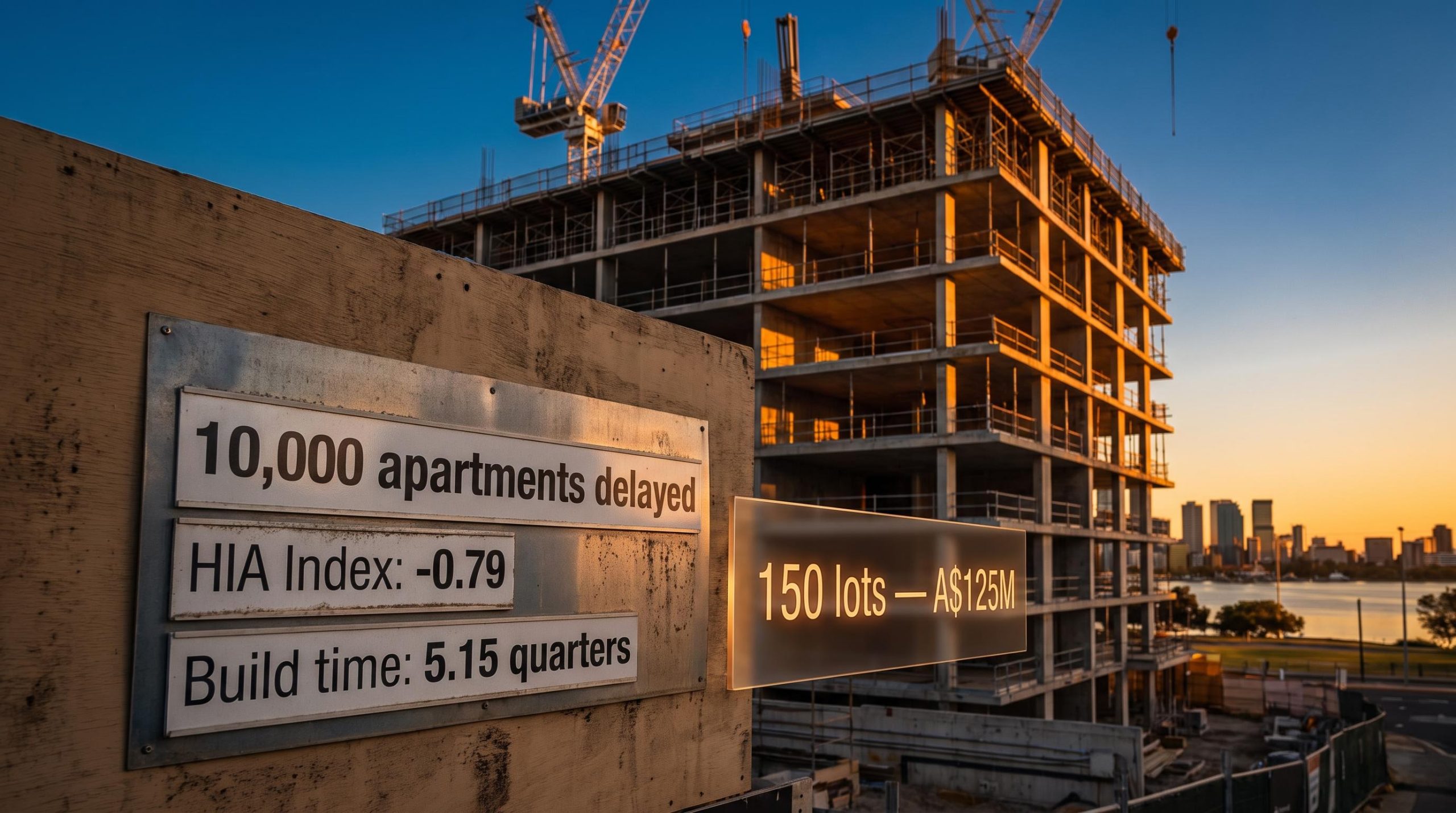
Perth apartments are selling in nine days. Developers are selling out entire buildings before a single slab is poured. And yet the city is not getting meaningfully more housing. That contradiction has a single explanation: there is no one available to build it.
The conversation about Australia’s housing affordability crisis tends to orbit planning delays, land releases, and interest rates. These are real frictions, but in Perth right now they are secondary. What is genuinely capping the number of new homes delivered is the chronic shortage of skilled tradespeople to physically put them up. This shortage is baked into the industry’s structure, it was building long before the current demand wave arrived, and without targeted intervention it will persist well beyond this cycle. It also has direct consequences for anyone watching ASX property stocks: in a labour-constrained market, the question is not whether buyers exist but whether a developer can actually deliver what it sells.
Here is what the data shows about the scale of the gap, why the labour shortage is the binding constraint on Perth apartment supply, and how you can apply that understanding when reading listed developer stocks in the current cycle.
Perth’s apartment market is running at full speed in one direction
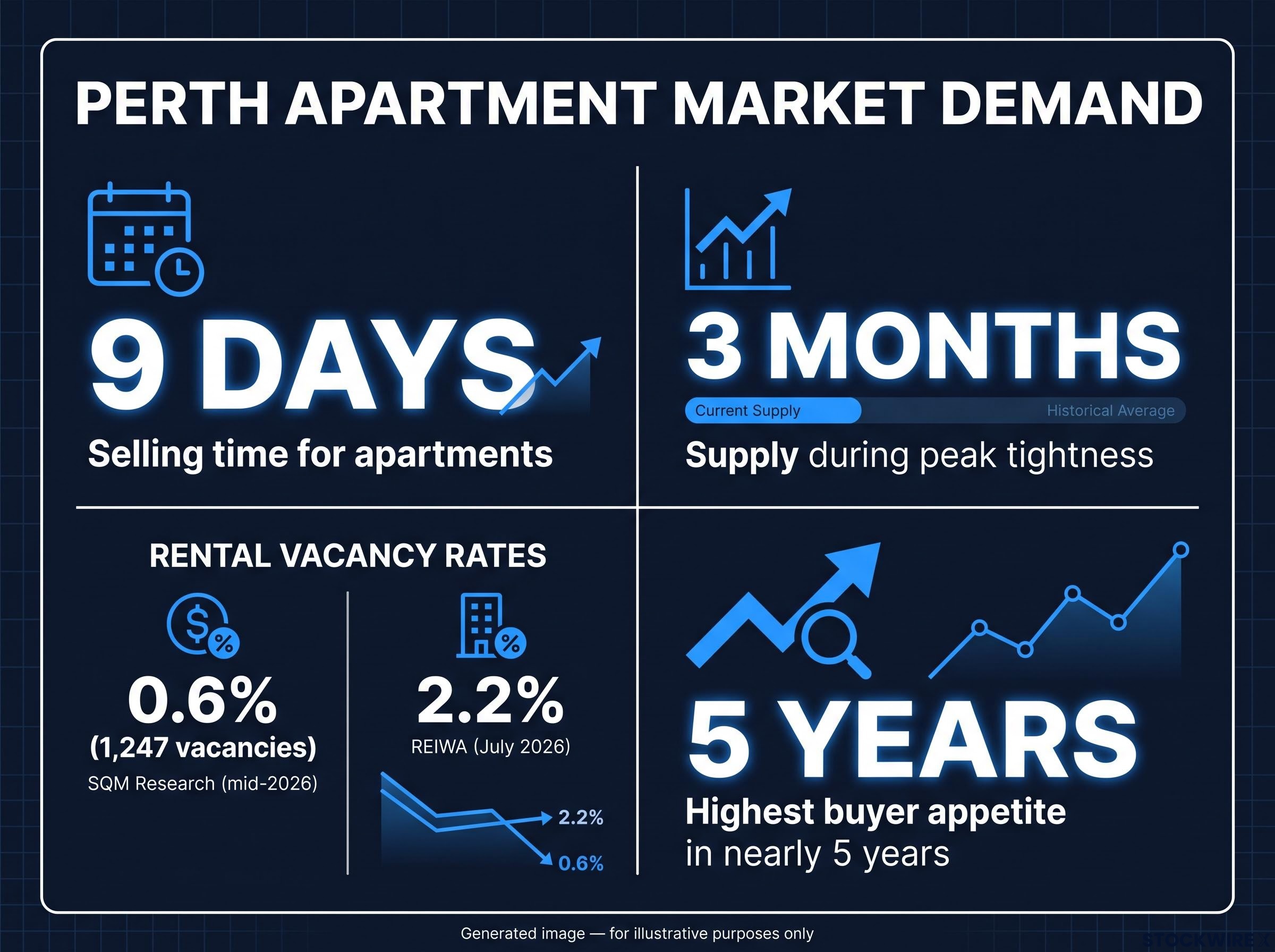
The demand picture in Perth is not ambiguous. Typical selling times for apartments have compressed to around nine days on market. Appetite for high-rise residential units has climbed to levels not seen for close to five years. For-sale stock has compressed to roughly three months of supply during peak tightness periods, forcing buyers to compete aggressively for whatever comes to market.
The rental side is even tighter:
- Perth’s rental vacancy rate sits at approximately 0.6% with around 1,247 advertised vacancies, according to SQM Research data from mid-2026
- REIWA’s July 2026 reading showed a modest easing to approximately 2.2%, though that still reflects acute undersupply
- Apartments are selling in approximately nine days of listing
- Buyer appetite for high-rise residential is at its strongest in nearly five years
Finbar Group (ASX: FRI), the largest apartment developer operating in Western Australia, logged a record sales month not seen in three decades: 150 lots moved for approximately A$125 million across a single calendar month.
At the project level, Finbar’s Bel-Air Apartments in Belmont shifted 193 of 194 available units while construction was still under way, with presales totalling approximately A$113.4 million secured ahead of completion.
These are not speculative numbers. They are evidence of a sustained, validated demand cycle with multi-year strength indicators. So why are numbers like these not producing a proportional surge in housing delivery? The answer sits in a different part of the supply chain entirely.
When big ASX news breaks, our subscribers know first
When approvals outpace the workforce available to act on them
The planning system is doing its job. Developments are being approved. What is not happening is the physical construction of those approved projects, and the gap between the two is where the real constraint becomes visible.
The approval-to-completion gap
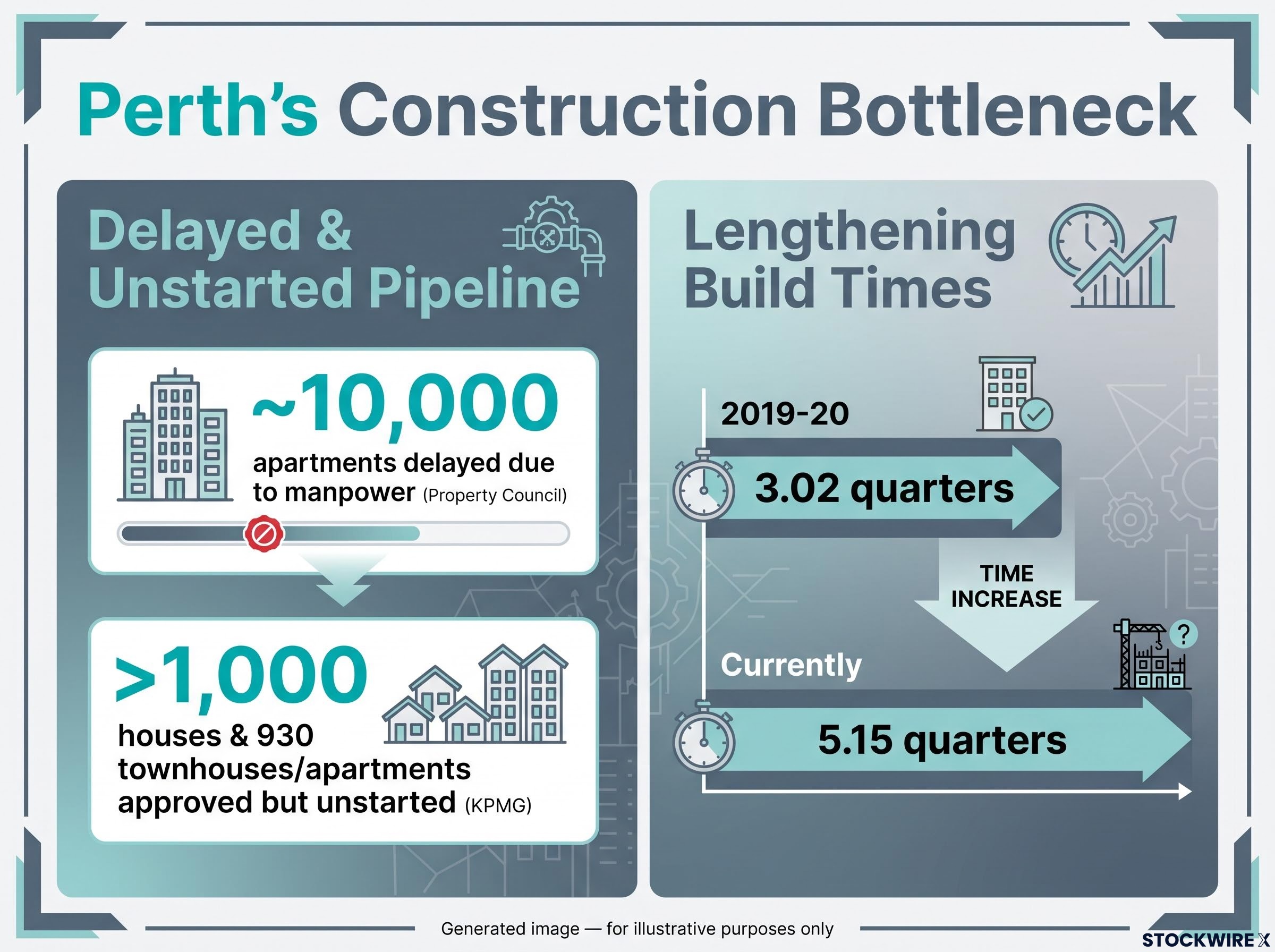
KPMG residential property market analysis for Perth found that more than 1,000 houses and 930 townhouses and apartments have planning approval but have not started construction. The approval channel is not the bottleneck. The pipeline is sitting there, approved and ready, with no one available to build it.
The Property Council puts the scale in sharper terms: approximately 10,000 apartments in Perth have been delayed due to a lack of manpower, with more than a third of approved projects currently on hold specifically because of labour shortages.
“Lack of industry capacity and capability to deliver the quantum and quality of apartments required by underlying demand.”
— Property Council commentary on Perth’s apartment sector
WA builders interviewed by the Australian Financial Review have made the same point directly: state moves to streamline planning will not solve Perth’s housing crisis while a severe workforce shortage and surging costs make developers hesitant to commit to new projects.
For you, whether you are tracking housing policy or ASX developer stocks, this data means that additional planning reform announcements are unlikely to move the completions needle in the near term without a parallel solution to the workforce problem. The lever most policy and media attention lands on is not the one actually stuck.
What the trade shortage actually looks like on the ground
The Housing Industry Association (HIA) Trades Availability Index is the authoritative sector-wide measurement of construction workforce availability. The index sits in negative territory when trades are in shortage; the further below zero, the more acute the gap. A reading of zero would indicate balance between demand for tradespeople and available supply.
The June quarter 2026 readings tell a clear story:
| Geography | HIA Index Reading |
|---|---|
| National | -0.59 |
| Perth Metro | -0.79 (indicative) |
| Regional WA | -1.54 (indicative) |
Perth metro is running worse than the national average. Regional WA is in critical shortage territory. The three most severely affected trades nationally are:
- Bricklaying, suffering the biggest shortage of all trades
- Ceramic tiling
- Roofing
Bricklaying being the hardest-hit trade matters structurally for apartment delivery because brickwork is a time-critical path item in multi-storey residential construction. You cannot sequence around it the way you can defer some finishes.
WA’s broader labour market amplifies the problem. Unemployment sits at approximately 4.2% with a participation rate of 69.1% as of June 2026, per ABS and WA Treasury data. Major mining and infrastructure projects compete for the same workers residential developers need, and construction is singled out as particularly affected.
Structural workforce constraints are not unique to residential construction: the Pilbara’s verified 98% contracted occupancy at workforce accommodation villages reflects the same competition for skilled workers that is suppressing Perth apartment completions, with mining and infrastructure projects pulling from the same limited trade labour pool.
Even with WA’s construction workforce reportedly reaching a record 172,500 workers in early 2026, average build times have still lengthened, from 3.02 quarters in 2019-20 to 5.15 quarters currently. The workforce is bigger than it has ever been and still cannot clear the approved pipeline.
Industry testimony consistently identifies labour costs, not global materials prices, as the primary driver of Perth building cost escalation, a legacy of the post-mining-boom downsizing that hollowed out WA’s construction workforce a decade ago.
A Perth metro HIA index reading of -0.79 does not resolve quickly. It reflects years of underinvestment in workforce capacity, and it tells you the skilled trade pool is operating well into shortage territory with no near-term path to balance.
Understanding what construction labour shortage means for housing supply
Here is the mechanism in its simplest form: when skilled labour is the scarce input in a construction supply chain, adding more money, more approvals, or more buyer demand does not expand output. The bottleneck is at the workforce layer, and it will remain there until that layer itself grows.
Think of it this way. A restaurant with full bookings and only two chefs cannot serve more covers by adding more hungry customers or a larger dining room. It needs more chefs. Perth’s housing market is operating under the same structural logic. The demand is real. The approvals are there. The capital is available. The tradespeople are not.
The post-mining-boom contraction is where this started. When the resources investment cycle peaked and turned, WA’s construction workforce contracted sharply. Workers left the industry or the state. Apprenticeship enrolments dropped. A decade later, the workforce has not recovered to the level the current demand cycle requires.
Why the standard levers do not reach this problem
Planning reform, land release, and demand-side subsidies address real constraints, but they are acting on variables that are not currently the binding one in Perth. Greenlighting every residential development application in the state tomorrow would not add a single completed home until there are enough tradespeople on the ground to do the work.
The structural interventions that would actually expand capacity fall into three categories:
- Skilled migration targeted specifically to construction trades
- Apprenticeship and training pipelines rebuilt after the post-mining-boom contraction
- Long-term demand signalling that encourages career entry into construction by giving prospective workers confidence the pipeline will still be there in four years when they qualify
All three take years to translate into additional completions. Even under optimistic policy scenarios, near-term supply remains constrained. The build time data (from 3.02 quarters to 5.15 quarters) confirms that even a record-sized construction workforce is still running behind the approved pipeline.
The housing affordability conversation often points at symptoms: prices, rents, auction competition. The cause sits one layer deeper, and it responds to a completely different set of solutions.
How one developer’s output ceiling reflects an industry-wide reality
Finbar Group is a business operating from a position of validated market strength. It has brought 80 apartment developments to completion with a 100% delivery rate, put more than 7,000 apartments on the ground since the mid-1990s, and assembled a forward pipeline that now exceeds A$1.15 billion. Its recent record sales result speaks for itself.
And its CEO says the company could be building nearly twice as much.
Finbar’s record presales performance in H1 FY26, with 409 lots sold at a velocity of 2.0 sales per day and total presale contracts reaching A$548 million, provides the quantitative baseline against which the CEO’s output-doubling claim should be assessed.
Finbar CEO Ronald Chan has stated that the company could “almost double” its apartment output if the chronic workforce shortage constraining the industry were resolved.
What makes that statement worth examining is the context behind it. This is not a performance shortfall being explained away. It is a structural observation from the head of an operation with an established record of selling and delivering at scale:
- 80 completed developments with a 100% delivery rate
- More than 7,000 apartments delivered since the mid-1990s
- Forward pipeline exceeding A$1.15 billion
- Record sales month: 150 lots, approximately A$125 million
- Bel-Air Apartments: 193 of 194 units sold, A$113.4 million in presales, completion on track for mid-2026
Chan’s statement is attributed Finbar CEO commentary rather than an independently verified market metric, which is standard treatment for executive statements. But it aligns precisely with independent findings from the Property Council, KPMG, and HIA data.
Finbar’s ability to continue delivering every project it starts, despite operating inside the same labour constraint as the rest of the industry, is itself evidence that disciplined contractor relationships and execution capability provide a genuine operational edge. With roughly 10,000 Perth apartments sitting in delay specifically because of workforce shortages, getting buildings across the line is a meaningful competitive differentiator, not something every developer in the market can take for granted.
What this means for investors reading ASX residential developer stocks
In a labour-constrained cycle, the standard risk lens for ASX property stocks needs adjusting. The central variable is not whether a developer can find buyers. Perth’s market conditions settle that question convincingly. What matters is whether a developer has the operational capability to convert its presales into finished apartments.
That shifts the primary variable from demand risk to execution risk. A large nominal pipeline only translates into shareholder value if the developer can secure labour and manage rising costs. The operational capability to deliver in a labour-scarce environment is a genuine competitive advantage, and it is one that standard valuation metrics do not fully capture.
Listed property vehicles offer a structurally different exposure to residential demand cycles than direct ownership, with two-day settlement and no stamp duty friction, characteristics that become more relevant when physical construction timelines are extending from three to five quarters.
Three questions matter more than usual when you are assessing listed residential developers in this environment:
- Pipeline quantity versus pipeline deliverability: How much of the announced pipeline has a realistic path to completion given current labour conditions? An approved pipeline and a deliverable pipeline are not the same thing.
- Delivery track record: Has the developer consistently brought projects to completion on schedule, or does its history include projects that stalled or were abandoned? With a third of approved projects currently on hold across the market, a 100% completion rate across 80 developments is a data point that stands apart from the industry norm.
- Workforce access as competitive moat: Long-standing contractor relationships and the demonstrated ability to secure tradespeople in a tight market represent an operational advantage that earnings per share, net tangible assets, and dividend yield do not measure.
The metrics that standard analysis can miss
EPS, NTA, and yield tell you about financial performance at a point in time. They do not tell you whether a developer has the operational execution capability to convert presales into completed apartments in a market where bricklayers are the scarcest resource in the construction industry. Delivery track record, the length of contractor relationships, and demonstrated presale-to-completion conversion rates are more diagnostic in the current environment.
The Property Council’s finding that WA has a small builder market with both labour and materials in short supply means the competitive advantage of labour access persists for as long as the HIA index remains in shortage territory. That advantage does not show up on a standard stock screen.
This article is for informational purposes only and should not be considered financial advice. Investors should conduct their own research and consult with financial professionals before making investment decisions.
Why workforce capacity, not policy announcements, will determine when supply improves
Perth’s housing problem is real. The demand is validated. And the constraint is specific and nameable: there are not enough skilled tradespeople to physically build the homes the city needs. That specificity is actually good news, because it means progress is possible. But only through interventions that reach the workforce layer directly.
Labour is the primary bottleneck, though it is worth acknowledging that financing costs, builder balance-sheet stress, and residual planning frictions interact with the workforce issue and contribute independently to supply constraints. Of all the factors holding supply back, the workforce shortage is the one that sits across the critical path.
The clearest signals of genuine supply-side progress will not come from a planning announcement or a land release headline. They will come from:
- Sustained improvement in HIA Trades Availability Index readings, particularly for Perth metro and regional WA
- A measurable reduction in the approved-but-unstarted pipeline, indicating that approved projects are actually breaking ground
- Sustained growth in apprenticeship completions and targeted skilled migration outcomes in construction trades
Training and migration interventions take years to translate into additional completions. Near-term supply remains constrained even under optimistic policy scenarios. The HIA national index sits at -0.59 for the June quarter 2026, and Perth is in worse-than-average shortage territory.
Right now, the developers that keep finishing projects are making the only contribution that genuinely shifts the supply picture. For investors following ASX property stocks, that is the real dividing line in this cycle. The capacity to close out a build separates the operators who create value from those who simply generate presales.
For investors wanting to situate Perth’s current cycle within the longer arc of Australian residential property returns, our full explainer on Australian property’s structural tailwinds examines KPMG data on generational capital gains and explains why the conditions that produced earlier windfall outcomes are structurally less available to buyers entering today.
Past performance does not guarantee future results. Forward-looking statements regarding housing supply, workforce capacity, and developer output are subject to market conditions and various risk factors.