A recurring fee stream looks like an annuity until the money behind it starts to move. MA Financial Group (ASX: MAF) shares sit about 48% lower than a year ago. WAM Capital (ASX: WAM), which traded at a 21.5% premium to its assets at 30 June 2026, now trades at roughly a 22% discount.
Both are businesses built on fees, and both are being repriced hard.
As at 5 November 2026, four ASX fund managers face four different problems. Regal Partners (ASX: RPL) is managing a founder’s exit. MA Financial has gated, or restricted, redemptions in its property-credit fund. Pinnacle Investment Management (ASX: PNI) is absorbing damage from one troubled affiliate, and WAM has halved its dividend target. If you treat them as one sector trade, you risk buying a risk you never priced.
This analysis gives you a way to tell cheap from risky and sticky from fragile across all four names.
How do the four managers compare on price, valuation and flows?
Placed side by side, the four look like they belong to different industries. The table draws on AFR and Intelligent Investor price data from 4-5 November 2026 and on company results.
| Manager | Share-price move | P/E | Yield | FUM or NTA |
|---|---|---|---|---|
| Regal Partners | About 26% lower over 52 weeks | 6.13x | 6.50% (prior year) | $21.4B FUM at 30 June 2026; $1.4B 1H FY2026 net inflows |
| MA Financial | $5.25 (5 Nov 2026); about 48% lower over 52 weeks | 46.70x | 4.44% | About $7.5B private-credit AUM |
| Pinnacle | $16.40; down roughly 7-9% on some measures | 20.73x | 3.71% | $229.4B affiliate FUM at 30 June 2026; about $238B in Q1 FY2027 |
| WAM Capital | $0.95 (4 Nov 2026); about 47.1% lower in calendar 2026 | Not reliably reported | 10.40% | $1.22 pre-tax NTA at 30 June 2026 |
WAM sits apart from the others. It is a listed investment company (LIC), a company that holds a share portfolio and is valued against its net tangible assets (NTA), meaning the value of those holdings per share. It earns no fees on outside money, so you cannot compare its flows with the other three.
Why the P/E figures disagree
A price-to-earnings (P/E) ratio divides the share price by earnings per share. The problem is that each data source picks a different “earnings” figure.
- Regal: screens show 6.13x, while guests on an Equity Mates episode cited roughly 8x.
- MA Financial: the screen shows 46.70x, against roughly 8.5-9x on adjusted earnings cited in the same discussion.
- WAM: the AFR displayed 0.00x while Digrin reported 21.44x. Digrin is not an issuer filing and may use a different earnings period.
Performance fees inflate earnings in good years and vanish in bad ones. Acquisition accounting can depress statutory profit, and an LIC paying dividends from reserves can show earnings that bear little relation to its payout. Treat any multiple here as the start of a question: which earnings were used, and how likely are they to repeat?
When big ASX news breaks, our subscribers know first
What is actually stressing each manager?
The headline multiples tell you very little. The stresses behind them tell you a lot more, and each manager carries a different one.
Regal Partners: a succession story with a performance-fee tail
On 24 August 2026, Regal announced founder Phil King had begun a transition to retirement, remaining in his roles until at least 30 June 2027. From 2 November 2026, Glen Barnes and Zac Corones took over as co-portfolio managers of RG8.
Key-person exposure Phil King was responsible for about 16% of Regal’s FUM, roughly $3.4B.
Ord Minnett kept its Buy rating but cut its target price from $5.40 to $4.90, flagging moderating performance fees. It noted that FUM at or near high-water marks fell $1.1B in the six months to June 2026. A high-water mark is the previous peak a fund must exceed before it can charge performance fees again. Ord Minnett still expects about $2.2B in CY2026 net inflows, above management’s $2B guidance.
Regal has diversified into Killara Water and mining royalties, yet equities remain about half of its funds. On Equity Mates, Luke Larity of Seneca and James Garrish of Market Partners both leaned positive: one called it an “easy buy”, the other a cautious buy.
MA Financial: property-credit liquidity in the front line
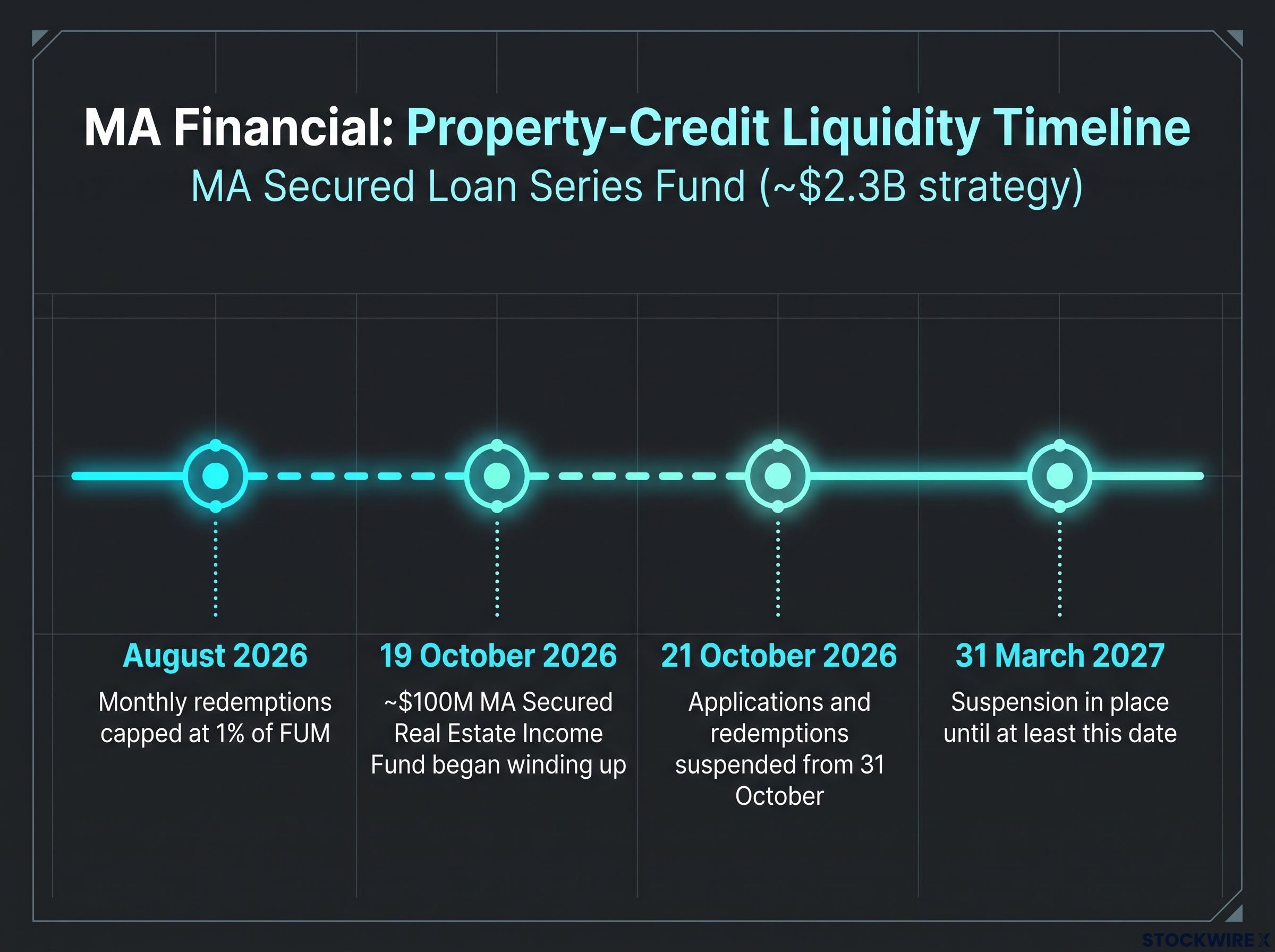
The MA Secured Loan Series Fund tightened its doors in stages:
- August 2026: monthly redemptions capped at 1% of FUM.
- 21 October 2026: applications and redemptions suspended from the 31 October redemption date.
- Suspension period: until at least 31 March 2027, across a strategy of about $2.3B.
- 19 October 2026: separately, the roughly $100M MA Secured Real Estate Income Fund began winding up.
Gating protects remaining investors from fire sales, but it can damage the brand with advisers. The broader group is holding up: in a recent update, asset management came in line with expectations, aggregation landed slightly below, and Money Me ran ahead.
Pinnacle: strong network, exposed to one affiliate’s problems
Pinnacle’s affiliates range from strong performer Plato to struggling Hyperion. Then there is Metrics Credit Partners. Its listed vehicles have been in a trading suspension since late September, not a redemption suspension, pending audited accounts after KPMG disagreed with fair-value assumptions on unlisted property investments.
Pinnacle bought an additional 10% stake in Metrics before the trouble began. The affiliate model spreads manager risk, but it cannot fully contain reputational risk.
WAM Capital: when reserves ran out
WAM’s portfolio returned -10.5% in FY2026, while the All Ordinaries Accumulation Index gained 5.7%. Dividends had exceeded earnings for several years, draining profit reserves. The board cut from 15.5c in FY2026 to an 8.0c FY2027 target, presenting it as capital preservation. Both Equity Mates guests rated WAM a sell.
LIC income smoothing works only while reserves last, since retaining profits in strong years is what lets a vehicle sustain dividends in weak ones, and WAM shows what happens when payouts outrun that cushion.
Put the four cases together and a single pattern emerges: flows follow performance and trust. What you are really choosing between is succession, liquidity, reputation or dividend policy, and each hits earnings through a different channel on a different timeline.
Why is private credit the pressure point, and is the stress structural or cyclical?
Two of the four stories run through private credit, meaning loans made by funds rather than banks. The mechanism works in five steps:
- Liquidity mismatch: investors can redeem monthly or quarterly, but the fund holds multi-year property loans that cannot be sold quickly without a discount.
- Property concentration: weaker residential development delays sales, refinancing and repayments.
- Performance-linked flows: when returns disappoint, investors want cash just as assets are hardest to sell.
- Gating: caps or suspensions prevent forced sales but push the problem into a queue.
- Valuation uncertainty: disputes over fair value, as at Metrics, can halt trading altogether.
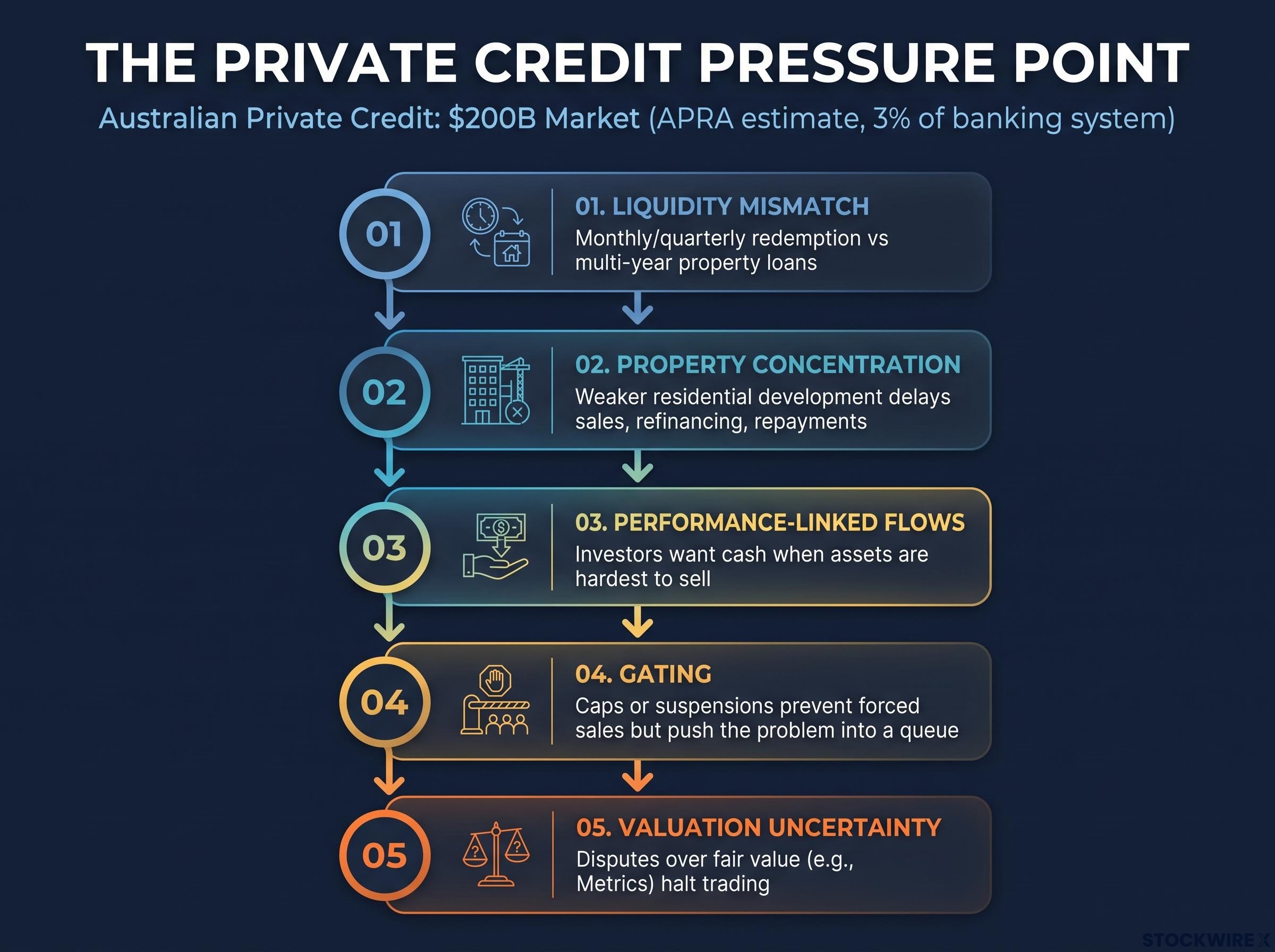
APRA estimates Australian private credit at about $200B, roughly 3% of the banking system. The RBA’s October 2026 Financial Stability Review reported more than US$15B of redemption requests at US non-traded vehicles in the June quarter, with about 60% unfulfilled at June. ASIC wants clearer disclosure of arrears, capitalised interest, developer exposure and redemption queues.
Gated redemptions overseas show the pattern is not local, with public vehicles holding similar assets trading at wide discounts to stated NAV while managers keep marking loans at book value.
Structural versus cyclical
Informed observers read the same evidence differently.
| Interpretation | Who holds it | Core argument | What it implies for investors |
|---|---|---|---|
| Structural | ASIC, Genium’s Tim Murphy (October 2026), RBA and APRA | Periodic liquidity against illiquid loans makes gates inevitable when many investors exit together | Gates can hit sound managers, not only weak ones |
| Cyclical | S&P Global Ratings (August 2026) | Restrictions are rising, but widespread industry instability has not yet occurred | Manager selection matters more than avoiding the asset class |
The outcome is not yet known. If the structural view proves right, the next gating headline says less about one manager’s loan book and more about the product’s design. If the cyclical view holds, you should look harder at who lent to which borrowers.
What should investors weigh before buying a listed fund manager?
The appeal of the model is real: recurring fees, potentially high margins, and affiliates that compound without heavy use of the parent’s balance sheet. But sticky revenue is not guaranteed revenue. Before you decide on position size, work through six questions:
The fee drag on returns is the investor’s side of the same model, because performance fees charged on gains later reversed mean the manager’s recurring revenue can exceed what clients ultimately keep.
- How much rides on one person? Regal’s 16% King exposure shows how far a founder can matter.
- What share of earnings comes from performance fees? These can collapse below high-water marks.
- How sensitive are flows to a bad year? Weak returns or reputational damage can reverse inflows quickly.
- How liquid are the underlying assets? Private-credit fees look stable until gates or delayed repayments arrive.
- Can one affiliate’s problem spread? Metrics shows contagion reaches the parent.
- For an LIC, what is the discount to NTA, and are dividends covered by earnings or reserves? WAM’s 8.0c FY2027 target remains subject to performance.
| Manager | Main vulnerability | Question to ask | Metric to watch |
|---|---|---|---|
| Regal Partners | Succession and performance fees | Will flows hold as King steps back? | Net flows; FUM near high-water marks |
| MA Financial | Property-credit liquidity | Can the fund reopen on schedule? | Redemption queue; suspension status |
| Pinnacle | Affiliate contagion | Is the Metrics damage contained? | Audited accounts; affiliate flows |
| WAM Capital | Underperformance, discount and reserves | Can returns rebuild reserves? | Discount to NTA; dividend cover |
Regal’s past rebounds have often come from raising leverage, though it reportedly is not finding opportunities to do so now. One Equity Mates guest floated Regal as a possible takeover target. That is speculation, not a signal. Tim Murphy has also argued that heavy inflows can erode the premium attached to successful managers.
A guest’s warning Private-credit capital can be locked up, so keep most of your holdings in liquid, simpler assets.
A cheap multiple only pays you for risks you can name. Answer each question first.
Where the pressure points sit, and what to watch next
These four ASX-listed managers share a fee model but not a risk. The Equity Mates guests expected the next 6-12 months to test flows, valuations and dividend policy, and each test has a date attached.
Watch for the end of MA Financial’s suspension, set for no earlier than 31 March 2027, and for Metrics lodging its audited accounts. For Regal, track net flow reports in the run-up to King’s 30 June 2027 transition date. For WAM, check whether the interim dividend meets the 4.0c target.
Each of those results will tell you whether a discount is an opportunity or a warning. Weigh them against your own circumstances, not a sector label.
This article is for informational purposes only and should not be considered financial advice. Investors should conduct their own research and consult with financial professionals before making investment decisions.