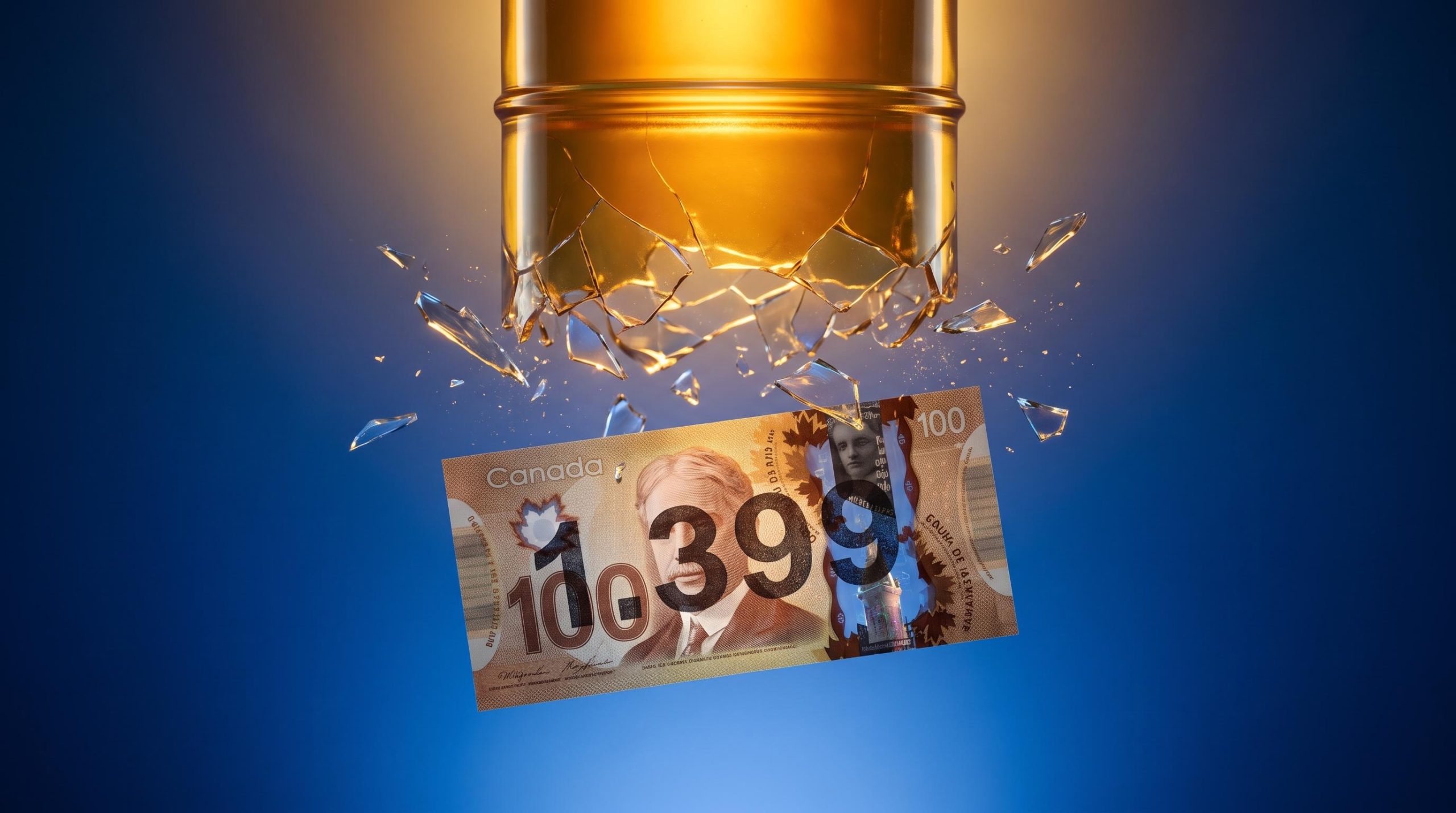
WTI crude is trading near $100 a barrel, a level that would normally send the Canadian Dollar climbing. Instead, the Loonie is sitting near 1.399 against the US Dollar, weaker than the oil price signal alone would suggest.
Something has broken the relationship between crude and the currency, and it is not random.
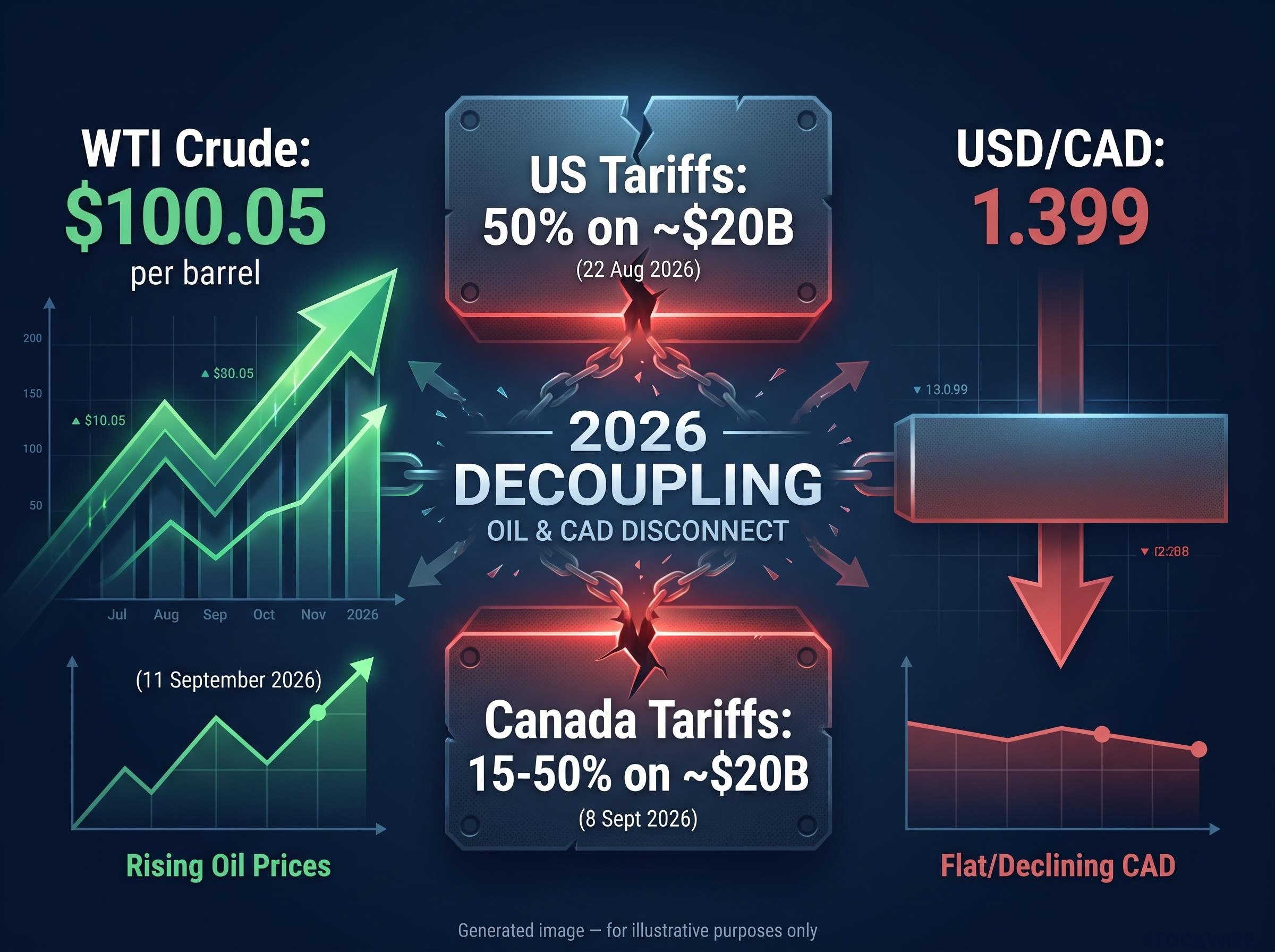
US tariffs of 50% on roughly $20 billion of Canadian goods, imposed in late August 2026, and Canada’s retaliatory duties of 15% to 50% on about $20 billion of American imports, effective 8 September 2026, are applying structural pressure to the Canadian economy. That pressure is offsetting the windfall that high crude prices would ordinarily deliver.
Meanwhile the Bank of Canada, holding its policy rate at 2.25% for the seventh consecutive meeting, has said plainly that it cannot directly offset the effects of tariffs or global energy prices. The Loonie is caught between two powerful and contradictory forces.
The interplay of US Canada tariffs and the Canadian dollar is the reason oil at $100 is not doing what the textbook model predicts. Here is how the decoupling works, why it matters for anyone holding CAD-denominated assets, and which signals now matter more for the currency than the crude price on any given day.
Why oil and the Canadian Dollar usually move together
Before you can understand what has broken, you need to understand what usually holds. The oil-CAD relationship is not a coincidence or a market quirk. It is built into the structure of the Canadian economy.
Petroleum is Canada’s single largest export. When global oil prices rise, Canada’s terms of trade improve, meaning the country earns more for what it sells relative to what it buys. That improvement flows through the economy in ways that tend to lift the currency.
The mechanism operates through several channels at once:
- Export revenue: Higher crude prices increase the dollar value of Canadian oil sold abroad, boosting national income.
- Trade balance improvement: Rising export earnings strengthen the current account, historically a supportive force for a currency.
- Corporate investment flows: Energy company profits and capital spending attract domestic and foreign capital into Canadian assets.
- Investor risk appetite: In risk-on environments, the CAD is often favoured as a commodity-linked currency, drawing inflows toward Canada.
When buyers overseas need to pay for Canadian oil, they convert their own currency into Canadian Dollars to do it. More demand for CAD, all else equal, pushes its value up.
This is why the Loonie behaves differently from currencies tied to manufacturing-driven economies. Its value carries a commodity signature. When WTI rises meaningfully, the Canadian Dollar has historically followed.
If you hold CAD-denominated assets and have assumed that high oil prices protect the currency, this is where that assumption comes from. It has been a reasonable one to hold for a long time.
How this relationship has played out historically
The oil-CAD link is reliable, but it has never been unconditional. There have been episodes where the relationship weakened or reversed.
During periods of broad risk aversion, when investors flee to the US Dollar as a safe haven, CAD has underperformed even with crude prices elevated. The same has happened during stretches of pronounced US Dollar strength and during bouts of domestic policy uncertainty.
Commodity-currency decoupling, in other words, is not unprecedented. Understanding that history matters, because it frames the current episode not as a permanent rupture but as the latest instance of external forces overriding the terms-of-trade signal.
When big ASX news breaks, our subscribers know first
What the 2026 tariffs are doing to that relationship
The current decoupling is being driven by trade policy, and it works through three channels that compound on each other. By the time you follow the logic to its end, you can see why $100 oil is actively unable to compensate.
Start with the direct hit. The US tariffs of 50% on approximately $20 billion of Canadian goods, effective 22 August 2026, depress demand for Canadian exports beyond energy. That erodes the trade-balance benefit high oil prices would otherwise deliver, cancelling out one of the currency’s key support channels.
The US-Canada tariff escalation that activated in August 2026 deliberately excluded energy, critical minerals, and potash from its product list, a political choice that explains why the oil sector did not absorb the same direct blow as consumer goods, dairy, and furniture.
Then comes the second layer. Canada’s retaliatory duties of 15% to 50% on roughly $20 billion of US imports, effective 8 September 2026, raise costs for Canadian firms and households that depend on American goods. That amplifies growth headwinds from the inside.
Canada’s counter-tariff product list, published by the Department of Finance, confirms retaliatory duties of 15%, 25%, and 50% on C$27.6 billion of US imports effective 8 September 2026, giving you the full scope of goods caught in the cross-fire beyond the headline figures.
The combination produces a stagflationary bias, meaning inflation stays high while growth weakens at the same time. High energy prices push headline inflation up, while the tariff-related trade drag pulls growth down. Markets are left with no clean signal to rally behind.
| Disruption channel | What it does | Tariff mechanism | Net effect on CAD |
|---|---|---|---|
| Trade balance erosion | Cuts demand for non-energy Canadian exports | US 50% tariffs on ~$20B of Canadian goods | Cancels the trade-balance lift from high oil |
| Stagflationary bias | High inflation alongside weakening growth | Energy costs plus tariff-driven price pressure | Removes a clean bullish signal for the currency |
| Risk premium widening | Raises uncertainty over market access and investment | Retaliatory duties and supply-chain reorientation | Lowers Canada’s structural appeal to capital |
The empirical evidence sits right in the numbers. WTI settled at $100.05 per barrel on 11 September 2026, while USD/CAD held near 1.399. Crude at historically elevated levels is simply not producing the currency strength the standard model predicts.
The Bank of Canada has confirmed why no policy backstop is correcting the distortion.
“Monetary policy cannot offset the effects of tariffs or influence global energy prices.” Tiff Macklem, Governor, Bank of Canada
That coexistence of $100 oil and a soft Loonie is not a data anomaly. It is the tariff effect playing out in real time, and you should treat it as evidence that the oil-CAD model now needs an extra variable before it is useful. If you hold Canadian equity or fixed income, you cannot assume oil at $100 will strengthen the currency in this environment.
The Bank of Canada’s balancing act and what it means for the Loonie
The central bank is not a bystander here. It has become an active variable in the decoupling, which is why watching its communication now tells you more about CAD direction than watching the oil price in isolation.
On 2 September 2026, the Bank of Canada held its overnight rate at 2.25% for the seventh consecutive time, with the Bank Rate at 2.50% and the deposit rate at 2.20%. That leaves the policy rate at the lower bound of the Bank’s estimated neutral range of 2.25% to 3.25%. The hold is a deliberate balancing act, not indecision, and it makes sense once you see what the Bank is juggling.
The BoC rate hold trajectory extends well beyond September: TD Securities projects 2.25% through every quarter of 2026, with the first policy move projected as a hike rather than a cut in January 2027, a timeline that removes the monetary policy channel investors would normally expect to amplify trade relief into currency strength.
The economy is running with slack. Unemployment sits around 6.4% to 6.5%, confirming the economy is in excess supply, which would normally argue for rate cuts to support growth.
But the inflation picture blocks that path. Headline CPI held at 3.0% year-over-year in August 2026, while core measures, the trim and median readings that strip out volatile items, sat near 2.0%. The Bank faces above-target headline inflation driven largely by energy, alongside underlying price dynamics that remain contained.
The Bank is simultaneously managing three conditions that pull in different directions:
- Above-target headline inflation, driven mainly by gasoline and diesel prices.
- Below-trend GDP growth, projected at just 0.7% in the Bank’s July 2026 forecast, with RBC and other analysts aligning near 1.0% after tariff revisions.
- An external tariff shock the Bank has said it cannot directly offset.
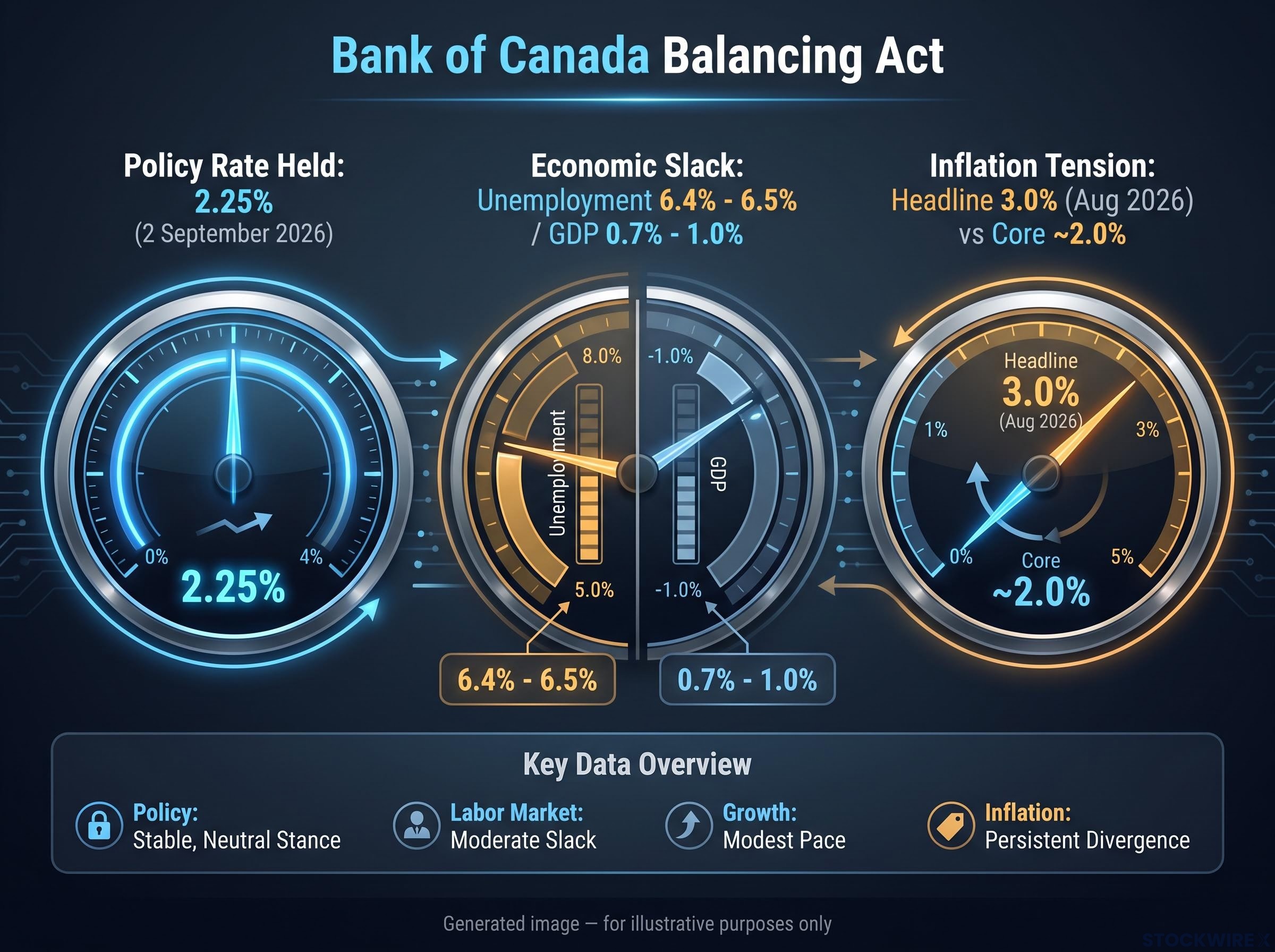
There is a further wrinkle worth noting. The Bank’s July forecast assumed Brent crude at $75 per barrel, but actual prices sat near $90 in September. The energy assumption underpinning its own projections is already materially outdated, which adds to the uncertainty around its next move.
What the BoC’s forward guidance actually signals
The Bank has told markets it is “prepared to adjust monetary policy as needed.” That phrasing is doing more work than it first appears.
“Prepared to adjust monetary policy as needed.” Bank of Canada, September 2026 policy statement
The language is deliberately two-directional. Markets must assign probability to both a rate cut, if growth weakens materially, and a rate hike, if inflation broadens beyond energy. National Bank characterised the September decision as a “policy balancing act,” which captures the ambiguity precisely.
That ambiguity itself keeps CAD range-bound rather than trending in a clear direction. The September minutes, released 16 September 2026, reinforced the point: the Governing Council expects inflation to stay elevated near term, particularly from gasoline and diesel, but found little evidence of broad pass-through to other goods.
For you as an investor tracking CAD, this changes where you should look. BoC meeting dates, policy statements, and minutes have become higher-signal events than daily oil-price moves, because the Bank’s reaction function is now the main transmission mechanism between commodity prices and the currency.
A practical framework for assessing CAD risk when oil is not enough
Here is the core shift, stated plainly. CAD has moved from a relatively clean terms-of-trade story, driven by a single observable commodity, to a more complex, risk-premium and policy-driven currency that requires a broader set of inputs. That means you need a wider lens than crude alone.
Three variables now matter most for the currency’s direction, and they are worth watching in this order:
- BoC policy communication. Meeting dates, statements, and minutes now drive CAD more than crude, because the Bank’s reaction function is the primary channel between energy prices and the currency.
- Tariff escalation or rollback signals. Developments out of Washington and Ottawa directly shape confidence in Canadian export volumes and the risk premium embedded in the currency.
- Domestic growth data. GDP, employment, and PMI readings shape the BoC’s reaction function, which in turn shapes CAD.
This is not a claim that oil no longer matters. It is a claim that oil must now be read alongside tariff risk and policy optionality rather than as a standalone bullish signal.
What to watch before the next BoC decision
The next scheduled BoC decision is the near-term focus point for CAD direction. The Bank’s communication on tariffs and inflation will be the clearest available signal about whether the growth-inflation balance is shifting.
Remember that the minutes, typically released about two weeks after each decision, now carry nearly equal weight to the decision itself. They reveal the reaction function, which is exactly what you need to interpret the currency.
For managing the risk once you have identified it, several practical tools apply:
- Scenario analysis. Model CAD behaviour across tariff-escalation and partial-rollback paths rather than assuming higher oil automatically means a stronger currency.
- FX hedging. Forward contracts or options can manage CAD exposure when the currency is driven by policy and geopolitical shocks rather than one observable commodity.
- Diversification. Avoid treating CAD as a straightforward energy proxy when positioning Canadian equity or fixed-income exposure.
History supports this broader approach. The 2018 to 2019 US-China tariff conflict saw targeted economies’ currencies weaken despite robust commodity demand, and earlier phases of Canada’s own pipeline-constraint era limited the pass-through from global oil prices to export volumes. If you treat WTI near $100 as sufficient reason to be long CAD assets without a tariff and policy overlay, the current environment is a direct challenge to that approach.
What changes the decoupling, and what it would take
None of this is permanent, and the outlook divides into two distinct paths rather than a single direction. Knowing which incoming data would push toward each is more useful than waiting for oil to do work it currently cannot.
There are two primary resolution routes. The first is a reduction in trade friction, whether through tariff rollback, negotiated carve-outs, or time-limited exemptions, which would restore confidence in Canadian export volumes. The second is a BoC policy shift, a cut or a hike, that changes the carry-adjusted attractiveness of CAD assets relative to the USD.
The case for a cyclical, temporary decoupling is real. Core CPI near 2.0% shows underlying inflation remains anchored, and Trading Economics noted a broad recovery in the second quarter.
The resilience case, drawn from Bank of Canada communications and Trading Economics commentary, holds that Canada’s Q2 recovery and contained core inflation suggest the decoupling is cyclical rather than a permanent structural break in the oil-CAD relationship.
The competing view, associated with Desjardins and others, is more cautious. If geopolitical conflict, tariff regimes, and supply-chain shifts persist, the risk premium embedded in CAD could stay elevated even with crude above $90, extending the divergence.
The economic slack tells you how far there is to travel. Unemployment around 6.4% to 6.5% and GDP growth projected at 0.7% to 1.0% mark the degree of slack that would need to resolve before a rate cut becomes the dominant CAD catalyst. With the policy rate at the lower bound of the neutral range, any upward move would be meaningfully CAD-supportive, provided growth data permits.
| Scenario | Key conditions | Likely CAD direction |
|---|---|---|
| Tariff rollback | Reduced trade friction, restored export confidence | Supportive; oil-CAD link begins to reassert |
| Tariff escalation | Persistent friction, wider risk premium | Weaker or range-bound even with crude above $90 |
| BoC policy shift | Growth or inflation data forces a cut or hike | Cut: softer; hike: firmer, given room to neutral |
Historically, commodity-currency decoupling has resolved either through reduced trade friction or through markets repricing risk and policy paths sufficiently. You should be able to hold both scenarios in view and read incoming data as evidence for one or the other.
The USD/CAD outlook from National Bank of Canada frames the asymmetry clearly: the bear case for the Loonie requires only one of two negatives to materialise, while the bull case requires two independent positives to occur simultaneously, a probability structure that makes the 1.40 projection a baseline rather than a worst case.
This article is for informational purposes only and should not be considered financial advice. Investors should conduct their own research and consult with financial professionals before making investment decisions. Past performance does not guarantee future results. Financial projections are subject to market conditions and various risk factors, and forward-looking scenarios are speculative and subject to change based on market and policy developments.
Reading the Loonie in a tariff era
The oil-CAD relationship is not broken for good. Its reliability has been suspended by a combination of trade friction, stagflationary pressure, and a central bank that has said openly it cannot act as a clean offset.
That leaves you with a practical toolkit rather than a single indicator. Watch the three variables that now drive the currency: BoC communication first, then tariff developments out of Washington and Ottawa, then domestic growth data. Together they tell you far more than the crude price on any given day.
Uncomfortable as this period is for the standard commodity-currency model, it is also a clarifying one. It reveals which drivers genuinely dominate the Loonie when the simple story stops working, and that knowledge stays valuable long after this particular tariff cycle has passed.