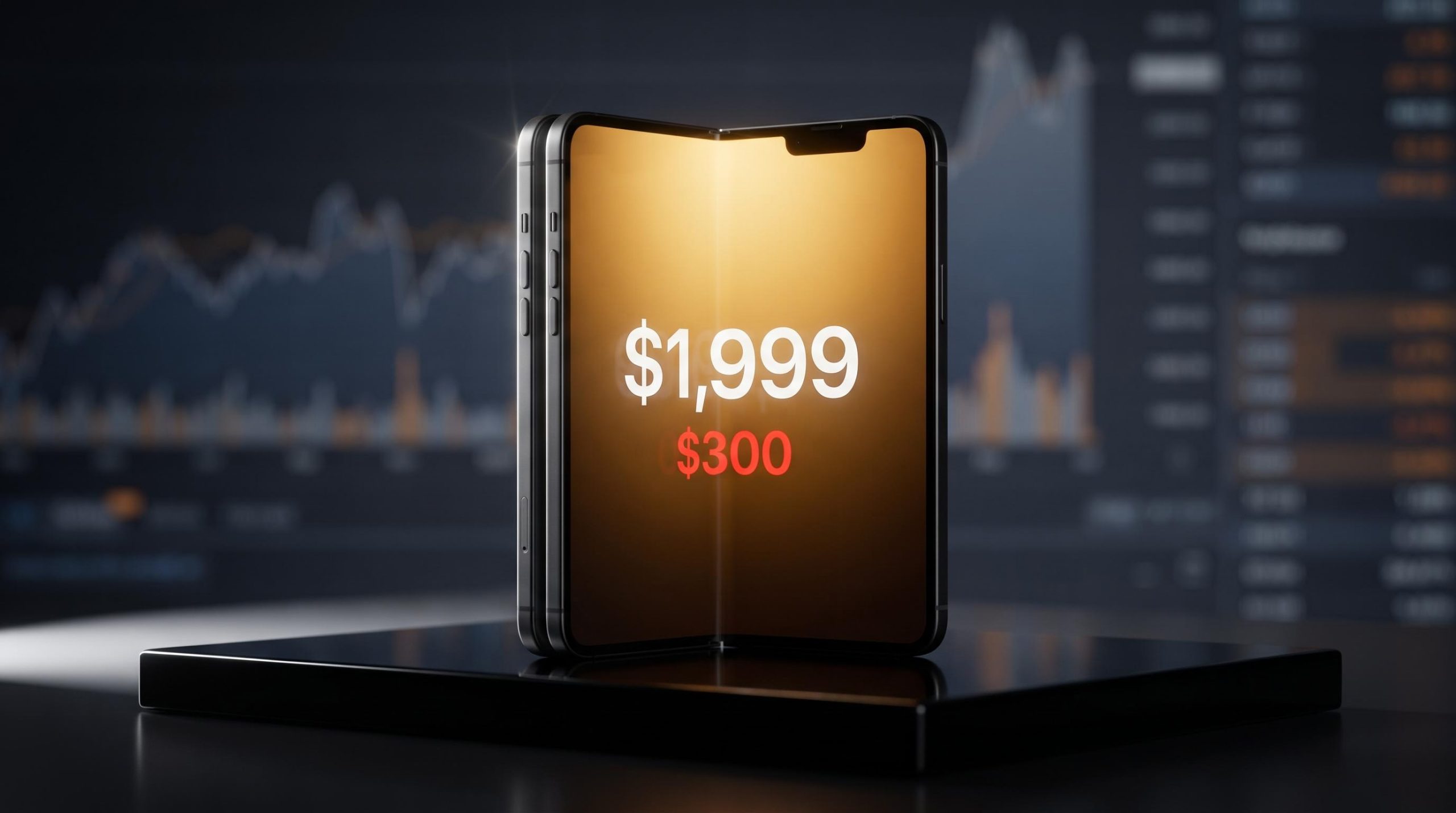
Apple just put a $1,999 foldable at the top of its lineup, raised prices on its Pro models, and watched its stock climb toward record highs. One analyst’s response to all of this was to keep a Reduce rating on the stock with a $300 price target. That is a genuinely uncomfortable gap between the product moment and the investment call.
As of 22 September 2026, Apple shares trade around $338.99, up roughly 24% year-to-date, against a Wall Street consensus that leans broadly constructive. Phillip Securities Research is one of the dissenting voices, and its caution rests on a specific set of concerns: valuation, AI execution, and whether demand at these prices can hold. Those concerns deserve examination on their own terms rather than dismissal as contrarian noise.
The question underneath all of it is simple to state and hard to answer. Does the stock’s premium pricing reflect a real product premium, or has the share price moved ahead of the fundamentals? This piece gives you a structured way to weigh both sides of the call before you decide which set of assumptions you are willing to own.
Apple’s pricing gambit: what the “Surprise and Shine” numbers actually signal
The pricing that came out of Apple’s “Surprise and Shine” event on 9 September 2026 was not incidental. It was a deliberate structural bet, and reading it correctly is the foundation for every forward revenue estimate on the stock.
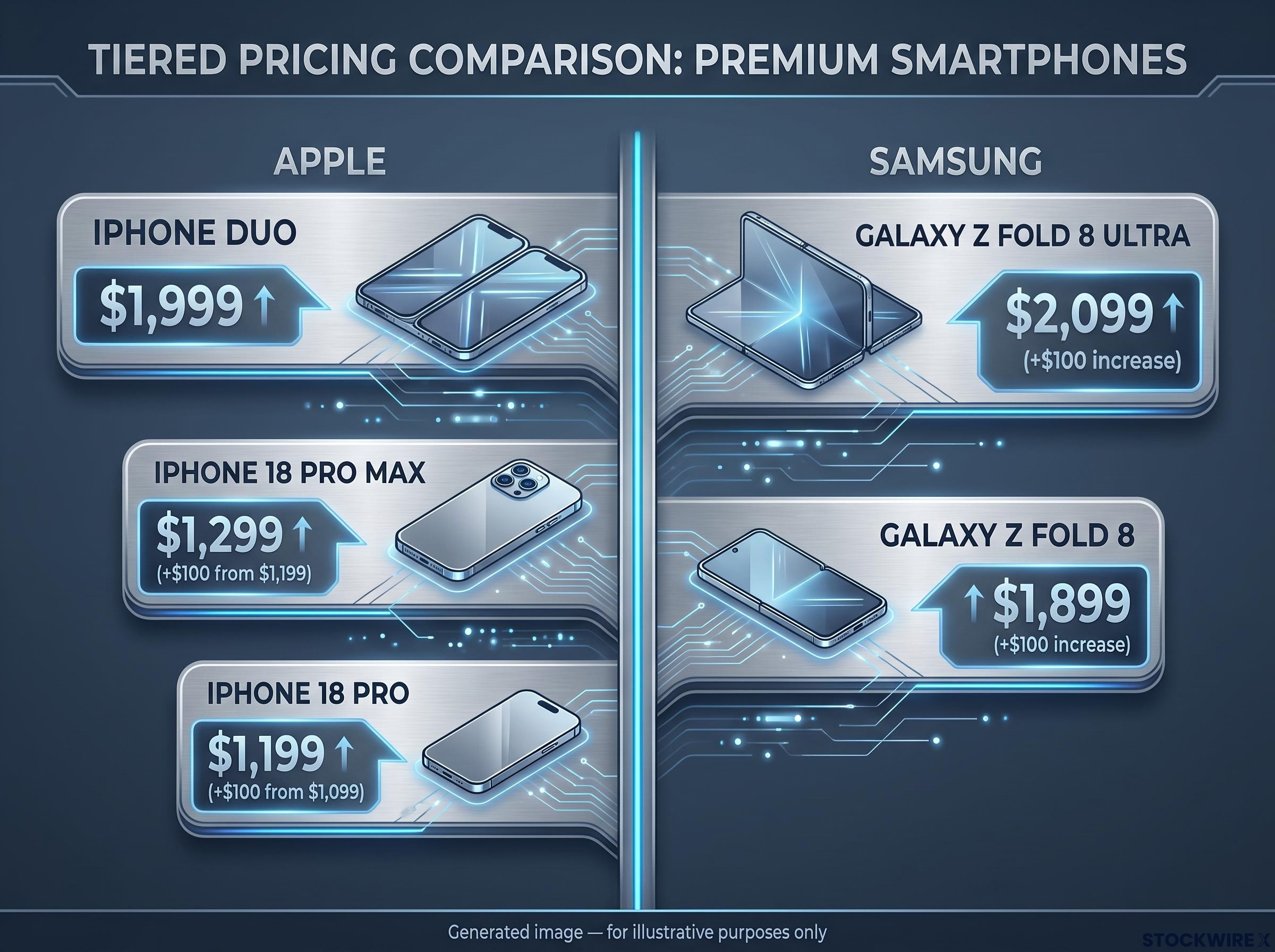
Three tiers emerged. At the apex sits the iPhone Duo, Apple’s first foldable, starting at $1,999 and carving out an entirely new ultra-premium category. Below it, the iPhone 18 Pro and Pro Max each took a $100 price increase, now starting at $1,199 and $1,299. The standard lineup stayed where it was.
The financial logic of a pure price rise is what makes this interesting. A $100 increase on the Pro carries no additional manufacturing cost, which means the extra revenue falls almost entirely to gross profit.
A $100 price increase on the iPhone Pro equates to roughly 9% more revenue per unit, with no incremental cost to produce it. That improves product mix and supports margin expansion in one move.
Apple is not the only one leaning this way. Samsung recently raised prices on its Galaxy Z Fold 8 and Fold 8 Ultra by $100, to $1,899 and $2,099. Analysts read Apple’s move as partly defensive too, a way to protect margins against rising component and memory costs driven by AI hardware demand across the industry.
The premium ASP dynamics driving Apple’s strategy are not isolated to one company; global smartphone average selling prices hit a record approximately $550 in 2026, up $100 from 2025, as the premium tier expanded to roughly 34% of total shipments while mid-range and entry-level segments absorbed the volume contraction.
What this tells you as an investor is that Apple is choosing average selling price expansion as its primary revenue lever rather than unit volume. That is a bet with clear upside and a defined ceiling. If consumer credit tightens or the financing ecosystem shifts, the ceiling arrives faster than the bulls would like.
| Model tier | Prior cycle start price | Current start price | Change |
|---|---|---|---|
| iPhone Duo (new category) | N/A | $1,999 | New tier |
| iPhone 18 Pro Max | $1,199 | $1,299 | +$100 |
| iPhone 18 Pro | $1,099 | $1,199 | +$100 |
| Standard lineup | Unchanged | Unchanged | No change |
How financing insulates Apple from its own price increases
The reason a $100 list price rise does not scare off US buyers is the financing structure sitting between them and the sticker. Carrier instalment plans, monthly payment arrangements, and trade-in credits spread the cost out, so a $100 increase becomes a few extra dollars a month rather than a lump sum shock. For the typical US consumer, the monthly outlay stays roughly in line with the last upgrade cycle.
That insulation is a structural feature of the US carrier market, and it is worth remembering it does not replicate everywhere. In price-sensitive emerging markets without the same financing depth, list price increases hit buyers more directly, which matters for how the strategy travels.
When big ASX news breaks, our subscribers know first
The foldable market reality check: who actually buys a $1,999 iPhone?
Before deciding whether the Duo is a growth catalyst or a margin curiosity, look at the size of the category Apple is entering. The numbers set the boundaries of what a foldable can realistically do for a company this large.
- Global foldable shipments in 2025 totalled approximately 18 million units, about 1.5% of total smartphone sales.
- Foldable average selling prices run roughly 4x higher than traditional smartphones.
- Samsung’s foldables currently lead the category and are growing at 30% year-over-year, the competitive hurdle Apple is stepping into.
- In China, foldables made up 13% of premium Android sales above $800 in 2025, confirming the format’s appeal to high-spend loyalists.
Read those together and the picture forms itself. A category that is 1.5% of the market, dominated by an incumbent growing at 30%, is not where a mass upgrade wave comes from. The Duo is far more convincing as a high-margin niche driver aimed at existing high-spend users than as a volume engine.
India offers the sharpest live preview of how this plays out. Counterpoint Research projects Apple could capture roughly 24% of India’s foldable segment in the Duo’s launch quarter. Pro series sales in the country already grew 32% year-on-year in the first half of 2026, even at elevated prices.
In India, analysts expect Apple’s unit volumes to dip by low single digits while local revenue grows 6-7%, purely on higher average selling prices and a richer Pro and foldable mix. Revenue up, units down.
That is the entire ASP strategy compressed into one market. Apple can grow revenue without growing units, which is financially meaningful and does not need a big volume story to work. The catch is that the model depends on sustained willingness to pay at the top of the range, and in a softening credit environment that willingness is exactly what you cannot take for granted.
Apple Intelligence and the upgrade cycle debate: catalyst or wishful thinking?
If the pricing strategy is mechanically sound and the foldable is a niche done well, the AI story is where the real disagreement lives, and where the Reduce rating makes its most coherent case.
Phillip Securities characterises Apple Intelligence as the weakest element of the investment narrative, pointing to a lack of conclusive evidence that AI features are generating meaningful upgrade behaviour.
The bear argument is straightforward. AI features have landed as incremental improvements rather than must-have capabilities, and because Apple pushes many of them out as software updates to devices people already own, they remove rather than create a reason to buy new hardware. UBS survey data shows consumer purchase intent rose 300-600 basis points year-over-year in the US, UK, and Germany, but that resilience is not explicitly tied to AI. Some analysts estimate that AI rollout delays may reduce expected iPhone unit sales by around 1.5% over two years, though this is an analyst estimate rather than a confirmed figure.
iPhone replacement cycle timing is the variable neither side of the debate can resolve with current data; Citi research confirmed the average replacement cycle held at approximately four years as of mid-2026, with no measurable AI-driven compression, which is the empirical foundation the bear case rests on when it argues the upgrade payoff is still a projection.
The bull case is built with equal precision. CFRA Research projects 5% iPhone unit growth for the iPhone 16 cycle and 3% for the iPhone 17 cycle, explicitly attributing those gains to AI-driven upgrades. Morgan Stanley holds a bullish $360 target and expects AI monetisation plus the Duo to drive a meaningful upgrade cycle from late 2026 into FY27.
| Consideration | Bear case (Phillip Securities) | Bull case (CFRA / Morgan Stanley) |
|---|---|---|
| AI feature assessment | Weakest link; incremental, no proven upgrade pull | Genuine multi-year ecosystem catalyst |
| Upgrade cycle timing | Evidence still thin; payoff unproven | Cycle begins late 2026, accelerates into FY27 |
| Price target | $300 (DCF, WACC 6.5%, terminal growth 3.5%) | $360 (Morgan Stanley) |
Strip the debate back and it is really a question about timing, not quality. If you agree AI will eventually drive upgrades but think the payoff is 18-24 months away, today’s valuation looks stretched. If you believe the cycle has already started, the mid-$330s look like a reasonable entry. The consensus is pricing in an outcome that Phillip Securities argues is still just a projection, and that distinction is exactly what you have to judge for yourself.
Regulatory pressure, FX drag, and the cost of being a platform at this scale
Even the most optimistic operational scenario runs into a set of external and near-term pressures that the bull consensus tends to treat as manageable friction. It is worth laying them out as a risk register before deciding whether that characterisation holds.
- EU Digital Markets Act (DMA): On 8 July 2026, the EU’s General Court ruled that Apple’s App Store and iOS both fall fully under the DMA, and regulators refused Apple’s request for an AI tools exemption. Non-compliance penalties could reach up to 10% of global annual turnover.
- Expanding EU scrutiny: Regulatory attention is broadening beyond the App Store into cloud infrastructure and AI services, raising the risk of feature fragmentation and costly compliance engineering for Apple Intelligence.
- FX and supply constraints: Management guided for near-term currency and component pressures directly affecting the September quarter.
The DMA ruling is the most structurally significant of these. A penalty scaled to 10% of global turnover is not a rounding-error fine, which is why the exposure sits in a different category from ordinary compliance cost. For most analysts this is not a base-case tail risk, but it is a scenario risk that reprices quickly if enforcement escalates. The asymmetric downside is worth factoring into any position sizing decision.
Services gross margin, running at 75.4% in FY 2025 and generating roughly $82.3 billion in gross profit from 26% of total revenue, is the structural reason the bull consensus treats double-digit services growth as more than an adjacency; it is the primary engine of company-wide margin expansion, which makes the regulatory risk to App Store commissions and the Google search default arrangement materially more important than headline fines alone suggest.
Near-term supply and currency pressures compounding the launch window
On Apple’s Q3 FY2026 earnings call, management flagged a 2.5 percentage point sequential FX headwind to year-over-year growth for the September quarter, and a 5 percentage point headwind across the March to September quarters. That is a mechanical dampener on reported revenue growth, meaning the headline numbers can soften even when the underlying business performs well.
Management also warned that supply constraints are expected to increase significantly sequentially, potentially limiting the ability to meet initial demand for the new devices. In practical terms, that can push revenue recognition into later quarters. The question you cannot answer yet is whether it is a transient launch dynamic or a signal of deeper component availability issues.
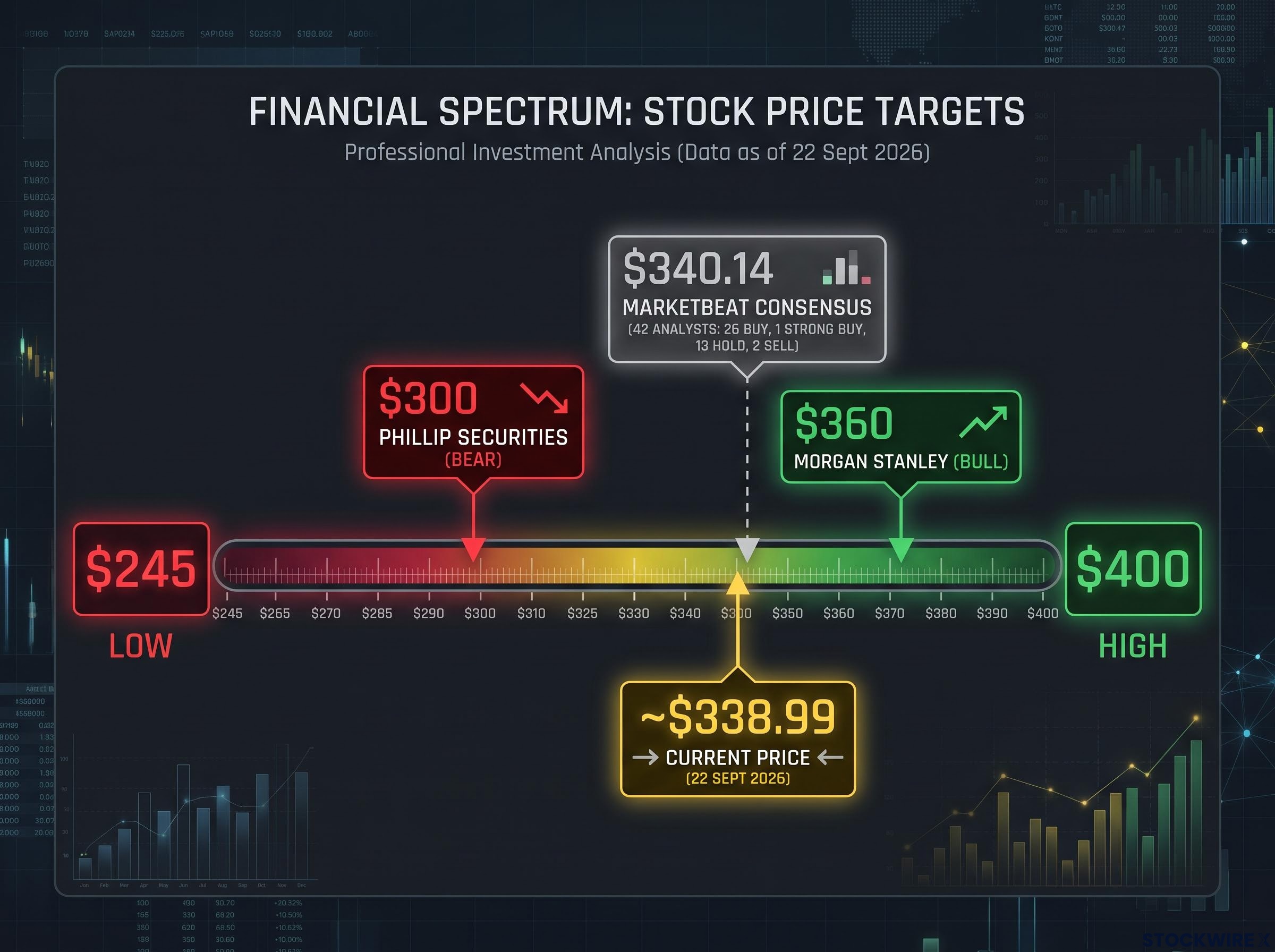
For context on where this all sits, MarketBeat tracks 42 analysts on Apple: 26 Buy, 1 Strong Buy, 13 Hold, and 2 Sell, with an average 12-month price target of $340.14. The headwinds above are the specific reasons that consensus is not unanimous.
Where the Reduce rating fits in a $340 consensus world
The Phillip Securities call is not contrarianism for its own sake. It is a valuation argument with a defined internal logic, and understanding that logic is what lets you map your own assumptions against it.
Phillip Securities raised its DCF target to $300 (from $290), holding its valuation assumptions of a 6.5% WACC and a 3.5% terminal growth rate. The gap between that $300 target and a share price near $338 is the market’s premium for the AI upgrade cycle materialising as projected.
Notably, the firm nudged its FY27 revenue and PATMI estimates up 1% and 2% respectively, acknowledging the positive product cycle while keeping the Reduce rating on valuation grounds. This is a call about price, not about business quality.
Apple’s fiscal Q3 2026 earnings delivered a 6.9% beat on EPS and a 0.5% revenue beat on a $109 billion base, yet the stock fell nearly 4% after hours, a reaction that reflects precisely the dynamic at the centre of the Phillip Securities argument: a premium-valued stock needs results that upgrade the thesis, not merely confirm it.
Three conditions would make the Phillip Securities view look prescient:
- AI upgrade evidence stays thin through the first half of FY27, leaving the super-cycle unproven.
- DMA enforcement escalates from ruling to material penalty.
- Consumer financing conditions tighten and price elasticity reasserts at the top of the range.
Three conditions would validate the bull consensus instead:
- The iPhone Duo captures meaningful foldable share, as Counterpoint’s India projection suggests it might.
- AI features drive a measurable shortening of upgrade cycles.
- Services revenue continues its double-digit growth trajectory.
The consensus lands at an average $340.14 target (high $400, low $245), with Morgan Stanley at $360. The stock has traded between a 2026 low of $243.42 on 20 January and a high of $344.57 on 29 July, and now sits near the top of that range. The disagreement between $300 and $340 is not about whether Apple is a good company. It is about whether the AI and foldable catalysts deliver on schedule, and that is the assumption you have to decide you are comfortable owning at current prices.
Making a considered call when the product story and the valuation story diverge
The tension this piece has traced is real and unresolved. Apple has delivered a genuinely significant product moment, its pricing strategy is mechanically sound, and yet the regulatory and AI execution risks are more substantial than a $340 consensus fully reflects.
The Reduce rating remains a minority view. The stock’s position near the upper end of its 2026 range reflects the majority’s confidence that the catalysts will land, and the roughly $40 gap between Phillip Securities’ $300 target and the $340.14 consensus is the quantified price of that confidence.
This article is for informational purposes only and should not be considered financial advice. Investors should conduct their own research and consult with financial professionals before making investment decisions. Past performance does not guarantee future results, and financial projections are subject to market conditions and various risk factors.
Three data points will settle the debate over the next two reporting periods. Watch the December 2026 quarter for whether the Duo and price hikes translate to revenue outperformance against expectations, watch the EU DMA enforcement timeline as the most binary regulatory risk, and watch the Services revenue trajectory for signs the ecosystem story is still compounding. Those are the numbers that will tell you which side of this call was right, and roughly when you will know.