Approximately 88% of active global equity funds in Australia failed to beat their benchmarks over 15 years, according to the SPIVA Australia Year-End 2025 scorecard. That single figure captures what decades of fee comparisons, fund manager interviews, and portfolio construction debates have been circling: the odds are stacked against active management before a fund manager selects a single stock.
The Australian ETF market surpassed $300 billion in assets under management in September 2025, with more than $157 billion allocated to global share ETFs alone. Retail investors and SMSF trustees are making allocation decisions between low-cost index ETFs and higher-fee active funds with increasing frequency, and the data behind that choice has never been more transparent. What follows uses the real performance and cost figures from Australia’s largest global share ETFs, including the only active fund in that group (Magellan), to show precisely what active management costs investors and why the structural case for passive indexing is so difficult to argue against.
The math that works against active managers before they place a single trade
Markets are a zero-sum game before costs. For every active manager who outperforms a benchmark, another active manager must underperform by an equivalent amount. This is not an opinion or a statistical tendency; it is arithmetic. The total returns earned by all investors in a market must, by definition, equal the market’s total return.
Fees are what turn this break-even equation into a losing proposition for the average active participant. Management fees, performance fees, and trading costs are deducted from gross returns, meaning the average dollar invested actively must underperform the average dollar invested passively by the exact amount of those costs. The result, compounded over a decade or more, is predictable and severe.
The structural disadvantage operates through three reinforcing mechanisms:
- Zero-sum dynamics: Every basis point of outperformance by one active manager comes at the expense of another active manager’s returns
- Management fees: Active funds in Australia typically charge 0.75% to 1.35%+ annually, compared to 0.04%-0.24% for index ETFs
- Trading costs: Higher portfolio turnover in active strategies generates additional transaction costs that do not appear in headline fee disclosures
92% of U.S. active fund managers failed to beat their benchmarks over a 15-year period, according to industry research cited by Stockspot. In Australia, the figure is approximately 88% for global equity funds over the same horizon, per the SPIVA Australia Year-End 2025 scorecard.
Roughly 85% of Australian equity funds underperformed the S&P/ASX 200 over five years, according to the same report. These are not exceptional failure rates. They are the structural consequence of a system where costs make a zero-sum game reliably negative-sum for active participants.

When big ASX news breaks, our subscribers know first
What index ETFs actually are, and why low cost is a feature, not a compromise
An index exchange-traded fund tracks a market benchmark by holding all, or a representative sample, of the stocks in that benchmark. There is no stock-picking team making buy and sell decisions. The fund simply replicates the index it is designed to follow, whether that is the S&P 500, the MSCI World, or the S&P/ASX 200.
This mechanical simplicity is the reason passive management costs so little relative to active management:
- No research team required: Index replication removes the need for analysts, portfolio managers, and the infrastructure that supports discretionary stock selection
- Low portfolio turnover: Because index changes are infrequent, trading costs remain minimal
- Efficiency of index replication: Modern ETF structures can track benchmarks with negligible tracking error at scale
The result is a fee structure that would have seemed implausible a generation ago. VTS (Vanguard U.S. Total Market Shares ETF) charges a management fee of 0.03% per annum. IVV (iShares S&P 500 ETF) charges 0.04%. VGS (Vanguard MSCI Index International Shares ETF) charges 0.18%. The average Australian ETF expense ratio sits at approximately 0.24%, and the industry, now projected to exceed $500 billion by 2028, continues to push that figure lower.
Why fees are not a service charge but a performance deduction
Every basis point in management fees is extracted directly from investment returns, not from a separate budget. A 1% annual fee gap between an active fund and an index ETF does not feel large in any single year. Over 20 or 30 years, compounding transforms that seemingly modest annual deduction into a material difference in terminal portfolio value, particularly for SMSF investors whose holding periods often span decades.
The fee gap in Australia’s global ETF market, quantified
The fee spectrum across Australia’s largest global share ETFs makes the cost of active management visible in a way that headline comparisons often obscure.
| ETF Ticker | Type | Management Fee (p.a.) | Bid/Ask Spread |
|---|---|---|---|
| VTS | Passive | 0.03% | N/A |
| IVV | Passive | 0.04% | 0.03% |
| VGS | Passive | 0.18% | 0.02% |
| MHG | Active | 0.75% (reduced Sep 2025) | 0.45% |
| MGOC | Active | 1.35% + performance fee | 0.35% |
Management fees tell only part of the story. Bid/ask spreads, the gap between the buying and selling price of an ETF on market, represent a hidden transactional cost that compounds for investors who add to their holdings regularly. MGOC’s spread of 0.35% is more than 17 times the 0.02% spread on VGS.

The total cost burden becomes stark when calculated as a round trip. An investor who held MGOC for three years to 31 December 2025, accounting for management fees plus entry and exit spreads, paid approximately 5% of their capital in costs. Against a net return of approximately 17.5% over that period, the total cost consumed over 25% of the gains delivered.
An MGOC investor over three years paid more than 25% of their net gains in total costs. A comparable holding in IVV carried total costs below 0.2% against a 23.3% net return, meaning costs consumed less than 1% of gains.
Magellan’s performance record against passive alternatives
Magellan Financial Group built its reputation on concentrated, high-conviction global equity investing, offering professional stock selection and, implicitly, the promise of downside protection that index tracking cannot provide. The performance record, measured against the passive alternatives available to Australian investors, tells a different story.
| ETF | Type | 3-Year Return (p.a.) | 5-Year Return (p.a.) |
|---|---|---|---|
| IOO | Passive | 27.4% | 19.8% |
| IVV | Passive | 23.3% | 17.6% |
| VGS | Passive | 22.0% | 15.6% |
| VEU | Passive | 17.6% | N/A |
| MGOC | Active | 17.5% | N/A |
| MHG | Active | 15.2% | 6.6% |
MHG’s five-year annualised return of 6.6% trailed IOO by approximately 13 percentage points per annum. Over three years, MHG’s 15.2% return sat below every passive comparator in the group, including VEU at 17.6%, a broadly diversified international ETF typically associated with lower-return geographic exposure. MGOC fared marginally better over three years at 17.5%, but still trailed IVV, VGS, and IOO by significant margins, before accounting for its substantially higher cost base.
Magellan benchmarks its performance against the MSCI World Net Total Return Index (AUD), and the fund’s own reporting confirms negative excess returns against that benchmark.
What AUM outflows signal about investor confidence
The market’s verdict has been expressed in capital flows. Magellan’s assets under management fell from approximately $39.9 billion in December 2025 to $37.5 billion by March 2026, a decline of roughly $2.4 billion in three months.
This is not a verdict on Magellan in isolation. It reflects the broader pattern of capital migrating from active to passive structures across the Australian market, a pattern that accelerates when the largest and most visible active managers deliver returns that trail low-cost index alternatives by wide margins.
When active management might still make sense, and the honest limits of that case
The structural case against active management does not mean it is without merit in every circumstance. Three conditions can make an active allocation defensible:
- Specific asset class gaps: Some market segments, including certain emerging market niches and less liquid fixed income sectors, are not efficiently replicated by index ETFs
- Demonstrable downside protection track record: A fund that has materially reduced drawdowns across multiple market corrections, not just one, may justify a higher fee for investors with specific risk constraints
- Fee-adjusted outperformance over a minimum 10-year period: Any active fund claiming value should demonstrate net-of-fee returns above its stated benchmark over a full market cycle
The difficulty is identifying these managers in advance with any consistency. The 8-12% of active managers who do outperform over 15 years are difficult to distinguish from the rest at the point of investment. Looking backward at their track records introduces a systematic distortion.
Survivorship bias inflates active management’s apparent track record. Funds that close or merge after sustained underperformance are excluded from historical performance databases, making the surviving pool of active managers appear more successful than the original cohort actually was. The SPIVA Australia scorecard specifically accounts for this effect.
ASIC’s 2025-26 Corporate Plan places emphasis on surveillance of advice relating to SMSFs and retail investments. The best interest duty obligations that apply to financial advisers require evidence-based justification for recommending higher-cost products. Any adviser recommending an active fund charging 1.35% over a passive alternative at 0.04% carries an obligation to demonstrate the net-of-fee value case explicitly.
The passive case is not about settling for average returns
The label “passive” is misleading. Investors who choose index ETFs are not passive about wealth accumulation. They are actively selecting the strategy with the strongest evidence base: capturing the full return of the market, minus a cost so small it barely registers on a portfolio statement.
The data in this analysis points to a three-step decision framework for Australian investors weighing fund selection:
- Apply fees as a first filter. Any fund charging more than 0.30% annually for broad market exposure needs to clear a higher evidence bar. The average ETF expense ratio of 0.24% is the competitive baseline.
- Examine long-run, risk-adjusted performance against a genuine benchmark. Compare net-of-fee returns over at least five years, and preferably ten, against the specific index the fund claims to beat.
- Adjust for survivorship bias. Recognise that the active funds visible in performance databases today are the survivors. The ones that failed have been removed from the record.
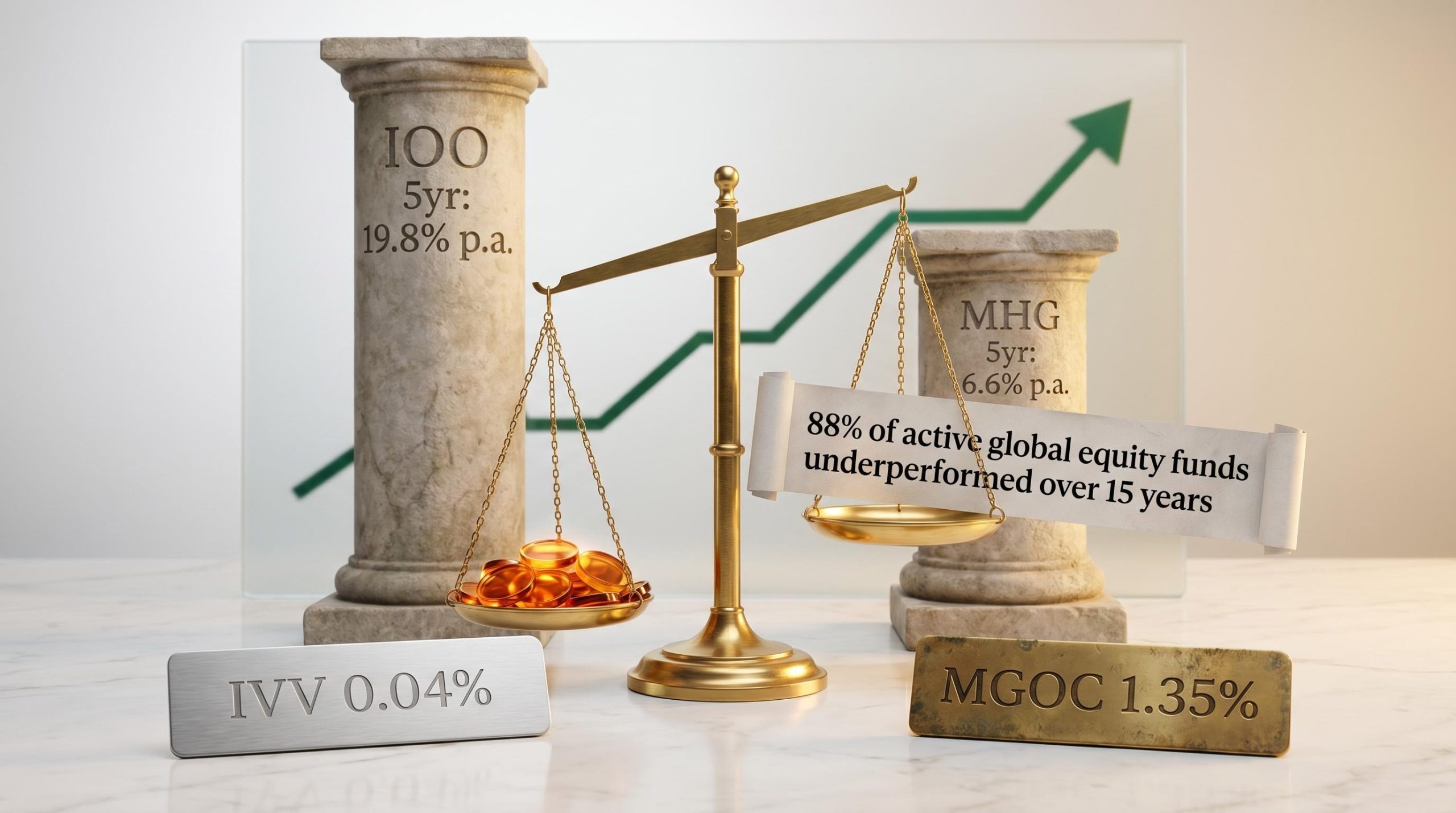
The closing comparison is difficult to argue with. IOO returned 19.8% annualised over five years. MHG returned 6.6%. Both are available to any Australian investor with a brokerage account. One charges 0.04%-0.18% in the passive range; the other charged 1.35% before its fee reduction and now charges 0.75%.
The Australian ETF market’s trajectory, from $300 billion in September 2025 to a projected $500 billion by 2028, suggests a growing number of investors have already done the maths.
What the numbers tell Australian investors about where to put their money in 2026
The structural disadvantage of active management, the fee drag, and the real-world Magellan comparison all converge on the same conclusion the SPIVA data has been documenting for years: most active funds deliver less than the index, at a higher cost, over the timeframes that matter to long-term investors.
Passive ETFs are not immune to market downturns. When equities fall, index funds fall with them. The fee advantage, however, means passive investors retain more of whatever the market delivers, in both directions.
The practical next step for Australian investors and SMSF trustees is not to adopt a single fund but to compare specific ETF options, whether VGS, IVV, IOO, or others, on the basis of geographic preference, cost tolerance, and investment horizon. The worst approach is to default to the product most aggressively marketed rather than the one best supported by evidence.
This article is for informational purposes only and should not be considered financial advice. Investors should conduct their own research and consult with financial professionals before making investment decisions. Past performance does not guarantee future results.