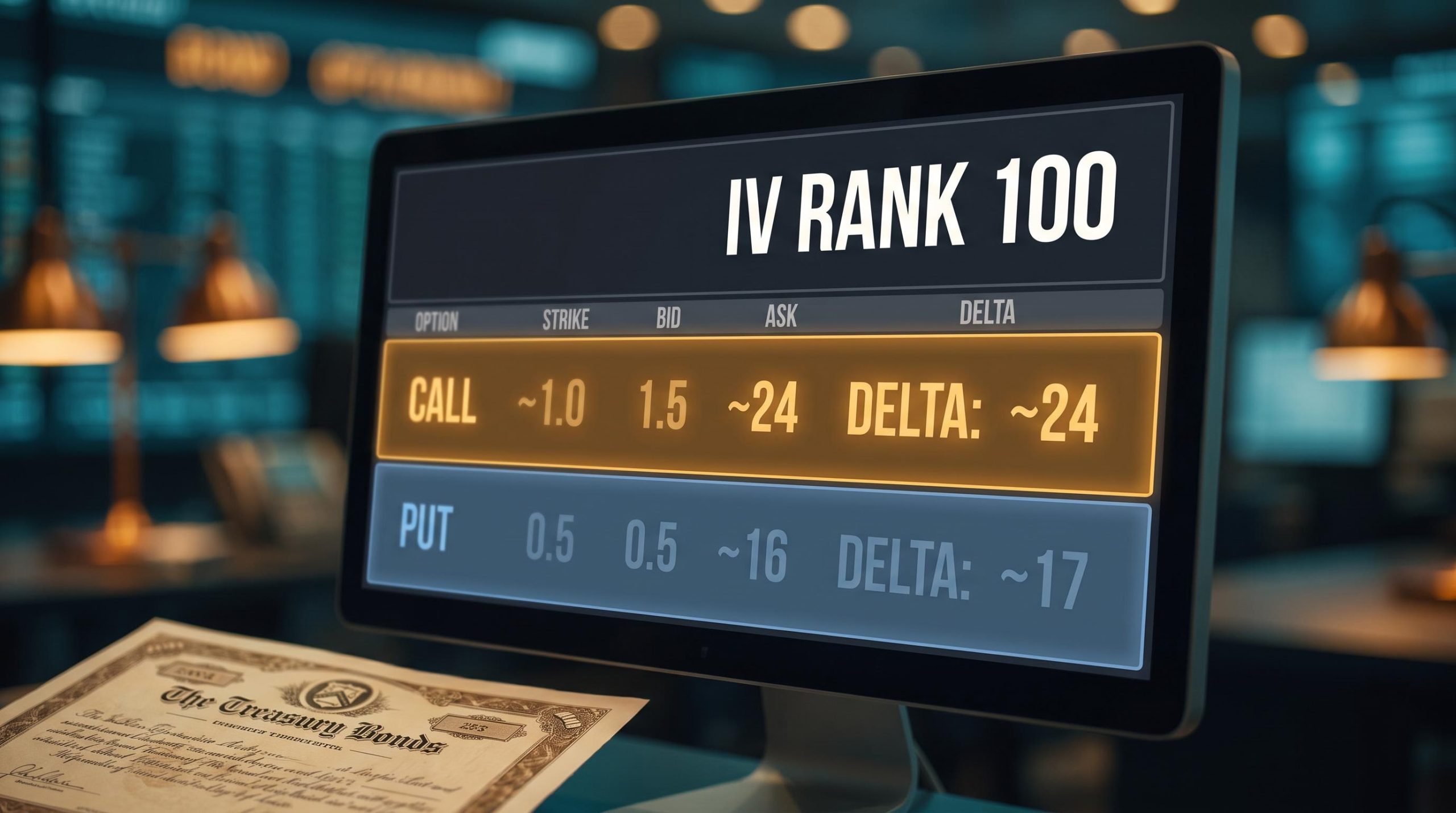
One trader paid $28.8 million in call premium on a stock that had already climbed more than 500% in twelve months. The position targets a breakeven price above every analyst’s average target, and roughly 19% beyond the stock’s then-current all-time high.
That is not a momentum trade in the ordinary sense. It is a wager that the most bullish consensus on Wall Street is still too conservative, and that the stock has to climb through territory nobody covering it has yet forecast in writing.
The company is Lumentum, and it is not a loose AI adjacency play. It is a physical production chokepoint. The lasers and optical modules it manufactures connect the accelerators inside AI clusters, and demand for them is running roughly 25-30% ahead of what the company can physically build.
That structural position is what separates this from late-cycle euphoria, or at least what might. After reading this, you will be able to judge whether the trade’s embedded assumptions are grounded in the supply-demand reality or are pricing in conditions that even Lumentum’s most enthusiastic analysts have not committed to on paper.
A $28.8 million call: how the Lumentum options trade is structured and what it requires
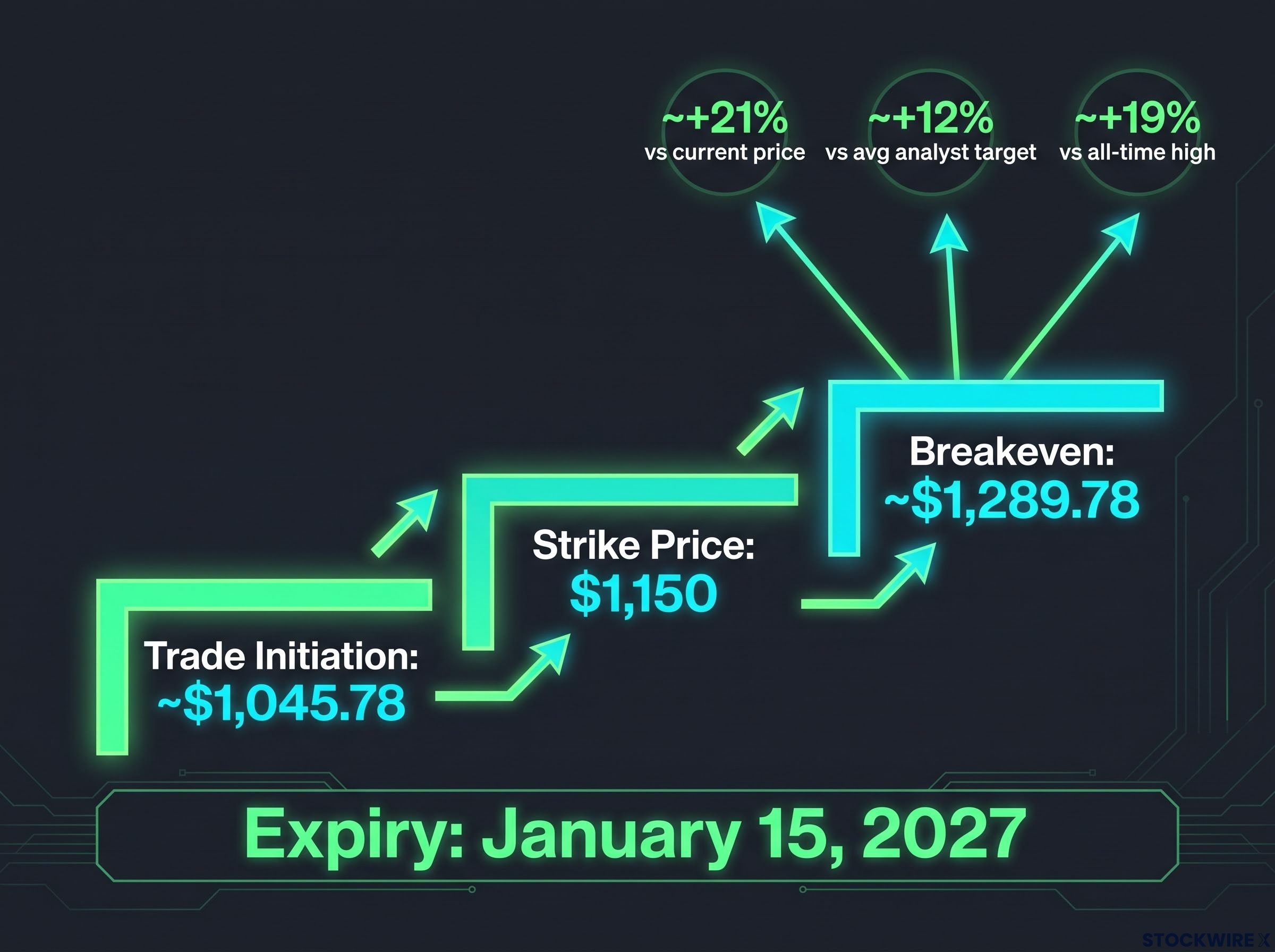
Start with the instrument itself. A single call position was bought on the January 15, 2027 expiry at the $1,150 strike, for $28.8 million in total premium, with 106 days to run at the point of initiation.
A call option gives its holder the right, but not the obligation, to buy shares at the strike price before expiry. For this position to turn a profit at expiration, the stock does not merely need to reach $1,150. It needs to clear that level plus the premium paid per share.
The risk profile here is shaped by call option mechanics that differ sharply from equity ownership: the $28.8 million premium is the absolute maximum loss, but time decay and implied volatility compression can erode the position’s value even when the underlying stock rises.
Run that math and the breakeven lands at approximately $1,289.78. That single figure is the entire story, because of where it sits relative to three separate reference points.
Breakeven: approximately $1,289.78 This sits simultaneously above Lumentum’s all-time high and above the average price target of the analyst community covering the stock. The trade needs conditions nobody has yet forecast.
With the stock trading around $1,045.78 at initiation, the breakeven is roughly 21% higher. Against the average analyst target, it is about 12% higher. And against the then-current all-time high, it is approximately 19% higher.
| Metric | Value | Context |
|---|---|---|
| Strike price | $1,150 | January 15, 2027 expiry |
| Total premium | $28.8 million | Single-leg call purchase |
| Days to expiration | 106 | At trade initiation |
| Implied volatility | 76% | Elevated, but priced in |
| Breakeven price | ~$1,289.78 | Strike plus premium per share |
| Breakeven vs. current price | ~+21% | From ~$1,045.78 |
| Breakeven vs. avg. analyst target | ~+12% | Above consensus |
| Breakeven vs. all-time high | ~+19% | Above prior peak |
At 76% implied volatility, the breakeven sits around half a standard deviation from the initiation price, which makes the position less extreme on a volatility-adjusted basis than the headline $28.8 million suggests. Time decay and volatility compression remain live failure modes, though, and both can erode the position even if the stock rises.
Here is the distinction to hold clearly. The breakeven sits 12% above even the average analyst consensus, which means this is not a trade expressing agreement with Wall Street’s current view. It is a bet that Wall Street’s view will have to be revised upward before January.
When big ASX news breaks, our subscribers know first
What Lumentum actually makes, and why AI cannot build around it
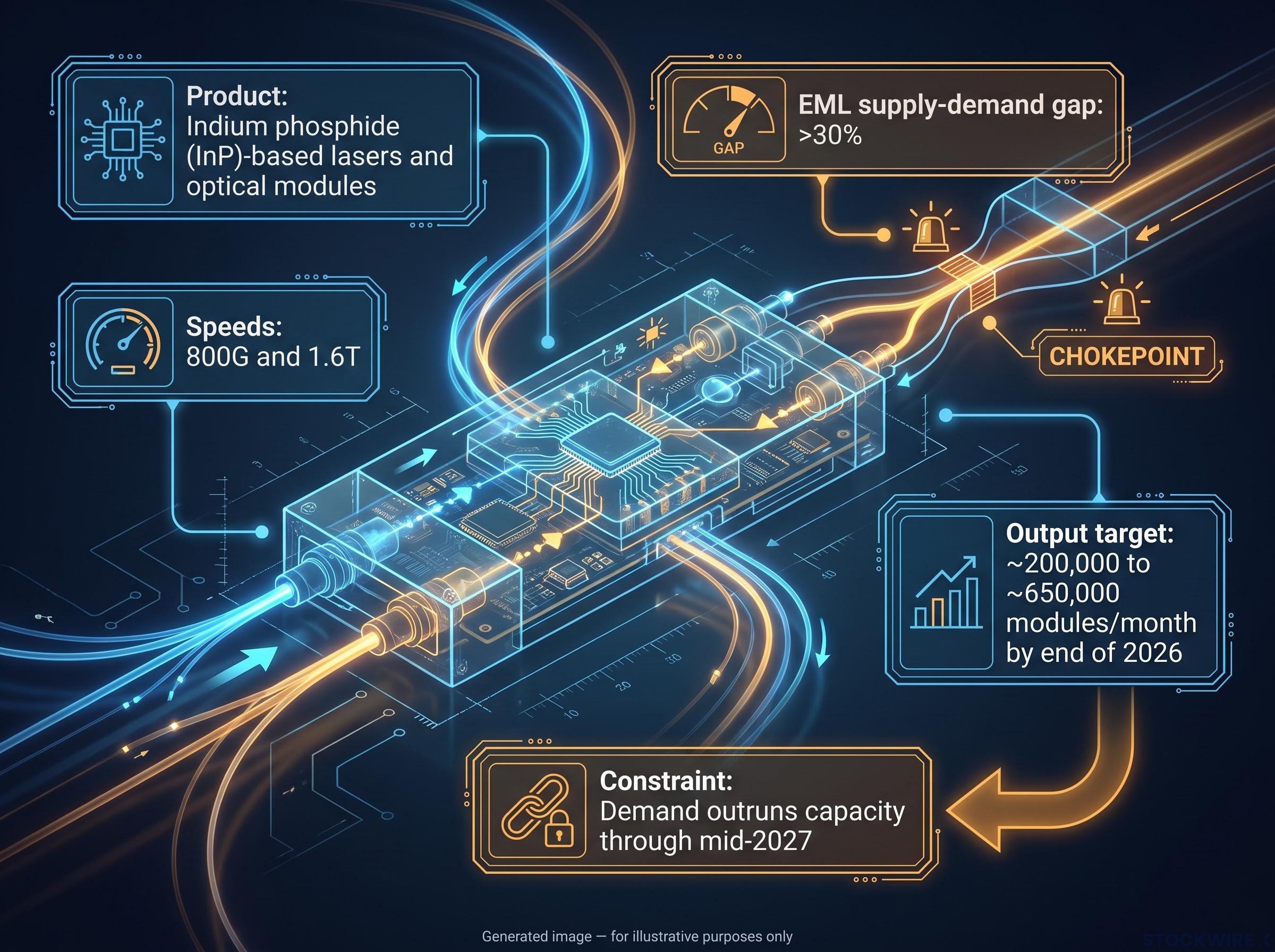
Picture the physical object. Lumentum manufactures indium phosphide (InP)-based lasers and optical modules, the components that carry data between GPU accelerators inside a data centre at 800G and 1.6T speeds. These are not interchangeable commodity parts, and there is no near-term substitute waiting on the shelf.
An optical module converts electrical signals into light so data can move across a cluster at the speeds AI training requires. When you cannot build the modules, you cannot connect the chips, and the accelerators sit idle.
The supply gap is severe and well documented. According to a Moomoo analysis of Lumentum’s fiscal Q4 2026 outlook, the constraints are binding across the product line:
- The supply-demand gap for electro-absorption-modulated lasers (EMLs) runs above 30%.
- Pump-laser shortages are even more acute, forcing the company to ration capacity between customers.
- Shipments of 800G products more than doubled sequentially in the most recent reporting period.
- Even with plans to lift monthly output from roughly 200,000 modules to approximately 650,000 by the end of 2026, demand is projected to outrun capacity through at least mid-2027.
TrendForce identifies InP scarcity as a central bottleneck in AI data-centre interconnects and quotes Lumentum CEO Michael Hurlston warning that the InP supply-demand gap has surpassed that of DRAM and NAND memory. When a chief executive compares his own shortage to the tightest memory markets in the industry, the implication for you is specific: this is not routine backlog management but a structural chokepoint that hands Lumentum real pricing and allocation power for the foreseeable future.
TrendForce analysis of InP supply dynamics corroborates the severity of the bottleneck, noting that Lumentum’s CEO placed the InP shortage above DRAM and NAND memory tightness in terms of structural severity, a comparison that underscores why pricing and allocation power remain concentrated at the fabrication layer.
From hundreds of units to hundreds of millions: why the scale shift broke the supply chain
The root cause is an order-of-magnitude change in demand. Legacy telecom customers bought optical components in the hundreds. AI data-centre operators order in the hundreds of millions, and the InP wafer-fabrication capacity that exists today was never designed for that kind of volume.
Even Lumentum’s multiple InP fabrication facilities are insufficient at the current trajectory. The knock-on effects are visible elsewhere too: according to the Moomoo review, rapid procurement by cloud leaders such as Google has constrained growth in Lumentum’s optical circuit switch lines because the broader supply chain simply cannot keep pace.
The GPU vendors have noticed. TrendForce reports that in March 2026, NVIDIA committed approximately $2 billion each to two key optical suppliers under long-term supply agreements, locking in scarce InP capacity ahead of demand. When the dominant GPU vendor pre-commits that kind of capital to secure parts, it tells you the bottleneck is being priced as durable, not transitory.
What the analyst community is pricing in, and why the consensus kept moving
The analyst coverage on Lumentum does not read as a settled consensus. It reads as a group still chasing a story that keeps outrunning them. Over recent weeks, firm after firm has initiated or lifted its target, and the pattern itself is more telling than any single call.
| Firm | Rating | Price target | Date |
|---|---|---|---|
| Deutsche Bank | Buy (initiation) | $1,200 | Recent |
| Evercore ISI | Outperform | $1,100 | August 2026 |
| Rosenblatt Securities | Buy (reiterated) | $1,300 | 23 September 2026 |
| Stifel | Buy | $1,400 | Recent |
| Citigroup | Buy (upgrade) | $1,400 | 28 September 2026 |
| Sanford C. Bernstein | Outperform | $1,220 | 30 September 2026 |
The conviction is grounded in results, not hope. Lumentum’s FY2026 revenue reached approximately $3.01 billion, up roughly 83.2% year-over-year. Q4 FY2026 revenue came in near $1.01 billion, a 109% year-over-year jump, with non-GAAP EPS of $3.23 beating consensus by about $0.26 and gross margin above 50%.
The forward guidance is where the pattern sharpens. Q1 FY2027 non-GAAP EPS guidance of $4.05-$4.35, with a consensus EPS estimate of $4.22-$4.34 representing roughly 283.6% year-over-year growth, and management lifted full-year operating-margin guidance to 35-36%, against a prior sell-side consensus near 32.4%.
Lumentum’s Q4 FY2026 earnings release placed Q1 FY2027 non-GAAP EPS guidance at $4.05-$4.35 and lifted full-year operating-margin guidance to 35-36%, a combination that moved the analyst consensus meaningfully above the 32.4% sell-side estimate that preceded the report.
86% Buy. 0% Sell. Of the 29 analysts covering Lumentum, CNN reports 86% rate it Buy, 14% Hold, and none rate it Sell. The average target sits around $1,073-$1,159, with a high of $1,400.
That consensus matters to the trade in a concrete way. Each successive target raise creates fresh institutional buying pressure, and that pressure is the mechanism through which the stock could be pushed toward and potentially past the $1,289.78 breakeven. A consensus that keeps being forced upward is one that has not yet found its ceiling, and the options position appears to be a bet that the revision cycle has one more significant leg before January.
Analyst price target spreads on high-growth stocks carry more information than the consensus midpoint alone: when the range runs from $1,073 to $1,400 on the same name, that dispersion reflects genuine uncertainty about terminal value assumptions, and the breakeven at $1,289.78 sits inside the distribution rather than above it.
Where the thesis breaks: valuation, volatility, and the conditions that could unwind the trade
Everything above is the bull case. A sober reading has to audit the assumptions the trade embeds, because each one is a variable you would need to monitor if you were weighing a similar directional view.
Start with valuation. At roughly 28-30x trailing sales, the stock leaves almost no margin for an execution miss, and the breakeven demands a price above the average analyst consensus, though several analysts including Stifel, Citigroup, and Rosenblatt have already published targets up to $1,400. That is a demanding combination even in a structural growth story.
The risks fall into five distinct buckets:
- Valuation extension: A 28-30x trailing sales multiple prices in sustained execution with little room for disappointment.
- Expiry timing: The stock must clear breakeven before 15 January 2027, not merely at some point afterward.
- Volatility compression: At 76% implied volatility, a fall in realised volatility can erode the position even if the stock rises.
- Supply-constraint reversibility: If the expansion to 650,000 monthly modules closes the demand gap faster than the mid-2027 projection, or competitors close the InP fabrication gap, the scarcity premium in the stock could compress.
- AI capex sustainability: The entire demand thesis rests on continued hyperscaler and GPU-vendor capital expenditure.
The macro variable none of the options math can hedge
AI capex sits outside every other line of analysis here. If hyperscaler and GPU-vendor spending cycles turn, or even pause, Lumentum’s demand thesis dissolves regardless of InP capacity or analyst targets. No strike selection, volatility assumption, or supply figure protects against that, which is precisely what makes it the one risk worth naming on its own.
The decision this leaves you with is a clean one. At 28-30x trailing sales with a breakeven above the all-time high, you need to decide whether you are expressing a view on Lumentum’s fundamentals or on the pace of the analyst upgrade cycle. Those are two different bets with two different sets of monitoring criteria.
What the trade is actually saying about where the AI build-out goes next
Step back from the specifics and the $28.8 million position reads as one data point in a wider pattern: institutional money moving into the physical chokepoints of AI infrastructure. InP optical components belong to the same category as high-bandwidth memory and advanced packaging, the parts the build-out cannot route around.
InP optical components belong to the same category as high-bandwidth memory and advanced packaging: physical bottlenecks the AI build-out cannot route around, where constrained supply has persisted well past initial projections and where the dominant chip vendors have begun committing multi-year procurement capital.
For the trade to pay off between October 2026 and January 2027, three things need to hold:
- Hyperscaler and GPU-vendor capital expenditure announcements keep coming.
- The analyst target revision cycle runs at least one more round.
- The stock moves at least 21% from its initiation price inside roughly 106 days.
The expiry date is not arbitrary. 15 January 2027 sits near the period when the 650,000-module monthly target faces its first real market test, with Q1 FY2027 guidance of $4.05-$4.35 EPS covering that window.
Read that way, the position is implicitly a bet that the next earnings print forces another round of upgrades and triggers a fresh leg of institutional buying. For context, the stock ran from roughly $145 to around $1,050 in twelve months, more than 500%, and the trade is wagering that run has not finished.
“The InP supply-demand gap has surpassed that of DRAM and NAND.” Lumentum CEO Michael Hurlston, as quoted by TrendForce. The forward view rests on that single supply-chain signal holding.
If you are tracking this position’s lifecycle, the earnings date is the event to watch above all others.
Reading the trade on its own terms before January’s verdict
The through-line is coherent even where the risks are real. Lumentum sits at a genuine physical chokepoint in AI infrastructure, its financials have repeatedly beaten expectations, with FY2026 revenue up around 83.2% and Q4 FY2026 up 109%, and the analyst community has been forced to revise targets upward more than once. The options position is a structured bet that this beat-and-revise pattern has one more significant leg before January 2027.
What it asks for is not trivial. A breakeven near $1,289.78 sits roughly 19% above the all-time high and 12% above consensus, and it depends on AI capex staying robust and the capacity expansion not closing the demand gap prematurely.
The trade’s thesis is falsifiable on specific, observable variables rather than on a general faith in AI. Three are worth watching between now and expiry:
- The Q1 FY2027 earnings print and its guidance update.
- Any shift in hyperscaler capital expenditure signals.
- Whether monthly production capacity progresses toward the announced 650,000-unit trajectory.
With 86% of analysts currently rating the stock Buy, institutional confidence is clearly high. Whether that confidence stretches another 21% by January is the question the trade is paying $28.8 million to answer.
For investors tracking this position through to the Q1 FY2027 earnings print, our dedicated guide to post-earnings decision frameworks covers the analyst revision timing, pre-earnings trigger rules, and tax considerations that determine whether acting within 24 hours of a result is optimal or premature.
This article is for informational purposes only and should not be considered financial advice. Investors should conduct their own research and consult with financial professionals before making investment decisions. Past performance does not guarantee future results. Financial projections are subject to market conditions and various risk factors, and forward-looking statements are speculative and subject to change based on market developments and company performance.