Two growth stocks posted double-digit after-hours gains in the same week that hardware names stumbled. That split tells you more about where AI capital is actually concentrating than any sector-rotation thesis currently circulating.
Airbnb and Cloudflare both reported Q2 2026 earnings after market close this week. Both beat consensus estimates on revenue and earnings per share, both raised full-year guidance, and both triggered outsized market reactions in after-hours trading. In the same window, SanDisk Corporation and Western Digital Corporation posted quarterly results that disappointed investors on multiple fronts. The divergence was sharp, visible, and instructive.
Here is a framework for reading after-hours earnings reactions in AI-adjacent names: what the numbers actually signal, why guidance language matters more than the quarterly beat, and how to distinguish companies with genuine AI pull-through from those wearing the label.
The numbers behind the after-hours moves
Start with the raw prints, because the pattern assembles itself before any interpretation is required.
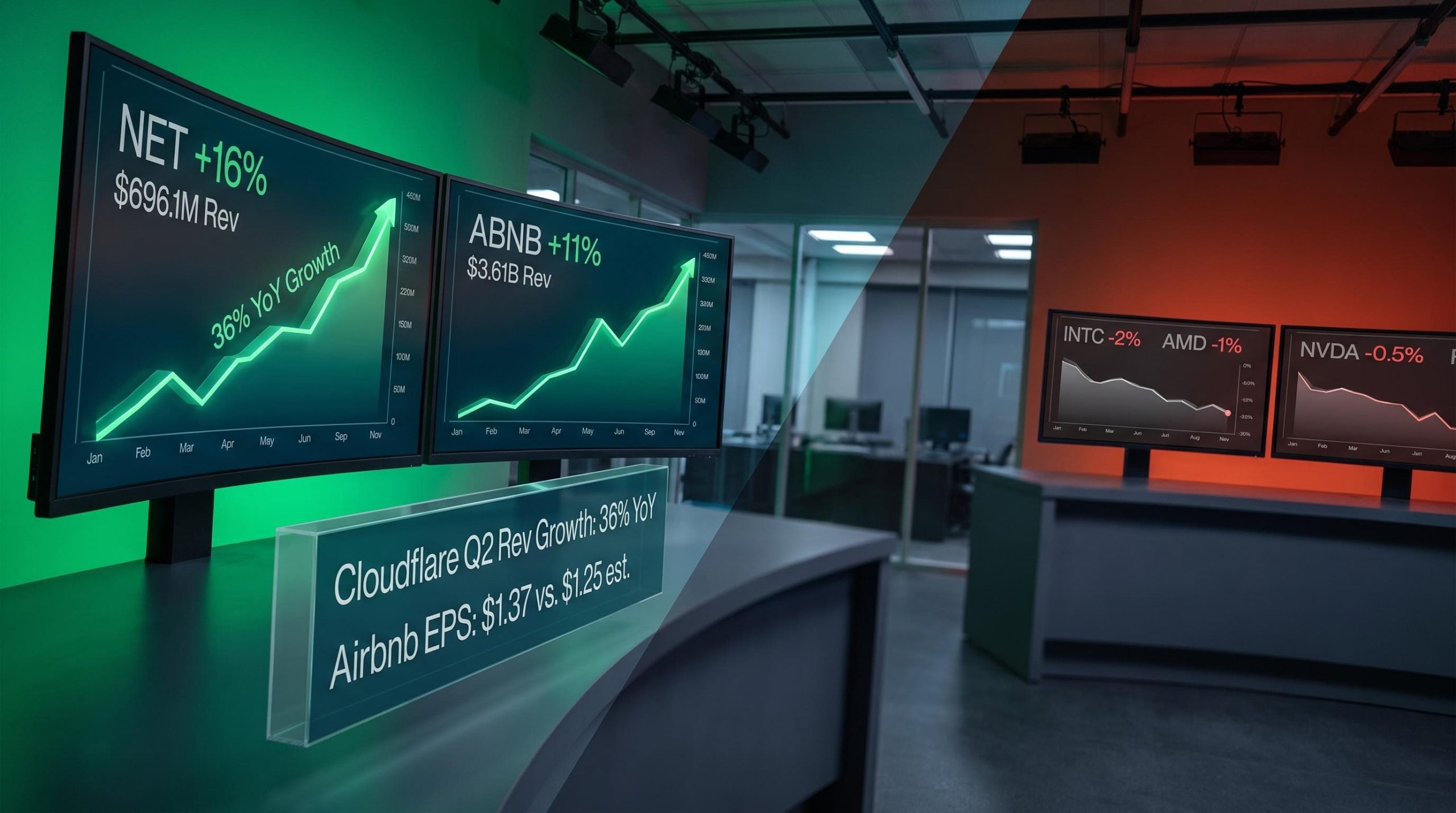
Airbnb reported Q2 2026 revenue of $3.61 billion, roughly 17% year-over-year growth, edging past consensus near $3.58 billion. Adjusted earnings per share came in at $1.37, ahead of the $1.25-$1.26 consensus range. The company raised its full-year revenue growth guidance to “at least mid-teens” and lifted its adjusted EBITDA margin target to at least 35.5%. Shares gained approximately 11% in after-hours trading.
Cloudflare’s result was sharper. Q2 revenue hit $696.1 million, up 36% year over year, beating consensus near $664-665 million. Non-GAAP earnings per share landed at $0.29 against expectations of $0.27. Full-year revenue guidance rose to $2.864-$2.870 billion, implying approximately 32% growth. Shares climbed roughly 15-17% after hours.
Cloudflare’s 36% year-over-year revenue growth was the single most striking figure of the week, beating consensus by more than $30 million and anchoring a broader software and cloud rally.
| Metric | Airbnb (ABNB) | Cloudflare (NET) |
|---|---|---|
| Q2 Revenue | $3.61B (~17% YoY) | $696.1M (~36% YoY) |
| Non-GAAP EPS | $1.37 (vs. ~$1.25-$1.26 est.) | $0.29 (vs. ~$0.27 est.) |
| After-Hours Move | ~11% | ~15-17% |
| Full-Year Revenue Guidance | “At least mid-teens” growth | $2.864-$2.870B (~32% growth) |
Two very different businesses, two different revenue scales, yet both executed the same structural pattern: beat, raise, and reprice. That pattern is what the market is paying for.
When big ASX news breaks, our subscribers know first
Why beat-and-raise moves valuation models, not just sentiment
A beat-and-raise does something specific inside a valuation model. Understanding the mechanics explains why a seemingly modest earnings surprise sometimes produces a 10% overnight move.
The expectations gap is the mechanism doing most of the work in any post-earnings repricing: a result that looks strong in absolute terms can still disappoint if the market had already priced in something stronger, which is why headline beats and negative after-hours reactions can coexist in the same earnings cycle.
Three compounding factors amplify the repricing:
- Current-period beat: Analysts must lift the quarter they just got wrong, which resets the starting point for all forward estimates.
- Multi-period guidance lift: Raising full-year guidance forces model revisions across every remaining quarter simultaneously, not just the one just reported.
- Sentiment baseline reset: When a company breaks a pattern of misses or low expectations, the surprise carries extra weight because it reverses a negative prior, not just exceeds a neutral one.
Airbnb illustrates all three at once. The company entered this print with a history of earnings-per-share misses and subdued expectations. A clean beat plus raised guidance broke that negative pattern, and the market responded accordingly.
What Airbnb’s guidance language actually changed for analysts
The specific language shift matters. Airbnb moved its full-year revenue growth outlook from “low- to mid-teens” to “at least mid-teens” and raised its EBITDA margin target to at least 35.5%. Cloudflare lifted non-GAAP earnings-per-share guidance to $1.25-$1.26 from $1.19-$1.20.
In plain terms, Airbnb raised the floor without setting a new ceiling. The phrase “at least” removes an upper bound, which in model construction is more bullish than a simple guidance raise to a fixed range. It signals management confidence that the trajectory has room to run, and analysts are forced to widen the upside of their estimates accordingly.
Even a small change in forward language can force analysts to revise long-term earnings trajectories upward, which is why a seemingly modest beat sometimes produces a double-digit price move overnight. For readers evaluating whether to act on an after-hours spike, that distinction between a one-quarter beat and a multi-period model revision is the difference between chasing momentum and understanding repricing.
What makes an AI growth story verifiable (and why Cloudflare’s print passed the test)
The AI label is cheap. Proving it in the revenue line is not.
Cloudflare’s 36% revenue growth, raised guidance, and management commentary directly linking growth to enterprise adoption of its agentic AI, edge, and zero-trust infrastructure constitute verifiable AI pull-through in the numbers. This is not slide-deck rhetoric. The revenue line moved, guidance went up, and management tied both to specific AI-driven demand.
The market is now specifically rewarding companies embedded in AI’s delivery infrastructure, the security, edge, networking, and model-routing layers that every AI workload requires, rather than those that merely reference AI in earnings commentary. The broader software and cloud rally this week was built on a string of beats that eased investor concerns about AI’s disruptive impact on legacy software models. But the largest moves went to companies that could demonstrate the link in their financials.
Wall Street’s shift toward demanding AI monetisation receipts, quantified paying customers, usage metrics, and EPS flow-through, rather than rewarding capex narratives and management commentary, is precisely the analytical standard that Cloudflare’s 36% growth rate and raised guidance cleared this week.
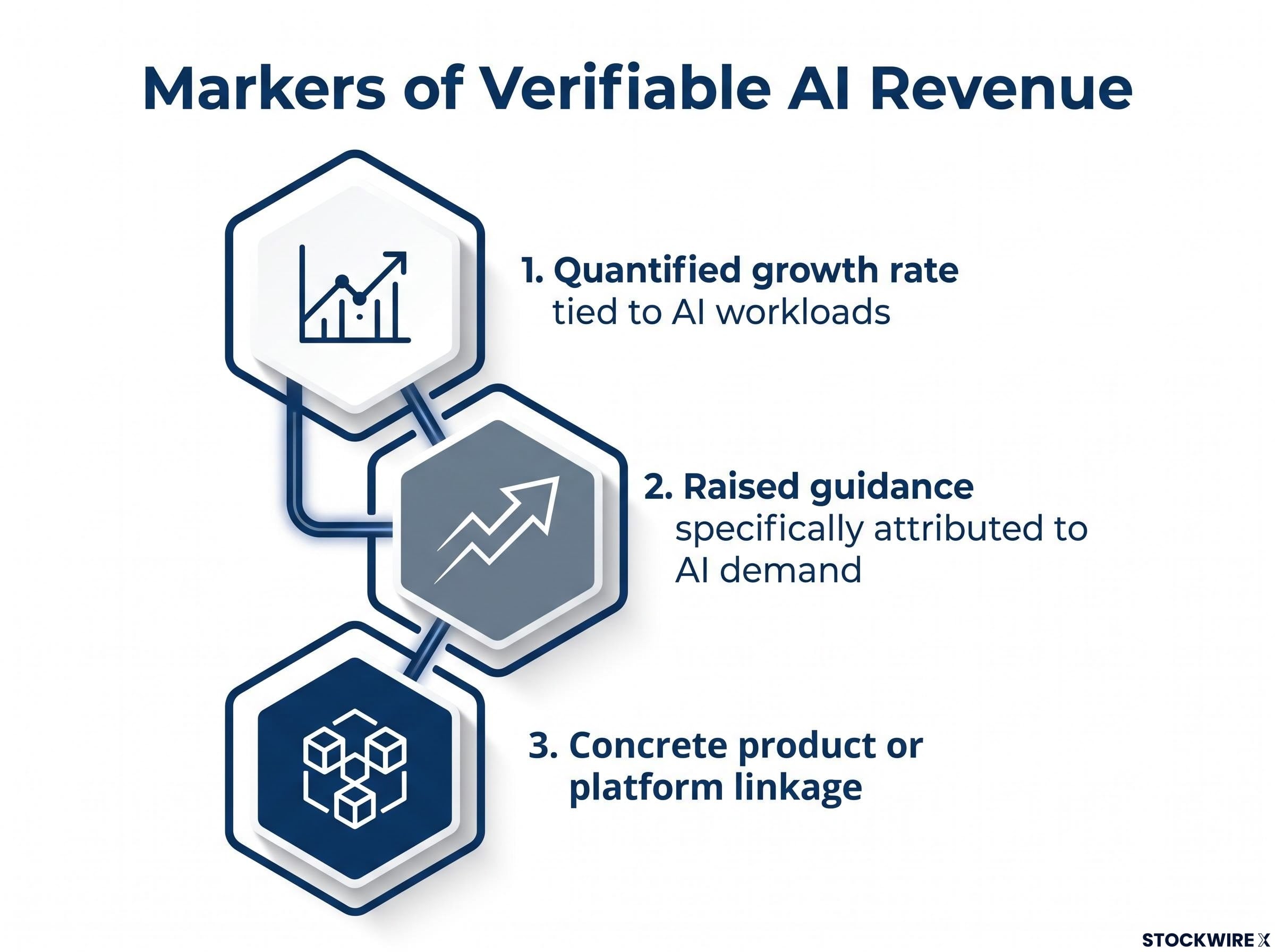
Three markers distinguish a verifiable AI revenue story from a narrative one:
- Quantified growth rate tied to AI workloads: Revenue growth that management can attribute directly to AI-driven demand, not just overall growth in a business that happens to touch AI.
- Raised guidance specifically attributed to AI demand: Forward outlook lifted because AI adoption is accelerating, not because of a one-off contract or seasonal strength.
- Concrete product or platform linkage: A specific product, platform, or infrastructure layer that sits inside the AI delivery stack, not a peripheral benefit.
If a company cannot point to a direct line from AI demand to revenue growth in its quarterly print, it is unlikely to receive the AI-premium valuation multiple, regardless of how prominently AI features in management commentary.
The SanDisk and Western Digital contrast: when the sector label is not enough
SanDisk and Western Digital each reported quarterly numbers earlier this week that fell short of what investors were looking for, coming in below the bar on key metrics. The timing made the contrast with Airbnb and Cloudflare’s reactions impossible to miss, and it reveals a filtering mechanism the market is applying in real time.
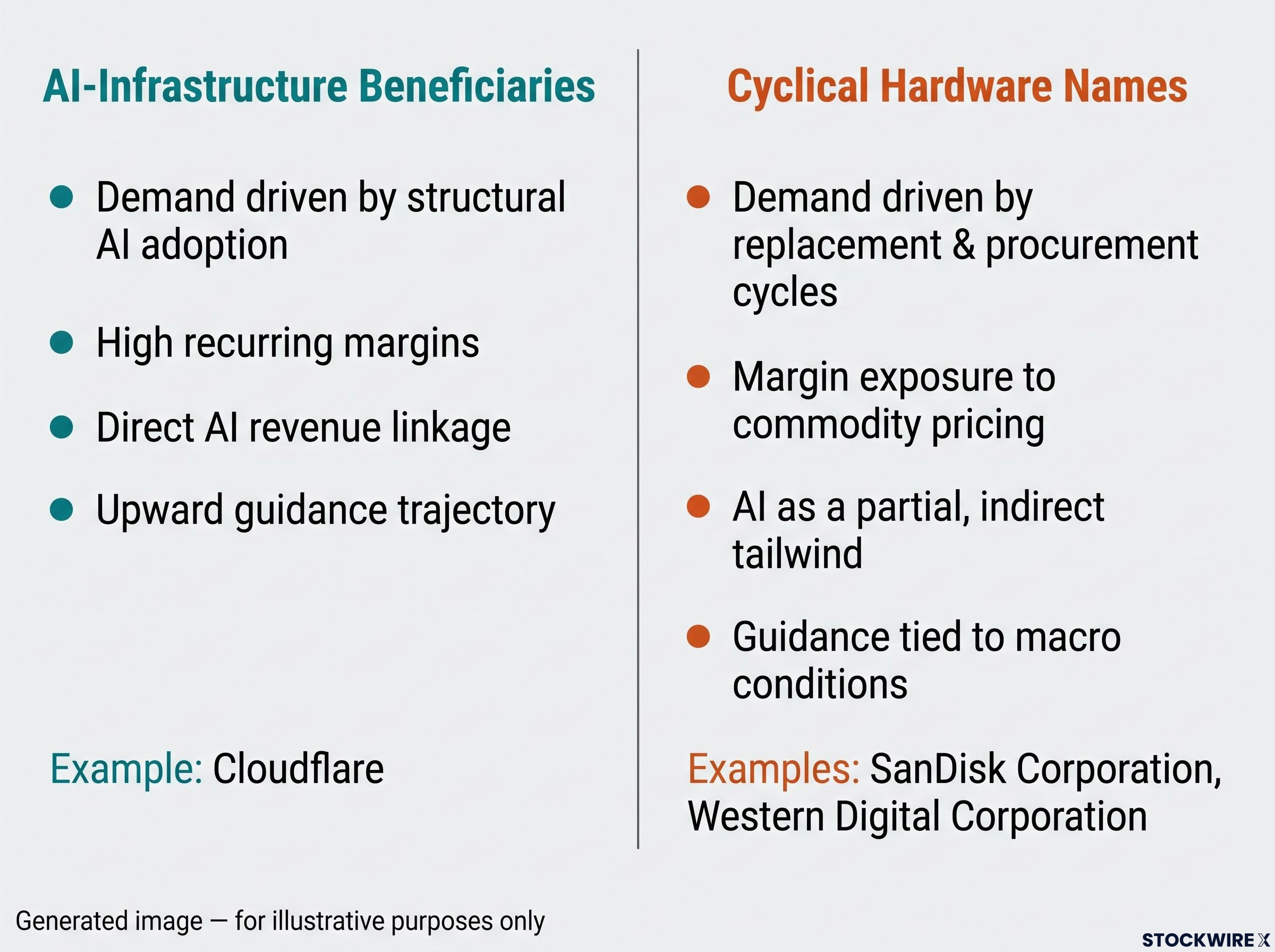
The distinction is structural. Hardware businesses tethered to older, more cyclical demand cycles lack the high-margin, AI-direct revenue exposure that investors are currently pricing at a premium. AI may generate incremental storage and compute demand for these names, but that demand is mediated through procurement cycles and commodity pricing rather than through the direct software-margin economics that Cloudflare and similar platforms capture.
- AI-infrastructure beneficiaries: Demand driven by structural AI adoption; high recurring margins; direct AI revenue linkage in the quarterly print; upward guidance trajectory
- Cyclical hardware names: Demand driven by replacement and procurement cycles; margin exposure to commodity pricing; AI as a partial, indirect tailwind; guidance tied to macro conditions
Why proximity to the AI stack determines valuation treatment
Security, edge, networking, and cloud platforms sit inside AI’s operational layer. Every AI workload requires routing, security, and inference infrastructure. Companies positioned here capture AI demand directly through their revenue model.
AI delivery infrastructure, encompassing security, edge networking, and inference routing, captures demand from AI workloads at structurally higher margins than hardware manufacturers because it sits at the binding operational constraints every deployment must resolve, regardless of which model or chip generation is running underneath.
Hardware manufacturers sit further back. AI creates demand for storage and compute, but the path from AI spending to hardware revenue runs through enterprise procurement budgets and component pricing cycles. The sector classification says “tech.” The valuation treatment says otherwise.
Owning broad tech exposure no longer provides the AI tailwind many investors assume it does. What matters is proximity to the AI delivery stack, and hardware manufacturers are further from that stack than their sector label implies.
Reading after-hours reactions without being led by them
After-hours earnings reactions are sentiment readouts, not trading signals. The 10-17% overnight moves in Airbnb and Cloudflare reflect high-conviction institutional re-rating of future earnings trajectories and narrative credibility, particularly around AI and durable demand. They do not communicate anything reliable about entry price the following morning.
Positioning amplified the magnitude. Both stocks entered earnings after periods of macro volatility and a technology-sector selloff through July 2026, which lowered the bar for surprise and gave the beat-and-raise more room to reprice. The same results in a high-expectations environment would likely have produced smaller moves.
Three questions to apply to any large after-hours earnings move:
- Does guidance reflect a structural change, or a single-quarter beat that may not repeat?
- Was the move amplified by low expectations, or by genuine fundamental surprise that would have repriced the stock regardless of positioning?
- Has the company demonstrated verifiable AI revenue linkage, or only narrative alignment with the AI theme?
After-hours moves in liquid growth stocks are a high-conviction institutional message about repriced earnings trajectories. They are not an entry signal.
For anyone evaluating whether to act on these gaps, the 10-17% repricing means the initial re-rating has already happened. The value now lies in assessing whether the raised guidance is durable, not in reacting to the price gap itself.
This article is for informational purposes only and should not be considered financial advice. Investors should conduct their own research and consult with financial professionals before making investment decisions.
What these prints change, and what they do not
Airbnb and Cloudflare’s results confirm that the beat-and-raise pattern combined with verifiable AI revenue linkage is the current threshold for receiving an AI-growth valuation premium. The market is applying that threshold selectively, even within the technology sector, as the SanDisk and Western Digital contrast made visible in real time.
What remains unresolved is broader. Questions about whether AI investment levels are sustainable continued to weigh on market sentiment throughout the week. Two strong earnings prints do not settle a macro debate about the durability of AI infrastructure spending. The overhang persists.
For investors wanting to understand the broader analyst debate around when AI revenue inflects into software earnings, our full explainer on Goldman’s 2027 AI software timeline covers the monetisation delay evidence and the two companies Goldman identifies as already meeting the quantified revenue standard.
The forward-looking question for readers is specific: it is not whether to own AI growth exposure, but whether the names in your portfolio can actually demonstrate the beat-and-raise plus AI pull-through pattern when they next report. That is the filter the market is applying. The companies that pass it are being repriced aggressively. The ones that cannot are being left behind, regardless of what sector they sit in.
These statements are speculative and subject to change based on market developments and company performance.