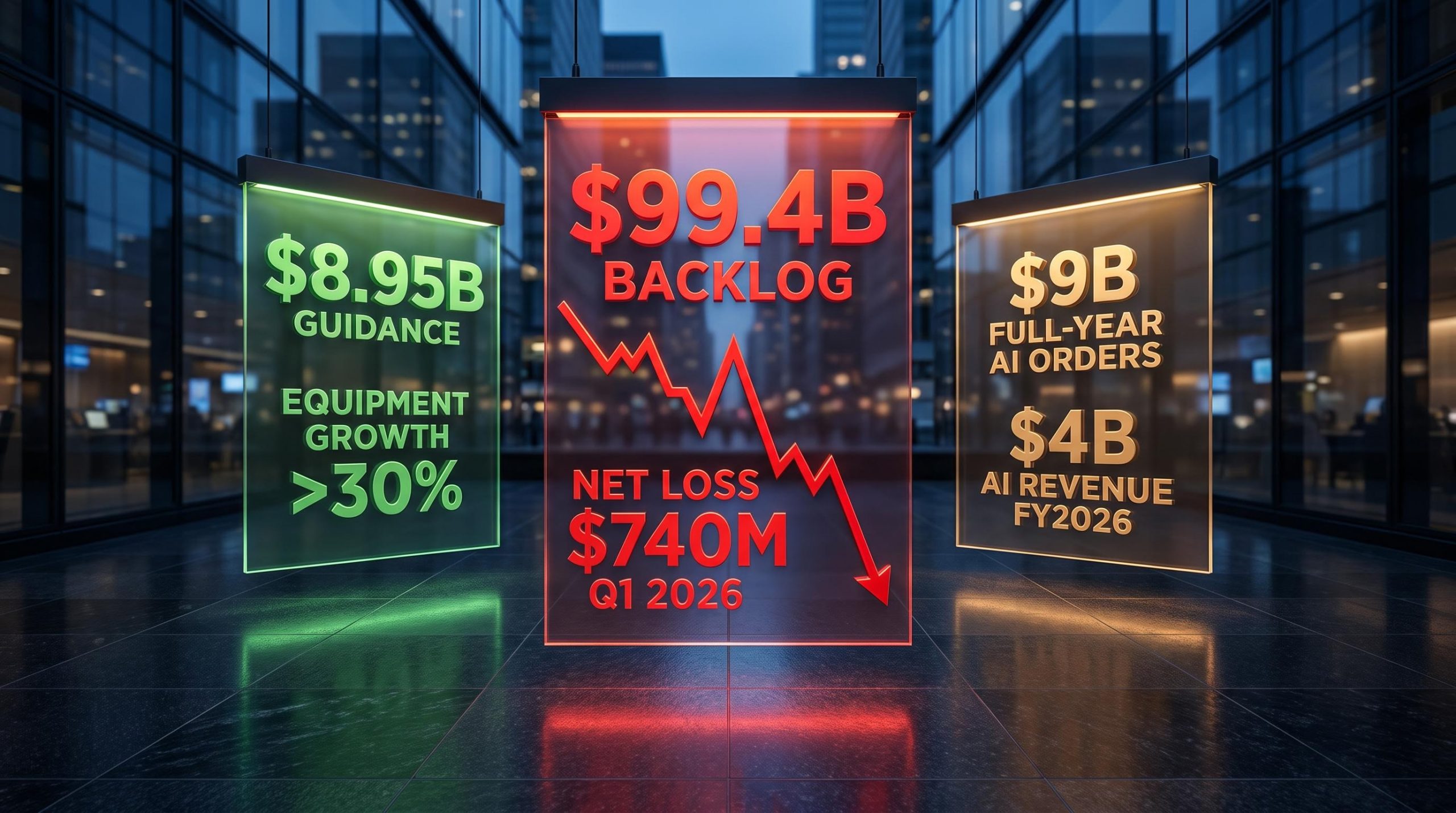
Three companies reported earnings this week, and together they tell a story that no single quarterly print could tell on its own. Cisco, Applied Materials, and CoreWeave sit at three different layers of the AI infrastructure stack: networking, semiconductor equipment, and GPU cloud. Their results landed within days of each other during the week of 10-15 August 2026, and the signals do not all point in the same direction.
That matters because the AI infrastructure investment thesis is no longer one trade. It is three distinct risk profiles, each with different capital structures, different margin trajectories, and different sensitivities to any shift in hyperscaler spending. Treating them as a single theme is increasingly expensive.
Reading these three prints together gives you a clearer map of where the AI buildout cycle actually stands than any individual company report could. Here is which layer is healthy, which is under strain, and what that means for how you hold AI exposure heading into the back half of 2026.
What three companies across the AI stack are telling you this week
The AI infrastructure buildout has distinct layers, and this week’s earnings cluster gives you a simultaneous read across three of them:
- Upstream (semiconductor equipment): Applied Materials makes the tools foundries use to manufacture AI chips
- Midstream (networking): Cisco builds the high-bandwidth switches, optical interconnects, and silicon photonics that connect GPU clusters
- Downstream (GPU cloud): CoreWeave operates the data-centre compute infrastructure that delivers AI processing power to customers
No single hyperscaler earnings call can replicate this cross-sectional view. When all three layers report in the same week, you get a structural read on the entire capital expenditure cycle, not just one company’s quarter.
| Company | Stack layer | Key metric | Reported value |
|---|---|---|---|
| Applied Materials | Semiconductor equipment (upstream) | Q3 FY2026 revenue guidance | ~$8.95 billion |
| Cisco | Networking (midstream) | Full-year AI order expectations | $9 billion |
| CoreWeave | GPU cloud (downstream) | Q1 2026 revenue | $2.078 billion |
The broader S&P 500 earnings season has helped stabilise sentiment around inflation and the AI investment cycle, which means these results landed in a relatively constructive macro context. The fact that all three layers are reporting growth simultaneously tells you the buildout has not yet reached the point where any major layer is pulling back. For portfolio positioning, that is the baseline you work from before examining each company’s specific risk profile.
The hyperscaler AI capex commitments for 2026, which the Financial Times has pegged at approximately $725 billion across Amazon, Microsoft, Alphabet, and Meta combined, provide the demand floor underneath all three layers of the stack and explain why equipment makers, networking vendors, and GPU cloud operators can raise guidance simultaneously.
When big ASX news breaks, our subscribers know first
CoreWeave’s numbers show the AI demand problem is now a capital efficiency problem
The backlog as evidence of demand
Start with the top line, because it is extraordinary. CoreWeave reported Q1 2026 revenue of $2.078 billion, more than doubling from $982 million in Q1 2025. That is not a company riding a narrative. That is a company converting contracted compute demand into recognised revenue at a pace few public companies have matched.
The backlog is even more striking. CoreWeave’s contracted revenue backlog stood at $99.4 billion as of 31 March 2026, after the company added more than $40 billion in new customer commitments in a single quarter. Those commitments came from names including Anthropic and Meta, which tells you the largest AI operators are still signing multi-year compute deals, not pausing. Approximately 36% of that backlog is expected to convert within 24 months, with 75% converting within four years, providing revenue visibility extending through roughly 2030.
$99.4 billion in contracted revenue backlog as of 31 March 2026, with more than $40 billion added in a single quarter.
The cost structure underneath the growth
Then the other side of the equation arrives. CoreWeave reported a net loss of $740 million in Q1 2026, up from $315 million in Q1 2025. Adjusted operating margin sat at approximately 1%, which management characterised as likely the cycle low point. The company’s 2026 capex guidance of $31-35 billion is more than double 2025 levels of approximately $14.9 billion. Interest expense hit approximately $536 million in the quarter alone, with long-term debt near $23 billion.
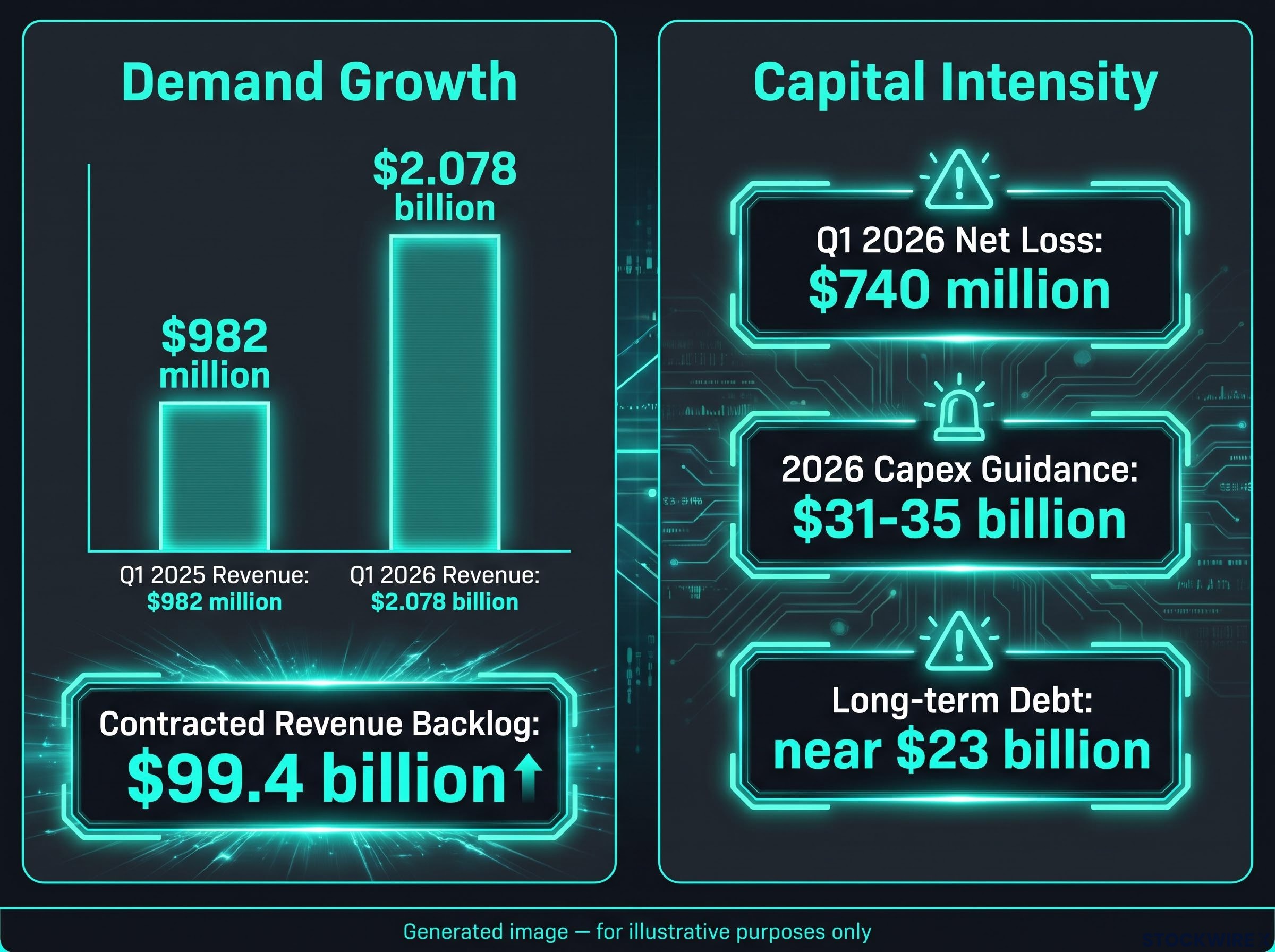
The market’s reaction told you which side of this equation investors are now focused on. The stock fell on higher capex guidance despite beating revenue expectations. That is not a demand question anymore. It is a financing question.
A $740 million quarterly loss alongside a $99.4 billion backlog is not a contradiction; it is a capital equation. Understanding which side of that equation you are betting on is what separates a disciplined position from a thematic one.
Hyperscaler cash flow constraints have become the structural ceiling on how fast the buildout can scale: Barclays models point to more than $200 billion in debt issuance required to close the funding gap between 2026 and 2028, a backdrop that makes CoreWeave’s $31-35 billion capex guidance and $23 billion long-term debt position part of a sector-wide financing pattern rather than a company-specific anomaly.
Applied Materials’ beat-and-raise is the cleanest bullish signal in this week’s cluster
Applied Materials sits upstream of the entire AI chip ecosystem. It makes the tools that foundries and integrated device manufacturers (IDMs), the companies that design and fabricate their own semiconductors, use to manufacture AI-optimised chips. That position matters because equipment orders reflect committed purchasing decisions that take months or years to unwind. When an equipment maker beats and raises guidance, it is reflecting capacity expansion commitments that fabs made well before the quarter closed.
The numbers were unambiguous:
- Q3 FY2026 revenue guidance of approximately $8.95 billion (plus or minus $500 million), well above prior consensus of roughly $8.1-$8.15 billion
- Record non-GAAP earnings per share and operating margins in the reported quarter
- Semiconductor equipment growth expectations for calendar 2026 raised to more than 30%
Semiconductor equipment growth expectations for calendar 2026 raised to more than 30%, reflecting committed capacity expansion by foundries and IDMs.
Management explicitly tied the guidance to sustained hyperscaler and data-centre AI infrastructure spending. That connection matters: strong equipment demand validates continued capex by Nvidia, hyperscalers, and specialised AI cloud providers including CoreWeave. Foundries are not pausing.
When semiconductor equipment makers raise guidance, they give you a forward read on AI chip capacity that is less volatile than any single quarter of cloud revenue. For investors seeking AI exposure with comparatively lower financing risk, equipment makers offer a path into the buildout cycle without the balance-sheet concentration visible in leveraged pure-plays.
The semiconductor equipment supercycle driving Applied Materials’ guidance upgrade is not isolated to a single customer: TSMC raised 2026 capex guidance to $60-64 billion, Intel grew tool purchases 40% year-over-year, and Tesla’s Terafab represents a third independent demand stream, each reinforcing the multi-year order visibility that distinguishes equipment makers from other AI stack layers.
What Cisco’s pivot tells you about where the networking bottleneck actually sits
Orders as the leading indicator
High-bandwidth, low-latency networking is not a peripheral layer of the AI stack. It is an architectural constraint. Large GPU clusters require optical interconnects, advanced switches, and silicon photonics to keep thousands of processors fed with data simultaneously. Without that network fabric, the GPUs sit idle. That makes networking a genuine bottleneck on how fast AI clusters can scale.
Cisco’s order trajectory suggests hyperscalers understand this. Year-to-date AI infrastructure orders reached $5.3 billion through May 2026, with full-year order expectations raised to $9 billion. Full-year FY2026 AI-related revenue guidance was lifted to $4 billion, up from a prior target of $3 billion. Those are not incremental adjustments. They signal that networking has moved from secondary procurement to a priority capex line.
Restructuring as strategic reallocation
Cisco is cutting roughly 4,000 roles as part of a wider restructuring programme. CEO Chuck Robbins described the rationale as ensuring the company maintains the discipline to concentrate capital where demand and long-term value creation are genuinely strongest. The capital is moving toward three specific areas:
- Silicon development for custom networking chips
- Optical components for high-bandwidth interconnects
- Cybersecurity infrastructure integrated with AI workloads
That is not a distress signal. It is a company trimming legacy operations to fund the transition toward the part of the stack where hyperscaler spending is concentrating.
Cisco raising its AI order expectations to $9 billion tells you that hyperscalers are not just buying more GPUs; they are investing heavily in the network fabric that connects them. Cisco’s margin trajectory over the next two quarters will tell you whether that shift is value-accretive or just volume.
How the AI infrastructure stack works, and why each layer matters to investors
The AI infrastructure value chain operates as a layered system. Each layer has a different function, a different demand signal timing, and a different risk profile. Understanding which layer a company occupies is not an academic exercise. It maps directly to the risk you carry in your exposure, how early you can see a cycle turn, and how much balance-sheet risk sits underneath the growth.
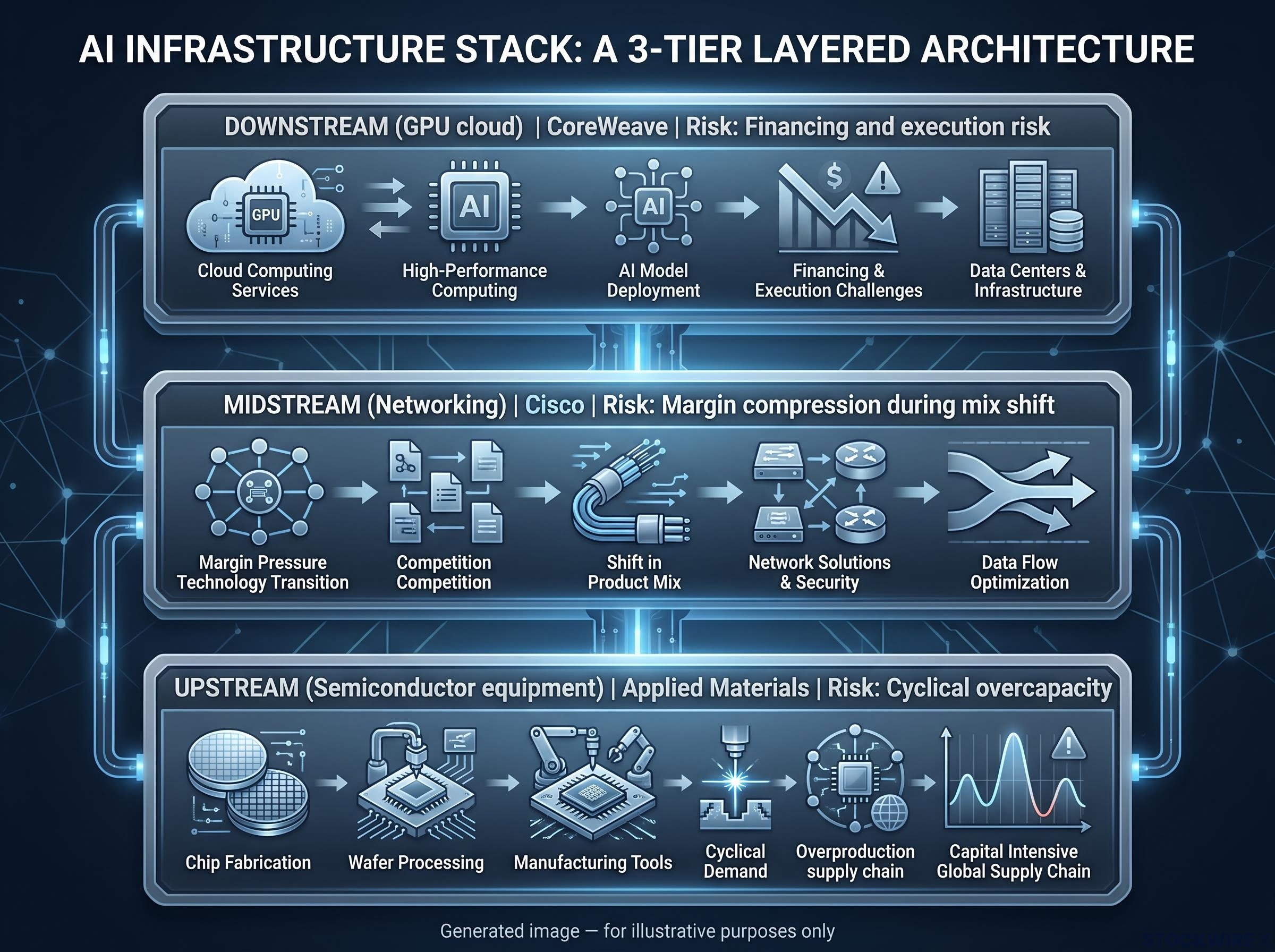
At the bottom of the stack, semiconductor equipment makers like Applied Materials supply the tools that build the chips. Their demand signals tend to be the stickiest and least volatile because equipment orders reflect multi-year capacity commitments. Above them, networking vendors like Cisco sit at the architectural bottleneck, connecting GPU clusters and enabling the compute to function at scale. At the top, GPU cloud operators like CoreWeave carry the most direct demand exposure but also the highest capex and financing risk, as illustrated by CoreWeave’s $31-35 billion capex guidance for 2026.
The AI supply chain layers that separate a GPU designer from a copper miner from a foundation model company represent fundamentally different investments with different moat types, macro drivers, and risk profiles, even though all three are routinely described as AI plays in the same portfolio allocation conversation.
| Stack layer | Representative company | Demand signal type | Primary risk factor |
|---|---|---|---|
| Semiconductor equipment (upstream) | Applied Materials | Leading (committed orders) | Cyclical overcapacity |
| Networking (midstream) | Cisco | Concurrent (order flow) | Margin compression during mix shift |
| GPU cloud (downstream) | CoreWeave | Concurrent-to-lagging (backlog conversion) | Financing and execution risk |
Investors who apply this layered model can make more precise risk-adjusted allocation decisions than those treating all AI-adjacent companies as a single thematic bucket. The layer tells you the risk profile. The company results tell you the health of that layer.
Where the risk-reward sits now across the three positions
The evidence from this week converts into a framework with three specific monitoring variables. Each one tells you something different about where the cycle stands.
- CoreWeave backlog conversion: approximately 36% expected within 24 months, 75% within four years. The headline backlog is powerful, but the pace and profitability of converting it into recognised revenue is the metric that determines whether the capital equation resolves or widens.
- Applied Materials guidance delta: the gap between guidance of approximately $8.95 billion and prior consensus of $8.1-$8.15 billion is the benchmark. If that gap narrows or reverses in subsequent quarters, foundry commitment to expansion is softening.
- Cisco margin trajectory: Cisco’s shift toward silicon, optics, and cybersecurity changes its revenue mix. Whether margins expand or compress during that transition tells you if the networking pivot is creating value or just displacing legacy revenue with lower-margin AI volume.
The market’s evaluation lens has shifted. Investors are no longer asking whether AI infrastructure demand is real. They are asking what the cost of owning that demand is, and whether the return justifies it. CoreWeave’s stock falling on higher capex guidance, despite beating revenue, is the clearest evidence of that shift.
The contrast between diversified beneficiaries and leveraged pure-plays is now the central positioning question. Applied Materials and Cisco offer AI infrastructure exposure with established balance sheets and profitability. CoreWeave offers maximum direct demand exposure but carries concentrated financing, technology, and execution risk. Those are different trades, and treating them as the same trade is where portfolio risk accumulates without being sized correctly.
The buildout is intact, but the investment calculus has changed
The combined signal from this week is clear: expansion continues across the full AI infrastructure stack. CoreWeave’s backlog is still growing, Applied Materials raised guidance above consensus, and Cisco’s order trajectory points to sustained hyperscaler networking spend through the back half of 2026. Full-year AI order expectations at Cisco of $9 billion and capex guidance at CoreWeave of $31-35 billion represent commitments that make any near-term cycle reversal unlikely without a significant demand shock.
But the investment playbook that worked in the early narrative phase of AI infrastructure is no longer sufficient. Capital intensity is rising. Margins are under pressure at the downstream layer. The market is demanding a credible path to returns, not just confirmation of demand. For your portfolio, this week’s practical takeaway is not whether AI infrastructure spending is real but how to hold that exposure across a maturing cycle where balance-sheet quality and execution discipline increasingly differentiate winners from the overleveraged.
Three signals to track heading into the next quarterly cycle:
- CoreWeave backlog conversion pace and margin progression beyond the 1% adjusted operating margin floor
- Applied Materials guidance trajectory and whether the beat-and-raise pattern sustains
- Cisco margin profile as its revenue mix shifts toward silicon, optics, and security
Investors who calibrate their AI infrastructure framework now, before the next earnings cycle, are better positioned to identify quality within the theme rather than defaulting to thematic exposure that treats every AI-adjacent company as equivalent.
For investors ready to translate this week’s stack-level signals into specific portfolio weights, our comprehensive walkthrough of AI infrastructure stock allocation covers a three-layer hardware, cloud, and software framework with Goldman Sachs projecting $527 billion in hyperscaler capex for 2026 as the baseline spending context.
This article is for informational purposes only and should not be considered financial advice. Investors should conduct their own research and consult with financial professionals before making investment decisions. Past performance does not guarantee future results. Financial projections are subject to market conditions and various risk factors.