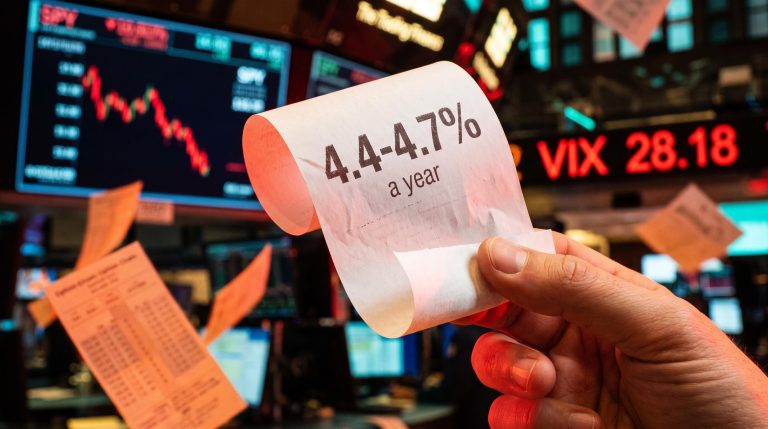
Sterling started Tuesday on the front foot, then gave it all back. By the European session, GBP/USD had slipped into negative territory near 1.3433 after Federal Reserve (Fed) Governor Christopher Waller signalled that more tightening could be needed. The near-term GBP/USD forecast now rests on a strangely small number: one-tenth of a percentage point on US core inflation.
The October US Consumer Price Index (CPI) is due at 8:30 a.m. ET (13:30 GMT) on 10 November 2026. It had not been published at the time of writing, so treat this as a preview, not a post-mortem. Every scenario below is conditional.
The setup matters because three forces are pulling on the pair at once. A Fed governor has named a specific trigger level. The Bank of England (BoE) has just raised rates while describing a sluggish economy. The chart has its own set of levels that traders will watch the moment the data lands.
Here is how to read those three layers together, so you can judge the move for yourself instead of reacting to the first headline.
What did Waller say, and why does the 0.3% core CPI line matter?
The market’s verdict came first. The US Dollar Index (DXY), which tracks the Dollar against a basket of major currencies, erased its early losses and settled roughly flat near 101.65. Sterling took the hit.
The reason sits in the detail of Waller’s remarks in London. According to Reuters, he said he was leaning toward a 25 basis point (bp) rate hike in December even if October inflation improved. A basis point is one-hundredth of a percentage point, so 25bp equals 0.25%.
Then came the condition that changed the stakes.
Waller’s 50bp threshold If October core CPI comes in around 0.3% or higher, a 50bp December hike should be considered.
Core CPI strips out food and energy, which tend to swing wildly, so it gives a clearer view of underlying inflation. Reuters reported Waller’s argument that a standard 25bp move could damage Fed credibility if core stays that hot. Bloomberg‘s account framed it similarly: he would favour 50bp if inflation looked like the previous two monthly readings.
He pointed to several pressures:
- Price increases spreading widely across the economy
- Producer-price pressure still working its way through
- Energy shocks that may prove lasting
- Solid GDP growth alongside a firm labour market
That last point has fresh support. October payrolls came in at 165,000 against expectations near 65,000, and unemployment fell to 4.1%.
Strong payrolls have already pushed December Fed hike odds sharply higher, which is why you should expect a hold, not a hike, to be the real surprise for the Dollar.
Sentiment gauges confirmed the hawkish read. FXStreet’s Speechtracker scored Waller at 8.6/10, against a historical average of 7.2/10, while its Fed Sentiment Index rose 1.58 points to 143.91.
What this tells you is that the Fed debate has moved on from “whether” to “how much”. A core print at 0.3% would change the size of the bet, not just its direction, and that is why a single decimal point now carries so much weight for every Dollar pair you might follow.
Why energy and oil sit behind the Fed debate
Oil is the hidden lever. Reuters reported that the US-Israeli war with Iran pushed oil higher, lifting fuel and goods costs and keeping inflation above target.
Hopes of a US-Iran deal have since sent Brent down more than 4%, easing inflation fears. Renewed escalation would reverse that, pushing oil and Treasury yields higher and lending the Dollar support.
When big ASX news breaks, our subscribers know first
How could the October CPI print move the Dollar and GBP/USD?
Start with expectations, because markets trade the surprise, not the number. Consensus sits near 0.2% month on month for core CPI, with MUFG at 0.23% and Deutsche Bank at 0.20%. Headline expectations cluster around 0.3%, with MUFG at 0.29%, FactSet at 0.24% and Deutsche Bank at 0.20%.
Notice the gap between those forecasts and Waller’s line. Consensus core sits just under his trigger, so even a modest upside miss could tip the debate toward 50bp.
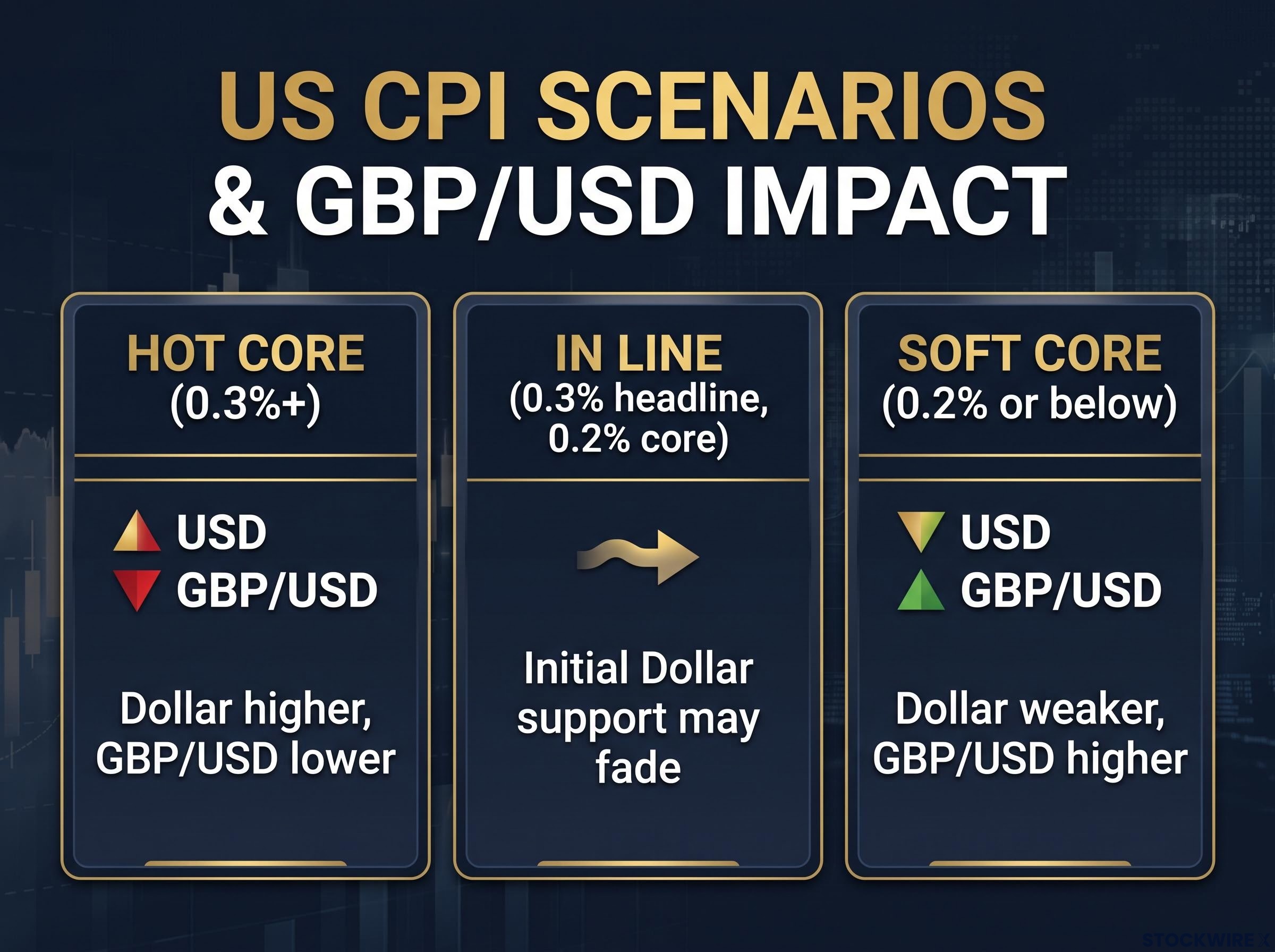
A hot core CPI print of 0.3%+ points to a higher Dollar, while a soft core of 0.2% or below points to a weaker Dollar.
| CPI outcome | Likely interpretation | GBP/USD implication |
|---|---|---|
| Hot core (0.3%+) | Meets Waller’s condition for considering 50bp | Dollar higher, GBP/USD lower via US short-term yields |
| In line (0.3% headline, 0.2% core) | 25bp December hike intact, 50bp not clearly justified | Initial Dollar support may fade |
| Soft core (0.2% or below) | Challenges the build-up in Fed hike bets | Dollar weaker, GBP/USD higher |
| Soft headline, firm core | Energy relief matters less than underlying inflation | Dollar likely stays supported |
| Hot headline, soft core | Looks like an energy shock, not broad inflation | Smaller or temporary Dollar move |
The counterintuitive row is “in line”. MUFG/BTMU argues the Dollar has already moved ahead of short-term yield spreads, meaning it has priced in more tightening than interest rate gaps alone justify. A soft print could call hike expectations into question, and a hawkish surprise may be needed just to sustain the Dollar’s strength.
So “in line” is not neutral for you here. If positioning is stretched, the first burst of Dollar buying could fade or reverse as traders take profits.
Reuters expects October CPI to moderate but still keep a December hike on course. Keep these caveats in mind:
- The Bureau of Labor Statistics lacks October 2025 observations because of the US government shutdown, limiting year-on-year comparisons
- Dollar positioning is already stretched, raising profit-taking risk
- An Iran deal or renewed conflict could swing oil and inflation expectations quickly
The lesson is to judge the release by its composition, meaning core, breadth and goods prices, rather than the headline figure flashing first on your screen.
Why does the Bank of England leave sterling caught between two forces?
Here is the paradox. The BoE raised Bank Rate by 25bp to 4.00% at the meeting ending 4 November, with an 8-1 vote and one member preferring 50bp. Yet Deputy Governor Clare Lombardelli describes an economy stuck in low gear.
“It’s what I call a low-gear economy. So a labour market where you’re seeing a real fall-off in hiring. But actually, we’re not seeing much in the way of redundancies. What’s going on is this kind of low-hire, low-fire dynamic.”
Speaking to The Guardian, Lombardelli would not rule out voting for a December hike, but said she lacked enough information. Her decision would depend on the conflict, energy prices and wider data. Speechtracker scored her at 6/10, below the 7.2/10 average.
| UK indicator | Latest figure | Date |
|---|---|---|
| GDP growth | 0.7% (June-August vs March-May) | 9 November 2026 |
| CPI inflation | 3.5% y/y September (3.1% August) | 9 November 2026 |
| Unemployment | 4.7% | 19 October 2026 |
| Regular earnings | 3.7% y/y | 19 October 2026 |
| Payrolled employees | Down 66,000 y/y | 19 October 2026 |
Inflation is rising while hiring shrinks. That mix explains the BoE’s caution and sets up sterling’s tug of war.
Sterling’s muted BoE hike reaction reflected a move that was fully priced in, and Bailey’s warning that inflation risks lean upwards keeps the December question open.
What policy divergence means for a currency pair
Policy divergence describes central banks moving interest rates along different paths. Currencies respond to the expected path of rates in one economy relative to another, not just today’s levels, because higher expected returns draw capital in.
That is why this is not a simple “dovish BoE, hawkish Fed” story. The BoE has optionality for December, which cushions sterling’s downside, but weak growth limits how far it can go, which caps the upside. Commerzbank expects the next BoE hike in February and judges that the Pound’s upside may stay limited until then.
For you, the practical read is this: sterling upside needs UK inflation to stay high and US CPI to soften together. One factor alone rarely carries the pair.
Which GBP/USD levels turn the news into a trading map?
The daily chart leans mildly bullish. Price holds above the 20-day Exponential Moving Average (EMA), an average of recent closing prices that gives more weight to the latest days. It has also regained the 50.0% Fibonacci retracement, a level that measures how much of a prior fall has been recovered.
Momentum agrees without shouting. The 14-day Relative Strength Index (RSI), which scores buying and selling pressure from 0 to 100, sits near 56: positive but not overbought.
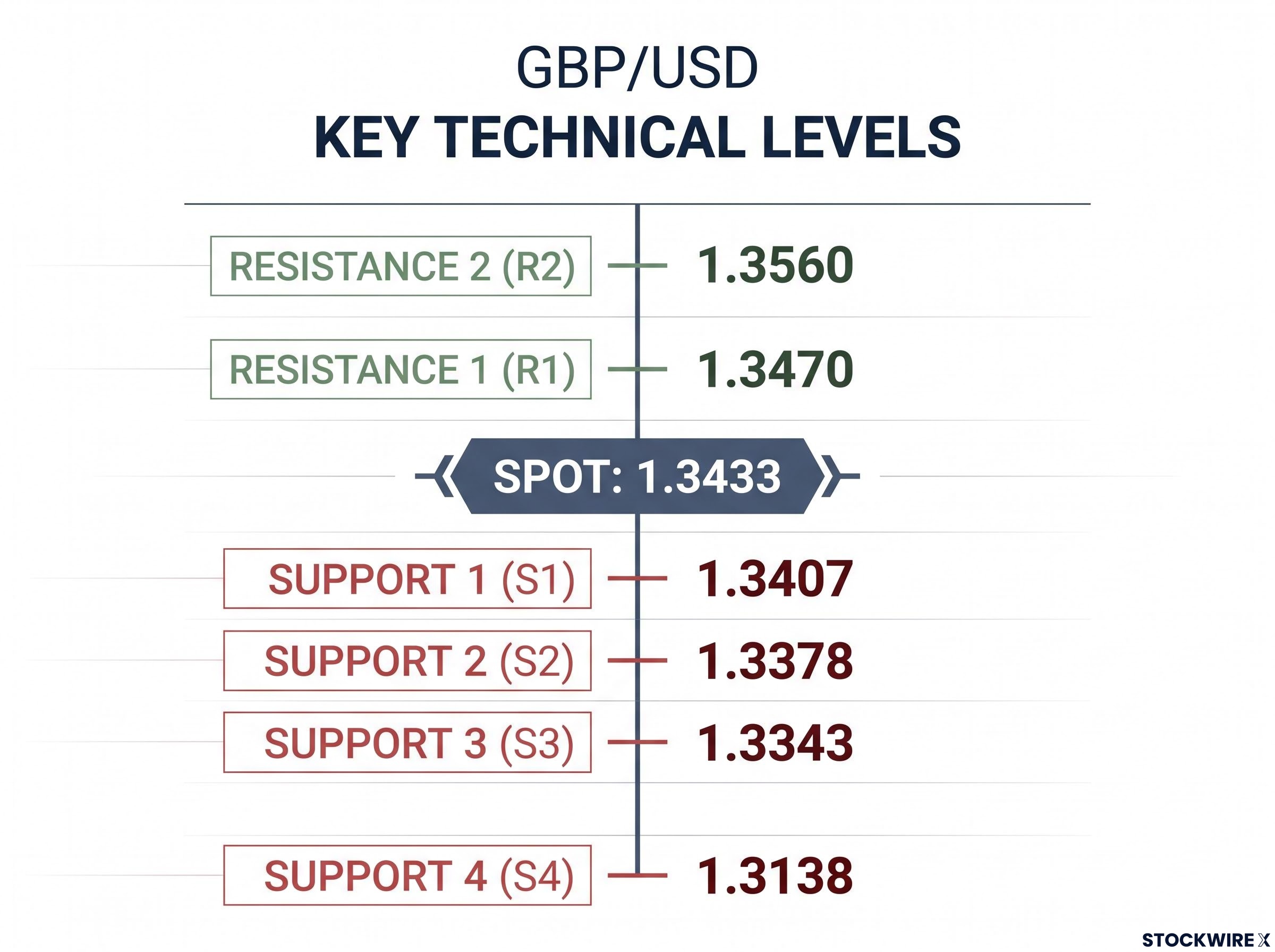
With the spot at 1.3433, GBP/USD faces resistance at 1.3470 and 1.3560, while support levels descend from 1.3407 down to 1.3138.
| Level | Approx. value | Role | CPI scenario link |
|---|---|---|---|
| 78.6% Fib | 1.3560 | Resistance | Extended soft-CPI target |
| 61.8% Fib | 1.3470 | Resistance | First soft-CPI test |
| Spot | 1.3433 | Starting point | Pre-release reference |
| 50.0% Fib | 1.3407 | Support | First hot-core test |
| 20-day EMA | 1.3378 | Support | Hot core confirmation |
| 38.2% / 23.6% Fib | 1.3343 / 1.3265 | Support | Hot core plus 50bp repricing |
| Structural | 1.3138 | Deeper support | Extended Dollar strength |
A break above 1.3470 opens the way to 1.3560, while a slide below 1.3378 brings 1.3343 and 1.3265 into view. Separate analyses place these levels a few pips apart, reflecting different calculation times and reference swings. The FXStreet technical read was produced with an AI tool.
A five-step way to read the reaction
- Policy rhetoric: Start with Waller’s 25bp baseline and 50bp core trigger, offset by Lombardelli’s open December door.
- Macro surprise: Compare core CPI and its composition with the 0.2% consensus and MUFG’s 0.23%.
- Chart confirmation: Test a Dollar-positive surprise against 1.3407 and 1.3378, and a Dollar-negative one against 1.3470 and 1.3560.
- Momentum filter: With RSI near 56, a soft print could extend gains without an extreme reading.
- Event-risk discipline: Expect first moves to reverse if details are mixed, oil swings on Iran headlines or positioning already priced the result.
Treat these levels as reaction zones to test against the outcome, not promises. These scenarios are speculative and subject to change based on market developments.
Readers interested in separating a corrective dip from a true reversal can use our deep-dive into GBP/USD pullbacks, which sets out a three-part moving average, RSI and price level framework.
This article is for informational purposes only and should not be considered financial advice. Investors should conduct their own research and consult with financial professionals before making investment decisions.
What to watch after the CPI release, and how to keep the forecast flexible
Your read on the pair now comes down to four things: core CPI against Waller’s 0.3% line, a Dollar that has already run ahead of yield spreads, the BoE’s December optionality and the 1.3407-1.3470 zone where the first reaction will be tested.
Once the numbers land, look past the headline to core composition and breadth. After that, keep an eye on oil and any Iran headlines, UK data ahead of the BoE’s December decision, and further Fed commentary that either reinforces or softens the 50bp talk.
If the details and the chart agree, the move has a better chance of holding. If they conflict, treat the first spike with caution and let the next set of data show you which force is winning.